
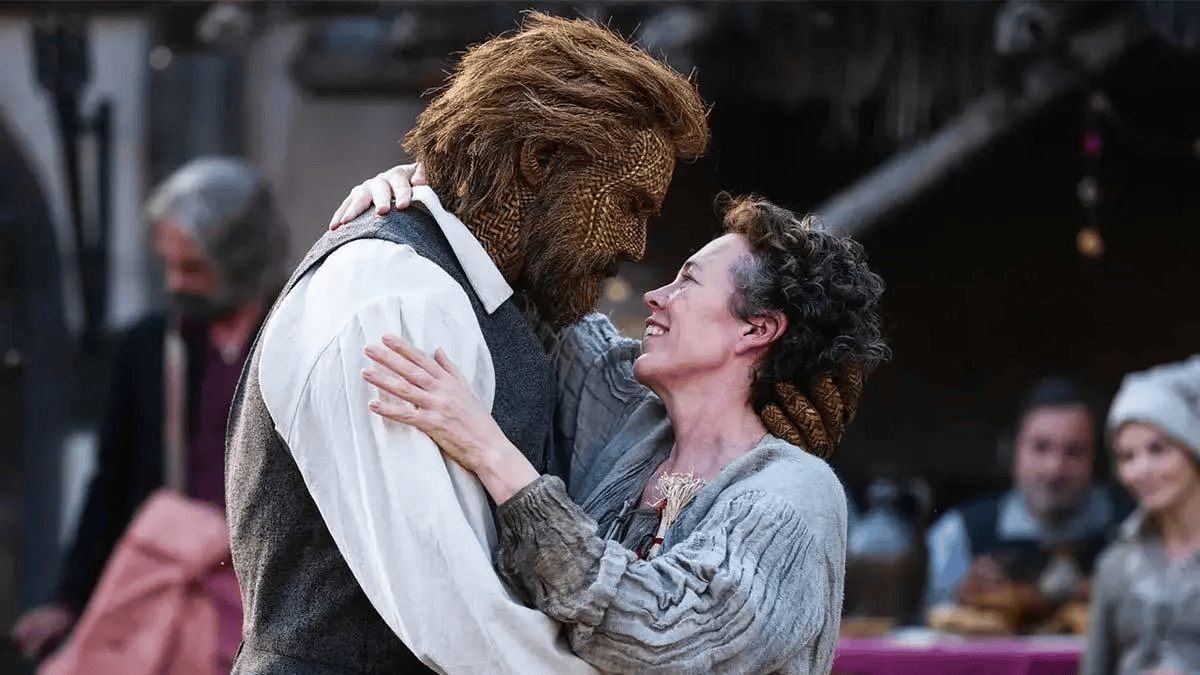
Since their inception, movies have brought to life things we could only imagine. A man flying through the air under his own power. Epic battles in outer space. Gigantic monsters destroying entire cities. Realistic reenactments of famous historical battles. Now here comes Wicker, a movie that does something I would have considered to be impossible. It makes the concept of wicker sexy. For someone like me who refuses to sit on wicker chairs and considers a wicker anything to be more hassle than its worth, this was something. The movie itself is bawdy fun, and if you see it, I guarantee you’ll never look at wicker the same way again.
In post-medieval times, there lived a solitary Fisherwoman (Olivia Colman). Like the rest of the townspeople, she’s known by her profession instead of a common name. Luckily for their sake, there’s only one of each, because asking for “Tailor Number 1” or “Doctor Number 2” would have been incredibly awkward.
The Fisherwoman lives a humble existence on the outskirts of the town. Every day, she gathers fish from her traps, guts them and walks to town to sell her catch. Given the hands-on prep required, she smells extremely fishy, leaving her open to insults from everyone in town. That the Fisherwoman is unmarried at her age invites insults combining the two unfortunate aspects of her existence. In short, she’s smelly and a single middle-aged woman. The Fisherwoman may as well have a “kick me” sign written in Ye Olde English font on her back.
Another outsider is the Basket Weaver (Peter Dinklage), a dwarf who creates amazing things from wicker. For example, he makes special wicker eggs for an upcoming wedding that when shaken, will emit colored smoke indicating who will be married next. Apparently, the town doesn’t have a Bouquet Maker. In any event, the Basket Weaver and the Fisherwoman have a cordial relationship based on their mutual outsiderness.
During the wedding, the Fisherwoman accidentally gets the “you’re next” egg. This invites more insults, including the Tailor’s Wife (Elizabeth Debicki), who is the town’s social pillar. Ha ha, nobody will ever marry the likes of you, the snooty Tailor’s Wife tells her. While the Fisherwoman laughs it off, it bothers enough to take extraordinary measures.
The next day, the Fisherwoman goes to the Basket Weaver’s hut. Make me a husband, she requests, handing over a bag of coins. Meet me in the church in a month, he replies. After retreating inside, the Basket Weaver talks the situation over with himself. Should he do this, he ponders. Since the payment is sufficient, he decides why the heck not and proceeds.
Over the next thirty days, the Fisherwoman tosses and turns at night, horny at the thought of finally having a husband to call her own. When the day comes, a strange man appears in town. He (Alexander Skarsgård) creaks when he moves, and his hands and feet are made of wicker. Since he can’t be married naked, he politely asks to borrow clothing and the gobsmacked townspeople oblige.
The Fisherwoman heads to church assuming nobody will be there, only to find a handsome wicker man waiting for her at the altar. The stunned priest marries the two, and they head back to the Fisherwoman’s home. Uncertain as to what to do next, the Fisherwoman says they can sleep separately. Mr. Wicker (as he becomes known), however, knows what a marital night is all about and promptly rails the Fisherwoman. Much to her delight, I might add.
The sex continues for several nights, prompting curious reactions from the townspeople. The Bottlewasher (Gustav Lindh) and his new wife (Marli Siu) wonder if someone is being murdered. The townspeople comment about how what’s going on is against nature. But something else is happening besides the frequent and rigorous sex.
The Fisherwoman is gradually being transformed by the experience. Mr. Wicker is handy about the house, helps with her fishing chores and is the perfect gentleman. At the next wedding, the bizarre couple turn heads when they eschew the weirdly formal dancing ritual in favor of intimate swaying. The two have become the perfect couple, where Mr. Wicker is the dutiful husband and the Fisherwoman is his devoted wife.
Of course, their relationship has altered the pecking order of the town and cannot stand. The Tailor’s Wife resents the attention directed towards the Fisherwoman. The men hate how Mr. Wicker has captured their wives’ imaginations. The meek lovemaking skills employed by the Bottlewasher leave his wife unimpressed. The Bakerwoman (Ella Bruccoleri) wants her husband (Ben Ashenden) to knead something besides dough. You get the idea.
The town soon devolves into a cesspit of jealousy and petty insecurities, making the now idyllic life of the Fisherwoman and Mr. Wicker precarious. Before it’s all over, accusations will be lobbed, feelings will be hurt and one side of the ideal marriage will be damaged by it all. Not to worry, this is a fable and things will work out in the end.
Recommendation
God save the English, who appear to be the only people who want to make sex comedies these days. While it is true that Hollywood does release them occasionally, I can’t imagine a major studio doing anything remotely like Wicker. Here’s a movie that is filthy and wickedly funny. That the movie was independently produced and distributed by the new and small Black Bear, tells you everything about the meager choices moviegoers have for comedies these days.
I don’t want to characterize Wicker as a bawdy comedy, though, because the racy material really is a means to an end. The movie is a variation on the “stranger comes to town” theme, with the stranger becoming the lens through which the townspeople’s actual feelings are brought to the surface and illuminated. Imagine if Benny Hill directed Chocolat and you’ll get what Wicker is after. While the ample sex jokes would have made Hill proud, they lead into moments of introspection and soulfulness that are surprisingly touching and moving. (No, not like that.)
Aside from the dirty stuff, Wicker has a lot to say about marriage, trauma, jealousy and insecurity. While its insights are familiar, the movie’s directness in conveying them makes them sticky. For example, there’s a funny scene set in a tavern where the town’s husbands are upset over their wives demanding more in the marital bed since Mr. Wicker’s arrival. It concludes with him asking one beleaguered husband if he loves his wife, a simple yet forthright question that causes him to break down crying. (If you don’t grasp what that response implies, please see Mr. Wicker for counseling.)
To sell a strange story like this, having the right actors in key roles is critical. Olivia Colman is perfectly cast as the Fisherwoman, a part that requires the incredible range she’s known for. As Colman has proven in movies like Wicked Little Letters, The Roses and The Favourite, she’s an extremely capable comedian because she’s willing to do anything for a laugh. This is a very unflattering role in many ways, and Colman spends a fair chunk of it looking like a slob. But the role plays to Colman’s strengths because what matters to her is being convincingly vulnerable on screen. She’s equally funny and touching in this movie, and proves why she’s one of the best actresses of her generation.
If you’re going to have a movie about a woman who falls in love with a man made out of wicker, it helps to have that man be played by Alexander Skarsgård. He’s become the go-to actor for roles that allow the audience to project their fears and desires, and manages to make wicker sexy. His performance is a tricky one, because he has to play Mr. Wicker as an innocent who gradually evolves into an introspective being. Skarsgård acts as the straight man to all the crazy townspeople, the sole enlightened character in a sea of degenerates that also lacks situational awareness. It’s a deft bit of acting that has become Skarsgård’s specialty.
Co-directors and screenwriters Alex Huston Fischer and Eleanor Wilson had the right approach to this cracked fable. They made the right call in grounding things in a setting that’s old-timey enough for the story, without fretting over period-specifics. Fischer and Wilson’s direction has a grimy Monty Python quality to it, and nearly every joke lands. The approach to the sex reminded me of The Little Hours, in how it implies much without being graphic. For those who shudder at nudity, there is none here. But if you watch it with your parents (or grandparents), you’re on your own.
The premise of Wicker sounds like a dirty joke you’d hear at a bar. And while the movie resembles a reenactment of one at times, what makes it special is how philosophical it becomes. Olivia Colman and Alexander Skarsgård shine as the incredibly unlikely pairing that runs the emotional gamut. Recommended.
Analysis
Being a fable, Wicker has more on its mind than being ribald. It has lessons to impart amidst the naughty stuff, and all of them are insightful and easy to grasp. Which goes without saying when the story is about a woman shagging a man composed of straplings. There’s no beating about the bush in this movie, so to speak. It imparts its wisdom organically, within the natural flow of the plot. Best of all, it does so in a manner-of-fact way that doesn’t draw attention to itself. The movie assumes folks in the audience can pick up on its messages without being hit over the head with a wicker basket. Following is what I gleaned from this funny and surprisingly thoughtful movie.
Don’t let the past poison the present
This is my main takeaway from Wicker. When the Fisherwoman finally Mr. Wicker as her husband, she finally has everything she’s always wanted. Love, sex, companionship and respect to name a few. However, the Tailor’s Wife easily plays upon her insecurities to make the Fisherwoman jealous of her extremely faithful husband. The idea of Mr. Wicker stepping out to “console” the other wives in town makes the Fisherwoman question everything she sees. She twists his very normal act of comforting the Bottlewasher’s widow as revealing that he’s not as honorable as he seems to be.
The Fisherwoman’s unresolved abandonment issues are the reason why her opinion of Mr. Wicker changes. She tragically lost her father and mother when she was a young and kept to herself ever since. The Fisherwoman may not like being picked on when in town, but she can always retreat back to her solitary existence.
The Fisherwoman’s life changes dramatically for the better once she has a husband, however. He’s always around, performing his husbandly duties, day and night. The Fisherwoman becomes emotionally attached to him, making the suspicion that he may be cheating on her extremely poisonous. When confronted with the wicker baby, she decides to drive him away rather than deal with the possibility of being hurt again by someone she loves.
The Fisherwoman soon regretted how she let past trauma dictate her actions in the present. When she sees that the Mr. Wicker is alive, she cries tears of joy at having another chance at happiness. The movie tells us to not be beholden to the past, because all it can do is rob you of your present.
Sparing the rod is bad parenting
Wicker establishes an interesting contrast between the Fisherwoman and the Tailor’s Wife in the early going. The Fisherwoman is uncouth, while the Tailor’s Wife is the polar opposite. As we eventually learn, who they became as adults was shaped by dramatic events in their childhoods.
Unlike the Fisherwoman’s sad story, the Tailor’s Wife’s childhood was defined by getting away with murder. Her father was the Doctor, a man with money and status in the community. The Tailor’s Wife was a spoiled child who always got her way, even when she killed a boy. Her father declared a cause of death that didn’t involve drowning, which the Fisherwoman says was completely ludicrous. But the townspeople bought it, and as a result the Tailor’s Wife learned that she was entitled to whatever she wanted.
As a person of privilege, the Tailor’s Wife commanded respect and got it. The only person she couldn’t control was the Fisherwoman. So when the Fisherwoman began to usurp her place in society, the Tailor’s Wife stoked her insecurities. In transforming the Fisherwoman back into a miserable outcast again, the Tailor’s Wife would be able to regain her place of prominence in society.
Which is why the movie’s second theme is to not spare the rod and spoil the child. The Tailor’s Wife destroys the town’s harmony because she can’t handle having the spotlight be on someone else. Since she never faced any repercussions for her actions as a child, she believes she can act terribly as an adult without consequence. The fact that she’s unable to buy her way out of a dull marriage is just desserts for someone who’s gotten her way all her life.
Traditions are stifling
Wicker is not fond of traditions. Some of its funniest scenes are dedicated to showing us the town’s traditions and point out how ridiculous they are. For example, when women are married, they take a vow of complete subservience to their husbands and agree to wear a ceremonial dog collar. And the dance performed after the ceremony has husbands and wives reenact coming to blows.
It’s notable that when the Fisherwoman gets married, she tells the priest that a collar isn’t necessary and there’s also no celebration with the townspeople afterwards. The significance of this is that unlike the other married couples in town, the union of the Fisherwoman and Mr. Wicker is one of equals. They are equal partners in the marriage and get along famously as a result.
Contrast that with the Bottlewasher and his wife. In their marriage, the woman exists solely to fulfill domestic responsibilities, which is to bear children and look after the home and have no life outside it. There’s no love between them when they are married, and that negatively affects their lives together afterwards. Their lovemaking is timid and unsatisfying, and he’s incapable of doing anything around the house. So it’s unsurprising that when the Bottlewasher dies, his wife has no reason for existing and asks the Basket Weaver to make her a baby to give her life purpose.
The Fisherwoman and Mr. Wicker’s marriage is harmonious because it’s the exact opposite of every other traditional marriage. They view each other as individuals who exist separately and together. As the Fisherwoman explains, they are together in the morning and at night, but do what needs to be done in between.
Colman’s bravery
A few years back, I sang Olivia Colman’s praises in my Wicked Little Letters review. Since then, I’ve seen her in Wonka, The Roses and the second season of Amazon’s The Night Manager, all of which were showcases for Colman’s many different facets as an actor. The Roses provides her with numerous opportunities for withering remarks. The Night Manager lets Colman do what caught my attention in Broadchurch, which is to be totally unassuming on the outside but deadly serious on the inside. And she’s a nasty piece of work who dances and sings in Wonka.
Taken together with Wicker, I’m more convinced that Colman’s one of the best actors of her generation. The only reason why she’s not as highly regarded as Kate Winslet and Rachel Weisz, who Google tells me are her peers, is that she doesn’t have their glamour. Colman looks like an average woman in comparison.
But that’s the secret power behind all of Colman’s performances, her ability to look like one of your friends, family members or neighbors. Colman always presents as an everyday person, which makes it easier for the audience to fall under her spell than it would if Winslet or Weisz de-glammed for the same role. Whether Colman’s a cook, an obsessed MI5 analyst, a hypocritically pearl-clutching spinster, the manager of a hellish laundromat or a filthy Fisherwoman, she’s a woman of the people.

