
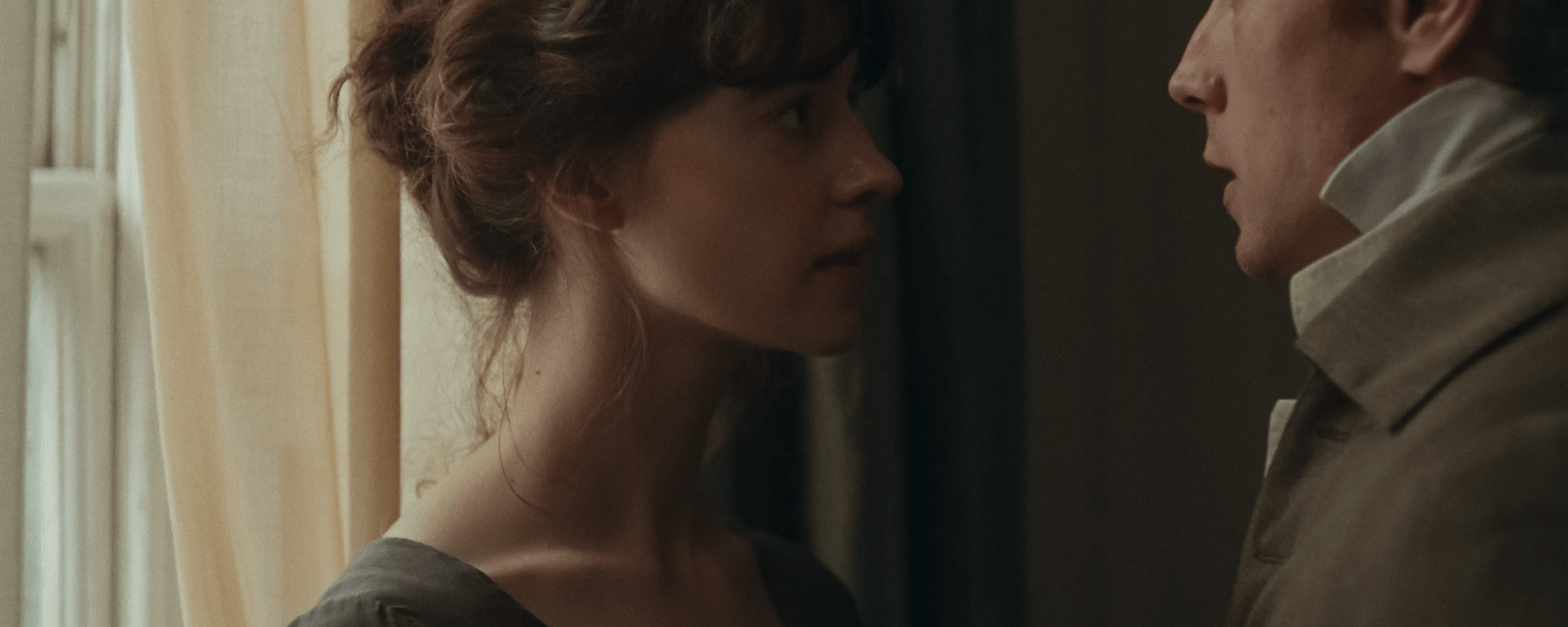
Looking back on 1995, I was incredibly fortunate to have been introduced to Jane Austen through Ang Lee’s Sense and Sensibility, which remains one of the best adaptations of her work. Thirty years later, fans of Austen can rejoice in having two exceptional cinematic versions of Austen’s novel to savor. While I’m usually reluctant to proclaim a movie that’s just been released to be a classic, describing Georgia Oakley’s passionately acted and evocatively shot film any other way would sell it short. This is undeniably masterful filmmaking on every level and a joyful work of art.
The laws governing inheritance were incredibly consequential for women in Austen’s time. This is true of the Dashwoods, who lived a happy existence in Norwood Park until the death of the family patriarch. Everything comes crashing down when the post brings especially bad news one sunny day. The estate now legally belongs to John (Tom Brooke), the sole male air from Mr. Dashwood’s first marriage.
In the blink of an eye, the carefree days that Elinor (Daisy Edgar-Jones), Marianne (Esmé Creed-Miles), Margaret and their mother (Caitríona Balfe) have vanished, replaced with the looming prospect of being evicted from their own home by their somewhat concerned half-brother John (Tom Brooke) and his horrible wife Fanny (Stacy Martin).
For his part, John wants to abide by his father’s last testament and do right by his half-sisters, but Fanny insists on showing them no quarter because what’s now his is also hers. I felt sorry for John because he doesn’t want to be the bad guy and keeps trying to find ways to help relations. Unfortunately, he’s married to evil made flesh, and getting on her bad side would make life very bad for him.
After forcing the Dashwood daughters out of their rooms, Fanny proceeds with an inventory of the silverware and invites her brother Edward Ferrars (George MacKay) to visit. Interestingly, that power move unexpectedly offers a ray of hope. Edward and Elinor immediately connect and appear to be a perfect match. This irritates Fanny to no end, who has been doing everything she can to make the Dashwoods want to leave Norwood Park.
A resolution to the awkward living arrangement comes by way of distant relation Mrs. Jennings (Fiona Shaw), who lives for drink and dining. Dinner that night is a particularly tense affair, despite attempts by Jennings and Sir John Middleton (Turlough Convery), Mrs. Dashwood’s second cousin to keep things lively. I would gladly pay to see a movie devoted to the rowdy exploits of Jennings and Middleton invading the homes of upper-crust families to drain their wine cellars.
When Jennings notices how attached Edward and Elinor are to each other, Fanny rudely interjects that she has higher hopes for her brother. That does it. When Jennings offers the Dashwoods Barton Cottage for nominal rent, Mrs. Dashwood accepts the offer. As the Dashwoods glumly pack up their belongings, Marianne states to Elinor how much she loathes Fanny. Elinor agrees, but has the maturity to not get upset over something they have no control over.
The cottage the Dashwoods now reside in is expectedly rustic, with stone floors, cobwebs and dust, but they make it their home in no time. While Elinor takes to gardening and tending to the sheep, she looks forward to Edward’s promise of a visit. Sir John Middleton keeps an eye on the family, bringing them fowl and their post from town.
Disappointment eventually arrives for Elinor by way of a letter from Edward stating that he’ll be in London for six months on business. Suddenly, Elinor’s faith in a marriage proposal from Edward is in question. Meanwhile, Marianne encounters two potential suitors while walking around nearby Devonshire. The first is Colonel Brandon (Herbert Nordrum), who she dislikes for being overly serious and having no interest in the arts. (He has good reasons for being a cheerless dullard, which are revealed later.)
Suitor number two, however, is much more promising. While cavorting at the beach, Marianne twists her ankle and is rescued by John Willoughby (Frank Dillane). The sparks fly immediately between them, and the two look destined for marriage as they put on a show at a dance. But when John doesn’t respond to Marianne’s letters, she’s left questioning what went wrong. His letter stating that he’ll be away in London for a year furthers her distress.
Fortunately, Mrs. Jennings has a plan to force the issue with Elinor and Marianne’s absentee suitors. They will accompany her to London for an extended visit with Lady Middleton (Chloe Pirrie) and Jenning’s cousin Lucy Steele. In the interest of not spoiling the story’s big revelations, all I’ll say is that Edward and John have reasons for ghosting the Dashwood sisters. One does so out of nobility, the other because he’s a conniving twat. I will say that after all the twists, turns and misunderstandings, Elinor and Marianne get the happy endings they deserve.
Recommendation
Georgia Oakley’s adaptation of Jane Austen’s Sense and Sensibility is proof that if you live long enough, you’ll witness something special. Ang Lee’s version is widely regarded as a classic, and now there is another that couldn’t be more different in terms of approach. Lee’s film was in line with how English classics had traditionally been brought to life, but Oakley’s is more naturalistic and expressive. The story may be exactly the same, but both directors go about telling it in distinctly different ways. Neither is better than the other, but both are exceptional. If directors tasked with revised IP took Oakley’s approach, the movies would be in a far better place.
While the plot of the movie is faithful to Austen’s novel, the aesthetics Oakley uses to bring us into this world are routinely breathtaking. She places the characters in physical settings (both modest and grand) that are so richly detailed and imbued with warmth that they recall works by the Dutch masters. This is largely due to the reliance upon natural lighting, with shadows playing as critical a role in the story as any human character. The only other comparable film I can recall where any randomly selected image would be suitable for framing is Stanley Kubrick’s Barry Lyndon, in how both movies use magic to bring paintings to life.
Oakley’s film also differs from Lee’s by allowing the emotions always lurking below the surface to be felt. The movie is still about who gets to be married to whom, but its larger concern is capturing the essence of the human experience. Whether the focus is on a caterpillar, a warm fire in a hearth, a dinner party drenched in friction or a rousing dancing scene, Oakley reminds us that no matter what happens to the Dashwoods, they still have each other. The future for these women may have been unsettled by fate, but they shouldn’t lose hope because their world is full of everyday wonders.
The story’s contrasting opinions on love and the expression of it are brought to vivid life by Daisy Edgar-Jones and Esmé Creed-Miles. As expected, Creed-Miles portrays Marianne as the impetuous, lust-for-life younger sibling with a hatred of decorum. The role significantly elevated Kate Winslet’s profile decades ago, and Creed-Miles’ take on it should do the same. Her Marianne is full of unbridled passion and recklessness, a live-wire performance that captivates every time she’s on screen.
The counterpoint to Creed-Miles’s performance is Edgar-Jones’s Elinor, a character I previously viewed as being tragically constrained by propriety. In this movie, however, Edgar-Jones portrays Elinor as passionate as her younger sister, just not publicly and certainly not around men. Like her siblings, Edgar-Jones’ Elinor is a free spirit and is equally at home with nature, but she’s also the product of good breeding. She can’t be the wild child like Marianne because that’s not how she was raised. Edgar-Jones’ ability to show the subtle differences between Elinor’s public and private faces doesn’t have the fireworks, but her ability to make us sympathize with Elinor’s yearning and heartbreak is almost overwhelming.
There are so many wonderful supporting turns in the cast that I can’t mention them all here. (One has only one line, and his delivery is devastatingly funny.) Tom Brooke is hilarious as the half-brother John Dashwood who wants to do the right thing but is more afraid of his fiendish wife. Fiona Shaw’s Mrs. Jennings and Turlough Convery’s Sir John Middleton are boisterously funny, with the latter recalling Jack Black. I liked how Herbert Nordrum plays Colonel Brandon as guarded and closed off, but not churlish or moody. George MacKay expertly brings out Edward Ferrars’ dueling nobility and befuddlement. The only misstep is Eliot Sumner, who is needlessly distracting in a cameo.
Sense and Sensibility is a fresh, vibrant and unabashedly passionate retelling of a familiar story that warrants being called an instant classic. The acting is sublime, featuring a career highlight from Daisy Edgar-Jones, alongside a head-turner by Esmé Creed-Miles. Possibly the most beautiful movie I’ll see this year. Highly recommended.
Analysis
Retelling a classic story that has already been adapted as a classic movie requires boldness by definition. The filmmakers simply can’t do what’s been done before. They need to take the material into a different direction, or the work will be perceived as inferior. Boldness certainly was on display in Emerald Fennell’s Wuthering Heights, with its rumpy-pumpy scenes, runway-ready costumes and avant garde sets. Although the movie didn’t work for me, I admired Fennell for taking risks.
Director Georgia Oakley had a similar challenge before her with Sense and Sensibility. Ang Lee’s 1995 film adaptation has been recognized as a classic for decades. How does one present such a well-loved and timeless story differently while still respecting the material? (Fennell did the former, but not the latter.) Oakley accomplishes this by making very deliberate choices with the film’s visual style and performances, so that the story feels authentic in construction but fresh in execution.
Exteriors and Interiors
The first sign that Oakley is charting a new path visually in with the movie’s opening exterior scene. We see Marianne Dashwood lying on the grass while studying a caterpillar crawling on her finger. With the sun shining down on her, it feels like time has stopped. The only thing that breaks the scene’s idyllic spell is the sound of approaching horses bringing bad news.
In that and subsequent outdoor scenes, Oakley drives home how important the outside world is to Dashwoods. Nature is their refuge from the world of everyday concerns, the space where they are at peace and emerge refreshed. For example, when Edward fails to visit Elinor as promised, she takes solace in gardening and tending to the sheep.
Oakley also uses the outdoors as settings for scenes laden with hope and optimism, particularly when love is involved. It’s no accident that Oakley shows Elinor and Edward first becoming attracted to each other while skipping stones, and that Marianne encounters both Willoughby and Brandon while away from the family cottage. Nature is where the best possible futures emerge for the Dashwoods, namely an acceptable match with a man that deserves them.
Conversely, Oakley uses indoor settings to represent intrigue, turbulence and uncertainty. Elinor and Marianne read their father’s will inside Norwood Park. Their family home is then unsettled by the arrival of step-brother John and his evil wife Fanny. The two dances represent the peak and valley of Marianne’s relationship with Willoughby. The scene where Edward fidgets while Elinor draws his portrait hints at his nervousness over choosing between honor and true love. And Edward and Elinor effectively break up during a visit to the National Gallery.
Oakley’s intent with her dichotomy is to highlight the innocence of the Dashwoods. They’re at home in nature, but overmatched when confronted with the harsh realities of everyday life. They rely on the kindness of Mrs. Jennings and Sir John Middleton to get by. And they wait patiently for Edward and Brandon to finally see the light. Fortunately, they have the English countryside to see them through their trials and tribulations.
A modern touch
The second way Oakley reinterprets the story is by having all of the actors give fully emotional performances. In Ang Lee’s version, the only character allowed to exhibit unbridled passion was Marianne. In all fairness to Lee, characters in classic literature were often portrayed with a heavy emphasis on restraint and polish, and his film followed that well-established norm. I refer to this as the “BBC’s Masterpiece Theatre house style”, which gives the productions that adhere to it a quiet and stagey feeling. In other words, the acting comes off as old fashioned, something that will appeal more to one’s grandparents than their grandchildren.
Oakley’s retelling, however, brings the emotions of all of the characters to the surface. There’s zero possibility that one could view any of the Dashwoods, or any of the other characters in the story as being emotionally stunted besides the impressively dull Lady Middleton. I would even go so far as to claim that Oakley is using her to poke fun at the dry way characters from classic literature have been portrayed.
There is no doubt in Oakley’s film as to what each character is feeling at any given moment. Even Elinor, the character who had traditionally been defined by her restrictive manners, wears her heart on her sleeve. The danger here is that the story’s original intention will be lost in favor of overheated melodrama. However, the performances throughout are pitch-perfect and engaging, making them more relatable to modern audiences than they’ve ever been.
The English way of life, wrought in shadows
Another significant departure on behalf of Oakley is to eschew the stately quality that has defined how stories like Austen’s have been shot in the past. The best way I can describe it as a tangible reverence for period detail. The camera wants us to see how faithfully the past has been recreated, to see it in the furniture, the tea sets, the tapestries, etc.
Oakley’s film still pays attention to detail, but on the characters instead of their surroundings. What often struck me was how the cinematography is used to render the character’s faces, hair and clothing. If you’ve grown accustomed to the overuse of digital cameras and CGI in film, the naturalistic approach employed by this film will come as a shock. The reliance on natural light alone makes the characters come alive in ways that I rarely see in movies today.
The use of natural light also enables the director of photography Arnaud Potier to evoke moods through shadow. Several scenes worth calling out are when Elinor draws Edward by candlelight, and when Marianne and Brandon open their hearts by the fireplace. In both cases, darkness is used to enclose the characters and connect them by way of the illuminating fire.
Potier’s use of natural lighting throughout makes me suspect he was heavily influenced by Dutch masters like Rembrandt and Vermeer. He wants to convey the tactile nature of this world by reproducing its lived-in qualities. The movie’s palette is one of rich, dark browns and creamy whites.
I mentioned above that this movie frequently reminded me of Barry Lyndon. Like Kubrick’s masterpiece, this one is one of the few where I felt like I was experiencing this world through a series of paintings. The cinematography of Sense and Sensibility is the best I’ve seen recently and deserves recognition.
Rays of light
The movie only has a couple of false notes. The first is a CGI shot of old London from a distance, which looks completely fake.
The second is Eliot Sumner’s portrayal of Mr. Palmer. When they first appeared, I wondered why the character was being played by a woman trying to sound like a man. I’m all for representation, and Sumner was fine in Netflix’s Ripley. However, Sumner’s presence in this movie calls attention to itself for reasons besides their performance, which broke the spell the movie had achieved until that point.
While it’s great that Elinor and Marianne wind up with suitable husbands, the luckiest character in the story has to be Lucy Steele. She’s initially engaged to Edward because of her family fortune. When the money disappears, Edward keeps his promise and they remain engaged for years. Then, when Edward’s mother disinherits him in favor of his younger brother Robert, Lucy chucks Edward and marries Robert instead. In those days, playing the long game paid dividends.
I suspect that folks looked upon a visit from Mrs. Jennings and Sir John Middleton with trepidation. As in, it’ll be a long and loud fortnight.
I wonder how Edgar-Jones approached being cast as Elinor. I’d think the major hurdle would be to accept that you’re attractive, but nowhere near as attractive as the actor playing your younger sister, the family hottie.
Why didn’t the Dashwoods bring Margaret’s beloved cat with them? If they feared for its safety near the shore, I doubt Fanny would have its best interests in mind.

