
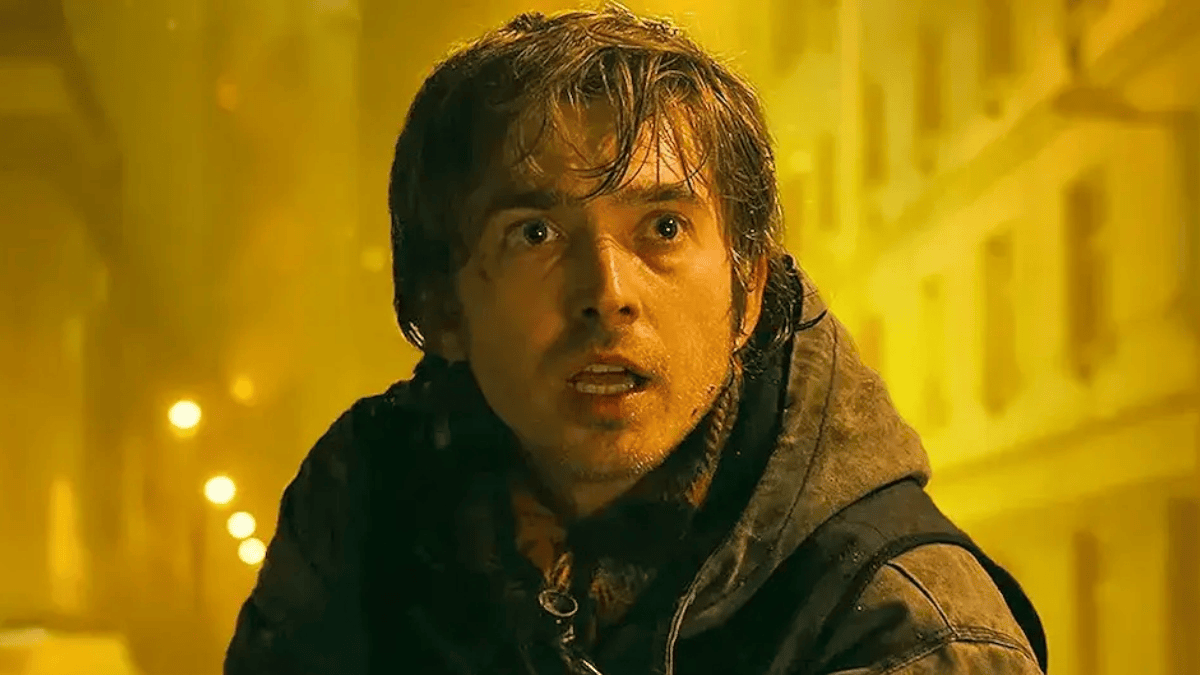
Having not played the video games that Resident Evil is based upon, I wonder what its fans make of the heavily obfuscated world where everything takes place. Do they wonder why the main city is named “Racoon City”? Or why the evil corporation responsible for all the trouble is cleverly named “Umbrella Corporation”? Or why so many different mutations originate from the same drug? I suspect they don’t care and focus on surviving the horrific landscape their character finds themselves in. This is basically the approach that the movie takes, which minimizes exposition in favor of keeping the horror pedal to the metal. The resulting movie made little sense to an outsider like me but worked as a scary-funny horror montage.
As is often the case with horror movies, a bad decision made by the main character has fateful consequences. In Resident Evil, this would be Bryan (Austin Abrams), a genial idiot who works as a medical courier. On the way to what should have been his last delivery of the night, his girlfriend Michelle tells him that she’s pregnant. Because Bryan is a manchild, he punts the decision over whether to have the baby or get an abortion back to her. She’s disappointed by his reaction, but I doubt she was surprised by it.
After Bryan makes his delivery, a nurse asks him if he can make another run to a lab in Racoon City General. At first he declines, but when she says he’ll get paid a premium rate, he changes his mind. Besides, working late will effectively keep Michelle’s situation at a safe distance–for a while at least. When Bryan calls Michelle back and apologizes for working even later, she’s not happy because she realizes that he’s using work to avoid the issue.
Making matters worse for Bryan is the wintry weather making the lonely road to Racoon City icy. A woman in a night gown emerges from the trees and walks directly towards his car, but he can’t react in time and plows right into her. Who is this woman and why was she in there at that time? No answers are forthcoming, which is a running theme with this movie.
When Bryan finds the lady he struck she’s contorted into a pretzel and shaking. He may not be much of a boyfriend, but he’s a good person at heart. So he helps her into his car and the two drive to Racoon City General together. The woman is particularly interested in Bryan’s head, though, and he keeps brushing her hand away. (Dude, I think she’s after your brains.)
A cop car pulls Bryan over, and Officer Wilson chews Bryan out for not driving with chains on. Bryan explains his job and shows him the woman he hit. The officer gives Bryan a break and escorts him to the city, agreeing to take the woman in his car because she might need first aid. Sure, Bryan. Way to dump your responsibilities onto other people.
Well, being a weasel works out for Bryan, because a few minutes later the cop car swerves off the road and tumbles across a field. Officer Wilson is dead, and the injured woman begins chasing Bryan around like a thing possessed. (The movie owes a huge debt to the Evil Dead films.) Bryan kills her with the cop’s gun, but also accidentally shoots his own car.
Stranded in the middle of nowhere, Bryan heads for a solitary house on the other side of the field. After poorly navigating the electrical fence, a guard dog chases Bryan into a barn. This is no normal dog, though. After crashing through a wall, its mouth turns into a meaty Venus Fly Trap. Bryan kills the dog and convinces himself that what he saw was a delusion.
Bryan enters an apparently empty house with scenes of a struggle. The house appears to be filled with video game easter eggs. For example, the significance of a writing room with an old fashioned typewriter on the desk eluded me. But that didn’t matter because Bryan is quickly faced with killing the home’s rabid occupant and the same crazy lady again.
The movie proceeds along these lines up to the climactic scene, with Bryan facing a series of video game challenges of increasing difficulty. He meets some people along the way to break the repetition. There’s a girl hiding in an RV, who bites Bryan and sets his mutant clock ticking. And an odd pairing of Umbrella Corporation flunky named Paul (Paul Walter Hauser) and his military handler Maxine (Kali Reis). Turns out that the delivery Bryan was charged with contains part of the antidote for all of the mutant weirdness going on.
Things don’t end well for Paul and Maxine, and Bryan’s challenges grow increasingly freaky, dangerous and gloppy on his way to the Umbrella Corp lab. Bryan survives them all, hopeful that the folks in the guys in the lab can cure his impending mutant conversion. If only he can hold on…just…a little…longer…
Recommendation
When I watch a movie, I expect it to reward my curiosity by explaining why things are happening. Resident Evil, however, offers no answers for anything beyond the premise. A bit of expository dialogue tells us that a scientific experiment performed by the Umbrella Corporation broke containment and is responsible for the mutant apocalypse that has overtaken Racoon City. Beyond that, the movie asks us to follow its clueless hero as he encounters one gross thing after another.
What takes place in this movie is so random that I was found myself wondering what would happen next. In place of a traditional plot, the movie is a series of horrific episodes spliced together. The experience is similar to channel surfing through the best parts of other horror movies, where each one is entertaining individually but together don’t add up to anything meaningful.
Having not played the video games this movie was adapted from (or loosely inspired by), I have no idea if they contain the answers I sought. Having forced myself to endure the original Resident Evil again before watching this rebooted version, I’m glad that writer-director Zach Cregger avoided the exposition trap that torpedoed that movie and other video game adaptations, which is that time spent on convoluted exposition is boring. Cregger wisely doesn’t bother with that and focuses on the fun stuff.
Cregger’s approach works well in simulating the experience of playing a video game. The audience tags along, observing the main character survive one challenge after another. Occasionally Cregger has us see the action from the character’s POV. However, Cregger avoids the other pitfall of video game adaptations, which often turn the action into playing the game on God Mode. That turns the movie into a zero suspense experience because the character is never at risk of dying.
In Cregger’s Resident Evil, the main character isn’t very smart and often makes ill-advised choices. Sometimes he’s lucky. Other times he simply fires enough bullets to get out of danger. The difference is that there’s suspense, which compensates for the lack of a plot.
If you’ve seen Cregger’s Barbarian or Weapons, you know that his calling card is using horror as a launching point for comedy. Resident Evil utilizes that formula, relying heavily on lead actor Austin Abrams’ stream of consciousness commentary for laughs. The movie is so funny that it often resembles a satire, but there’s plenty of creepy vibes and medium-level scares to keep it from being mistaken for a comedy.
The movie is a one man show, with Abrams playing Bryan as the “Final Guy”. His Bryan is a lovable doofus who tries hard but constantly finds himself in one bad situation after another. There’s a nice comedic touch to his performance, in how Bryan is intrigued while also being scared out of his wits. Abrams has a manic quality to him that would have felt right at home in the John Hughes comedies of the Eighties and Nineties, the sort of loser you can’t help rooting for. What’s key to Abrams’ performance is that he’s a screwup with a heart of gold.
I’ve enjoyed the three Cregger films I’ve seen so far. He has a real sense for creating nightmarish landscapes and quick bursts of violent and gory action. Resident Evil is his most interesting film visually and the least narratively. It’s the best video game adaptation I’ve seen so far, but frankly that’s a low bar to cross. I think Cregger used that as a justification to make this movie, and on those terms he was successful. However, this movie isn’t at the level of what he’s done before. It may be bigger in scope and have CGI effects, but it’s inconsequential.
Zach Cregger’s Resident Evil adapts the game as a mutant mayhem highlight reel, with hilarious running commentary from a Postmates delivery guy. It’s enjoyable in a nonsensical way, and the most engaging video game adaptation I’ve seen so far. Recommended.
Analysis
I don’t want my analysis of Resident Evil to devolve into all the unanswered questions I had while watching the film. That exercise would be exhausting for me to write and you to read. Instead, I’ll go over how the different approach to the material, in comparison to the 2002 film, made for a better film.
Note that I didn’t say a more faithful adaptation of the video game. I haven’t played the game, so I can’t say which movie is better in that regard. Fans of the game have voiced their displeasure at Zach Cregger’s movie for not being sufficiently faithful, but I don’t accept that as a valid approach to film criticism. If you want to experience the video game, you should simply play the video game. A movie version will never be the same as a video game because they are two different mediums, with completely different objectives in terms of entertaining people.
As I mentioned above, I rewatched the original movie directed by Paul W S Anderson before seeing Cregger’s movie. I’m intentionally avoiding making a “Cregger is better than Anderson” argument because I don’t like pitting artists against each other. I like Cregger’s films more than Anderson’s, but that’s a matter of taste, not analysis.
What is interesting to me is how the two directors approached the material differently and came up with vastly different movies. Putting aside the technical skills of the writer-directors, there are distinct choices made that, in total, made one movie much more interesting than the other.
Environment
In the 2002 movie, most of the action takes place within a single building. A group of people break into the Hive to get the antidote for the T-Virus, then spend the rest of the movie dodging zombies and mutants on their way out. The action proceeds from one enclosed space to the next, with the characters trying to survive increasingly difficult challenges. As a result, the movie always feels oddly constrained, because it’s reproducing segments of video game action.
In the 2026 movie, the action takes place in the outside world until the very end, when Bryce enters Racoon City General Hospital. Before that point, every challenge he encounters is in a unique setting: in his car, in a strange home, in an RV, in the sewer, on the Racoon City streets, etc. The movie feels like a horror movie first and a video game adaptation second.
Exposition
The 2002 movie suffers from exposition overkill. Whenever a character explains what’s happening and why, the film grinds to a halt. Even worse, the exposition provided isn’t that interesting. It’s mostly backstory intended to make the narrative seem detailed and expansive, but fails because it has little bearing on what’s actually happening in the movie.
The 2026 movie, however, has very little exposition. I can only recall two scenes with it: the one with Paul and Maxine driving Bryan to the city, and then when Bryan is inside the lab. The rest of the movie is exposition-free. This results in a movie that doesn’t make logical sense, but is more entertaining.
Boss mode
I didn’t like the 2002 movie very much, but Milla Jovovich makes it tolerable because she’s very beautiful and a convincing action movie heroine. For a while I was convinced that she kicked off the “skinny woman kicks ass” movie trope, but that title belongs to either Tomb Raider (2001) or Charlie’s Angels (2000). But I digress.
Jovovich’s performance as Alice is fine, but for all of the amazing action her character does, not very exciting. The problem is that because Alice is some sort of super spy, I was never convinced that she was ever in any real danger. The movie tries to fabricate tension by giving her amnesia (groan), but this only temporarily delays the reveal that she is a killing machine. Then the spectacle of Jovovich killing mutants becomes the equivalent of watching an expert play the game. Alice has the skills to survive every challenge she faces, which makes her survival a foregone conclusion.
Compared to Alice, it’s a miracle that Bryan survives as long as he does. He’s not very smart, panics easily and can barely hit anything with a gun. His everyman persona creates tension because he could conceivably die at any moment.
Limited perspective
The 2002 film has at least a half dozen other characters besides Alice who play a role in the story. This would be fine if all of the characters had distinct personalities, but they don’t. Their purpose is to die one-by-one until only Alice remains. The rest of the characters are bland and I didn’t care when they died.
The 2026 film is told exclusively from Bryan’s perspective. The encounters he has with the other characters are very brief. The movie is basically an intimate portrait of one man’s horrific last night on Earth. Bryan’s fight for survival is moving because we get to know him over the course of the movie. The mutant apocalypse may be engulfing the world, but following Bryan through it all makes it personal.

