
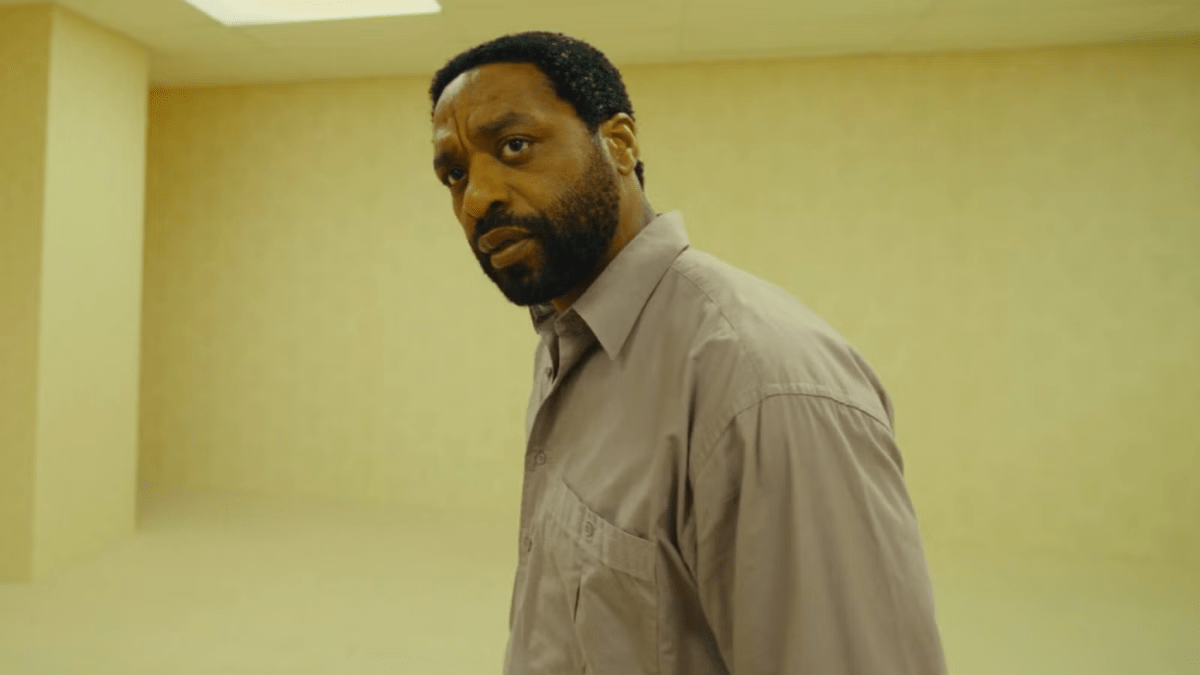
What’s the last thing a beleaguered furniture store owner needs? More furniture! That’s what immediately came to mind when Clark (Chiwetel Ejiofor) walks through a wall in a sub-basement and finds a huge pile of furniture. It’s all free, but what good is it when his store–Cap’n Clark’s Ottoman Empire–has the same amount of customers whether it’s closed or open. To crib from Samuel Taylor Coleridge, it’s a case of “Furniture, furniture everywhere, nor any customer in sight.”
Before Backrooms gets to Clark and his plight, we get a small taste of the phenomenon that was the basis for the movie. If you’re a fan of the series of YouTube videos by movie director Kane Parsons, you’ll feel right at home. If not, the introductory five-minute sequence shows you what all the fuss is about.
After some graphics circa 1990, which mention a company named Async, a camcorder video plays. A scared guy in a hazmat suit captures an oppressively bland and surreal landscape that Clark later describes as being “made by construction workers on acid”. Chairs are positioned in curious formations. The floor, walls and ceiling are shades of bleached yellow, all lit by fluorescent lighting. Corridors lead in circles, windows are blocked by walls, and doors lead to more hallways and rooms.
When a sound indicates something is following him, the man runs in a panic. He stumbles upon a room filled with A/V equipment, cassette tapes, 3.5” floppy discs, amplifiers, you name it. (The movie clearly has a fetish for analog electronics.) He calls out to “standard” to extract him, but nobody responds.A bird flies in, crashes, then flies off.
Within seconds, the man is attacked by whatever is stalking him, screams are heard and the video cuts to bluescreen. A television is turned off and lab-coated figures are reflected in the black television screen. Welcome to the backrooms!
Now that the preliminaries are out of the way, we meet Clark and Mary (Renate Reinsve), his psychiatrist. In a session, she talks to him about loops, habits and behaviors that keep us walking in circles, solutions that we reach for repeatedly expecting a different result that never happens (a.k.a. the definition of insanity). Mary asks Clark if he’s interested in forging a new neural path that will take him out of his loneliness. Clark’s there, so yes, he’s willing.
Mary asks him to roll-play during their session, and Clark reveals unresolved anger surrounding his wife and failed marriage. He took the furniture store job to support them both while she was attending law school. The constant drudgery caused Clark to drown his sorrows in booze, and his wife threw him out of “his house” after their last angry confrontation.
For her part, Mary has lingering abandonment issues from her traumatic childhood. Her mother suffered from acute paranoia, taping newspapers to the windows, neglecting housework and Mary. Mom is eventually committed to a psych ward, which Mary internalized as her failure and inspired her career in psychiatry. Mary watches her childhood home being demolished as an act of closure, but the fact that she takes a memento indicates she’s unable to forge her own new path.
Bobby (Finn Bennett), a young employee, films Clark parading around the store in a pirate costume while imploring potential customers to come on down. When Clark falls down, Bobby’s co-worker and girlfriend Kat (Lukita Maxwell) looks embarrassed. When Clark tells Kat to open the store, she says it’s already open.
Because business is terrible, Clark is looking to cut expenses everywhere. Electricity surges at night, which is odd because Clark sleeps in the store and shuts all the lights off before turning in. Lo and behold, the electrician finds an oddly placed breaker in the circuit box. Toggling it doesn’t seem to affect anything, though.
After another night of drunken TV watching, Clark notices the lights flickering in the sub-basement. While investigating, he stumbles upon the “backrooms” we saw in the beginning. Clark sees a huge pile of furniture, and is gobsmacked. As he wanders around, he encounters a cardboard figure playing a foreign language instruction tape. One room depicts a surrealistic tableau. Everything is oddly connected to Clark. Then Clark hears a threatening noise and runs for the entrance. The following morning, a lab coat man (Mark Duplass) watches a recording of Clark with apprehension. Due to the Law of Economy of Characters, we’ll see him again before the movie is over.
Energized by his discovery, Clark reveals all to Mary during their next session. She naturally thinks Clark is crazy, and Clark asks about her 5150 protocol. He shows her a mapping of his world as proof, but Mary is incredulous. Clark storms out and says that when he returns with proof, she’ll owe him a “big f-ing apology”.
Clark recruits Bobby and Kat to aid his exploration of the backrooms, and things go about as well as you’d expect for them–not well. After Clark misses his next session, Mary goes looking for him. His store looks abandoned, but she goes in anyway, locates the gateway and walks through. As she explores the backrooms, she becomes aware of being followed. Is it Clark, or something monstrous?
Recommendation
If you haven’t experienced Kane Parsons’ “Backrooms” videos, I highly recommend you seek out “Found Footage 3” on YouTube before seeing Backrooms (the movie). It’s forty minutes of what people (much younger than I) have been fascinated with, and will help you decide whether this movie is for you. Generally speaking, the backrooms concept is like watching a videotape of someone playing a first-person shooter game, except there’s no shooting, and the landscape is inspired by surrealism and MC Escher. While I appreciate the inventiveness of the landscape of Parsons’ world, it’s obvious that he took his vision as far as he could in short-form videos.
Making a movie out of this concept requires much more than extending it to the length of a feature film, however. Besides the anticipated weirdness, there has to be a plot, with characters, a three act structure, and so on. This is what eventually trips up Backrooms. While the notion of having everyday characters stumble upon the backrooms makes sense, eventually the movie has to lead somewhere. If it didn’t, the movie would be the equivalent of a museum video installation. A movie has to have a payoff, for me at least.
Where Backrooms stumbles is when it starts explaining things with a layman’s understanding of psychiatry, which diminishes its mystery and intrigue. The original “Backrooms” was/is interesting because it’s a Rorschach test. It never explains itself and is open to all interpretations. As such, anyone who says they have the definitive answer for “what Backrooms means” is not to be trusted.
Unfortunately, Backrooms devolves into familiar horror tropes in the end, with monsters chasing people and references to Stranger Things. And while the answers provided make sense to a degree, the movie’s conclusion is abrupt and unsatisfying. That said, I was intrigued by this strange world and its puzzling and obscure aesthetic. Movies rarely succeed through production design alone, but this one does.
Chiwetel Ejiofor deserves a lot of credit for making us care about a very thin character. He’s a terrific actor and the producers were wise to bring him on board. Renate Reinsve is OK but is underutilized. Her accent is comically out-of-place given her character’s backstory. She’s great at being terrified, but her part could have been played by anyone. Mark Duplass was “this close” to pulling off a brilliant David Lynch impersonation.
The term “visionary” fits writer-director Kane Parsons. His construction of the backrooms makes the movie worth watching. Movies (The Shining, Skinamarink) and television shows (Twin Peaks, Severance) have utilized liminal aesthetics before, but Backrooms is unique in that I wanted to explore this unsettling world despite its lurking evil. (It will become a Halloween attraction eventually.) Parsons does have limitations as a storyteller, but he compensates for them with mesmerizing visuals and directorial flair.
Backrooms works best as a trippy alternative reality that reflects viewer anxieties of all kinds. The movie held me when it was weird and inscrutable, less so when it became a conventional horror movie. Mildly recommended.
Analysis
Over the past several years, I’ve become aware of a vast trove of videos on YouTube that promise to explain movies to those who just didn’t get it. Confused by Skinamarink? No problem, here’s a virtual crowd of explainers at your fingertips. After watching a few of these videos, I find their claims dubious because what’s said is entirely subjective, which is how everyone processes cinema. (I also disagree with these digital sleuths because I’ve already formed my own opinion.)
I’m even more incredulous when someone professes to have “the answer” for an overtly ambiguous movie like Backrooms. Because of its construction, Backrooms is destined to inspire countless such videos. It is explicit in some ways, but purposely vague in many others. Familiarity with Kane Parson’s preceding YouTube video series helps, but even then there’s very little concrete information provided. Parson’s world works because of its mystery, not because helpful explanations are provided along the way.
The backrooms-flavored segments of Backrooms remind me of a video installation in a modern art gallery that plays on a loop. They’re equally arresting and captivating, driven by mood and atmosphere, or vibes if you’re younger than I. Backrooms is chock full of vibes, but what it means is up to the beholder.
Surrealism, the new frontier
Like all great artists, Parsons has taken things that fascinate him and turned them into art. He also wisely withholds what they mean to him so that we can supply their own. His work reminds me of David Lynch, a multi-media artist who readily conjured up weird stuff unlike anything seen before, and would steadfastly refuse to explain it to anyone. Lynch’s background in painting and sculpture taught him that the power of art art lies in its interpretive malleability. What inspired him to create a painting, film or television show was irrelevant. What did matter was that his creations triggered discussion from others. Lynch welcomed discussion of his art, which is why it will persist in the cultural consciousness long after his death.
Lynch’s opaqueness is one reason why I’m suspicious when anyone professes to know exactly what Parsons is up to, either with his YouTube videos or his movie. One can easily identify what inspired him while watching it. Analog technology fascinates him, because it has a prominent place in his alternative reality. However, his film isn’t the first to exhibit a love for old technology like cassette tapes and bulky computers. What the presence of these objects mean is anyone’s guess.
Inspirations abound
A key element of Backrooms is its usage of the “found footage” aesthetic. As was the case for The Blair Witch Project and other films in this genre, the subject uses a camcorder to film everything happening, even when things get tense and there’s a monster pursuing them. It’s a silly concept when you think about it, but I’ll be damned if it doesn’t work on me every time.
The world captured on grainy videotape unfolds as an unending series of hallways, conference rooms, stairways, and the point-of-view evokes a first-person shooter video game. Further driving home the video game analogy is when the subject travels beyond the initial blasé corporate chic to discover surrealistic set pieces. The objective of the backrooms world is discovery and survival. The further one goes into the backrooms, the more there is to see.
Much has been made of Backrooms (and its videos) being a “liminal horror”, because its overall effect is derived from the vastness, emptiness and inexplicableness of its world. The backrooms go on endlessly and the movie provides little context for why it exists in the form that it does. I get into some plausible explanations for what inspired Parsons below, but if Parsons is saying something specific about the world he’s created, he’s been very cagey about it.
“Answers”
Getting back to what Backrooms means, there’s been a lot of conjecture, but nothing I would call definitive. A piece from the New York Times says plenty, and while I agree with most of it, I would argue that the answers yield only more questions. It states that the movie is a distillation of GenZ’s anxieties. They grew up online and became isolated during the pandemic and became fascinated with a world filled with empty streets and buildings. Concerns over the untrustworthiness of generative AI is another boogyman. The unease that comes from the realization that your digital life is controlled by algorithms, is another.
A member of the X film community postulates that Backrooms reflects GenZ’s recognition that the culture they experience has been endlessly recycled from the 1990s. Culture has always been recycled and revisited, and I would argue that culture from the Eighties has endured longer. We’re still making Ghostbusters movies and television shows, after all. And what about Star Wars and Star Trek, franchises that date back to the Seventies and Sixties? Elvis is still the subject of movies almost fifty years after his death. The longer you live, the more likely you’ll revisit your childhood memories over and over.
Others state that the backrooms can be interpreted as GenZ’s apprehension over entering the workforce where the rules for success are byzantine. Or maybe the backrooms symbolize the decimation of prominent physical spaces like shopping malls. Or maybe it reflects the rapid decline of social media. Or depicts the hollowing out of corporate spaces like office buildings. Or the ongoing effects of 1990s globalization upon culture and society. Or the emotional effect of late-stage capitalism. Or the devastating effects of dementia. Or…or…or…
The one answer to rule them all
All of these takes are valid because the movie is designed as a playground for our unconscious fears. It’s a nightmare tableau that feeds on our anxiety through its use of the uncanny. The movie is an anxiety projection apparatus where all interpretations are welcome and none are wrong, but all of them are right. Whatever the viewer brings to the movie “fits” because the movie is about unlocking those inner fears, not providing answers.
If you’re GenZ, then the movie symbolizes what you fear the most. Job insecurity, alienation, isolation, lack of meaningful relationships, debt, and so on. As someone a bit older, I connected more with the movie’s themes of frustration and failure. I do think people who focus extensively on entertainment see parallels with the movie’s theme of recycled images and people because that’s the world they live in.
In short, Backrooms isn’t about giving us answers, but taking what troubles us and reflecting it back in a way that’s creepy and unsettling. It’s a horror movie where it provides the set and we bring our monsters and let them roam.
That old tech feeling
I marvel at how people have embraced what was commonly referred to as “dead technology”. I experienced the transformation of recorded music from analog to digital first-hand, but I never missed LPs and cassettes. At least with CDs, I no longer had to endure record pops and tape hiss. But CDs are bulky and turned into coasters with a single scratch.
I went digital and put hundreds of songs on my iPhone, which is convenient but lacks the physical element I had associated with listening to music. Choosing a song using a phone touchpad isn’t the same as selecting something off a shelf, putting it into a device and pressing play.
There’s also the pride I took in building a library of music. What you collect says a lot about you, because your collection is part of your physical space (ex: Perfect Days). Having 10,000 songs on your phone doesn’t convey the same feeling because digital collections are intangible.
For filmmakers, I think they’ve found ways to incorporate video tape and choppy film footage because digital cameras produce images that are too perfect. The imperfections of video tape and the luminous quality of film both produce images that are almost impossible to achieve with digital cameras. The former looks like it was captured by an artist, while the latter could have been done by anyone. A good example is the difference between Guillermo del Toro’s Nightmare Alley and Frankenstein. One looks like a horror movie, while the other looks like it was filmed with an iPhone.
Digital devices have made things easy and convenient, but they’ve also taken away the physical relationship we had with things that filled our spare time. We can access books, music, movies and television shows on our phones, but it doesn’t feel the same. People are choosing non-digital devices because they want a physical relationship with art. Convenience is nice, but not when it comes at the expense of what makes us human.
Do you want to see something really scary?
Maybe I’m too old to be scared by Backrooms. I once worked in an office building that was so nondescript that I had to carry a map to find my way back to my cubicle if I got lost. The rows of cubes went on forever. I also worked in an empty office building during the pandemic and appreciated the quiet. Do empty office buildings really make young people anxious?

