
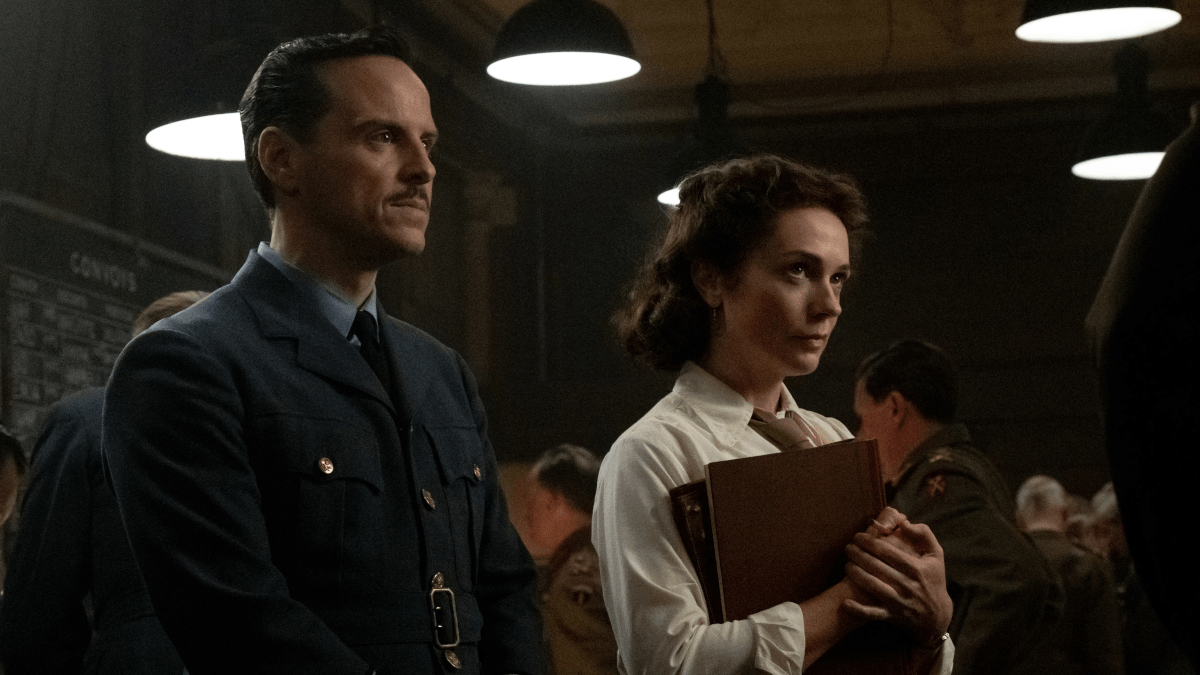
During a quiet moment in Pressure, Group Captain James Stagg (Andrew Scott) poignantly asks a colleague, “What is wind?” His question is rhetorical but it reflects the philosophical differences he has with a rival who bases his optimal D-Day forecast upon historical charts. In the face of unrelenting pressure from everyone around him to change his pessimistic weather forecast, Stagg stays true to his convictions, because he knows that predicting the weather requires more than pattern-matching. It requires curiosity and insight, two things that ultimately won out in what was proven to be the most consequential weather forecast in history.
I suppose if I watched The History Channel, I would know about “Exercise Tiger”, the dress rehearsal for D-Day. Pressure opens with the aftermath of that mission, with soldiers washing up on shore either dead or severely wounded. General Dwight D. Eisenhower (Brendan Fraser) later explains that the exercise was a disaster because of a typographical error. An alert involving the presence of German E-Boats in the area was never received and resulted in hundreds of lives being lost.
The aftermath of Exercise Tiger haunted Eisenhower, who wanted to prevent a similar fiasco at all costs. The key to D-Day is for the weather to accommodate boats landing and planes providing air cover. Although Eisenhower has used his preferred weatherman, Colonel Irving P. Krick (Chris Messina), many times before, Winston Churchill insists that he use Stagg instead. Churchill calls Stagg a genius, a description that befits his brusk nature.
Stagg isn’t commanding outside of work, however. He’s married and dotes upon his wife Liz (Tamsin Topolski), who is very pregnant. Duty calls, however, and before leaving Stagg tells Liz that he says he doesn’t know when he’ll return. Odds are that he’ll likely be away when she gives birth, which is unfortunate given that the Germans are actively bombing London. But Stagg is a stiff upper lip chap and leaves her to meet Eisenhower.
Southwick House serves as Eisenhower’s command center, meaning everyone of military significance is present. Field Marshal Bernard Montgomery (Damian Lewis) immediately telegraphs that he’s a British prick. Colonel Krick is arrogant because he correctly predicted favorable conditions for Eisenhower (and movie producer Louis B Mayer). Eisenhower is by turns fatherly, jovial and furious. Stagg, however, is a Scottish prick, extremely confident in his abilities and refuses to back down under pressure. (The movie title has a dual meaning, get it?)
Balancing testosterone levels a bit is Eisenhower’s personal assistant, Kay Summersby (Kerry Condon), who acts as sounding board, conscience and confidant. Incredibly, she continues to speak to Stagg after he rudely tells her to vacate his office. Being very familiar with men in power, Kay doesn’t take Stagg’s demeanor to heart. It’s just what all arrogant men do.
The crux of Pressure involves the accuracy of the weather report for June 5, 1944, the original date for the invasion of Normandy. If the weather isn’t right, it could turn the war in Germany’s favor. Stagg is tasked with delivering his final report to Eisenhower in a little over a day, which will be the determining factor of his go/no-go decision.
Using historical charts, Krick proclaims that the weather will be perfect. Stagg scoffs at Krick’s methodology and insists upon getting all weather-related data he can get his hands on. The more data he gets, the clearer picture he’ll have of what’s to come on the fateful day. When the moment arrives, Stagg tells Eisenhower and all of the bigwigs precisely what they don’t want to hear. Storms are coming, which will bring 8-10 feet waves. Stagg advises against invading under these conditions, and is chastised by Montgomery.
Subsequent updates from Stagg convinced Eisenhower to delay the invasion indefinitely, which only incenses Montgomery because the longer they hold off, the more time the Germans have to fortify Normandy. I can’t fault Montgomery over his pushiness, considering that he’s watched London being bombed daily and the threat of German occupation looming.
Speaking of bombings, the hospital where Liz went is hit, but Stagg can’t leave until after the invasion. Even with the possibility of his wife and unborn child’s death hanging over him, Stagg never wavers in his judgement. When Kay tries comforting him, saying that she always thought weather men were boring, Stagg explains that while that may be true, the weather itself isn’t boring. Stagg’s understated monologue in this scene is delivered perfectly by Scott and is one of the the highpoints of the movie.
Fortunately for Stagg, his prediction is proven right when a storm arrives after several days of sunshine. He was right, but the question now becomes, when can the invasion take place? Waiting two weeks is out, so it’s up to Stagg to monitor the steady stream of data and find another date that will be good enough. (Spoiler alert, he finds one.)
Recommendation
I distinctly remember reading a post on social media taking a shot at Pressure when the trailer came out. “A movie about the guy who did the weather report for D-Day? Ridiculous!” Having seen this movie, I can say that there was nothing ridiculous about it. In fact, the accuracy of that report was terribly important, a point driven home repeatedly in the movie that the invasion would have been a disaster in poor weather. Take that, glib naysayers!
The central argument of Pressure involves which methodology is better when devising a weather forecast: using historical charts or interpreting current data. You might think that the latter would be the obvious choice, but success feeds bias, which in turn blinds us to luck. Furthermore, the movie shows how dangerous cherry-picking data to arrive at the desired answer can be. Short cuts are more efficient, but bad things can happen in the absence of human insight. If you’ve been following the current debate over AI, you may find the movie’s harsh assessment of pattern-matching masquerading as actionable intelligence uncanny and surprisingly relevant.
I hesitate to call Andrew Scott’s performance his best, because I’ve seen only a small portion of his work. Scott’s performance as Captain Stagg stands out because of his ability to play a cerebral and unlikable character who demands the respect he’s earned. There’s only one scene where his emotions erupt, and it’s gripping because Scott’s performance had been tightly wound leading up to it. Scott’s ability to command the screen through subtle variances in intensity is something he’s done previously in Netflix’s Ripley series and as Richard Rogers in Blue Moon, but it’s still remarkable.
Playing historical figures like Dwight Eisenhower are plumb roles reserved for actors with name recognition and awards under their belt. This group now includes Brendan Fraser, a recent Academy Award winner for The Whale. His approach boils down to never portraying “Ike” as a larger-than-life caricature. Aside from his balding head, Fraser’s Ike is a thoughtful bear of a man who cares deeply about the men who will die under his command. When he blows up, it’s justified. Fraser has always had presence and movie star appeal, and while the movie relies on both, I appreciated how he makes Ike human.
It’s essential for a war movie like Pressure to have an exceptional supporting cast. Kerry Condon is on hand to provide warmth and understanding. Damian Lewis has fun as Bernard ‘Monty’ Montgomery, taking the character’s abrasiveness into villainous territory. Con O’Neill portrays Air Marshal Leigh-Mallory as the sensible senior member of the group. And Chris Messina’s Colonel Krick is so arrogant I waited for someone to call him a prick. (It doesn’t happen.)
Although Pressure was adapted from a play, it never feels stagey. Director Anthony Maras achieves this through a judicious use of newsreel footage, which provide wartime context. Scenes of camped troops outside the manor house also remind us that the outcome of Stagg’s work, even when proven accurate, will ultimately cost most of those men their lives. The movie’s climax cuts away to moments of harrowing Saving Private Ryan action that further emphasizes the overwhelming price paid for victory. On a technical level, the movie is well-paced and beautifully shot, with an attention to detail that befits a historical drama like this.
Pressure might be the best film ever made about a weather report, which also happened to be the most crucial one in history. Andrew Scott further solidifies his case as a leading man with another intriguing performance that highlights his soft-spoken, introspective qualities. Recommended.
Analysis
As I mentioned above, the movie’s theme is the difference between knowledge and understanding. On one side, there’s Colonel Krick, who matches the current weather pattern with historical analog charts to derive his forecast. Because what’s happening in the present also happened three times before, he concludes that the same outcome will also take place.
Captain Stagg disagrees with Krick for three reasons. First, having lived in the UK, he knows that the last thing one can do with his country’s weather is forecast using historical precedents. Northern Pacific weather is very unpredictable, which is why he insists upon using only current data for his prediction. Second, Krick has been lucky in only having to predict weather in very stable locations. Finally, Krick excluded a chart that contradicts his hypothesis. In Stagg’s opinion, Krick’s methodology is as scientifically sound as reading tea leaves.
Today, we have an unprecedented amount of weather data to base predictions upon. Stagg and Krick would probably be astonished that we have multiple streaming channels devoted to the weather. Thanks to The Weather Channel, people know about bomb cyclones, polar vortexes, El Niño, La Niña and so on. We know the weather at any minute of every day. But knowing the weather (facts) isn’t the same as understanding it (insight).
When it comes to hurricanes and tornadoes, we still can’t reliably warn people to evacuate before they strike. People die because the alerts come with too little time, or not at all. We’re gathering more weather data than at any other time in human history, and still have preventable weather-related fatalities.
On The Weather Channel, meteorologists mention using different models to try to predict the path of hurricanes. These models are likely based upon predictive AI, which is useful but limited because they are based upon historical data and pure statistical analysis. Computers and programs are driven by logic and equations, but the weather is not.
That Pressure makes an impassioned argument for human intelligence and ingenuity over computerized thinking, or AI, took me by surprise. Stagg may be an insensitive jerk, but he is also a genius who understands the weather better than anyone. Where Krick uses pattern matching to come to his conclusions (like AI), Stagg relies on his intellect. Krick has his analog charts do the thinking for him, while Stagg uses his unique capacity to make connections that historical charts (or a computer) wouldn’t uncover.
In the end, when Stagg’s genius guarantees the success of the D-Day invasion, it’s clear that Pressure is warning us to not rely upon technology to make critical decisions. Instead, we should always rely on what makes us human, namely our capacity to think, reason and draw conclusions. In 1944, AI would have told Eisenhower to proceed as planned. Where would we be today if he had listened?
When weather changed history
If you’ve been watching The Weather Channel for the past twenty years or so, you may have seen When Weather Changed History, a show discussing instances when weather did indeed change history. Like Strangest Weather on Earth, Storm Stories and Deadliest Space Weather, the show was a combination of news footage and prerecorded “talking head” segments broadcast after peak viewing hours. (These shows were typically pre-empted in favor of late-breaking weather emergencies.) As you may have guessed, the weather report’s impact on D-Day was the focus of an episode.
Given that D-Day is also a regular topic on The History Channel, younger moviegoers may have the impression that Pressure is something for their empty-nester parents and/or their grandparents to enjoy, but not them. The events in the movie took place eighty-two years ago, or several lifetimes in their eyes. Also not helping matters is how recent WWII movies have a tendency to feel stodgy due to their mimicry of the “war movie” genre formula dating back to the 1940s.
Nothing can change the fact that D-Day happened a long time ago, or that there have been many movies made about WWII. However, Pressure benefits greatly by being based upon a stage play that premiered in 2014. The movie reflects a modern approach to the subject, in that the dialog and the performances are direct, unsentimental and unromanticized. (The Choral, set during WWI, did likewise.)
While I’m fine with watching a modern WWII movie with old-fashioned sensibilities, Pressure might be the most relatable movie of its kind in recent memory. I hope that younger audiences will give it a chance when it arrives on SVOD and PVOD.
Bob Newhart
In an episode of The Bob Newhart Show, Bob Hartly (Newhart) uses his new VCR to record that night’s weather forecast. When Bob’s wife Emily (Suzanne Pleshette) asks him why, he replies that he wants to see if the weatherman was correct tomorrow. The joke being that most people don’t take the weather report that seriously. Bob is the only person on earth who wants to hold the weatherman’s feet to the fire, whereas everyone else simply goes on with their lives if the forecast is wrong.
Of course, the weather report for Chicago is rarely life-or-death. Like Bob, we can always take an umbrella and a rain coat just in case. Whenever the weather forecast is wrong, we crack jokes at the weatherman’s expense. Meteorologist Kevin Lighty says the one he hears most often is, “Boy I sure wish I could be like a meteorologist at my job and be wrong 50% of the time and still keep my job.”
I bring this up because Pressure is the first movie I recall that explains why the weather isn’t trivial or boring. When Stagg tells Kay that human life depends upon the weather, I wondered if the meteorologists seeing this movie clapped and cheered. Finally, here’s a movie that takes their career seriously, and not as the source of jokes.
WWII movies in abundance
Over the last ten years, there has been an abundance of movies about WWII. 2017 had two prestige movies, Darkest Hour (featuring Gary Oldman Academy Award winning performance) and Christopher Nolan’s Dunkirk. Midway was a 2019 American and Japanese co-production.
Apple TV released Greyhound, starring two-time Academy Award winner Tom Hanks, in 2020. Netflix’ Operation Mincemeat (2021, featuring Academy Award winner Colin Firth) told the story of a British plot where a corpse was used to supply the Nazi’s misinformation. 2025 brought us Nuremberg, which was about the psychiatrist who helped break Hermann Göring during the trials, with Academy Award winners Rami Malek and Russell Crowe going toe-to-toe.
In addition to Pressure, this year’s release schedule also includes Lucky Strike, about the advent of portable radio communications during WWII, as well as Jimmy, focusing on Mr. Stewart’s experience as a member of the Air Corps. If you’re as interested in WWII movies, your cup runneth over.

