
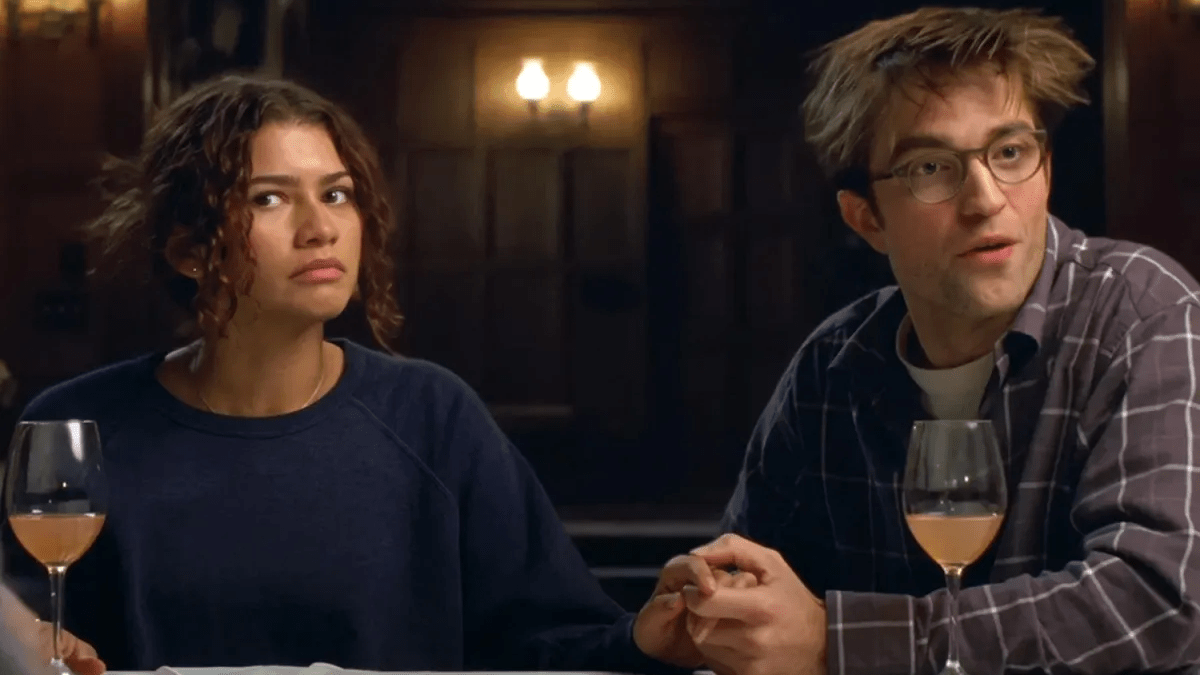
If there are any lessons to be learned from The Drama, it’s that you should avoid playing silly party games like “The Worst Thing I’ve Ever Done” before your wedding. If it can’t be avoided, for God’s sake don’t be honest. Pick something way down on your list of awful things that won’t give your partner second thoughts about marrying you. And if you feel the need to be as candid as the bride-to-be in this movie, get a ring on it first and confess your sins afterwards.
The movie begins innocently enough, with Charlie (Robert Pattinson) going over his reception speech with his best man Mike (Mamoudou Athie). It focuses on their meet-cute, and it’s a good one. A few years ago, Charlie took one look at Emma (Zendaya) at a coffee shop and decided to put the moves on her. He covertly snapped a picture of her book so that he could tell her how much he loved it. But when Charlie approached her with a big smile to convey his love of her book, she didn’t react.
Figuring Emma was ignoring him, Charlie retreats to his table. A few minutes later, he decides to try again–this time leading with an apology. Emma notices him and removes her ear bud and explains that she’s deaf in the other ear, so she never heard a word. Charlie is relieved, laughs and delivers his line. Later, over dinner, Charlie sheepishly admits to not having read the book at all. Emma thinks what he did was weird, but shrugs it off because this is typical guy behavior, right? There’s no harm where love’s involved.
Mike is so moved by Charlie’s speech that he cries. Charlie’s feelings for Emma are genuine, and a montage of their intimate moments prove as such. They make each other laugh, enjoy being with each other and have a rigorous sex life. (I hope Tom Holland is thick-skinned.) That they’re both incredibly handsome makes them the perfect couple, or so you would think.
The Drama isn’t about Charlie and Emma falling in and out of love rom-com style, but what drives a wedge between them. It arrives unexpectedly when they are sampling the reception dinner with Mike and his wife Rachel (Alana Haim). The four are having a great time, and while polishing off the last bottle of wine Rachel gets Mike to tell the others the worst thing he’s ever done. Mike does so and admits doing something cowardly that didn’t hurt anyone.
To make it up to Mike, Rachel admits to something worse that was harmful, but excuses her actions because she was a child at the time. Kids do the darndest things, after all. Charlie’s up next, and he did something when he was fourteen that drove a family in his neighborhood to move away. He also cops to the same “just a kid” excuse.
Honestly, I’m not sure I’d want to spend time with any of these people after hearing how horrible they were, but the point of this exchange is to provide an opening for Emma’s worst thing ever, and it’s a doozy. I won’t give it away here, because not knowing it in advance is a worthwhile surprise. Emma also planned on doing something very bad when she was young, but never went through with it due to bad timing. Something similar took place the day before, which would have lessened the impact of what she had planned.
After stopping herself, Emma went on to become a respectable adult. And since she never did what she wanted to do, there’s no harm done, right? Wrong. Rachel’s sister was critically wounded in an incident like the one Emma was planning, so it’s no laughing matter for her. Charlie is gobsmacked. He was going to marry the girl of his dreams, but then her answer to this game has suddenly thrown that into doubt.
Over the next several days, Charlie tries to reconcile what he now knows about Emma’s childhood with the woman he’s about to marry. The movie ingeniously puts us into Charlie’s frantic mindset, where he revisits moments first with present day Emma, only for her to be replaced with Emma as a troubled child. For her part, Emma explains her mindset back then, which was the result of bad experiences at school and long periods of isolation at home.
Charlie’s life has become defined by how he responds to his moral quandary. He tries empathy, but that doesn’t make him feel better. Should he respond like his friends and be judgemental, cut bait or call the police? The movie doesn’t offer a “right way”, but instead invites the audience to mentally play along while watching Charlie squirm. All of this leads to one of the craziest wedding receptions ever, which only reinforces the truism that secrets are best taken to the grave.
Recommendation
The Drama is one of those films that asks the audience a question and leaves it to them to answer it. Indecent Proposal asked the audience to weigh in on whether Demi Moore should take one million dollars in exchange for twisting the sheets with Robert Redford. Two years ago, Juror #2 put us in the shoes of a jurist who finds out that he committed the crime someone else is on trial for. The fun part of these movies is how they get us to debate the moral dilemma in our heads while the story unfolds.
Similarly, the moral issue at the center of The Drama, has no right or wrong answer. Everyone who watches it will respond differently based upon their life experiences. Instead of providing any answers of its own, the movie explores the situation by having each character represent a different likely response. The husband-to-be tries to be sympathetic and understanding. The best man is protective. The maid of honor is angry. The future wife is perplexed at how the people closest to her have turned on her so quickly. Regardless of who you side with, watching everyone’s emotions play out succeeds in ratcheting up the tension to the breaking point.
Strangely, the movie utilizes a sitcom-level device to conclude things, and it nearly derails what came before. While the antics are funny in a cringe comedy way, it’s a clumsy way to achieve the emotional release the movie has been building towards. The quietly touching moments that follow it are what the movie should have gone for, not ridiculous wedding reception stuff.
This is the most affecting performance I’ve seen from Zendaya in a movie to date. (I haven’t seen Euphoria.) Her roles in the Spider-Man and Dune franchises never gave her the opportunity to show off her range. Challengers was a step in her evolution as a leading actor, and The Drama represents another. Zendaya is very comfortable being sarcastic, abrasive and churlish. In this movie, she lets us see how those traits shield her vulnerability while simultaneously acting as a pressure valve for her inner turmoil. Zendaya’s Emma is captivating because we never know how she’ll respond at any moment, a live wire who also happens to be disarmingly beautiful.
Robert Pattinson’s performance initially puzzled me. His Charlie is so full of ticks and mannerisms that I wondered if he was channeling Woody Allen. I then thought that writer-director Kristoffer Borgli had gender-swapped Charlie and Emma as a provocation. Pattinson represents the expressive and emotional girl, while Zendaya is the blunt and confrontational guy. Regardless of the intent, Pattinson should have reigned it in some because his panic-driven flailing became annoying at times.
I wasn’t familiar with writer-director Borgli’s previous films, but based on this movie he’s a talent on the verge of breaking out. Borgli has a gift for depicting heightened emotional states, dynamic interpersonal interactions and the malleable tendencies of memory. Borgli’s control over the ebb and flow of the story, with its many many tonal shifts, is masterful. He’s also a very cunning writer in how he invites the audience to step into each of the characters points of view. Lastly, I want to acknowledge Borgli and Joshua Raymond Lee’s brilliant editing, which perfectly captures the fractured and panicky nature of the plot.
The Drama is entertainment as provocation. The movie’s fun is in how it directly engages the audience with a moral question that’s impossible not to have an opinion on. It’s overwrought and implausible, but very entertaining. Featuring a career best performance from Zendaya and an unforgettable turn from Robert Pattinson. Recommended.
Analysis
I first heard the phrase “suspension of disbelief” in Basic Instinct. In case you haven’t seen the movie or don’t remember the scene in question, Sharon Stone’s character Catherine Tramell explains the concept while being driven to the police station to be questioned about the murder of her f-buddy Johnny Boz:
You make stuff up, it has to be believable. It’s called suspension of disbelief.
What I found admirable about The Drama is that it never bothers trying to suspend our disbelief. The initial scenes are actually a ruse intended to fool us into thinking the movie would be a traditional rom-com, where the two became lovebirds despite Charlie being a bit deceitful. (Think When Charlie Met Emma.) From there, the expectation is that something would threaten to tear the couple apart, only for the two to wind up together in the end.
And while that does happen, it’s far very removed from the usual rom-com shenanigans. It’s Emma admitting that she nearly committed a mass shooting while in grade school. She clarifies that the only reason she didn’t go through with it was because someone else did it at a mall the day before. In other words, Emma planned to commit one of the most heinous crimes one could ever do, but didn’t do it because someone else stole her thunder.
After that disastrous end to the evening, Charlie asks Emma why she confessed to such a thing in front of their friends. Her excuse is that she was drinking, which is true but not convincing. I got the impression that when it was her turn, Emma wanted to one-up her friends. What Mike, Rachel and Charlie admitted to was bad, but Emma had something up her sleeve that will blow them all away (figuratively). Almost nothing tops a school shooting.
Regardless of her reasoning, the plot of The Drama is utterly implausible. Nobody in their right mind would ever admit to what Emma did in mixed company. It would be as bad as admitting one was a pedophile. Some things you just never admit having done at the risk of being universally shunned until you die.
The first clue that The Drama won’t be a run-of-the-mill rom-com is telegraphed before that scene, however. On their way to the restaurant, Emma spies a woman who she thinks is their DJ smoking crack with friends on the street. Emma’s very bent out of shape about what she sees, while Charlie isn’t concerned. Doing hard drugs is still hard core in this time of marijuana acceptance, but why is Emma so upset over her DJ doing drugs? What does her drug habit have to do with whether she’s able to do her job at the end of the week?
That scene, in conjunction with the dinner scene, signals that the film is actually an argument about morality and passing judgement on others. When is it appropriate to judge people for the things they did? Are evil thoughts as bad as the deed itself? Do extenuating circumstances matter, like your age? Should your relationship to the person be taken into consideration? This is what The Drama is about, having a dialog with the audience on a hot button issue.
After accepting what the movie is about, I had no problems with its implausibility. Writer-director Kristoffer Borgli is using the characters as place-holders for different takes on the topic, with Charlie in the hot seat. As the one who’s in a romantic relationship with Emma, he’s the most conflicted about her admission. Does he still love her? Should he? Does it matter that she was a child at the time? Does how she led her life afterwards excuse what she almost did? Emma’s confession has thrown Charlie’s entire life into doubt, and he doesn’t know the right way to handle it because he’s in love with her.
The reactions of Mike, Rachel and Misha are more cut and dry because they’re only friends and acquaintances of Emma. Rachel despises Emma because her sister was permanently disabled from a school shooting. For Rachel, anyone who even thinks about doing such a thing deserves harsh condemnation. It doesn’t matter that Emma became an anti-gun activist later. Rachel has a direct connection to a school shooting and can’t be impartial. People who plan or do something like that were evil then and evil now, full stop.
As Charlie’s best friend, Mike’s concern is for his buddy’s health. He tells Charlie to cancel the wedding and fly back to England, and adds that he’ll beat up Emma to protect him. As far as Mike’s concerned, Emma’s a crazy girlfriend that Charlie needs to distance himself from immediately. Mike may be a sensitive person, but he only cares about Charlie. Emma is just “the girlfriend”. I hate to say it, but Mike personifies the “bros before hoes” code.
Misha’s response to Charlie’s “hypothetical situation” is equally unsympathetic. She says that she’d call the police, probably because she thinks that anyone who harbors such thoughts is a danger to the public. Hearing this drives Charlie over the edge, because Misha, Mike and now Misha refuse to give Emma the benefit of a doubt.
The Drama doesn’t make passing judgement on Emma easy for the audience, either. It gives Emma equal time to explain what was going on in her life at the time. We see her being bullied during school and spending her time afterwards alone. Her trajectory was the same as many other school shooters. No friends. No parental involvement. Easy access to guns. Becoming radicalized via the internet. A school in Michigan, my home state, had its first school shooting ever a couple of years ago, and what was reported during the shooter’s trial is identical to what drove Emma to almost committing her own.
For the movie’s part, it asks us to understand and sympathize with Emma, but not to forgive. It leaves that up to us. Should she be judged based on the worst period of her life? Does she need to be forgiven for something she almost did? Has she redeemed herself enough since that point to have earned compassion? It’s clear that Emma believes that she has, and is caught off-guard by the reactions of her friends and her boyfriend. If Charlie isn’t on her side, then what does it matter?
The Drama is one of those movies that anyone who sees it will want to talk about, because it’s all set-up. It wants us to explore our feelings over what we see, instead of telling us how to think.
A few words on Charlie
Borgli clearly doesn’t want his movie to be taken seriously. If he did, he wouldn’t have turned Charlie into a cartoon character. Consider the following:
He throws away a coffee mug with a gun on it because he thinks it might trigger Emma’s dormant rage.
While withholding judgement on Emma, Charlie ponders whether questionable incidents should have clued him onto the person she once was. The best he comes up with is yelling at a car that almost hit you while crossing the street, and the time when she slapped him while they were having sex.
While leafing through the photo book of women with guns, Charlie visualizes Emma dressed provocatively while cradling an assault rifle. Like everything about this movie, the image is designed to provide a response from us. But it’s also funny because it takes the American fetishization of guns to the next logical step, which is sexual.
Random thoughts
Generalizations are always tricky, but I’m pretty sure that if most guys found themselves in love with someone like Zendaya, they’d forgive her for whatever she thought of doing when she was a child in a heartbeat.
It’s too bad that Tom Holland is going to be acting as Spider-Man for the duration, because casting him as Charlie would have put The Drama into Eyes Wide Shut territory.
Charlie remembering that time when Emma tried a little rough sex play and wondering if she’s really a violent sociopath waiting to strike were hilarious.
While Misha did reciprocate Charlie’s misguided advances, it’s incredible that she didn’t march right over to HR to report him.
Is head-butting the guy who hit on your wife/girlfriend better than punching him in the nose?
Is it terrible to say that most, if not all hetero men would forgive a woman who looks like Zendaya of her sins in a heartbeat?

