
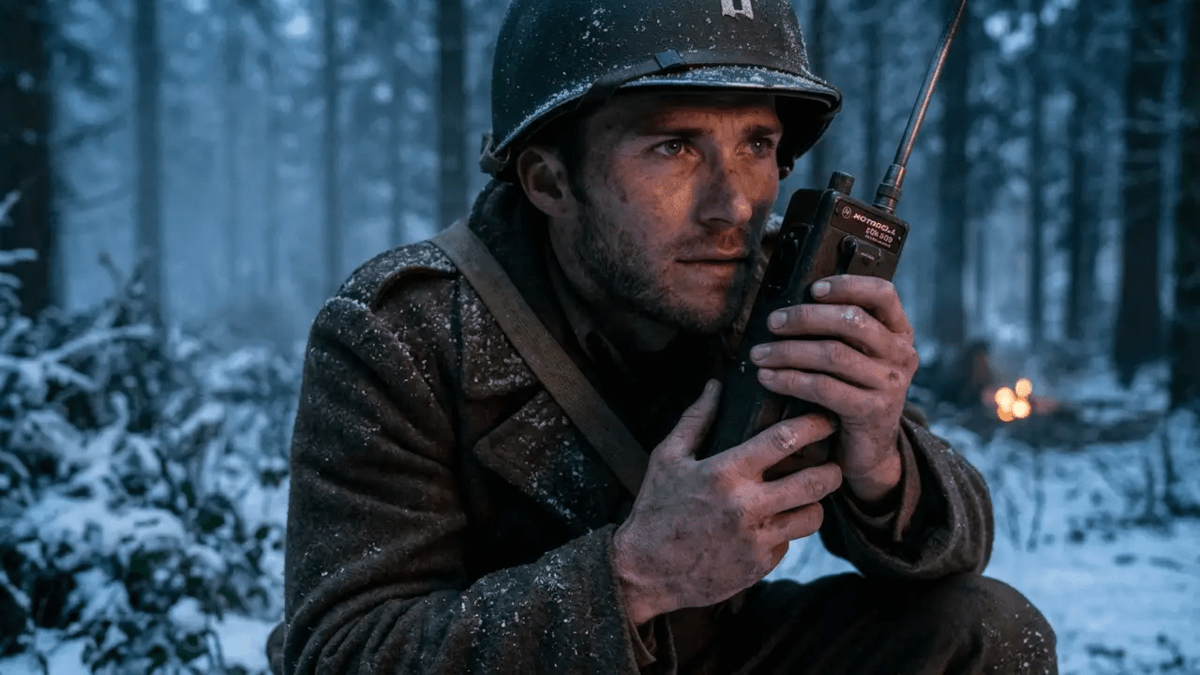
Did the fate of the free world really depend upon how American soldiers smoked their cigarettes during WWII? Lucky Strike, named after one of the brands included in their rations, says that it did. In this movie, that small part of military training played a key role in a soldier’s struggle for survival behind enemy lines during The Battle of the Bulge. Accordingly, the movie is an interesting entry in the growing “little-known facts of WWII” genre, which emphasises small-scale stories over huge battle scenes. But don’t worry–there are tanks and a flamethrower!
Lucky Strike begins with a black and white scene of African American troops driving across a winter-ravaged road in Belgium. Two soldiers exchange corny dialog about where they’re from, how damn cold it is, concluding with the superior officer telling the driver to keep his eyes on the road. After their truck gets stuck in a ditch, the group is quickly killed by Germans passing by a Panzer tank.
Flash-forward to post-war times, and Captain Castle (Scott Eastwood) is at the doorstep of Mrs. Caldwell (Aunjaune Ellis-Taylor). Because this is a movie, it’s understood that she’s the mother of one of the soldiers we just saw die. Castle wants to talk about her service towards the war effort. (She made Motorola SCR-300 radios.) Mrs. Caldwell tries to close the door on Castle, but he says he has good news and a story to tell, so she lets him in.
Back in the war, Castle is asked to lead his men to a nearby bridge and booby trap it to prevent German advances. Chit-chat between Castle and Colonel Neale (Colin Hanks) reveals several interesting things about Castle. He enlisted when he could have asked for a deferment due to his young children. And Castle was an infantryman until the higher-ups discovered he was an engineer, which got him a promotion and a job in explosives. In other words, he’s a humble patriot, willing to die for his country but avoids drawing attention to himself.
The first sign that this won’t be a typical war movie is that Castle’s mission goes south. Just like in the opening scene, the transport truck for Castle and his men gets stuck in the mud. They’re soon under fire from Germans in a hilltop bunker, but Castle and Ramirez (Daniel Ray Rodriguez) successfully take them out. Ramirez is killed after hesitating before a wounded enemy, and Castle watches helplessly as Germans kill the rest of his command. Castle destroys the bridge after the Germans leave, but now he’s stuck behind enemy lines alone.
Castle uses his radio to contact the nearest base for rescue, but Dauntless (Henry Hughes), the soldier on the other end, says that his unit is pinned down by enemy fire. Castle has no choice but to walk thirty kilometers to Elsenborn, while also trying to survive the bitter cold and avoiding discovery by German patrols. How he accomplishes this and who he meets along the way are the reasons behind Castle’s visit to Mrs. Caldwell.
As is typical for WWII movies made in the wake of Saving Private Ryan, Lucky Strike has a very grim view of life during wartime. Castle is adept at hand-to-hand combat and merciless with German soldiers when he encounters them. The movie’s depiction of the horrors experienced by civilians is particularly bleak. The longest and most effective sequence of the movie involves a Belgian family who take Castle in and are kind to him, only to face German troops. Castle has become inured to the deaths of his fellow soldiers, but the aftermath of that tragedy is the one instance in the movie when his emotions break through.
Lucky Strike isn’t entirely dour, though. The appearance of a white horse symbolizes hope, or possibly Castle’s lost innocence. And when Castle commandeers a tank, a chance encounter with a dog gives him an unusual view of the terrain. Castle also exacts revenge upon some Germans he encountered earlier by rudely crashing their tea time.
Castle’s final confrontation before reaching safety doesn’t involve the famous battle mentioned above. Instead, he has a tense battle of wits with a friendly face who also speaks English that Castle isn’t sure is trustworthy. Fortunately, Castle’s attention to detail never wavers, even when he’s on death’s door.
Recommendation
Like last month’s Pressure, Lucky Strike is another WWII movie that focuses on a little known aspect of the war. This time, it’s how smoking Lucky Strikes and Motorola radio communications devices played roles in the Allied victory over the Germans. I enjoyed this movie as someone who’s generally fascinated by trivia involving the war. However, if the subject of this movie makes you question its right to exist, you should probably skip it.
Lucky Strike is another example of how influential Saving Private Ryan has been to the war movie genre since its release in 1999. This movie adopts Ryan’s unsparingly brutal combat sequences, putting the action up close so that we can almost feel each soldier’s last breath. It also has the same drab palette as Ryan, where everything in this world is devoid of color with few exceptions. Lastly, Strike is a similarly grim experience, where heroism boils down to survival.
Since Lucky Strike doesn’t have the budget to depict an epic battle like the Battle of the Bulge, it skips it entirely. This makes sense within the movie’s focus on one man, but it does feel conspicuous within the context of the story. Honestly, nothing could top HBO’s exceptional Band of Brothers and any attempt at doing so would have been disappointing.
Where Lucky Strike goes awry is with its clichéd dialog, which recalls war movies from the Forties, no matter how much conviction the actors use when saying their lines. Conversely, the movie omits subtitles for all of the foreign language dialog, which puts us into the mindset of an American soldier who only understands English. For all the care that went into making this movie, punching up the screenplay would have been time well spent.
IMDB tells me that Scott Eastwood was in Brad Pitt’s Fury, and I vaguely remember people saying how much he looks like his famous father at the time. Scott does echo Clint’s thin build and unpretentious demeanor, but he’s visibly more comfortable and conveys compassion more readily than his father. Scott certainly looks era-appropriate for this movie, as if he’d walked out of a wartime photograph. He gives a convincing performance here, full of grit and dogged determination while always reminding us about his injuries. The movie is a star vehicle for him, and Scott makes a solid case for himself getting showier roles in bigger projects.
Writer-director Rod Lurie has made war movies before, and this one is convincingly authentic. He allows brutal scenes to play out without flinching, and ratchets up the tension in the movie’s longer scenes. The dialog is a flaw, but ultimately not fatal. The movie’s coincidences are incredible, but I went along with them because Lurie avoids drenching them in sentimentality. Like the movie’s hero, Lurie says what he wants to say without fanfare, and I respected his conservative approach to the material.
As an “untold story of WWII” movie, Lucky Strike certainly has novelty on its side in showing us how important cigarettes and radio communications were in saving soldier’s lives. Regardless, it’s an effective small-scale story of survival grounded by a fine performance by Scott Eastwood. Mildly Recommended.
Analysis
So, another movie about WWII trivia? Yes, and I enjoyed it just the same.
Did we need a movie that basically says that smoking saved lives? No, but that’s a very simplistic take on what Lucky Strike is about.
The message behind this movie (and others like it) is how important everyone’s contribution was towards winning the war. Everyone who served played a role in the victory, no matter how small their impact was.
In taking the time for us to get to know these soldiers before they’re killed, Lucky Strike is honoring them for their service. Many died not long after they reached their arena of combat. Lucky Strike says that it’s important for us to remember everyone who gave their all to protect our freedoms, that they were just as important as those who received medals.
Similarly, the movie uses Mrs.Caldwell as a stand-in for those who supported the war with their hard work. War stories are often about soldiers being brave, it’s easy to forget about those who made the equipment that ensured the survival of soldiers like Captain Castle. The movie uses the denial of Mrs. Caldwell’s pension to represent the lack of respect given to those who supported the war effort through their hard work.
For Castle, unlocking Mrs. Caldwell’s pension was personal. He did it to express his gratitude for someone who (indirectly) kept him alive. In showing him doing this, the Lucky Strike reminds us that everyone who played a part in the war deserves to be honored, including civilians. The movie tells us that not everyone who played a role in WWII was as heroic as Captain Castle, but he wouldn’t be alive without their help.
Victory is in the details
Films often pivot on a character remembering a key detail in a critical moment. Lucky Strike might be the first one where this moment conceivably changed the course of human history. The movie lays the groundwork for this setup and payoff in the early going, when Castle reminds a subordinate to light his cigarette from the brand end. This storytelling method is very common in movies because it rewards the audience for paying attention.
However, Lucky Strike goes far beyond the usual payoff when Castle uses the Lucky Strike detail to uncover a spy. It’s not the only thing that clues him into the fact that Kemp isn’t an American soldier. Kemp also doesn’t know that the Cubs don’t play in Wisconsin, or that it’s referred to as the “Army-Navy” game, not the other way around. (Whether you believe that a naturalized American would make these mistakes is up to you.)
Castle paying attention to that one detail winds up being very important. Castle is able to prevent Kemp from getting ahold of his radio, his military intel and infiltrating American forces. As Castle tells General Lauer in the aftermath, if Kemp had gotten the details right, he might have fooled everyone. But he didn’t, and the payoff for Castle, the audience and the fate of the free world was incredible.
In the shadow of greatness
Over the past several years I’ve realized that Saving Private Ryan (1998) casts a huge shadow over the war genre. That movie has become the standard-bearers for how epic battles and hand-to-hand combat is depicted. Bullets and explosions from artillery must be omnipresent and concussive. The audience must feel like they’ve been transported to an actual battlefield, witnessing the horror of soldiers being shot down and blown apart at every turn.
Ryan also demands that hand-to-hand combat sequences must be uncomfortably intimate. The movie must make the audience understand the fear and desperation involved with fighting someone to the death. They must see it play out in graphic detail until the end, when the light goes out of the loser’s eyes. It’s not enough for us to see combatants die, we have to understand that killing someone, even a bad person, is a gruesome and terrifying act.
Several movies released since Ryan have followed suit, including Fury (2016), Dunkirk (2017), Hacksaw Ridge (2016), and All Quiet on the Western Front (2022). While Lucky Strike handles the hand-to-hand combat scenes as we’d expect, it doesn’t have the budget to give us even a brief view of The Battle of the Bulge. Instead, the movie implies what’s happening via radio communications and a nighttime firefight that never shows either side.
I wonder if audiences will feel cheated by the movie’s obvious limitations. It’s rare for a movie situated within a large-scale military action to not show even a single scene of large-scale combat. Even Pressure included its own Ryan-inspired sequences in the end, instead of having characters hear the outcome relayed back through the radio. I’m fine with Lucky sidestepping the battle taking place just outside the frame, but I would understand viewers asking after the movie was over, “Did I blink and miss the battle scene?”
A small-ball war
For those unfamiliar with the above phrase, it refers to winning a baseball game through bunts, stolen bases, walks and singles instead of home runs. This is how I view the WWII movie genre since 2020. Consider:
- Greyhound (2020): about a single American destroyer-class vessel escorting supply and troop ships across the Mid-Atlantic
- Operation Mincemeat (2021): the stranger-than-life story of how a corpse was used to deliver misinformation to the Germans.
- The Zone of Interest (2023): depicts the life of a Nazi general’s family living near Auschwitz.
- Oppenheimer (2023): the biography of the life of J. Robert Oppenheimer, the father of the atomic bomb.
- Blitz (2024): follows the lives of various citizens of London during the German air raids
- Nuremberg (2025): tells us about how psychiatrist Jack El-Hai helped the prosecutors convict Hermann Göring of war crimes.
- Pressure (2026): an inside look at the weather forecast for the D-Day invasion
Although Lucky Strike is set within a combat zone, it is cut from the same cloth as the above films. It eschews the larger picture of the war in favor of a little-known story instead.
1917 is calling
I mentioned it above, but Lucky Strike is really 1917 wearing Saving Private Ryan’s uniform.
For example, both movies involve soldiers who:
- see a colleague get killed for showing mercy and/or compassion.
- wind up trapped behind enemy lines alone, having to rely solely on their wits to survive.
- encounter citizens speaking languages they can’t understand.

