
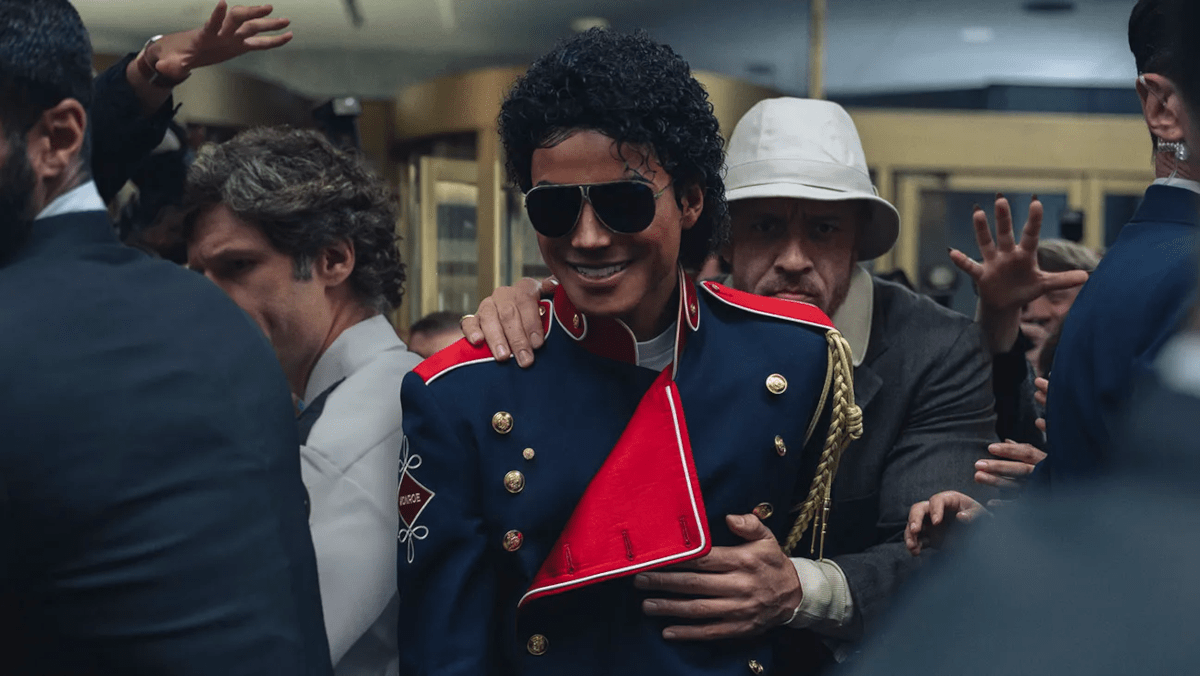
Musical biopics often resemble a legacy band concert. They play the hits and the audience leaves feeling they got their money’s worth. Fortunately for the people behind Michael, the artist in question has plenty of those, and the movie makes ample use of the catalog of the Jackson Five and Michael’s solo material. However, the movie’s retelling of the biographical “hits” of Michael’s personal life is blinkered in the extreme, omitting people and events that one would expect to be acknowledged in a film like this. The results are a film that entertains despite being shockingly one-dimensional.
The timeline for Michael is 1966-1988, and opens with a flash-forward of Michael on the eve of his Bad tour in the UK. It says something about him that only a glimpse of his black shoes and white socks are enough to identify him. The tour and corresponding album represent Michael’s liberation from his family, and the last step in his evolution into a superstar. If only the movie had something interesting to say about the connection of the two besides they were both great.
Back in 1966, Michael (Juliano Krue Valdi) was just a young boy fronting The Jackson Five, the band created and managed by his father Joseph (Colman Domingo). The movie immediately establishes that Joseph was a mean SOB early on and never waivers from its simplistic characterization. Late one night after returning home from a gig, Joseph insists that his sons practice until they get it right. Michael justifiably protests and his father whips him on the spot. Thankfully, the movie only hints at future beatings to get its point across.
When the band starts playing county fairs, they catch the eye of Motown records assistant Suzanne de Passe (Laura Harrier). Like most outsiders who see Michael in action, she acknowledges his brilliance. In short order, Joseph and the band meet Barry Gordy (Larenz Tate), sign with Motown Records and get to number one on the Billboard Hot 100 with “ABC”. Michael, however, provides no insight into Gordy’s own genius other than him explaining the workings of a studio sound board to Michael. If you didn’t know Gordy’s history with acts like The Supremes, Jackie Wilson, Smokey Robinson and the Miracles, you are out of luck.
When the movie ventures into Michael’s personal life, what we see is common knowledge and treated with an armchair psychiatrist’s level of insight. He wore gloves because of his vitiligo. He was skinny because his diet consisted of junk food. His love of animals was a result of having no friends his age. His obsession with Peter Pan and Neverland represented his interest in escaping his oppressive and demanding childhood. All of Michael’s quirks and eccentricities that would come to define him in later the media are breezily rationalized away as unconcerning.
Michael is downright eerie when it explores Michael’s relationships with his family and associates. In this movie, his sisters Rebbie and Janet and brother Marlon don’t exist. La Toya (Jessica Sula) is on hand, but only for Michael to tell her to shut it, which she does for the remainder of the film. The only other woman in Michael’s life is his long suffering mother Katherine (Nia Long). This Michael spends no time with women of the opposite sex, and is presented as an asexual artist exclusively focused on music.
Michael becomes more interesting when he steps out on his own. After meeting with Quincy Jones (Kendrick Sampson), the two put out Michael’s first solo album Off the Wall. Like Gordy, Jones is another surrogate father figure who sees Michael as a genius who helps him on his journey. Why is Jones such a good producer? How did he help Michael achieve his greatest successes? The movie is completely silent.
Freedom arrives in the form of Michael’s new attorney, John Branca (Miles Teller), who fires Joseph as Michael’s manager in the funniest way possible. Like the rest of the people in Michael’s life, Branca does whatever is needed to help him without question. But aside from strong-arming CBS Records president Walter Yetnikoff to strong-arm MTV into playing “Billie Jean”, Branca gets a lot of screen time for doing very little.
The movie’s middle section is almost entirely devoted to the making of Thriller, and it gives us a window into Michael’s creative process. He seemingly pulls the wordless closing refrains of “Wanna Be Startin’ Somethin’” out of the ether, because the movie doesn’t bother to articulate what he was going for, artistically. Michael is more than willing to give us plenty of evidence of Michael’s genius, but with no context or analysis.
When Thriller becomes the biggest album of all time, Michael still can’t pull away from Joseph. Instead, Joseph and boxing producer Don King colluded behind Michael’s back on the Jacksons “Victory” tour. This is the extent of the dramatic tension of Michael: whenever the time is ripe for Michael to put his foot down with his father, he cowers.
Michael’s inability to stand up to his father tragically results in his hair catching on fire while filming a Pepsi commercial, which led to one of the few revelations I didn’t already know. Michael’s injury required skin grafts, he permanently lost nervous sensation in the back of his head and had to wear a toupee for the rest of his life. The movie highlights Michael’s outreach while in the burn ward, emphasizing how much he cared for the children and wanted to make them happy. While all of this is true, it made me queasy knowing the accusations that would be leveled against Michael in later years.
I’m not sure what could constitute spoilers in the well-documented life of Michael, but the end of the “Victory” tour enables him to focus on his next solo album, Bad. The movie doesn’t speak to that album’s success, but it concludes with his performance of the title track to fainting fans during the initial UK date. As we all know, Bad was huge, his last triumph before his life became consumed by controversies. A closing title card that states, “His story continues”, but what story will be told is an open question.
Recommendation
All biopics come with a heavy dose of dramatic irony. As someone who grew up witnessing Michael Jackson’s popular culture dominance in real-time, I’m fully aware of what awaits him after this movie ends in 1988. Which is what ultimately made Michael a disquieting experience for me. On the one hand, I appreciate the movie for reminding me how brilliant Michael was artistically. On the other hand, I couldn’t help recalling all of the negative things that would come to define him five years after the events in this movie until his death in 2009. As such, Michael is a “sunny day” portrait of the artist that never acknowledges the storm clouds looming on the horizon.
Future troubles aside, the Michael Jackson depicted in this movie is accurate, if overwhelmingly positive. Artistically, he’s brilliant, driven and a perfectionist. Personally, he’s childlike, sensitive, soft-spoken, loves animals and is sympathetic towards children. Both align with his public persona from the timeframe in question. He’s a gentle, benevolent genius whose eccentricities are rationalized as side effects of his horrible childhood.
What the movie lacks is any friction outside of Michael’s relationship with his father, Joseph. And even then, the mistreatment Michael suffers never prevents him from achieving anything he sets out to do. Success comes without him circumventing a single blocker, where his rise is the equivalent of a staircase. While this is true to an extent, there’s no sense of the effort of Michael and his artistic collaborators to reach that degree of success.
Where Michael becomes uncanny is in what it omits. Three of his siblings are never seen or mentioned. Collaborators like Paul McCartney and Diana Ross are entirely MIA. Aside from a throwaway line about Prince, there’s no description of the cultural environment Michael exists within or his contemporaries. His life is a bubble consisting of his family, music producers and hired white guys who push Joseph away. The various child stars Michael hung out with and the Hollywood actresses he dated are absent. “We are the World” also doesn’t exist in this timeline, either.
Despite the movie’s many gaps, it is entertaining. The actors who portray Michael are both talented and bring Michael to life. Juliano Krue Valdi is very touching as young Michael. Jaafar Jackson, Michael’s nephew (via Jermaine) does a good job imitating his uncle’s dance moves and speaking voice. I’m not sure how much he actually sings here, because he sounds extraordinarily identical to Michael. Regardless, Jaafar exemplifies Michael as a likeable, charismatic oddball.
Colman Domingo is the only other actor who makes an impression. His Joseph is always menacing, like a horror movie monster. Domingo’s face is so heavily covered by prosthetics that he’s reduced to using his voice to convey his emotions. Aside from being an effective villain, he’s also the only one who offers any insight into Michael, which is strange considering how much the film wants us to hate him.
All of the other characters exist to bear witness to either Michael’s abuse and talent. Of the siblings who do appear, they are basically non-player characters. Nia Long’s Katherine (Michael’s mother) remains tight-lipped until the very end. Miles Teller does little as Michael’s lawyer John Branca besides wearing a wig. As Michael’s bodyguard KeiLyn Durrel Jones, Bill Bray looks upon Michael with moist eyes.
Director Antoine Fuqua (Training Day, The Equalizer) sufficiently energizes the movie’s many musical performances, which comprise at least half of the movie’s run time. The real-life moments are surprisingly stilted. Screenwriter John Logan has written better dialog than this (Gladiator, The Aviator), but I’m sure he was paid well by the Jackson estate for his services.
Michael is a lively, if incredibly constricted look at Michael Jackson’s life. It offers a swiss-cheese rendering of his personal life in between electric reenactments of him recording and performing. Thankfully, the latter makes up for the former, and the movie is entertaining in a “hall of fame highlight reel” way. Mildly recommended.
Analysis
A few “shamones” regarding Michael.
The ideal mentor
Casting Miles Teller in a movie about the relationship between a musical genius and his abusive mentor brings a galaxy-level of irony to Michael. Teller’s best acting performance to date remains Whiplash, where JK Simmons plays his jazz instructor. Aside from the brilliant acting by Teller and Simmons, the movie is a chilling exploration of how tormentors bring out the best of their victims. Whether Teller’s Andrew would have given such an astounding closing performance if it weren’t for the physical and emotional abuse from Simmons’ Terrence is an open question.
Michael focuses the story on the same dynamic, where Michael’s father Joseph routinely treated him horribly to force the greatness out of him. Unfortunately, the movie never bothers to state conclusively whether Michael would have achieved the same heights without Joseph’s mistreatment. We never see Joseph teach them how to play musical instruments, to sing or their dance moves. We can assume this came from Joseph but the movie is coy in this regard.
The movie does present Michael with several gentile mentors in Barry Gordy and Quincy Jones, but never makes a case that they were better at bringing out Michael’s talent than Joseph. All we learn about Gordy is that he knows how to operate a sound board. Jones’ talents as a producer aren’t even recognized. Lyricist Rod Temperton, who wrote three songs on Thriller, is name-dropped once. Eddie Van Halen, who provided the searing guitar solo on “Beat It”, isn’t shown or even mentioned by name, other than someone in the studio saying, “That’s some Van Halen shit!”
The way the movie fails to juxtapose the effect of the negative and positive mentors in Michael’s life results in the false conclusion that he never needed any guidance from anyone. Michael is obviously the product of both kinds of mentorship, and it’s dubious that he would have eventually become a superstar if left to his own devices. Which means that no matter how much the movie depicts Joseph as the villain, he played a role in Michael’s success. The movie leaves us in a gray area, unwilling to take a side because doing so would negate the argument that the movie makes, which is that Michael was a latent superstar who just needed others to get out of his way.
Family matters
I’ve long been a proponent that a biopic’s fidelity to the truth, or lack thereof, shouldn’t be held against it. If the movie gets its point across by taking liberties with the historical record in order to be effective, so be it. For example, writer-director Sean Durkin eliminated one of the wrestling brothers in Iron Claw because he felt that having one more family tragedy would have been too overwhelming for the audience. The film still told an emotionally devastating story despite that omission, which is all that matters.
Although the absence of three of Michael’s siblings from the movie can be excused with similar reasoning, I didn’t buy it. Jermaine is present, then abruptly disappears right when the rest of his siblings sign with Epic records. The explanation we get comes from Joseph, who states dismissively that he opted to stay with Motown. What the movie fails to clarify is that Jermaine married Barry Gordy’s daughter. Did he remain with Motown perhaps in a show of loyalty to his father-in-law? The movie doesn’t bother to set the record straight.
Jermaine was the only brother of Michael who had success outside of The Jackson Five. He had several top thirty hits, one of which “Let Me Tickle Your Fancy”, featured Devo on backing vocals. While a movie named after Michael isn’t obligated to mention the accomplishments of other people, it seems spiteful that Jermaine’s solo success isn’t given its due.
Michael also only features one of his three sisters, La Toya, who ironically has the least musical talent. (Her life story would make for an engrossing biopic.) His sister Rebbie had a top forty hit with “Centipede”, which Michael wrote, arranged and produced. The most shocking thing about the movie is that it contains no mention of Michael’s sister Janet, who’s album Control came out in between Thriller and Bad and was an enormous success, with five singles charting in the top five.
From what I’ve read, Michael’s siblings aren’t in the film because they declined to participate. With that in mind, I fail to understand why the filmmakers went ahead with a twenty-year retrospective approach. Because even someone like me, who was never one of Michael’s biggest fans, immediately notices who’s missing from the Jackson family narrative.
A musical bubble
Michael gives us almost no context of the musical world Michael existed in. When we hear that Thriller has become the biggest selling album of all time, the movie doesn’t bother to tell us what it eclipsed. Would it interest you to know that before Thriller, the Saturday Night Fever soundtrack, Fleetwood Mac’s Rumours and The Eagles’ Their Greatest Hits (1971–1975) previously held the crown? The movie is oblivious to the fact that a Black man was responsible for the biggest selling album of all time.
In the scene where Teller’s Branca calls in a favor from CBS Records president Walter Yetnikoff, much is made that MTv isn’t playing “Billie Jean” in heavy rotation despite the record selling like gangbusters. Why not include a montage of what MTv was playing at the time, which was everything and anything to do with the British New Wave (Duran Duran, The Human League, Billy Idol, Culture Club, A Flock of Seagulls, etc.) It also was playing songs from soft rock bands like Survivor and Toto. The movie had an opportunity for an easy lay-up and passes.
If you were listening to popular music on the radio (!) when Thriller came out, you were aware that Michael and Prince were often viewed as rivals. Incredibly, Prince’s 1999 came out one month before Thriller. Prince then had his biggest success with Purple Rain in 1984. One of the funniest lines in Michael is when he tells his brothers he must listen to the Lord at all times, so that He doesn’t give His best ideas to Prince. But the movie doesn’t mention how big Prince is, nor does it mention that Prince had one accomplishment that eluded Michael, which is starring in a successful film. The Wiz was a flop and the last time he acted in a theatrically released film outside of a cameo in Men in Black 2.
Even more incredible is that Prince released three albums in the time between Thriller and Bad: Around the World in a Day, Parade and Sign ‘o the Times. By the time Bad came out, people had written Michael off as passe. In about four years, Prince had become the new darling of MTv, but you would never know that based on this film. You never would understand how much pressure there was on Michael to take back his crown. Instead, the movie insists that all we need to know about his motivation is how badly Michael needed to break away from his father.
Michael the virgin
In Michael, there isn’t even a hint that Michael had sex as an adult or is interested in girls. However, if you know Michael’s history, you would know that he had many high-profile relationships with women. He proposed to Diana Ross, was rumored to have a shrine at his Neverland Ranch dedicated to Elizabeth Taylor, attended the 35th Annual Grammy Awards with Brooke Shields, referred to the then twelve year-old Tatum O’Neil as his first girlfriend, attended the Oscars with Madonna in 1991, was married twice and so on.
For whatever reason, Michael insists that Michael was an asexual being, an artist focused on his music and performing to the exclusion of everything else. If Michael was produced as a rebuttal of the Leaving Neverland documentary, I fail to understand why it doesn’t even try to show Michael as having some interest in the opposite sex.
Joseph the soothsayer
In their last scene together, Joseph tells Michael that once he leaves the family, he’ll be surrounded by people who will never tell him “no”. On the surface, the scene provides insight into Michael’s psyche. And like most biopics, it covertly alludes to the subject’s future, a cinematic “wink” to the audience who knows what will happen. Compared to the rest of the movie, however, the scene stands out for its unexpected complexity.
It is the only attempt in Michael to examine him from a different perspective. After celebrating his musical, artistic and performative genius for over two hours, the movie belatedly acknowledges that Michael was a deeply troubled person. He may have been great, but there was a dark side lurking underneath that had yet to emerge.
Having Joseph offer up this modicum of truth about Michael is a very strange choice. The movie has spent almost all of its run time depicting Joseph as a horrible father to Michael, and we despise him by the time he takes his parting shot. For a movie that has played fast-and-loose with the makeup of Michael’s family, this dialog could have been spoken by any of Michael’s siblings, his mother or even Branca. After everything we’ve seen up to this point, it’s fair to ask why the movie gives this moment to Joseph.
It makes sense that the man who had tortured Michael for decades would know how Michael would react to being alone. It’s unfortunate that the movie didn’t bother to make Joseph a complex person instead of a monster. If it had, Joseph’s words would have been much more resonant than they are. Instead, they represent one last cutting remark from a man who will no longer be a factor in Michael’s life.


One thought on “Michael (2026)”