
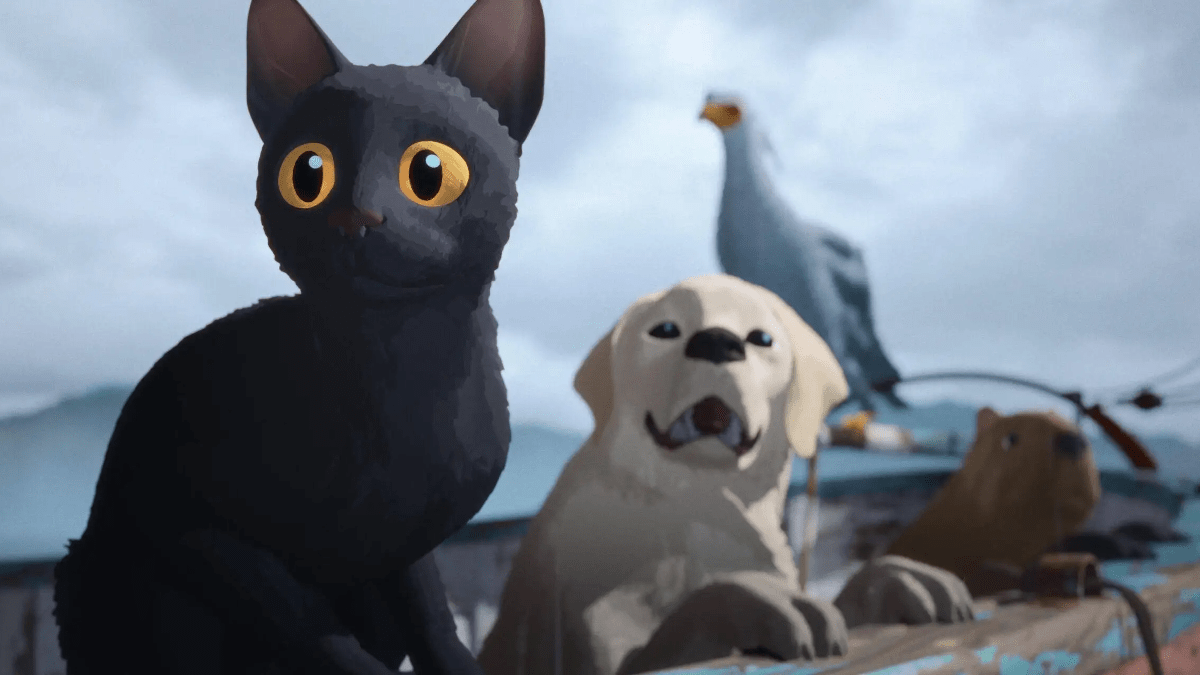
Although never explicitly stated, Flow is about climate change. Even if you don’t believe in it, I think you can still enjoy the movie, but its underlying message will elude you. There is a reason why an unassuming grey cat is forced to deal with a sudden environmental catastrophe, and it’s not so that we can see how well it can steer a boat. (It steers surprisingly well, by the way.)
Before the catastrophic event happens, the cat wanders around what looks like a forest in South America but could elsewhere. (Some ruins have ancient markings. A submerged city encountered later could be in Italy.) Like all cats, this one loves to explore and disregards the danger that comes with it. Accordingly, it encounters a pack of dogs who are looking for something to chase and probably eat. They happen upon a stream and one of them catches a fish. Since all of the dogs are hungry, they all feel that they are entitled to the fish. When the dogs start quarrelling, the cat snatches the fish and sneaks off. The dogs notice the cat’s thievery and give chase. The cat gives up the fish but the dogs continue their pursuit until they spot a rabbit. (I almost could hear the rabbit saying, “Oh, crap!”) Fortunately for the cat, the dogs are now distracted by the rabbit, so they leave the cat and redirect their energies towards their new target.
Free of harm, the cat heads back home. One of the dogs, a golden retriever, follows him. The dog just wants to be friends, but the cat wants nothing to do with it. The cat evades the dog by jumping to its favorite resting place in his owner’s house, leaving the dog to wander around outside the home. The place the cat calls home is surrounded by cat sculptures of various sizes. Considering how many sculptures there are, the cat’s owner must love it very much. (The dog is unimpressed and pees on one.) The cat’s owner is nowhere to be found, however. We see an unfinished drawing of a new sculpture, and a work in progress surrounded by wood chips. The artist appears to have left suddenly, and in our minds we wonder what could have caused them to leave their beloved pet behind.
The answer is a tsunami, which rapidly covers everything with water. The cat escapes the tide by scampering up the tallest cat statue, but that becomes engulfed by water. Fortunately, a boat with a capybara on board happens along and the cat climbs aboard. The two are an odd couple, with the cat constantly nervous of the water while the capybara sleeps the day away. When they encounter a white secretary bird, the cat falls overboard and is miraculously saved by a whale. (The whale plays an outsized role in this story.) The secretary bird rescues the cat, but the cat’s fear of heights forces the bird to drop the cat into the boat. Later, the capybara convinces a lemur to come aboard. When the boat reaches dry land, they are joined by the golden retriever we met earlier, who is very happy to be reunited with his good friend the cat.
When the cat intrudes upon a flock of secretary birds, the leader angrily drives the cat towards the water. This is secretary bird territory and cats are not welcome. When the secretary bird that previously rescued the cat protects it at great cost, it’s clear that Flow is about more than cute animals floating along in a boat. Over time, these animals learn to tolerate each other, work together and–in the case of the cat–evolve. Among the many pointed messages weaved throughout the story is how much we can learn from each other when we stop fearing “the other”.
Soon there is a rescue operation, which strains the delicate group dynamics of the boat. The animals are then separated by a fierce storm, followed by a moment of pure transcendence when time seems to stop. Then, as quickly as the waters came, they recede, revealing another crisis that must be dealt with. Will these newfound friends still come together one more time, or will their ingrained behaviors reassert themselves at the worst possible moment?
Recommendation
Given that Flow is about a ragtag group of animals trying to survive an environmental disaster, one would expect it to be a sad and fraught experience. It is, because there are few moments when the cat, the dog, the lemur, the capybara or the secretary bird, either individually or collectively, weren’t in mortal danger. You know how cats are said to have nine lives? The wide-eyed black one at the center of this story goes through three of them at least. What surprised me was how funny Flow often is. Like any movie that puts animals front-and-center, it’s filled with jokes derived from their well-known tendencies. Cats are compelled to chase flashes of light. Dogs piddle on everything and want to play fetch anytime, anywhere. In the highest praise I can think of, the movie is Bambi with a modern touch, where its humorous moments help to ease the inescapable sense of tragedy lurking just beyond the frame.
Flow is also deeply philosophical. As the animals become increasingly courageous and resourceful with each life-or-death situation they face, I realized how each of them represented a different aspect of our (humanity’s) collective reactions towards climate change. The cat is constantly terrified about the existential threat. The capybara, on the other side of the spectrum, shrugs it off. The secretary bird wants to be in charge and moodily sits on the sidelines when it’s overruled. Flow is a nuanced study of group dynamics, in how difficult it is for those with different backgrounds to agree on the best course of action. Fortunately, the animals are able to override their ingrained natures and traditional animosities when the situation requires it, even if only temporarily.
Gints Zilbalodis, who produced, wrote, directed, animated and scored Flow, should be commended for his remarkable achievement. With a budget equivalent to three minutes of Inside Out 2, Zilbalodis crafts a film that is beautiful and evocative. Although the limitations of his medium are apparent, Zilbalodis overcomes them with a visual style inspired by impressionist paintings. The natural environment, consisting of churning waters broken up by natural and man-made structures, is sublime, while its characters are fully emotive and engaging. The combination produces the eerie sensation that we’re witnessing the end times we’ve only considered in our nightmares. With this film, Zilbalodis has established himself as a gifted storyteller whose artistry and ingenuity deserves our attention.
The main question Flow asks is if we can get over our tribalism, self-absorption, materialism, laziness, etc. to confront an existential threat? The movie cautiously says “yes”, that if it is possible for these animals to get along, we too should be able to work together to survive. Honestly, I’m pessimistic about the odds of that happening before it’s too late. I admire the optimism that permeates Flow, which shows how even long-standing enemies can put aside their differences and become friends when their mutual survival depends upon it. I hope that this will be the case for us, because as the movie shows, it’ll be too late when everything is underwater. Beautiful, haunting and thoroughly captivating, Flow is one of the best movies of the year. Highly recommended.
Analysis
Animals in distress
Last year, I wrote about EO, a movie about a circus donkey who is liberated by politicians and activists from what they perceive is a life of indentured servitude. Unfortunately, EO’s new life grows increasingly perilous, primarily because EO has learned to implicitly trust humans and assumes that their intentions are good. Some treat EO with kindness, while others consider it to be their property and disposed of as they see fit.
Flow expands upon this premise by telling a story where people have completely abdicated their responsibility towards animals, leaving them defenseless in the path of danger. The reason for this is an impending environmental catastrophe, a fact that makes the decision understandable but morally unjustifiable (to me, at least).
Since I have pets and generally love animals, watching Flow was a distressing experience. All of the animals in the movie are faced with mortal danger at least once. The cat, who is the protagonist of the story, almost drowns several times. Early on, maybe fifteen minutes into the movie, I watched helplessly as he sank below the water and his eyes grew dark. Fortunately, he’s saved by a whale–a deus ex machina if there ever was one– which allowed me to breathe a momentary sigh of relief. Before that happened, I wondered if the movie was actually going to have me watch an animal die.
All of the other animals in the movie face life-or-death situations as well. The secretary bird has a violent encounter with a member of his flock. The capybara finds itself trapped in a boat and nearly falls to his death. There were times when I wondered if the golden retriever’s buddies would attack and/or eat one of the other animals. The whale, who came to the cat’s rescue several times, finds itself land-locked at the end of the movie when the waters recede. Thankfully, fortune favors this group of animal friends, and they make their own luck by sticking together. That said, Flow is easily the most distressing movie I’ve seen since EO.
Animated thoughts
I know I’ve been spoiled by how proficient animation studios have become with computer animation. Unlike the days of hand-drawn animation, both the characters and their environments look so incredibly lifelike. For example, I remember hearing about how Pixar spent a lot of energy perfecting how light appears underwater for Finding Nemo. Then they spent an inordinate amount of time perfecting human hair for The Incredibles.
Pixar’s Toy Story was the first release by the studio not because it was the only story envisioned, but because rendering toys was much simpler than dealing with people or animals. Looking at Toy Story today, the way Andy, his mother and sister are depicted is nowhere as impressive as in Inside Out 2. Buster, the family dog in Toy Story 2, doesn’t look as good as the dogs in Up. Obviously, one film is not better than another because of how far the animation techniques have advanced. I still enjoy Pixar’s early films despite their obvious limitations.
I bring this up because some will criticize Flow for its rudimentary qualities. Even though the ducks in Migration look much better than the secretary birds in Flow, I would rather watch Flow another hundred times than watch Migration ever again. It doesn’t matter to me how perfect (or not) computer animation is, because without a compelling story or characters, pretty images are empty and meaningless.
I’m guessing that director and animator Gints Zilbalodis would have loved to have a $200m budget (like the average Pixar film) to make Flow. He could have given us a cat that looked much more realistic, and perfected the other animals as well. However, I doubt the additional money would have resulted in a film that was more emotionally rich as the one that Zilbalodis made.
Judging an animated movie solely based on how beautiful and pretty it looks is a very limited way of experiencing the art form. Low-budget animated films can be just as captivating as those costing hundreds of millions of dollars, provided their stories draw you in. I hope that prospective animated filmmakers who see Flow are inspired to make something with a small budget. While having money certainly helps, there’s no guarantee that a well-funded film will move an audience.
If you’re interested in how Zilbalodis made Flow, please see this article.
Animals are people too
Initially, I thought that Flow would do the expected thing and define the animals by their well-known traits. The cat is either a scaredy-cat or recklessly curious. The capybara is lazy and only wants to sleep and eat. The golden retriever wants to be everyone’s friend. The lemur collects shiny objects. The secretary bird is territorial and aggressive.
Flow does play upon our familiarity with animal behavior to introduce some well-needed humor into the story. The sight of a cat spontaneously coughing up a hairball is reliably funny, just like when it becomes wide-eyed after spotting a reflection of light. The dog wants to play fetch with whatever ball that’s around. The lemur is vain and enamored with its own reflection. The capybara stinks and the other animals avoid him. The secretary bird is stiff and formal, like a brigadier general.
Where Flow caught me off-guard was how nuanced it actually is. Besides the jokes based on observational animal behavior, it uses this collection of animals to represent different kinds of people. The movie subtly wants us to see ourselves in them, insofar as how their actions would be the same as people thrown together during a crisis. The cat is scared of everything, even when being rescued. The capybara is totally nonplussed about everything. The lemur is so materialistic that it almost dies safeguarding its prized possessions. The dog is loyal to a fault. The secretary bird insists on being in command.
Flow then shows how these diverse animals experience friction just like people from different backgrounds. Each animal is very distinct from the others, and they initially don’t get along. Their situation reminded me of people trapped on a life raft after their boat sank, with each of them coming from a different walk of life.
Then, as the journey continues, Flow shows how the animals grow when they look beyond their simple prejudices. They learn to get along and each of them helps to steer the boat. Since the story is told from the perspective of the cat, he experiences the biggest evolution of the group. The cat observes the capybara and learns how to swim, finally overcoming his fear of the water. Even better, he learns how to fish and helps feed the others. His newfound skill also brings him a moment of transcendence, when he becomes spellbound observing the tropical fish swimming in the crystalline water. (He’s so taken with the sight he has to force himself to return to the surface for air.)
But just as it would with people, discord reemerges with the animals. When dry land appears, several of them return to their familiar behavior patterns. The lemur was so happy to be reunited with his own kind and only remembers his friends trapped in the boat when he sees the cat. The cat, who has had the most personal growth on the journey, immediately jumps into action. The pack of dogs initially help after they are rescued, but leave when they spot a rabbit. (Old habits die hard.) Fortunately, the golden retriever remains loyal to his new friends and helps the capybara escape.
It is with the taut rescue scene that Flow makes its most profound argument. Like the pack of dogs and the lemur, it’s easy to revert back to tribalism when things return to normal. Maintaining the bonds established through facing danger together is difficult. However, the movie shows that groundwork laid by our actions will pay dividends down the road.
With that in mind, the climactic shot of the movie is one of cautious optimism. As the cat, the dog, the lemur and the capybara study their reflection in the water, it’s wonderful that they’re still friends and came to each other’s aid in a time of need. While it seems like an obvious choice to make, the movie subtly asks us to think about the state of the world today and wonder why humanity rarely, if ever, does the same.
How does a secretary bird pilot a boat?
With a steady hand.
At first, I found it odd that these animals would know how to steer a boat. But I’ve seen countless videos of animals doing amazing things, like a raven playing tic-tac-toe, so it’s not that far-fetched that any of them could figure out how to use a rudder. Although the movie steadfastly avoids anthropomorphizing the animals (as in Zootopia), it isn’t intended to be taken as a realistic vision of the natural world, either. It’s a parable about how friendship and trust lead to personal growth. In that sense, I thought it was fine that the animals are sea-worthy. Besides, if they weren’t, it would have been a very short movie.
Friendship is all that matters
While watching Flow, the word that kept entering my thoughts over and over again was friendship. In a crisis like the one the animals face in the movie, the only way they can survive is by becoming friends. Without friendship, it’s unlikely any of them would have survived. Given that the movie that overtly refers to climate change, its message of friendship couldn’t be more resonant. Like these animals, can we find a way to get along and help each other survive what’s coming? I hope so, because if not we’ll all be looking for something to grab ahold of as our feet get wet.
What happened to the secretary bird?
In the movie’s most indelible scene, the secretary bird and the cat are lifted into the air and float towards a swirling light in the nighttime sky. While the bird keeps rising and eventually disappears, the cat slowly drops back to the surface of an ancient structure. The movie is vague as to what happened. Was the bird raised up into Heaven, or saved by an alien race? And why was the cat left behind? I have no firm answers to those questions, but the underlying spirituality of the scene leads me to believe that the secretary bird was rewarded for rescuing the cat and protecting it from harm. Friendship is about being there when times are difficult, even when it may put your own life at stake.
As for why the cat was left behind, it was because its job on Earth wasn’t finished.
 Detroit Cineaste
I was wondering too what happened to the secretary bird & I agree with you, thank you for your analysis of the movie
LikeLike