
Compared to Dune, which spent the entirety of its time on table-setting, Dune: Part Two is a decidedly energetic experience. Now that all of the table-setting has been thoroughly dealt with, the sequel is free to explore the central themes of the story: oppression and destiny. On the one hand, there’s the ongoing battle between the Fremen and the undeniably evil (and white) colonizers of their planet, led by the Baron Harkonnen (a very larval Stellan Skarsgård). That conflict envelops the story’s protagonist and reluctant hero, Paul Atreidis (Timothy Chalamet), who has aligned himself with the Fremen. When he’s not helping them with their acts of rebellion, he grapples with becoming the Fremen’s Lisan al Gaib, the prophesied off-worlder who will bring forth a green paradise on Arrakis. To his credit, Paul really doesn’t want to lead the Fremen. Although the movie never has him state as such, he’s probably a bit uncomfortable with being a white leader of a vast army composed of People of Color. Chani (Zendaya), his native girlfriend, encourages him to avoid taking that path, but she’s no match for the adults he looks up to. The combined influence of Lady Jessica (Rebecca Ferguson), Gurney Halleck (Josh Brolin) and Stilgar (Javier Bardem) steadily guide him towards accepting his role as the Chosen One, regardless of the toll it will have on Paul, the Fremen and the galaxy.
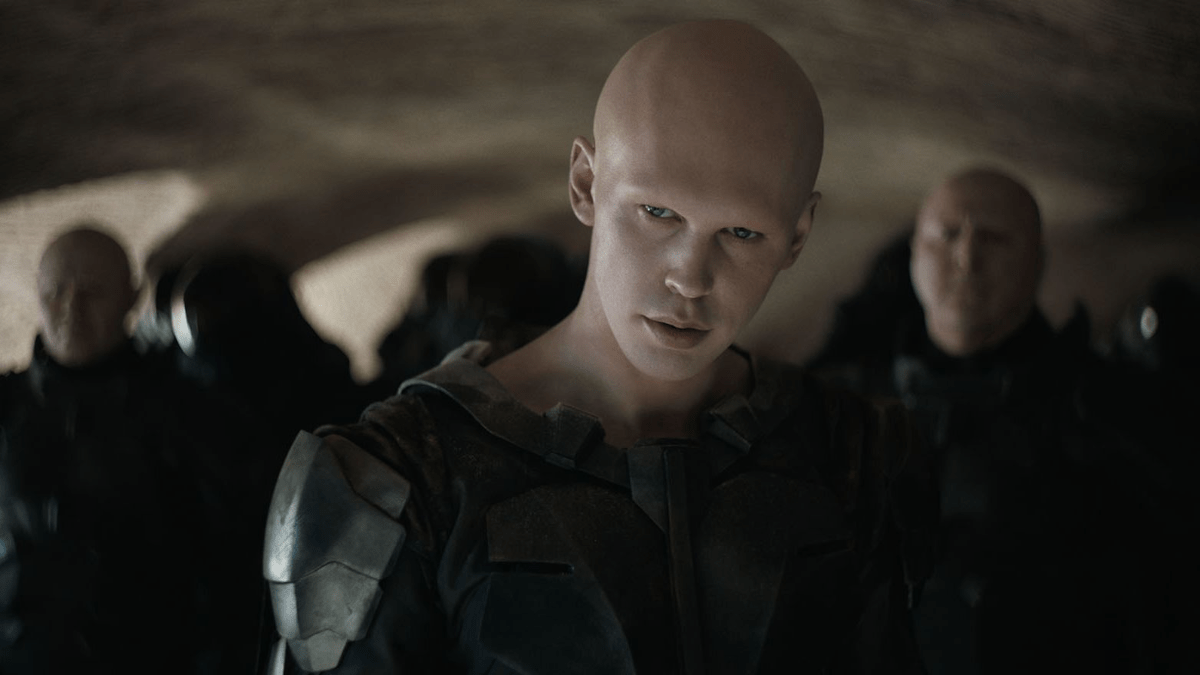
As with the first movie, Dune: Part Two features an exceptional cast in major and minor roles. Timothy Chalamet fares better here because he becomes a man of action and conviction. Zendaya is moving as the conscience of the story, the sole character who views her boyfriend’s predestination as problematic for her people. Aside from those two, the rest of the cast are mostly one-dimensional players, pieces on Denis Villeneuve’s chess set whose purpose is to advance the plot to its logical conclusion. The new characters introduced in this movie are played by noteworthy actors but for the most part do little besides wearing interesting costumes. Christopher Walken glares as the Emperor, Florence Pugh wears outfits inspired by Medieval knights and Léa Seydou appears briefly as a Bene Gesserit assigned to collect a genetic sample. (Having the gorgeous Seydou play a seductress while hidden in a black habit is as comical as it is ridiculous.) Only Austin Butler’s Feyd-Rautha is given the space to fully inhibit his character’s giddy viciousness with the appropriate verve. Butler seizes the role by the throat and plays it to the hilt, which should be the assignment for all actors in a space opera such as this one.
As for the returning cast, Skarsgård easily dominates every scene he’s in. He plays the Baron for the disgusting villain that he is, cooling off in pools of oil when he’s not grunting out orders or killing his staff. (Note to self: do not go to the Harkonnen job fair.) Ferguson, Brolin and Bardem are all fine, but really exist only as cogs in the immense Dune machine. They represent the different elements of the equation that will result in Paul’s transition into a god, and do what they can with characters that have no nuance or subtlety. As before, Bardem has fun playing up the fundamental silliness of fundamentalism. (There’s a scene in the movie that directly quotes from Monty Python’s Life of Brian.) Less fun but more intense are Ferguson going full Machivellian and Brolin as the hammer of justice. I honestly missed Oscar Isaac’s impertinence and Jason Mamoa’s joie de vivre to offset the seriousness of things every once in a while.
From 2016’s Arrival onward, Villeneuve has increased the canvas of his movies substantially. In the first movie and now this one, he loves conveying the bigness of things. The overwhelming sense of spectacle is where Part Two shines. The spaceships, the spice harvesters, the Harkonnen homeworld of Gedi Prime all look incredible. (The outdoor scenes set on that planet, filmed in striking black and white, are the most striking in the movie by far.) It goes without saying that there are numerous shots of the beautiful desert sands of Arrakis. The visual effects, remarkable for their underlying tangible quality, reminded me of the last Star Wars trilogy. Given that movies are primarily a visual medium, I don’t want to begrudge Villeneuve for gazing intently at the sights his staff was able to conjure up through CGI. However, he has a tendency to linger that gives the proceedings a ponderous atmosphere. I also grew tired of the frequent Middle-eastern wailing women on the soundtrack. I chuckled at Villeneuve’s visualization of “riding the worm” as the dustiest chariot ride ever. Overall, I enjoyed the movie for its outsized vision, its eclectic performances and staying true to the source novel’s warning about conjuring a God to do your bidding. Be careful what you’ve prophesied, because you just might get it. Recommended.
Analysis
In order to get to how I felt about Dune: Part 2, I need to start at the end. This may seem counterintuitive, but everything has been building to the moment when Paul tells Stilgar, “Take them to paradise.” Before that moment, Paul had gotten the emperor to kiss his ring, effectively ceding control of the universe to the young man who had successfully led an uprising against his ruthless allies, House Harkonnen. After that kowtow, Paul has Gurney send a message to the other houses with his evidence of the emperor’s machinations, to which the other houses respond by collectively shrugging and refuse to accept him as their leader. At that moment, Paul could have decided not to send the Fremen off to conquer the other houses, but he sends Gurney, Stilgar and the Fremen off to defeat them. This moment, foretold by the prophecy, should be one that cements Paul as a hero, savior, or both. The Fremen finally have the agency to do what they’ve always wanted: defeat their oppressors and seize control over their own destiny. However, Paul doesn’t see this moment as a heroic one. Instead he seems resigned to it. The reason for Paul’s reaction is rooted in how director Villeneuve has framed Paul’s journey towards becoming the Chosen One, and what the culmination of that journey means for both Paul and the Fremen.
In the first Dune, Chalamet portrayed Paul as a moody, reluctant heir to the throne. When he tells his father, Duke Leto, that he isn’t sure he wants to lead House Atreides, his father tells him that he felt the same way when his father died. Leto assures his son that he’ll “find his own path” when the time comes. Unfortunately, that time becomes the present after the Harkonnens, with an assist from the Emperor’s Sadukar army, sacks House Atreides. Suddenly, Paul becomes the leader of his house and must do something, but he’s not sure what.
For direction, Paul looks to his surviving parent, Lady Jessica. Her primary concern is for their survival. She has them set out to find the Fremen and hope that they will provide them with sanctuary. Unfortunately, the Fremen don’t feel obligated to House Atreides and consider letting them die in the desert or killing them for the water in their bodies. Lady Jessica sizes up the situation and understands that in order for the two of them to survive, they need to adapt. They must convince the Fremen that they are allies and will prove their loyalty by learning their ways. Lady Jessica shows Paul the path by agreeing to become the Fremen’s new Reverend Mother. This is not a simple task, because it will require her to transmute the poisonous Water of Life. However, being that Jessica is an advanced Bene Gesserit, she and her unborn child survive.
Paul follows his mother’s lead by learning the Fremen ways, riding a sandworm and fighting alongside the Fremen against the Harkonnen. These steps help to endear Paul to the Fremen. So long as he puts his life on the line for their cause, they will let him live among them. For Paul, his new role gives him a newfound sense of purpose. His house may be no more, but he can be useful by helping the Fremen fight their mutual enemy. The enemy of my enemy is my friend, after all. However, Paul’s new path puts him on a collision course with two prophecies that speak to a Chosen One. The first is the Kwisatz Haderach, the Bene Gesserit name for the man who will become the most powerful of their order. The second, the Lisan al Gaib, originates from the prophecies the Bene Gesserit have instilled in the Fremen.
Most of Part Two concerns Paul’s association with the latter, an off-worlder who, as the Fremen messiah, will make their dream of a green paradise on Arrakis become reality. Paul isn’t comfortable with being regarded in that way and insists that he only wants to help the Fremen. He views Stilgar as the rightful leader of the Fremen and doesn’t want to insert himself into that position just because he seems to fit the prophecy. It’s also possible that he, being a white man, doesn’t feel comfortable with leading a vast army composed exclusively of People of Color. The movie, however, implies this point every time it contrasts his white complexion with those of the Fremen. Paul stands out like a sore thumb, no matter how well he wears his Stillsuit and walk-dances across the sand. Unfortunately for Paul, fate has other plans for him.
Paul has resisted Stilgar’s characterization of him as the Lisan al Gaib until two events change his perspective. First is the return of Gurney Halleck, who reminds him of his father’s death and the destruction of his house at the hands of the Harkonnens. The second is Feyd’s attack on Sietch Tabr, which I’ll get to shortly. While Paul has looked upon Stilgar as a father-figure, his bonds with Gurney are much stronger. Whenever they speak, Gurney drives home his desire for revenge, something that Paul has buried since he and his mother joined the Fremen. Gurney doesn’t want to just disrupt spice harvesting, as Paul has done vis-a-vis his assistance to the Fremen. Instead, Gurney wants to obliterate the Harkonnens, a desire he communicates to Paul when he reveals the Atreidis’ hidden cache of atomics on Arrakis. Through wielding them, Paul could both exact revenge for his house and usurp the Emperor as leader of the galaxy in one fell swoop. Again, the movie infers that Paul isn’t comfortable with Gurney’s recommendation, but Feyd’s arrival on Arrakis forces his hand.
Paul’s sudden change of heart is a bit surprising. We never saw him reveal his emotions over the death of his father and everyone in House Atreides. Perhaps he had been suffering from PTSD since that traumatic day. Regardless of the reason, Paul’s rage doesn’t surface until his new friends are viciously attacked. As a result of the carnage, Paul travels to the south and declares himself as the Lisan al Gaib before the tribal leaders. He states he will help him fulfill the prophecy if they agree to follow him. Any qualms Paul had with being the off-world leader of the indigenous Fremon have been put aside. Like Gurney, he wants revenge against the Harkonnens and the Emperor. But agreeing to be the Chosen One comes at a huge cost, both for him personally as well as the galaxy.
As the Chosen One, Paul will be directly responsible for the death of billions throughout the galaxy. This is something that he has foreseen and will be unable to prevent as the Lisan al Gaib. (Paul can’t pick and choose which parts of the prophecy he will adhere to.) As the messiah, Paul becomes the de facto leader of the Fremen and the one who will bring about the outcome described by the prophecy, and he expresses this realization at the end of Part Two. In short, he became what he never wanted to be and caused what he didn’t want to happen to happen. The question then becomes whether he understands how he wound up in this position.
In becoming the Lisan al Gaib (or Chosen One), Paul finally understands the role he will play in the prophecy. No longer able to change things, he must watch them play out exactly as he had seen in his visions. This is why he is so dispirited when he issues that fateful command to Stilgar. He realizes that his existence will no longer have any agency. Whereas before he had made a choice to help the Fremen fight the Harkonnen, everything from here on out will be carried out in his name. Paul has become a Christ figure, a person who exists only to fulfill a destiny that has been conceived by others. He’s not unlike Neo in The Matrix: Reloaded, who learns at the end of that movie that as the Chosen One, he’s expected to play the same role as he had countless times before. However, unlike Neo, Paul can’t chart a new path for Zion and the Matrix. Once the fuse has been lit, Paul can only stand by and wait for the explosion.
As for why Paul wound up an agentless Chosen One, Part Two shows that this is due to Paul’s lack of identity and susceptibility to influence. Before coming to Arrakis, Paul had no sense of himself. His identity consisted of knowing that he was the heir to House Atreides. When his father and his house were destroyed, he was left with nothing to anchor his belief system. His decision to become a Fremen and learn their ways helped him to define who he is and what he stands for. Through them, Paul’s life gained meaning and purpose. Unfortunately, Paul’s lack of identity also leaves him exposed to the influence of others.
Throughout the movie, Paul looks to the adult figures in his life for direction. Jessica instructs him to adapt and survive. Stilgar instills the values of fraternity and acting within a religious belief system. Gurney stokes his anger and desire for revenge. Together, they project onto Paul their desire for revenge, power and control that, when combined with Paul’s malleability, moves him in the direction they want him to go. In the end, Jessica is not only safe but wields incredible influence over her son and the Fremen. Stilgar gets to lead his people to the promised land. Gurney sees the Harkonnen defeated and House Atreides placed at the top of the galactic power structure. While Paul’s three parental figures reap the rewards for pushing him into the role of the Chosen One, their achievement does not produce clear-cut victories. In fact, there are shifts in power that they don’t fully appreciate at the moment.
Most concerning is how Stilgar and the Fremen people have relinquished their right to self-determination. Throughout Part Two, Chani had been trying to convince Stilgar to not let his fundamentalism cloud his judgment. Unfortunately, when Paul declares himself to be the Lisan al Gaib, Stilgar’s religious fanaticism goes into overdrive and he follows Paul like a god. This produces the outcome that Chani had been critical of all along, that of an off-worlder becoming the leader of her people. Stilgar’s belief system resulted in her people forever being part of House Atreides. Once the Fremen leadership accepted Paul as their leader, they tacitly consented to be ruled by outsiders in perpetuity.
Through his exclusive use of PoC actors in the roles of the Fremen, Villeneuve has been making a direct allusion to colonialism. The (very) white Paul has become the undisputed ruler of a non-white race. In linking colonialism with the fate of the Fremen, I suspect that Villeneuve wants the movie to serve as a cautionary tale against fundamentalism. In very simplistic terms, he could be saying that fundamentalism will cause you to do things that you think are righteous, but are really not in your best interest. Stilgar may be happy at the prospects of getting revenge on those who oppressed his people, but his people will never have a true Fremen as a leader.
The other concern deals with the other Chosen One prophecy, that of the Kwisatz Haderach. For centuries the Bene Gesserit had been manipulating bloodlines in the hope of one day producing a man who would be the most powerful of them all. In their arrogance, they thought they would be able to control him. However, as the end of the movie shows when Paul silences Gaius Helen Mohiam, all they did was create someone who is not only uncontrollable, but who will make things much worse for the galaxy. This is a very damning outcome for them, considering that the outgoing emperor was basically a Machivellian ruler who cared about consolidating his power. In his place, Paul has initiated a galactic genocide. To paraphrase Pete Townsend, “Meet the new boss. Worse than the old boss.”
I give Villeneuve credit for being true to the book and concluding Part Two on the same sour note. Villeneuve wants us to feel terrible for having a rooting interest in a conflict where the presumed heroes are driven by revenge and religious dogma. Not many big budget movies would get made with an ending that declares in no uncertain terms that the heroes are actually villains in disguise, and that the only difference between the two sides is how they justify their atrocities. Like the book, Villeneuve’s movies shine a harsh light on how war, conquest and religion bring out the worst of human behavior. There are no heroes in the end, only those who get to write history so that it presents them in a favorable light.
Sand Traps
The movie opens with an electronic voice intoning “Power over spice is power over all.” Was that the Sadukar High Priest, or is the Kraftwerk tribute band still on tour in the year 10191?
Charlotte Rampling is simply incredible as Gaius Helen Mohiam. As with the first movie, she commands the few scenes she’s in with such authority. For a movie filled with lasers and hand-to-hand combat, neither of those compared to how she snaps off every word with such menace. Her acting in both movies is a master class in how to be memorable in a cameo.
For a movie that features Zendaya, Florence Pugh and Seydou, it’s very chaste. There was one kiss by my count. Pugh somehow manages to simmer through the funky armor and chain mail she’s required to wear.
After having two Mentats in the first movie, this one has none. I heard that Villeneuve had to make cuts to get the movie down to a reasonable runtime, but I would rather have given Thufir some screen time over having Feyd dispatch Dr. Yueh. The notion of a human computer was one of the coolest things about the Dune mythology and I’m disappointed that this idea was given a short shrift.
You would think that anyone who works for Beast Rabban would know that it’s best not to ask questions or recommend he “get some rest”.
I really wanted Walken to Walken-ize his dialog. His performance was remarkably restrained for him. I think the idea was to have him exert as little energy as possible. He’s the Emperor, after all. But, when you have Walken on the set, an actor famous for being an emotional livewire, I feel that the direction he was given on his character was a mistake.
The best visualization of spaceships in both movies remains the Ornithopters and the harvesters. I’m glad Villeneuve used bugs as his inspiration for the style of both. I wished he had taken Lynch’s approach and given the story even more visual flights of fancy than he did, though.
Speaking of Lynch’s Dune, the way it depicted the Fremen riding sandworms was widely mocked. Lo and behold, Villeneuve’s movie does the exact same thing. The scene in Part Two of Paul taking his crew to the south via Worm Line 1 was unconvincing to me, looking like the dustiest chariot ride ever. After both Lynch and Villeneuve gave it their best, perhaps showing people riding huge worms was just never going to look right. (Villeneuve wisely doesn’t show much of it at all.) Neil deGrasse Tyson complained about how the worms in Part Two don’t behave like actual worms, a sentiment echoed by cartoonist Gahan Wilson in his review of Lynch’s Dune from way back in 1985:
Now if you take a worm, an actual worm, and hold it in the palm of your hand (or, if you are squeamish, examine it more sanitarily), the most visible and inescapable thing about its motion–the thing that makes it distinct from snakes or eels or anything else along those lines–is that it moves by expanding and contracting, something like bowels. (Worms really are bowels, more or less, when you get right down to it.) Their many segments constantly squeeze and swell like sections of an accordion.
This is an unavoidable downhome truth which any barefoot boy with cheek of tan could tell you. Which makes it stupid past belief that Dino De Laurentis spent in excess of forty-five million bucks on an epic about mammoth worms which move so badly they look like giant salamis being pushed through the sand. Even more annoying, this bowellike puffing and shrinking of the flesh is exactly the kind of gorpy effect that David Lynch is particularly renowned for; it’s precisely the sort of thing he may have been hired for.
Gahan Wilson, Rod Serling’s The Twilight Zone Magazine, June 1985
I was very impressed by how the Fremen can lie still under the sand and breathe through a tube. The movie makes a solid case for how much better the Fremen are as fighters. That said, I found it odd that the Harkonnen haven’t adapted in years. They seemed to be quickly overwhelmed whenever confronted by the Fremen. Certainly what the Fremen do isn’t surprising after decades of conflict between the two factions.
While I fully understood Chani’s disappointment in Paul at the end, did she really think she stood a chance against Paul’s mother, two surrogate father figures and two centuries-old prophecies? You’re lovely, Chani, but sometimes it just isn’t in the cards.
Although she only has a cameo in this movie, Anya Taylor-Joy’s character of Alia will be front-and-center in the next chapter of the saga: Dune: Messiah, or Part Three. I don’t want to spoil things here but it’ll be another plumb role for her.


As a fan of the book, I really loved this movie and I enjoyed a lot the changes made in it that were really smart. It’s a movie directed very well and with a powerful estethic and I’m really glad they will do even Messiah (I would love to see even Children and God-Emperor, but I can understand Villeneuve wants to do others things and not only Dune).
LikeLiked by 1 person