
Like many people, I was very skeptical about Wonka. The trailer, which tries too hard to appeal to younger and older audiences, had turned Willy Wonka into a guileless nerd who is singularly fixated on chocolate. Yes, this movie is a prequel (of sorts), but I couldn’t see how the character ever becomes the one in Charlie and the Chocolate Factory. I suspect that won’t happen, as Timothy Chalamet’s Wonka is far removed from Gene Wilder’s version of the character. Having grown up with the 1971 movie, no one could ever match Gene Wilder’s eccentric performance in my mind. So it stands to reason that this movie wouldn’t even try to go there. Instead, Chalamet’s Wonka is nothing like Wilder’s Wonka. (Sorry, but Depp’s version doesn’t exist to me.) While this Wonka may look like his predecessor, his personality is the polar opposite. Instead of being bitter and isolated, he’s full of youthful optimism and naivete. Like the movie that surrounds him, this Wonka is funny, clever and cares about others, and I was won over by the end of the opening musical number. Like Wilder, Chalamet isn’t a song and dance man. However, his talent makes up for his lack of a musical actor’s pedigree. However, he has enough handsomeness and charm to spare, and he sells his seven (7) numbers well enough in my opinion. (Chalamet’s performance is akin to Ryan Gosling’s in La La Land in this regard.)
The movie itself is infused with the same good-natured spirit as its eponymous character. It’s charming, playfully funny and whimsical. Calah Lane is fine as Wonka’s partner-in-crime Noodle, a role that requires her to play the straight man throughout the story. The culmination of her character arc at the end of the movie should melt even the most cynical of hearts. The supporting cast is a murderer’s row of veteran actors, each of whom brings a nuanced comedic touch to their characters. The villains are the clear standouts here, with include Rowan Atkinson (Father Julius), Olivia Colman (Mrs. Scrubitt), Tom Davis (Bleacher), Keegan-Michael Key (the Chief of Police), Paterson Joseph (Slugworth), Matt Lucas (Prodnose) and Hugh Grant (Oompa-Loompa) taking turns being dastardly. The movie is so generous that it includes the delightful Sally Hawkins in a flashback cameo. It’s too early to tell whether any of the musical numbers will ever obtain the cultural awareness of “The Candy Man”, “Pure Imagination”, or “I Want It Now”, but that may come in time as this movie becomes a staple on cable/streaming. Similar to The Greatest Showman, director Paul King’s Wonka takes immense pride in entertaining everyone in the family, kids and adults alike. It doesn’t have a mean-spirited bone in its figurative body and wishes only to make people laugh and be enchanted by its fantastical world, where everyone goes out of their way to be nice to others and dreams come true–with a little help from chocolate. Recommended.
Analysis
I was not keen on seeing Wonka. Even though the trailer explained what the movie was about, I couldn’t get past the idea of someone besides Gene Wilder playing Willy Wonka. It didn’t matter that the movie focused on a younger Wonka, before he had his chocolate factory and met Charlie Bucket. The role of Wonka had belonged to Gene Wilder in my mind for decades, and nobody else could do it justice. I avoided Tim Burton’s Charlie and the Chocolate Factory for this same reason. I’d enjoyed many of Johnny Depp’s performances, but he simply could not be Wonka. It didn’t help that what I’d seen of his take on the character was incredibly weird, even for Depp. Wilder was Wonka, and vice versa.
Getting back to Wonka, I wasn’t convinced Timothée Chalamet was right for the part. I thought he was a good actor, but his efforts to channel Wilder looked cringy to me. I have nothing against Chalamet. I thought he was good in Little Women, fine in Dune and listless in Don’t Look Up. He’s undeniably handsome, but his acting wasn’t exceptional. I still haven’t seen Call Me By Your Name, the movie that consensus tells me is his best performance to date. Whenever I finally rectify that omission, my opinion of Chalamet could improve. As it stands, I view him as a good actor with charisma to spare.
Perhaps that is why I was resistant to seeing Chalamet as Wonka. Wilder was the perfect fit for the role, and anything else couldn’t possibly match it. Wilder imbued Wonka with his feisty wit, sly impertinence, violent exasperation, disarming tenderness and lethal deadpans–all of the characteristics that made him a brilliant comedic actor. It’s become fashionable to knock the 1971 musical down a peg or two these days, which is fair because Willy Wonka and the Chocolate Factory isn’t perfect. However, Wilder’s performance was perfect and iconic, to me at least.
Funny thing is, I had no trepidation at all watching Chris Pine portray Captain Kirk or with Alden Ehrenreich as Han Solo. In both of those cases I was open to new interpretations of the iconic characters I grew up with. I may have been so resistant towards Chalamet’s Wonka because I was unconvinced that he could give a performance as mercurial and eclectic as Wilder’s. Chalamet is handsome and charming, but I’ve never seen him try to be funny, zany or maniacal. However, after seeing and thoroughly enjoying Chalamet’s performance, I realized that the trailer didn’t fully represent how Chalamet portrays Wonka.
To be fair, the trailer had the impossible task of making Wonka appealing to two different segments of the audience. It tries to show how Chalamet’s character is familiar enough for people like me who loved the 1971 movie starring Gene Wilder, but different enough to appeal to Chalamet’s younger fans. The juxtaposition of the two led me to believe that Chalamet was trying to approximate Wilder, but that’s not what he actually does.
Unlike Wilder’s Wonka, who was a cynical businessman when the Golden Ticket contest winners arrived at his gates, Chalamet’s Wonka is innocent and trusting to a fault. This version of Wonka is actually very similar to Ehrenreich’s Han in Solo, in that they are far removed from the cynical versions we know like longtime friends. That Chalamet’s Wonka is so incredibly naive and trusting despite spending seven years at sea remains an open question, but I assumed this was because Wonka’s world is filled with generally nice people. Even the boat hands wave him a fond farewell when he goes ashore after spending seven years with him at sea.
My skepticism of Chalamet was put to rest by the movie’s opening number, “A Hatful of Dreams”. Wonka explains that his dream is to sell chocolate, and that he’s come to London to make it come true. As he walks about the city, he gives away nearly all of his money to the people he meets. He even pays for a shoe shine he never asked for, and easily could have turned a blind eye to the homeless mother begging on the street. This Wonka is a kind, empathetic person and would give the velvet coat off his back to help anyone in need. Honestly, it’s impossible to hate a character like Chalamet’s Wonka. He’s just too darn nice.
Before I go further, I want to address Chalamet’s performance at a technical level. Even though he gives it his all in this movie, Chalamet will never be confused with a Broadway musical actor. This was the same knock made against Ryan Gosling in La La Land, a movie I also loved. Fortunately Chalamet and Gosling both have enough singing and dancing skills to be passable within the context of a movie musical. Chalamet doesn’t have much range, and his throaty voice really isn’t a match for the lyrical tunes he sings in this movie. As I keep repeating, his charm helped me to look past his obvious deficiencies. The movie asks him to sing seven times, which shows he has guts. In comparison, Wilder’s performance had one number.
As the story unfolds, Wonka shows us that while this Wonka may look like Wonka on the outside, he has a completely different personality. He does share the same odd speech patterns that Wilder embraced, but these two Wonkas are distinct creations. For example, this Wonka has magical powers. Chalamet’s Wonka tells Noodle that he’s a magician, and he’s able to pull all sorts of things out of his hat. Chocolates fly through the air commanded by his thoughts. He’s also a master inventor, able to create a machine that utilizes a running dog to power laundry equipment. He can also manufacture large quantities of chocolates from his mechanized suitcase. In comparison, Wilder’s Wonka had powerful contraptions at his disposal, but he himself never had magical powers.
This Wonka is also brimming with youthful optimism and is singularly fixated on chocolate. With his all-encompassing knowledge of it, he reminds me of people who know everything there is to know about craft beer. I’m not sure if calling someone who wants to make the best artisanal chocolate ever made a geek is what the movie intended, but it fits for me. Chalamet’s Wonka is also a bit of a momma’s boy, fondly reminiscing of his childhood. Given that Mrs Wonka is played by the always delightful Sally Hawkins, I couldn’t help but sympathize with his loss.
This Wonka is also a people-person. He quickly befriends Noodle and the others being held captive in the laundry operation under the hotel. He includes them in his plans and wants to free them as much as he wants to become a famous chocolatier. Chalamet’s Wonka is a youthful dreamer who is engaged with others, whereas Wider’s Wonka is older, isolated and untrusting.
The fact that the entire movie is as witty, funny and playful as Chalamet’s Wonka also helped win me over to this newfangled version of Wonka. I haven’t seen director Paul King’s Paddington movies, but from what I’ve heard his Wonka is cut from the same cloth. There wasn’t a single mean-spirited joke in the entire movie. Every laugh is earned in a gentle, good-natured way. There were two flatulence jokes, but I doubt anyone would be offended by them in 2023.
Even the dastardly villains are exceptionally funny. Slugworth, Prodnose and Fickelgruber’s number where they corrupt the chocolate-loving Chief of Police was hilarious. I loved how Prodnose always took it upon himself to explain the obvious subtext to everyone around him. And when the Chief of Police becomes incredibly fat, the movie is able to use it for laughs because we know he’s been eating way too much chocolate. Mrs. Scrubitt and Bleacher, obviously a gentle riff on Les Miz’s scheming Thénardiers, become comedic gold when she thinks he’s a Turkish Lord and he’s pretending to be one. Rowan Atkinson’s knack for silly, pompous characters makes his cameo as Father Julius a treat. I’m curious if King intended to turn Keegan-Michael Key’s Chief of Police into Mr. Creosote from Monty Python’s Meaning of Life. Thankfully, he doesn’t explode from all the chocolate he eats.
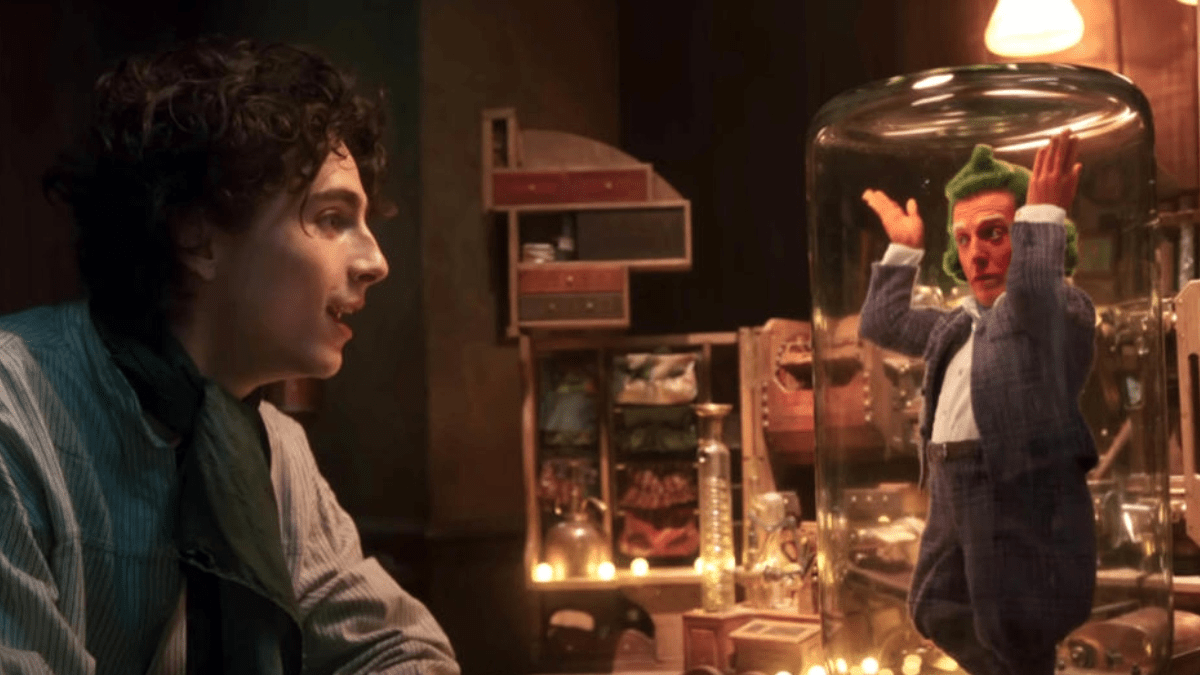
While not specifically a villain, Hugh Grant’s Oompa Loompa certainly makes Wonka’s life difficult. The movie leverages Grant’s genuine churlishness perfectly, and he steals every scene he’s in. The CGI used to transform Grant into a miniature version of himself with orange skin and green hair isn’t very convincing, but the character worked because Grant is always so good at playing conceited, priggish characters like this one. If he keeps getting plum roles like this one, we could end up talking about Grant’s late career renaissance before long.
The one quibble I had with Wonka was that while the villains were distinct and had their own comedic sensibilities, the good guys were mostly nondescript. The exceptions being Abacus Crunch, whose character benefits immensely from Jim Carter’s incredible voice and bushy eyebrows, and Sally Hawkins bringing her luminescence to Mrs. Wonka. For example, the running gag about the captive stand-up comedian who isn’t funny was weak compared to Fickelgruber becoming nauseous whenever someone says the word “poor”. And while the Chief of Police has an overwhelming chocolate fixation, Officer Affable is just…there. The script could have used another polish to flesh out these characters.
There were many aspects of Wonka that I appreciated, but the one that stood out was its emphasis on being nice. Wonka succeeds not because he’s brilliant and has magical powers, but because he cares about others. Because of this, his friends are willing to help him after Slugworth and the cartel deal him a devastating blow. Wonka owes the culmination of his dream directly to the people he’s helped along the way. Because of this, I suspect that the follow up movie(s) probably won’t feature the version of Wonka that I grew up with. Which is fine because I’d rather this Wonka continue on his own unique trajectory instead of being compelled to mimic the past. Or take a dark turn like the middle entry of trilogies often do. Besides, I like the idea of a franchise where the underlying principles are positivity, collaboration, friendship…and chocolate.
 Detroit Cineaste
One thought on “Wonka”