
The Exorcist is proof that no franchise, no matter how moribund, will always get another chance at box office glory. After proving time and again that they could not make a successful sequel, Warner Brothers let The Exorcist property languish on the shelf. In the years since the equally uninspiring prequels were released in 2005-06, an interesting thing happened. Rival studios used the original movie as a template for their own demonic possession movies. While those movies were not on par with the movie that inspired them, they were usually profitable. (2010’s The Last Exorcism was inconceivably profitable.) This steady stream of success is probably what led Universal to purchase the rights to The Exorcist, with the justification that if knock-offs could make money, a small-budget Exorcist movie rooted in the lore of the original certainly could make a healthy profit.
Perhaps due to budgetary limitations (reportedly $30m), The Exorcist: Believer certainly is less ambitious than the previous sequels. The movie actually doesn’t even recognize them, a tactic that director David Gordon Green also utilized in his recent Halloween trilogy. Regan taming a whirling cloud of grasshoppers in The Heretic? Never happened. George C. Scott and battling Father Karas in an insane asylum in Exorcist III? Forget it. As far as Believer is concerned, the original movie is the only one that matters. This approach will undoubtedly irritate those who tout the third movie as the only good sequel in the franchise. However, after seeing this sequel, those folks can safely make that claim (with no argument from me).
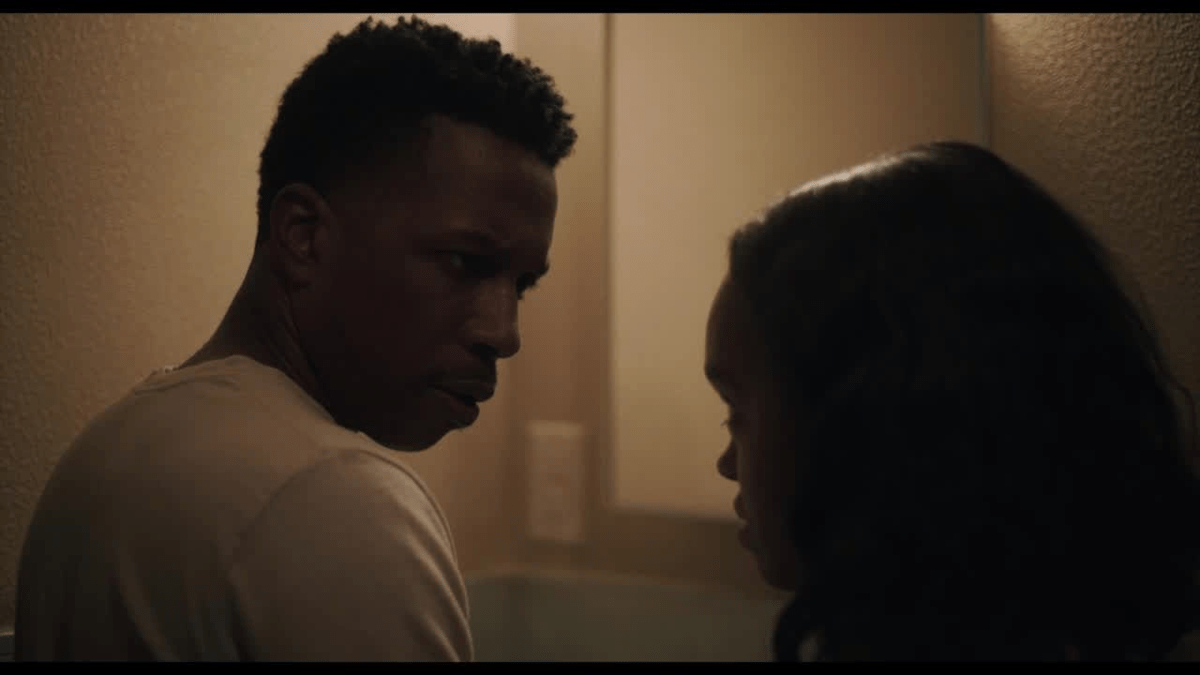
As a sequel, The Exorcist: Believer attempts to both honor the original while tweaking the formula just enough to feel different. The opening scenes set in Haiti illustrate how much these two tendencies are at cross purposes with each other. Set thirteen years ago, Victor (Leslie Odom Jr.) photographs the locals at a beach while a very pregnant Sorenne (Tracey Graves) shops. No Exorcist movie is complete without dogs ominously fighting with each other, and Victor eyes them with concern. (Father Merrick also witnessed barking dogs in the original, remember?) Some of the locals at the beach yell angrily at each other in French, but Victor doesn’t speak the language. The setup is foreign, ominous and familiar at the same time, a tightrope act that surprisingly works.
When Victor and Sorenne part ways, you just know something bad will happen. An earthquake hits the island, just like it did thirteen years ago. Victor is unharmed but Sorenne is mortally wounded by the partial collapse of the hotel. Doctors tell Victor he can only save his wife or his unborn daughter, leaving him with the worst possible choice a parent could ever make. (You may think you know the choice Victor made, but just you wait.)
Flash forward to the present day, and Victor is now a doting father looking after his teen daughter Angela (Lidya Jewett). Angela is tired of living a sheltered life and pleads with her father to let her go to her friend Katherine’s house after school. He relents, and naturally things go horribly wrong. The girls disappear without a trace and aren’t seen again until three days later. Aside from suffering from mild exposure, they appear to be unharmed. The physical exams are uncomfortable and intrusive, but there is no sign of physical or sexual abuse. (These scenes should remind you of the original movie, although the tests these girls undergo are nowhere near as invasive as what Regan endured.)
When Victor brings Angela home, she’s not herself. She’s in a trancelike state most of the time, staring at things Victor cannot see. (One of the movie’s few jump scares arrives here. There are so few of them you can count them on one hand, maybe on two fingers.) One night Angela wets the bed and physically attacks Victor. Meanwhile, Miranda and Tony, Hannah’s parents, are having similar difficulties with their daughter. They’re Evangelical Christians who are mean-spirited and self-absorbed. (It would have been nice if the movie had avoided this sigh-inducing trope just to be different.) They believe that Angela is responsible for the situation they are in, an accusation that Victor doesn’t take lightly. In flashbacks, the movie shows us that the girls went off into the nearby woods to conjure the spirit of Angela’s dead mother. Why do they do this? Why did Regan use a Ouija board to talk to Captain Howdy? Kids always do the darnedest things when parents are not around.
Unable to care for Angela at home, Victor visits a psychiatric hospital and considers committing his daughter. Victor is clearly gobsmacked but is trying to be practical about the curveball life has thrown at him. When Victor returns home, his neighbor Ann (Ann Dowd) tells him bluntly that his daughter isn’t mentally ill, but possessed. At this point, Believer had been happy to be little more than a carbon copy of the original movie. Unfortunately, the filmmakers have Ann hand Victor a book by Chris MacNeil, a hamfisted move to insert the plot of the original movie into this one that is both crass and desperate.
If you’ve seen the trailers, you already know that Ellen Burstyn’s character from The Exorcist returns in this movie. If you’ve also seen the previous sequels, you’ll remember that Burstyn did not appear in any of them. Why she decided to be in this one is anyone’s guess, but her role in Believer is to provide a superficial link to The Exorcist. While her character’s appearance satisfies that goal, the character of Chris hijacks the movie from Victor and the task at hand. (This is not meant as a knock against Burstyn, who performs admirably and earned whatever she made for appearing in this movie.)
After Chris is ridiculously and grotesquely ejected from the plot, Victor decides that a) his daughter is actually possessed, and b) he should seek out unconventional treatment. He meets with Dr. Beehibe (Okwui Okpokwasili), a rootwork healer, who explains that she left her normal job to help people like Victor. With the assistance of Ann, Beehibe, Miranda and Tony and several of Victor’s neighbors, the team performs a community exorcism on the girls. If you’re as big a fan of the demonic possession genre as I am, you know this won’t go according to plan. It certainly doesn’t, but probably not how you would have expected.
As I pointed out above, Believer matches the plot of The Exorcist step-for-step. This choice mostly works because almost none of the copycat movies spend much time on how dealing with the medical community in situations like these leave parents feeling exhausted and helpless. The copycats mostly are in a rush to get to the possession scenes, and rarely consider the toll a demonic possession would have on the families. (Watching a possessed child utter profane and blasphemous things is more fun than to consider the toll the experience is having on the family.)
David Gordon Green is a good director, although I mostly disliked his Halloween trilogy. Believer is competently directed and Green allows his actors space to breathe life into their thinly drawn characters. Odom Jr, Dowd and Okpokwasil come off the best, while the rest of the adults are forgettable. As the possessed tykes, Jewett and Murphy are fine, but really can’t hold a candle to Linda Blair’s iconic performance. (In all fairness, few actors have ever come close.) The movie is evocatively shot by Michael Simmonds, who also worked with Green on the Halloween movies.
The Exorcist: Believer does tweak the genre formula in several ways that I appreciated. This is one of the rare demonic possession movies where an African American family is front and center. I liked the relationship between Victor and Angela, and I thought Victor’s shell-shocked reaction to the situation was credible. The movie’s other big twist–dual possessions, was also intriguing. Most of these movies deal with one possessed person at a time, so my curiosity was piqued when both girls began behaving badly, so to speak. How many times have we heard the demons say they are legion, but they only ever possess one person? Lastly, having a team exorcism was a departure from the tried and true formula. The movie should have been titled The Exorcists, but that would have given too much away.
Unfortunately, the appearance of Burstyn’s character at roughly the midpoint of the movie destroys all of the movie’s momentum. The movie tries to jump start things after she is sidelined, but the action proceeds at a frustratingly sluggish pace. Believer really needed to bring the heavy artillery to that final exorcism scene, but instead is content to set off a couple of firecrackers. Believer is only two hours long and it feels like it could have easily been trimmed to ninety minutes. The movie should have focused on the father, his lingering regrets over making an impossible choice, and how his daughter has had to live with the fallout. The community approach taken by Believer, while novel, is cute but completely unnecessary. The filmmakers should have taken the lessons offered by the copycat movies and kept it simple. Get in, speak your holy rights, show the possessed climbing the walls and get out. That this movie was created with the imprimatur of The Exorcist didn’t phase me. However, as someone who genuinely likes these movies, I was underwhelmed by this one. Not Recommended.
 Detroit Cineaste
I love The Exorcist, it’s one of my favorite movie and this sequel was just terrible in everything, it wasn’t a good sequel and it wasn’t a good entertainment horror.
LikeLike
Yeah, I’m very forgiving with these movies. Believer’s changes to the formula just weren’t enough for me.
LikeLiked by 1 person