
Is there anything more pernicious than a hedge fund? I’m not a financial guru, but I wouldn’t be off base if I characterized the way these organizations make money for their investors as being destructive. The news is littered with accounts of a hedge fund buying a company, loading it up with debt while siphoning off profits until the enterprise eventually implodes. If this is the American dream, please wake me up.
Since buying a company and running it into the ground requires time and effort, hedge funds have gone all-in on a faster way to profit off of failure: short selling. In this scenario, a hedge fund manager uses the immense capital at his disposal to bet on a company’s stock falling. The more it falls, the more money the hedge fund manager makes. Even more insidious is how the bet itself becomes a self-fulfilling prophecy. People take note of the “negative sentiment” and either dump the stock or bet against it themselves. A significant short sell creates a snowball effect, depressing the company’s stock which in turn pressures the company itself. A falling stock price can make it difficult for the company to raise capital to put into the business, which can result in the company filing for bankruptcy. Through it all, the hedge fund manager takes his profits while the company he bet against dies. Everyone sees the fingerprints and the murder weapon, but no murder has been committed because it’s all perfectly legal.
As a society, we’ve gone a long way from investing in companies and hoping they succeed to profiting from their failure. Due to the rise of ecommerce and Amazon, retail companies have been the favorite targets of the short-sellers. The thinking behind this strategy is that the demise of a company like GameStop is inevitable, so making a profit on the downward spiral makes logical sense. Tough luck for the people who work for these companies, though. Welcome to economic churn, unfortunate retail workers. This is where Dumb Money begins.
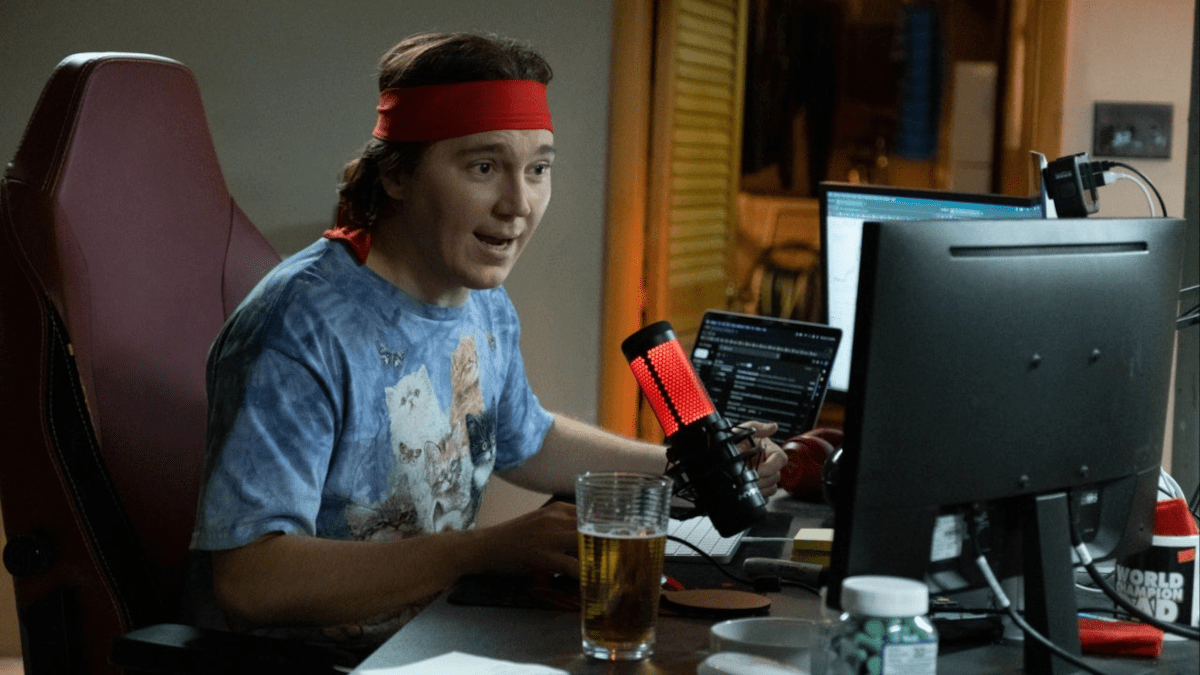
Keith Gill (Paul Dano), a financial analyst out of Brockton, Massachusetts, sees GameStop as both viable and profitable. His opinion of the company is the exact opposite as the hedge fund managers who have shorted it, but he’s focused on the company’s fundamentals, not external sentiment. Kevin has invested most of his family’s money in GameStop stock and regularly discusses his investment on his YouTube channel using the moniker “Roaring Kitty”. (His calling card is a video featuring a cat leaping into the air to catch a snowball. Priceless.) Keith’s brother Kevin (Pete Davidson) thinks he’s a dork and covertly harrasses him during his live feeds. Thankfully, Keith’s wife Caroline (Shailene Woodley) is behind her husband 100% and encourages him to go on camera whenever he doubts his choices.
Keith’s devotion to GameStop stock draws the attention of retail investors on the Reddit forum WallStreetBets. Among Roaring Kitty’s devotees is beleaguered nurse Jenny (America Ferrera), college student Harmony (Talia Ryder) and GameStop employee Marcus (Anthony Ramos). Whether those three actually understand Keith’s discussion about GameStop as a company isn’t clear, but what they do latch onto is his contention that hedge funds are out to destroy the company. Each of them represent a different segment of society who has taken it on the chin during the Covid pandemic. Jenny has fought to keep people alive but is in debt. Harmony had student debt before the pandemic and is facing limited prospects after graduating. Marcus is fighting to keep his job after lengthy shutdowns of the retail sector to limit the spread of the virus. Keith unfortunately lost his job at Dick’s and has resorted to borrowing Keith’s car to be an occasional DoorDash delivery person.
While those four are struggling to keep their heads above water, the one-percenters in the financial sector have continued to make money, either by buying stock for distressed companies on the cheap or by betting against them. When Jenny, Harmony, and Marcus hear Keith say that hedge fund managers are lining-up against GameStop, they see buying the stock as a way to stick it to the man. For them, Keith is Paul Revere and the hedge fund managers are the invading British troops. They collectively answer Keith’s call to arms and buy the stock using the Robinhood trading app, which features commission free trades. And so do many others on WallStreetBets. So many retail traders buy and hold that something amazing happens: the stock goes up. And continues to go up.
This surprising turn of events naturally causes huge problems for Melvin Capital Management and its founder Gabe Plotkin (Seth Rogen). After several days, he glumly reports to his wife (Olivia Thirlby) that his company is losing a billion dollars a day. Facing the imminent collapse of his company, Plotkin begs fellow hedge fund managers Steve Cohen (Vincent D’Onofrio) and Kenneth C. Griffin (Nick Offerman) for help. Together, they call in favors to tip the scales back in his (and their) favor. First WallStreetBets is taken offline for comical reasons. This triggers the retail traders to sell the stock in a panic. Unable to honor the avalanche of trades, Robinhood co-founder Vlad Tenev (Sebastian Stan) disables the sell button for GameStop stock in the app. Through all the turmoil, Keith and his followers hold onto their stock (“diamond hands” in WallStreetBets parlance) until congress gets wind of the turmoil. Hearings on capitol hill expose the devious shenanigans of the power brokers, but we already know that the one-percenters were never held to account. (Since all of this just happened a couple of years ago and was all over the news, discussing the plot at length can’t possibly be considered a spoiler.)
Dumb Money reminded me of the “slobs versus the snobs” comedies from the late Seventies and early Eighties. Paul Dano is clearly in the nerdy Dan Aykroyd/Harold Ramis mold, with Pete Davidson as the anarchic, underachieving type that made Bill Murry famous. On the snobs side are Seth Rogan, Vincent D’Onofrio, Nick Offerman and Sebastian Stan, each supplying their own unique take on oafishness. The movie’s portrayal of the rich cretins is mostly cartoonish, however, with only Rogan delivering more than a one-note performance. For example, the defining trait of D’Onofrio’s character is that he has a pet pig. The slobs fare better, but not by much. The members of the peasant’s rebellion are salt of the earth types who work day jobs and use a combination of drinking, swearing and rap music to let off steam. (The movie earned its R rating with its many F-bombs.)
Unlike the typical rich versus the poor comedy, Dumb Money is based on real people and actual events. As such, it comes off as Caddyshack crossed with Margin Call. The problem with Dumb Money is that it’s not as raunchy as it thinks it is. The good guys are underdogs, but are a fairly straightlaced bunch of working stiffs and college kids. The movie isn’t as wonky as it should be, either. The movie would have benefited tremendously from a few absurdist asides that explain why things are happening, ala. The Big Short. Also, if you hadn’t followed the GameStop stock saga a few years ago, you may be scratching your head over the why of what is going on. That said, the movie features noteworthy performances by Paul Dano and America Ferrara that effectively ground the movie. As financial analyst Keith Gill, Dano manages to be both funny and relatable. Ferrera also brings a hearty dose of righteous anger as put-upon nurse Jenny. Between this performance and Barbie, she’s having a solid year. The movie also captures the social media frenzy that surrounded GameStop stock. With its frequent montages of gifs, YouTube videos and reddit posts, the movie effectively shows how a bizarre notion like buying a company like GameStock to give hedge funds “the finger” went viral. Dumb Money may treat the source of its inspiration lightly, but it is entertaining and occasionally moving. Mildly Recommended.
After Market Trading (Analysis)
Bad Money is a good movie. What bothers me is that It could have been great, though. It has many ingredients that should result in a great non-fiction movie (timely subject, excellent cast, solid director), but it never turns into one. As I thought about this movie, I hit on the reason why it never achieves escape velocity: focus.
The emotional core of Bad Money is Keith Gill and how he takes on Gabe Plotkin and (with the help of his many devotees) beats him at his own game. If the movie had limited its story to the obvious David versus Goliath matchup, it would have been a much stronger movie than it turned out. The mistake made by the writers (Lauren Schuker Blum and Rebecca Angelo and Ben Mezrich) was to broaden the story beyond Keith and Game and turn it into a variation of The Big Short. The problem with this approach is if the supporting characters don’t play a significant part in the story, they are superfluous.
The only villain in the movie who is given sufficient screen time to register as a human being is Seth Rogen’s Plotkin. The movie shows Plotkin having tantrums at his new mansion, with his main issue being that it’s not ready for him to hold a party. The movie introduces us to Plotkin’s wife Yaara and makes a point of telling us that she’s a teacher. Why she decided to marry such an insufferable man is a question the movie doesn’t bother to answer, and Rogen overplays his character’s obnoxiousness to his detriment. Regardless, Plotkin is a clearly defined villain just like Gill is the movie’s obvious hero.
As much as I like Vincent D’Onofrio, Nick Offerman and Sebastian Stan, they have little to do in the movie and their performances are basically glorified cameos. Even though the characters they play are based on real people, their personalities can be summed up with one word. D’Onofrio is repugnant, Offerman is belligerent and Stan is conceited. Each is little more than a one-dimensional cartoon. If you eliminate their characters from the movie, it would play out exactly the same.
The same goes for the members of the proletariat. Riri (Myha’la Herrold) and Harmony (Talia Ryder) make for a sexy couple, but aside from Harmony’s brief monologue about her student debt, the role they play in the story is trivial. Same goes for GameStop employee Marcus (Anthony Ramos). He puts up with a dick for a boss (thank you, Dane DeHaan) and has a loving family, but if he wasn’t in the movie we wouldn’t miss his character at all. And as much as I like the feisty energy America Ferrera brings to Jenny, she’s just another diamond hands stock trader.
Instead of filling the movie with a bunch of unnecessary supporting characters, the movie should have focused more on Keith and his family. Shailene Woodley should have been given more to do than play the long-suffering wife who puts the kids to bed. Gill’s parents are colorfully portrayed by Clancy Brown and Kate Burton, but the movie gives them very little time to shine. The movie’s beating heart should have been Keith and those in his immediate circle, and any moment away from them feels like an unnecessary diversion.
I mentioned above how Pete Davidson plays the Bill Murray (or Chevy Chase) role in the movie. I haven’t seen Davidson in a movie before, but he makes Kevin far too irritating to be likable. The movie manages to redeem him a bit in the third act, but I never understood why Kevin constantly gave his brother so much grief. The implication seemed to be that they had a long-simmering sibling rivalry, but it ended up being about how Keith let his running shoes get stolen. I get that Davidson’s schtick is being a jackhole or asshat or whatever, but if he would have dialed things way down for this role his performance would have worked much better.
Dumb Money hints at an alternative way it could have approached the story of Keith and Gabe via their congressional hearing testimony. Keith states that graduated from a community college in the Great Recession. Gabe says he graduated from Northwestern. Keith spent time unemployed and eventually became a financial analyst, while Gabe went on to found a hedge fund with billions of dollars at its disposal. The movie could have spent time at the outset contrasting how its main characters got to the point where they were duking it out over GameStop stock. That would have made for an incredibly compelling opening montage.

