
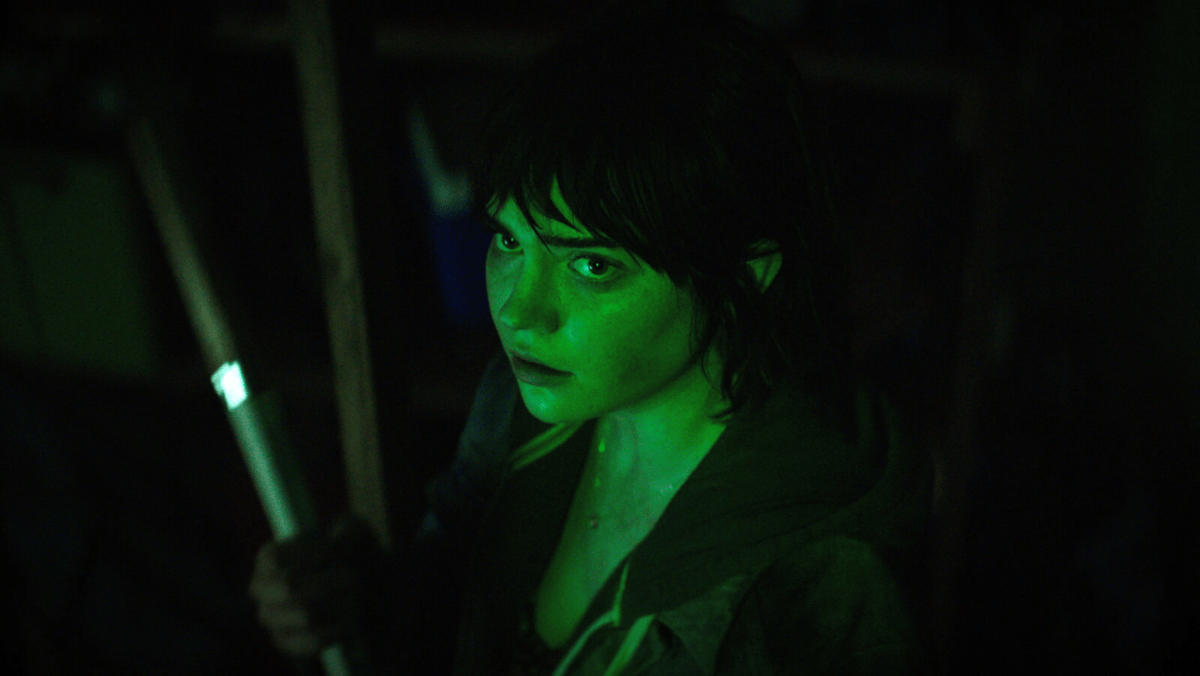
As far as horror movie cold openings go, The Boogeyman has a brief yet effective one. A toddler is crying in her crib while something that sounds like a wet bag of bones lets itself into her room. A few seconds later, there’s a slashing sound, a spray of blood and the child is silent. (The movie is rated PG-13, so nothing graphic is depicted throughout the movie.) Who, or what, killed the child? The answer to that question arrives soon enough, and to nobody’s surprise it is The Boogeyman.
But whose child was killed? She wasn’t a member of the Harper family, who are recovering from an entirely different tragedy. Their mother died from a car accident, and the Harper’s have been struggling to keep it together ever since. (Mom was the artistic one who offset her husband’s fuddy-duddy-ness.) Father Will (tepidly played by Chris Messina) is a therapist who listens patiently to everyone else’s feelings but refuses to discuss his own. Older daughter Sadie (a sultry Sophie Thatcher) is a sulky teen who gives her father grief for being closed off emotionally. (What else are teenage daughters for but calling their parents out for their adultness?) Younger sister Sawyer (Vivien Lyra Blair, full of childlike spunk) is tormented by a creature with shiny, glassy eyes that creeps out of her bedroom closet and crawls under her bed. Sawyer is a typical Stephen King kid: she has to convince her family she’s not suffering from night terrors but an actual monster, all while her teeth are coming in.
One morning, a man insists on seeing Will without an appointment. Will usually doesn’t take walk-ins, but he agrees because what could possibly go wrong? Having a sit-down with a man who looks troubled and unstable and is a foot taller than you goes with the territory. The man is Lester Billings (David Dastmalchian, always existentially haunting), and he tells Will that he’s suspected of killing one of his children. His youngest died from SIDS, while the other was brutally murdered. (Remember that cold opening?) Lester says that he didn’t kill his child, but when their youngest died, it made them “susceptible”. Lester doesn’t blame what has happened on The Boogeyman, but he shows Will a drawing of what he says is behind it all. When Will excuses himself to make a phone call to the police, Lester finds his way to mom’s room and hangs himself. Sadie, home after an incident with her mean girlfriends at school, heard sounds of a struggle before Lester died. Who would Lester be struggling with before hanging himself?
While Sadie tries to reconnect with her best friend Bethany (Madison Hu) and their group of sorta-friends, Sawyer is left to confront The Boogeyman on her own. She screams, she gets thrown into the TV, but her family doesn’t believe she’s being tormented by anything. Her father believes she’s making it all up, perhaps her way of externalizing the horror of losing her mother. In King’s horror-verse, parents are always oblivious non-believers, until the horror is staring them in the face.
Eventually, Sadie experiences The Boogeyman for herself. She tries to convince her father that yes, what Sawyer says is happening to her is real, but Will refuses to accept it. Desperate for answers, Sadie visits Lester’s home and discovers an odd plant-like growth covering the walls and Lester’s shotgun-toting wife. After being used as Boogeyman bait, Sadie rushes home to save her father and her sister from a fatal (and final) encounter by you-know-who.
If you’ve either read Stephen King’s “It” or seen either the television (1990) or movie adaptations (2017 and 2019), the plot of The Boogeyman will feel very familiar. They both share the theme of children being forced to confront an unspeakable horror while their parents are either oblivious–or unwilling to accept what is happening right before their eyes. Instead of Pennywise, there’s The Boogeyman. Instead of a “Losers Club”, there are Sadie and Sawyer. I suspect that The Boogeyman (the short story) was an early attempt by King to flesh out the concepts he would later expand upon with It and his other novels. (The short story was published in 1973. It was published in 1986.)
As with most King stories featuring an evil creature, The Boogeyman is largely unexplained. Suffice to say that it has been around for a long time and has a system for targeting those people it wants to torment and then eat. (If you’re suffering from a traumatic event, you’re on the short list.) How The Boogeyman has managed to do what it does for so long is never explained–it simply “is”. As far as the story (and the movie) is concerned, understanding The Boogeyman’s motivation places a distant second to surviving it and (hopefully) killing it. The movie ends with a degree of finality, but then there’s a “is it really over?” closing scene that teases a sequel. To be fair, moments like that one infect most horror movies these days. Even the worst horror movies aspire to sequel status. Horror movie antagonists are never really dead; they’re just waiting around for someone to greenlight their next appearance.
As far as monsters in the dark movies go, The Boogeyman is competently made but nothing special. The eponymous creature is suitably grotesque, but not extravagantly so. (I suspect the budget for this movie was small.) The acting is solid for the most part, with Thatcher making the biggest impact. Dastmalchian is great in what is a one scene cameo, and the movie would have been better off with a longer opening scene with him and his family before their child is killed. Messina underplays Will a bit too much, even for a cardigan-wearing therapist. To be fair, all of the characters in the movie are very thin, with the exception of Thatcher’s Sadie. She has some nice scenes with Hu that let her expand her character beyond a basic outline. For example, in a sharp contrast to the mostly perfunctory dialog that fills the movie, the two of them share a scene in a bathroom where Bethany gets to tell Sadie, “I’ve seen you pee a thousand times!” The movie could have used more dialog like that.
The Boogeyman offers at least a half-dozen solid jump-scares. I found the scenes where the creature slinks around in the dark, uttering sounds that are a weird mix of human and non-human voices to be scary, but my expectations for this movie were minimal. There’s nothing in The Boogeyman that I haven’t seen before, and better. (I would recommend Come Play, It or The Empty Man over this one.) The movie doesn’t do anything exceedingly well and is not an original take on the concept, but it succeeds at being a modestly entertaining horror movie. Thatcher, with her performance here and appearances in The Book of Boba Fett and Yellowjackets, is a rising star to watch. If you see this movie, you can say you remember her back when she was a humble scream queen running from a CGI monster. Mildly Recommended.


The short story was really amazing. I really liked it and the ending was really unexpected. This movie was nice but nothing incredible. I like the first part of the movie because it talked about the trauma of losing someone dear to you and the Boogeyman didn’t appear too much. Then it started to show to much and probably for that the creature didn’t scared me so much. The idea of showing this two white eyes in the shadow is pretty simple but well made, those two eyes in the dark are very scary. I’m just sorry that they didn’t tried to go deeper in the psychology of the characters. In a certain point i almost expected they could do something similar to The Babadook. Of course I didn’t expected the same deepness and the same incredibile story, but I almost hoped they could go in the same way. In the end for me was a pleasant movie but nothing amazing. Surely a lot better than the movie of 2005.
LikeLike
I never saw the 2005 movie. I like your comparison to The Babadook. The latter was a much better movie.
LikeLiked by 1 person
Indeed. Babadook is one of my favorite movie and for me it’s a great inspiration and what I want in horror.
LikeLike