
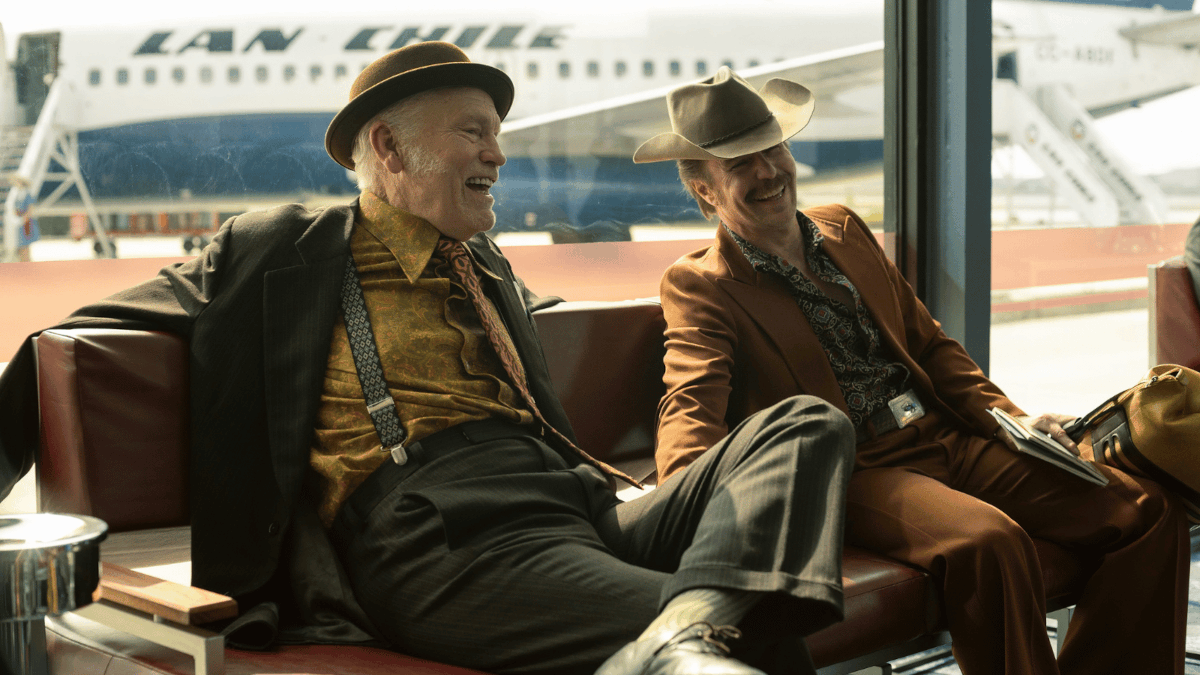
Having sympathy for the devil certainly applies to the CIA operatives in Wild Horse Nine. They’re both responsible for countless deaths, both directly and indirectly. We know this because one of them talks openly about it. When it’s revealed that he is in a bad way, does that mean we should feel sorry for him? And does the fact that he’s trying to be a good guy on his way out make a difference? That’s the crux of Martin McDonagh’s Wild Horse Nine, a movie that asks us to pity someone who doesn’t regret anything he’s done but is trying to make up for it.
Wild Horse Nine is a classic shaggy dog story, one that tells us what it’s about when it’s good and ready. It asks us to be patient and enjoy spending time with CIA spooks Chris Carlisle (John Malkovich) and Lee Chesterfield (Sam Rockwell), who act like an old married couple on vacation. For example, Chris has a tendency to say what’s on his mind the moment he thinks it. Sometimes it’s a ridiculous observation, like how gay countries have the best cheese, or how to disguise a bomb with an inexplicable picture. At other times, Chris broadcasts how they’re the CIA and have killed people, which makes Lee apoplectic because the CIA demands secrecy. Lee chastises Chris for saying too much, but Chris clearly doesn’t GAF.
Chris and Lee are on assignment in Chile doing some routine skullduggery. The year is 1973, which has outsized importance in Chilean history. For now, Chris and Lee are taking photos of radical young people and reporting back to Chile bureau chief MJ (Steve Buscemi). Chris and MJ don’t like each other, and appear to have a long-running feud about JFK. (That event looms large in the story.) Lee does his best to smooth things over before he and Chris fly to Easter Island to see the “big heads”.
Chris’ big mouth resurfaces while he and Lee wait to fly out, when he casually tells Monica (Mariana di Girolamo) and Alicia (Ailín Salas) to enjoy their new president while they can. I wondered if Chris’ behavior represented American braggadocio, as in, “I’m the CIA and can say whatever I want,” but it’s not that simple.
Chris also gets testy about trivial things, like how he and Lee have separate rooms on the island. Lee insists that this is how they’ve always done things, but Chris closes his door in a huff. Later, at dinner, Chris gets angry when an English couple politely corrects him about the indigenous name of the island (Rapa Nui) and of the big heads (maoi). Sensing Chris’ anger, Lee tells the couple to shut up.
That night, Lee walks in on Chris injecting morphine, and I figured Chris’ drug habit was behind his unpredictability. As the story unfolds, McDononagh reveals more and more about Chris and Lee and their strange dynamic, which makes sense when two pertinent facts are revealed. The first is that Chris is dying from cancer, which explains his devil-may-care attitude. The second reveal involves Lee, and it explains why he endures Chris’ behavior. I won’t give it away here, but it makes Lee’s situation unexpectedly poignant.
MJ has ordered Lee to keep a close eye on Chris and tell him if he’s going through with his threat of writing a tell-all memoir. Lee repeatedly tells him “no”, even though Chris is doing exactly that. As Chris recounts his experiences into a Dictaphone, he reveals that he’s had a hand in several of the CIA’s most infamous geopolitical interventions, including JFK’s assassination. There’s no tinge of regret in Chris’ voice, but maybe a sense of pride. All of his targets are dead while he’s still alive, which is an accomplishment.
What concerns MJ is Chris saying anything on the record regarding his role in Kennedy’s assassination, because that would be extremely problematic for MJ and everyone else in the agency. MJ orders Lee to kill Chris if he’s following through on his plans. Lee doesn’t want to do that because Chris is his friend, so he keeps stalling while the two pay tribute to the big heads.
Chris develops an odd case of altruism during his stay, which involves being kind to the moths in his room. Chris is also fascinated by the wild horses that are everywhere, one of which seems to be following him around. His interest in helping innocents extends to Monica and Alicia, who are also on the island. Chris first makes nice with Monica at the beach, then proceeds to tell her everything he knows about the upcoming military coup that probably will claim their lives. The question becomes, why is Chris forcing MJ’s hand?
The tone of the story shifts from darkly comedic to serious as it heads towards an inevitable confrontation between Chris, Lee and MJ. Clearly not everyone will leave the island alive, but does that matter when it comes to three bad guys with a lot of blood on their hands? Should we feel sorry for who dies, or observe it all with silent detachment like the maoi?
Recommendation
Wild Horse Nine speaks to the undying optimism of writer-director Martin McDonagh. How else to interpret his movie, which is about a lifelong bad guy who belatedly decides to be a good guy? Considering all of the evil things that he can remember, his turn towards the light is on par with that of Darth Vader at the end of The Return of the Jedi. Like Luke Skywalker, McDonagh believes that there’s good in even the worst of us. Both movies espouse the belief that goodness will emerge from the worst people, given the right circumstances. I’m not sure I believe that, but I’m not going to tell him he can’t indulge in some wishful thinking.
McDonagh has been down this road before, specifically Three Billboards Outside Ebbing, Missouri. In that movie, the world’s worst police officer had a life-changing epiphany after losing his job. Again, I’m not here to call McDonagh a Pollyanna, because I also want to believe that unlikely changes of heart aren’t relegated to the movies. At the very least, these stories tell us to never give up hope, because people can surprise you.
Epiphanies aside, McDonagh is very good at creating characters who make us laugh despite their inherent awfulness. In this movie, it’s Sam Rockwell’s Lee and John Malkovich’s Chris. Even though I know these two have done many dirty deeds on behalf of the CIA, I could listen to them talk for hours. They’re done their job so long that they don’t even bother discussing it anymore, because it’s boring. Instead, they talk about mundane things with a cracked world view that recalls Tarantino, where something like cheese becomes a topic of conversation for no reason at all. McDonagh has more affection for his characters than Tarantino does, though, and he made me feel sorry for these killers more than I should have.
Since character-driven movies have become a lost art in Hollywood, it makes sense that an outsider like McDonagh has taken up the charge. He started out as a playwright, and the ebb and flow of Wild Horse Nine feels like it was written for the stage and adapted later. Aside from the beautiful vistas of Rapa Nui and some violent action in the closing moments, the majority of the movie is basically us watching two guys talk. Not only is this movie set in the Seventies, it feels like it came from the Seventies.
Having Rockwell and Malkovich on hand to speak McDonagh’s loopy dialog is worth the price of admission. Malkovich plays the unrepentant psychopath this time around, with Rockwell as his straightman. The two have played characters like these for so long and so well that they’ve basically cornered the market. The movie really is a showcase for Malkovich, another captivating weirdo in a career full of them. Rockwell knows his place and wisely doesn’t fight him for the spotlight, and his deference may just get Malkovich a well-deserved Academy Award next year.
As great as Wild Horse Nine is at times, it’s not without its flaws. Parker Posey’s character isn’t much to speak of, a ditzy wife that felt dated. Steve Buscemi doesn’t have much to work with as the CIA bureau chief. The horse and “big head” symbolism is a tad obvious at times. McDonagh’s choice of incorporating a hand held movie camera is so effective that I wish he’d used it more. And given how Mariana di Girolamo’s Chilean student sparks Malkovich’s turnaround, McDonagh should have given her more screen time.
Wild Horse Nine is a darkly comedic and surprisingly melancholy yarn led by John Malkovich and Sam Rockwell. The movie’s a meandering and somewhat unfocused two-hander, but Martin McDonagh’s singular dialog is always a treat. Recommended.
Analysis
One of the most interesting aspects of Wild Horse Nine is deciphering Chris Carlisle’s motivation. Compared to the other characters in the film, he’s frustratingly opaque. The rest are all open books. Lee puts up with Chris’ antics because they’re friends. MJ wants Chris killed to keep the CIA’s secrets under wraps. Lee’s wife Marge cheats on him because he’s never around. Alicia has befriended Monica to get the names of her radical friends who will be rounded up, tortured and killed by the new dictatorship. But Chris remains a puzzle until the end.
I don’t know the exact moment when the movie tells us that Chris is dying from cancer, but I’d guess it’s a third of the way through. Before giving us that revelation, McDonagh keeps us guessing as to why Chris acts as he does. Is he just a cantankerous old man who forgets things and doesn’t care who he offends? Is his contempt for a career bureaucrat like MJ the reason why he threatens to write a tell-all memoir? Is his drug use responsible for his unpredictable mood swings?
Chris’ behavior makes more sense once we know that he has terminal cancer, but not entirely. It’s easy to pin the blame for his forgetfulness, moodiness and irritability on the disease, but it doesn’t explain all of his actions. For example, his efforts towards writing a memoir make little sense in hindsight. As a veteran of the CIA, he would know that he would be killed long before any of his material would be published. And even if that did happen, what would he hope to achieve with it besides making MJ’s life miserable?
Other things Chris does defy explanation, like his concern for the moths in his room. He’s also fascinated by the wild horses that roam Easter Island. And he’s very intent upon saving Monica from the terror that will encompass her country before long. Taken together, Chris is intent on saving innocent lives from certain death. For someone who seemed to care little for the lives of others before, why he does what he does lingers after the movie ends.
Whenever Chris talks about his role as a villain, he describes it matter-of-factly. He never expresses any regrets for the things he’s done. My assumption would be that Chris would describe regret as a waste of energy. What’s done is done, and can’t be undone. This leaves the audience with reconciling what Chris says about his past and what he’s doing in the present. Is Chris trying to prevent deaths because he does harbor some regrets he can’t bring himself to admit? McDonagh denies us that closure despite having numerous instances where Chris could say as such.
I think Chris’ actions are the result of him realizing that he’s done awful things over the course of his life and wants to do some good before he dies to balance them out. Perhaps he’s building a case for leniency in the afterlife. This is why I mentioned Darth Vader above, because he’s like Chris in that he did something good before dying. But is it enough to save him? Does one final act of selflessness erase a lifetime of evil?
Perhaps this is what McDonagh is asking us. Is there anything the wicked can do to change our lasting opinion of them? Is it possible to consider Darth Vader or Chris Carlisle as heroes after all the bad stuff they’ve done?
Seventies redux
Another question that I had while watching the movie is why McDonagh chose to set the film in the mid-Seventies. He easily could have set it in recent times without changing too much. Certainly the CIA have been active in the decades after the events of this film have taken place, destabilizing governments and installing leaders who are sympathetic to the US.
My hunch is that McDonagh chose to set his movie in the Seventies because his story aligns with the films of that decade, which was the last decade when moviegoers in sizable numbers paid to watch characters simply talking on screen. It compares favorably to The In-Laws (1979), another darkly comedic movie with minimal action that’s driven by two phenomenal character actors (Alan Arkin and Peter Falk).
Movies for old people
I hate to generalize, but Wild Horse Nine is definitely for older moviegoers. This is not to say that someone in their twenties or thirties couldn’t enjoy the movie. It’s just that I’m not sure how much appeal the movie would have for younger people. (Old person’s rant incoming.)
Of the main actors in the cast, Sam Rockwell and Parker Posey are both 58. John Malkovich is 72 and Steve Buscemi 68. I grew up watching these actors, but to youngsters I’d imagine that the movie would be like watching their parents on screen. The pace of the movie definitely requires patience. It’s a dialog-driven movie with no action until the closing moments. And to top it all off, the romance within the story is entirely platonic and happens between Malkovich and Mariana di Girolamo, who’s 36.
Wild Horse Nine is for people who love watching actors act, and don’t need spectacle to make the story interesting.
The best storytellers
McDonagh is fascinated by bad people. Not because of what they do, but because of how their lives inform how they talk and what they talk about. Because death is commonplace, the two CIA black ops veterans in Wild Horse Nine obsess over trivial things, and what they say is funny because it’s incongruous. We don’t expect to hear these guys discuss cheese and dinosaurs, but that’s probably what secret agents do talk about because their jobs are routine and boring.
McDonagh also gives us the flip side of bad guy silly chatter, when Chris explains his role in history-changing operations. There’s no intrigue or suspense, just a flat recount of what he did. This, too, is probably how agents like Chris would tell us about his career. It was one job after another, like a corporate desk consisting of an unending series of projects. Some go well, some don’t, and you move onto the next.
What McDonagh gives us in Wild Horse Nine is special because it’s atypical of how filmed entertainment often presents these characters. Instead of depicting them as serious types who are “all about the mission”, we get two lifers who would rather talk about anything than what they do for a living.
A response to Billboards
As I mentioned above, Wild Horse Nine mirrors Three Billboards Outside Ebbing Missouri, in how both feature a psychopath turning towards the light. The difference is that McDonagh tones down the violence significantly in the former, and never shows Chris harming any innocent people. Instead, we only see him kill the bad guys. In choosing this approach, McDonagh makes it easier for us to sympathise with Chris in the end, even though he may have shot JFK. Perhaps McDonagh is telling us in a subtle way that it’s easier to compartmentalize someone’s bad actions if we only hear about them and don’t experience them first-hand.

