
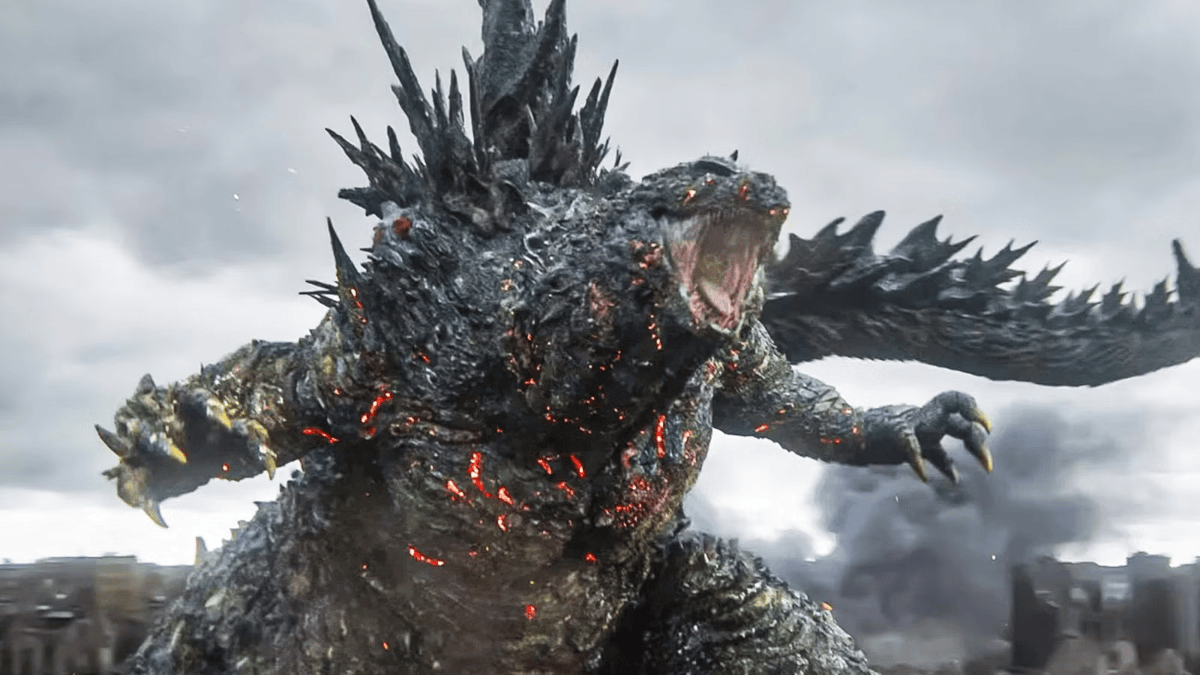
If the Godzilla movies have taught us anything, it’s never get too comfortable if you live in Japan. It doesn’t matter how long it’s been since the last kaiju attack, because another one will come along without warning and make their lives miserable again. This has been the go-to plot device of the franchise for a long time, and the latest movie by writer-director Takashi Yamazaki honors that tradition by bringing back a familiar face: King Ghidorah. While I felt bad for the Japanese over this development, it does result in another epic throwdown between Godzilla and one of his most dangerous adversaries. Consider it a tragically awesome outcome.
Life has definitely improved for the characters we first met in Godzilla Minus One. Redeemed former kamikaze pilot Kōichi Shikishima (Ryūnosuke Kamiki), Noriko Ōishi (Minami Hamabe) and their adoptive daughter Akiko (Sae Nagatani) have become a tight knit family unit. Sumiko Ōta (Sakura Andō), their neighbor and “aunt”, runs an orphanage for children of the war. Scientist Kenji Noda (Hidetaka Yoshioka) is the director of the Large-Scale Disaster Response Bureau, which is tasked with identifying severe weather and any future monster appearances.
While they all look fine, the scars of Godzilla’s attacks haven’t healed. For example, Noriko wears a patch over the eye that hasn’t healed from when she was injured during Godzilla’s assault on Ginza. The fact that she’s alive at all was one of the biggest mysteries of the first movie, and I’m happy to report that this movie offers a satisfactory answer for that.
This very modestly happy post WWI and Godzilla existence had been going on for two years, so it’s unsurprising when trouble literally falls from the sky in the form of a meteor. What emerges isn’t Venom, but something remarkably similar. Scientists Kanji Murakami (Min Tanaka) and Akira Hagiwara (Kisuke Iida) were observing it when the neighboring city was attacked by a dragon-like creature that emits lightning from its mouth. The devastation triggers Murakami, who survived the bombing of Hiroshima.
When Murakami and Haigiwara meet with Noda, they show him footage of the nascent creature gobbling up local animals who wandered too close. Murakami’s theory is that the dragon is the result of several animals it absorbed. He names it “Ghidorah”, a mash-up of “chimera” and “hydra”. (The hydra inspiration will be incredibly prescient.)
Justifiably concerned that the creature will continue destroying swaths of Japan, Noda decides to take decisive action and kill the creature. The US military has developed a new fuel-air bomb and sees the situation as the perfect opportunity for testing it, so they hand it over with a couple of Douglas AD Skyraiders. Showing American soldiers painting red circles on the planes was a nice touch.
Noda is understandably skeptical of the altruistic motives of the US military and seeks an alternative in case the bomb doesn’t work. This comes from meteorologist Makoto Aoyama (Masami Nagasawa), who is known as a weather-predicting genius. As I watched her flip through charts and study them intensely, I thought of Andrew Scott’s character in Pressure who was another weather genius circa WWII and wondered what would be the harder task, forecasting D-Day or a monster from outer space?
Both plans require an expert pilot who has experience dodging kaiju, so Noda recruits Shikishima to advise the actual pilots. Because Akiko suffers from separation anxiety, he assures her that he won’t be in any danger. However, it doesn’t take long for Shikishima to realize that he needs to join the mission because the other pilots are terrified. So he breaks his promise and leads the formation to where Ghidorah has been sleeping for days.
As you may have guessed, the American bomb just pisses Ghidorah off. That’s when Noda orders the crew to put Aoyama’ Plan B into motion. This involves sticking lightning rods into Ghidorah, with the intended effect of electrifying him via the stormy weather in the area.
That plan goes pear shaped as well. The electricity causes Ghidorah to mutate into a much larger beastie that has three heads. Even worse, it has new powers that enable it to levitate buildings miles above the ground and drop them. The shot of Shikishima flying through a town hovering in mid-air is pretty remarkable, possibly the most horrifying image in a Godzilla movie.
Distressed over the devastation they unintentionally wrought, Noda and Aoyama are now tasked with coming up with a way to stop the monster referred to as “King Ghidorah”. As luck would have it, Godzilla has suddenly reappeared, giving Murakami the opportunity to pitch his insane plan. Attract Godzilla to the mainland, have it fight King Ghidorah and have the military kill the winner. Nora and Aoyama are shocked by the immorality of the plan, but what choice do they have?
I won’t spoil it here, but how Murakami lures Godzilla harkens back to earlier films in the franchise, where the science turned loopy in order to get things to happen. And as I mentioned above, the title match between Godzilla and King Ghidorah is worth the price of admission. The movie does have several unexpected plot twists at the very end, which effectively set up another sequel. A monster’s work is never done!
Recommendation
I’ve been watching Godzilla movies for a long time, so I knew that eventually this current iteration would embrace the silliness that has historically defined these films. Godzilla Minus One took things very seriously, a story about survivors’ guilt and cultural shame, and how uniting to defeat an existential threat would be therapeutic for all concerned. This resulted in the most dramatically moving Godzilla film since the 1954 original.
Godzilla Minus Zero also has its share of serious themes and human drama, both of which made its predecessor a singularity in the franchise. Revenge, failure and sacrifice all weigh heavily on the characters throughout this story. However, the plot is much sillier this time around. Trouble comes not from the bottom of the ocean, but from outer space in the form of a monster that, at least initially, looks a lot like a lost dragon from Game of Thrones. Scientists then proceed to make the monster far more dangerous while having little concern for the risks involved. There’s also the matter of one character being able to “call” Godzilla because they share a psychic connection. And here I thought monster/human telepathy was more aligned with the Warner Brothers Godzilla franchise.
The tonal shifts between the serious and the goofier stuff makes Godzilla Minus Zero an interesting viewing experience. On the one hand, it wants to be taken as seriously as the last one, and the acting certainly warrants it. On the other hand, the movie is also a monster battle royale, as has often been the case with the Godzilla movies. Minus Zero isn’t significantly worse than Minus One, but its inability to reconcile its contradictory impulses works against it.
In terms of pure spectacle, Godzilla Minus Zero outdoes the first one. The early action sequence with planes attacking Ghidorah is a thrilling combination of visual effects, editing human performances and Naoki Satō’s score. And while I definitely enjoyed the climactic (and bloody) wrestling match between Godzilla and King Ghidorah, it’s not at the same level as the earlier scene because the human characters are reduced to playing spectators. The contrast between the two scenes speaks to the same issue I had with the Transformers franchise, where the action that resonates best has a human ingredient to it. When it doesn’t, it’s the equivalent of playing with action figures.
This is, obviously, how many Godzilla movies have played out. What’s different here is that writer-director Takashi Yamazaki has gone to great lengths to ensure his films are taken more seriously than what came before. He’s given us three-dimensional characters to care about and action scenes that are more realistic than anything I’ve seen in a Godzilla movie. The key to Yamazaki’s success was to keep the human drama front-and-center amidst all the monster mayhem. This movie departs from that approach in order to align with how the franchise has traditionally shifted Godzilla from being Japan’s destroyer to its protector. With that in mind, I’m curious how Yamazaki handles this going forward and look forward to Godzilla Plus One (or whatever it’s called).
Godzilla Minus Zero doubles the monster mayhem by (re)introducing King Ghidorah, one Godzilla’s most fearsome foes. The visual effects and the action are both spectacular, but the human drama doesn’t reach the same level of the last one. Even still, this movie is far better than the average Hollywood blockbuster. Recommended.
Analysis
One reason why Godzilla Minus Zero didn’t hit me as hard as its predecessor is that it takes a while to establish which character will serve as the emotional fulcrum of the story. In the first movie, it was Shikishima, who had to overcome his survivor’s guilt over not completing his kamikaze mission. When he returns home, everyone knows he’s a coward because he shouldn’t have returned home at all. And if he did, he should have either been dead or at least severely wounded. Instead, Shikishima walks around the ruins as an able-bodied man ashamed to be alive.
The movie then expands Shikishima’s overwhelming feelings of shame to encompass the Japanese people. First, they were bombed into surrender by the Americans, a humiliation that permeates their entire society. Then they were crushed by Godzilla. Incredibly, the survivors of both atrocities come to see defeating Godzilla as the logical way to restore their pride. There probably were less dangerous ways for them to do this, but given the situation, taking out Godzilla was more expedient than years of therapy.
Since Minus One concludes Shikishima’s redemption arc, Minus Zero has to use a different character as the emotional center of the drama. The movie eventually explains that scientist Murakami, a Hiroshima survivor who witnessed the devastation first-hand, has been obsessed with using Godzilla to exact revenge upon the Americans. The scene where he envisions Godzilla nuking New York city, with slow-motion shots of people melting from Godzilla’s energy blast, are the most terrifying I’ve seen in a movie since Sarah Conner’s nuclear nightmare in Terminator 2.
Murakami’s desire for revenge is compelling, but Minus Zero is roughly half over when this theme is revealed. Until that point arrives, the movie lacks focus because the lives of the returning characters are ordinary. While it’s nice to see that everyone from the first movie was doing well under the circumstances, that confirmation isn’t dramatically interesting. Dramatically, writer-director Takashi Yamazaki paints himself into a corner with this approach, and he’s only able to unlock the story when Godzilla is reintroduced.
Abandoning the original cast and starting over with Murakami in the lead might have been the most straightforward way to begin this new story. But I’m guessing Yamazaki couldn’t bring himself to do that because he loves his characters and wants them to provide continuity for all of his Godzilla movies. Having them on the run and making Noriko the only one who can control Godzilla should provide Yamazaki with plenty of dramatic avenues to explore in the next movie, though.
Family matters
In addition to revenge, the other theme running through Minus Zero is sacrifice. Every character in the movie risks their lives for others. Even Shikishima breaks his promise to not fly in the upcoming Ghidorah mission because he knows it won’t succeed without his help. If it fails, there will be more orphaned children for Sumiko to care for. Shikishima accepts his fate because it might ensure that everyone will have a monster-free existence.
This line of thinking leads directly to the tearful goodbyes in the movie’s closing scene. Shikishima and Noriko believe that the best thing for Akiko is to be raised by Sumiko, and not living a life on the run from the American military. But Akiko’s sobbing makes them realize that caring for your children is what’s most important, regardless of the challenges it creates.
A touch of mystery
I liked how Minus Zero resolved the mystery of how Noriko survived a Godzilla attack in the first movie, when she’s thrown against a building by a Godzilla shock wave. However, she’s later shown to be fully conscious and with minimal injuries at the end of the movie, when she should have been reduced to a bloody pulp.
The answer to Noriko’s miraculous recovery turns out to be Godzilla’s cells. Since he can regenerate, anyone infected with his DNA gets that ability as well. For whatever reason, Noriko’s the only person who’s survived as long as she has before succumbing to Godzilla-induced mutations. I’m not entirely clear as to why everyone else with Noriko’s condition died from their scales and fins. Having a legion of Godzilla/human hybrids would have been an interesting way to go. Oh well. At least Noriko’s radioactive eye looks cool.
A walk on the wild side
One of the benefits of being a longtime fan of the Godzilla franchise is seeing how it and its fellow monsters are reinvented for a new generation. Minus One was a reboot and a solo outing, and Minus Zero introduces King Ghidorah, a fan favorite. If you’ve never seen the Godzilla movies from the Sixties and Seventies, check out what King Ghidorah looked like back then. Yes, its heads are bouncing around because of invisible wires, but as a kid I thought it was a cool effect.
While I fully expected Yamazaki to begin incorporating the other monsters into his overarching narrative, what surprised me was how doing so contrasted with the realism of Minus One. That movie is similar to the 1954 original, which established that Godzilla was originally a dinosaur that was transformed by the nuclear test off of Bikini Atoll. The classic movies then left realism behind and focused on monster mash material instead.
With that in mind, I wasn’t expecting Yamazaki to follow suit. I had anticipated Yamazaki coming up with a more realistic explanation of how King Ghidorah came into being than making it a “random cosmic event”, even if that aligns with Ghidorah, the Three-Headed Monster (1964). I wonder if this means Yamazaki will be respecting canon from here on out, no matter how ridiculous it is. Does this mean that we’ll have tiny fairies serenading a larval Mothra in a future installment?

