
“The sexiest thing is the mind.” Although this quote has been misattributed to Sigmund Freud, it rings true anyway, because the mind is the source of our desires. I thought of this while watching Verity, the latest cinematic adaptation of a Colleen Atwood novel. As a sexy thriller, it curiously never generates heat despite providing the requisite glimpses of skin and a few sexual encounters. What does the trick is the dialog, which proves that talking about wickedness can be just as exciting as seeing it in action.. Freud would have been proud.
Verity begins with an economical introduction to struggling author Lowen Ashleigh (Dakota Johnson). For any authors out there, they would say that the biggest struggle is being published. Lowen has cleared that hurdle, but her books elicit yawns during a book store appearance. One patron even leaves to take a phone call during her reading. I never realized that being ignored can be even worse than not being published.
Lowen is one of those down-on-their-luck characters that only exist in the movies. She’s gorgeous, with luscious brown hair that extends down to her waist. Lowen has a lithe figure, a pretty face and a soft voice that would melt any hetero man nearby. Which goes without saying that she’s played by Dakota Johnson. In real life she’s a famous celebrity. Here, she’s a dejected loser who lives alone and pops her recently-deceased mother’s Xanax to chill out. In the movies, beauty isn’t everything, but I’m confident most women would willingly trade places with Johnson in real life.
Good fortune arrives at Lowen’s feet in the form of a mysterious meeting at publisher Hachete. But on her way to the meeting she witnesses a cyclist being struck and killed by a car. Blood splatters all over her pretty face and clothing. Some would take this as a bad omen and go home, but Lowen doesn’t have a choice. She’s being evicted and can’t turn down work, even when she’s covered in viscera.
A (very) handsome stranger (Josh Hartnett) takes pity on her and guides her to the men’s room in the building to wash up. He even gives her his dress shirt to wear for her meeting. Maybe being beautiful has its advantages after all.
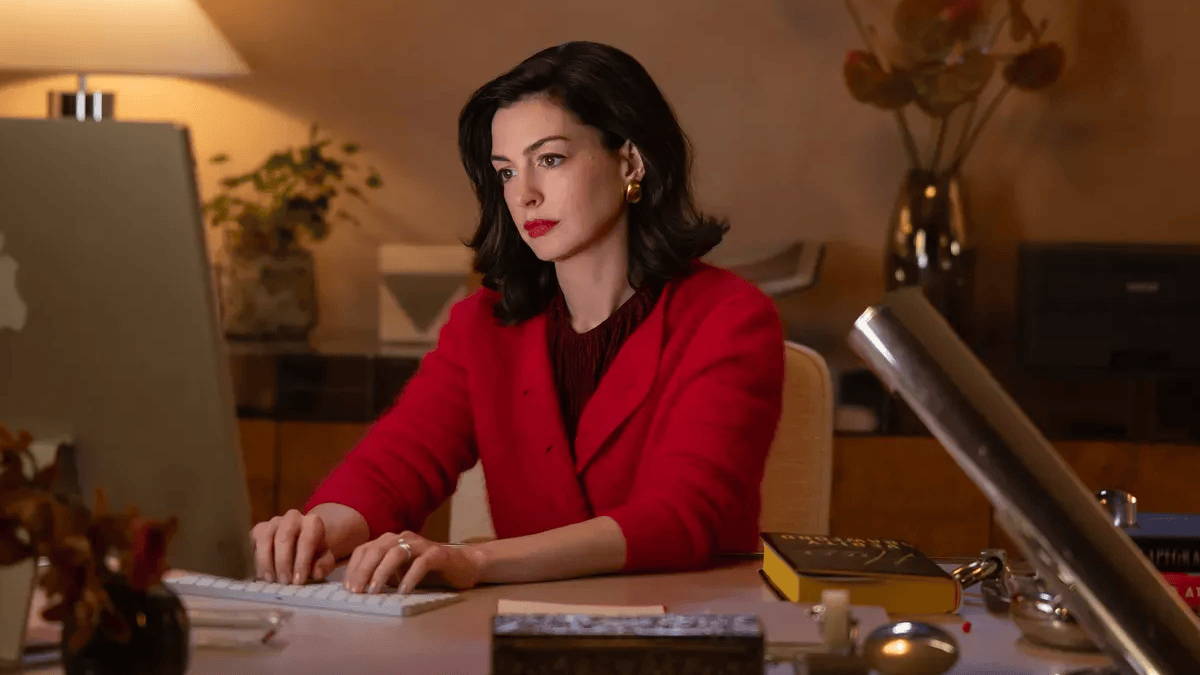
Things get weird when Lowen spies the stranger in her meeting. After Lowen and her agent Corey (Ismael Cruz Cordova) sign NDAs, the portent of the meeting is revealed. Verity Crawford (Anne Hathaway) was in a car accident, is unable to write and her handlers want Lowen to help finish her planned trilogy. Oh, and Lowen’s good samaritan is Jeremy Crawford, Verity’s husband.
I suspect most any author would jump at this opportunity. Lowen, however, turns it down because Verity’s readers know her voice and would recognize a ghost author. Jeremy has the perfect counter-arguments at the ready, though. Verity loved Lowen’s last book and specifically requested her, and she can up her asking price to half a million dollars.
Lowen naturally accepts, but with trepidation. She doesn’t like Verity’s books because they’re told from the perspective of the villain and Lowen’s a gentle soul. Corey, however, is glad that she put her qualms aside because he wants her to succeed–and to consummate their professional relationship. Lowen politely turns him down, and Corey’s surprisingly not a jerk about it.
The plan is for Lowen to stay with the Crawfords for several weeks, pull together Verity’s notes and come up with an outline for three books. The Crawford family home consists of glass walls and pointy arches, a modern castle. The place is nestled in the country and close to a lake. It’s a beautiful place that implies that authors of beach reads still make good money.
The movie’s Gothic touches come quickly once Lowen walks inside. Verity wasn’t just injured, but comatose. She even has an Eastern European caregiver around to give Lowen dirty looks. And the beautiful lake is where the daughter drowned. If you’re familiar with Jane Eyre, you’ve already got Lowen as Jane, Jeremy as Rochester and Verity as his demented wife Bertha.
Lowen’s job is dull at first, collating Verity’s notes and papers on the floor. To get into Verity’s head, she starts reading one of her novels and has dreams where she gets it on with Jeremy and then Verity. Mild kink for mom’s, basically. Things get interesting when Verity finds a thumb drive hidden in a pack of cigs.
The drive contains a manuscript by Verity that purports to be her autobiography, a chronicle of her wickedness. She describes herself as a maneater who marries Jeremy because he’s good in bed, marries him and regrets it when she becomes pregnant with twins. Her response is to be a very bad mom in private, but a happy homemaker when Jeremy returns home.
The worst part is when Verity admits to causing her daughter’s drowning. This disgusts Lowen, who now pities Jeremy as a victim of Pure Evil. Then, as if on cue, Lowen begins seeing the catatonic Verity looking at her and walking around. Could it be that Verity has been pretending the whole time? Jeremy insists that what Lowen says she saw is impossible, because there were tests and doctors concurred.
Lowen is convinced Verity is faking it, and she starts feeling…differently towards Jeremy. You can see where this is headed, straight to Sexy Love Triangle land. But how can Lowen expose Verity for who she is and steal Jeremy away from her at the same time? Luckily, she’s a writer who knows her way around a devious plot. Or at least she thinks she does.
Recommendation
The biggest challenge the filmmakers had in Verity is in convincing us that Dakota Johnson’s character is depressed, unmoored and even a bit shy. They attempt to do so by obscuring Johnson’s beauty with a very humble wardrobe consisting of baggy denim jeans and dark colored blouses. She also wears minimal makeup. I didn’t buy it for a second, because Johnson is ravishing in any outfit. At one point the director admits the futility of it all and includes a gratuitous shot of her in her underwear. The point being, Johnson can’t pass for a starving artist, so why bother trying?
The filmmakers do make good use of Johnson’s languid personality to explain why her character Lowen is stuck in neutral. It boils down to a lack of drive and passion. Since Johnson is listed as an executive producer I believe she thought Lowen was perfect for her. People often mock Johnson’s acting as boarding on narcoleptic, and she does seem to be acting from another dimension than the rest of the cast. With that in mind, a movie has to embrace her detached qualities or it will fail. Verity does this by making her acting style central to her character. Johnson has a range and when she stays within it, she’s quite good. It certainly helps that the camera loves her, and the movie obliges our voyeurism with the occasional eyeful.
The best performance in the movie belongs to Anne Hathaway, who snarls while delivering her juicy dialog. She’s having a blast playing a classic femme fatale, and her scenes are the highpoint of the movie. For reasons unknown, Johnson and Josh Hartnett never meet her level of sensuality. Hartnett looks handsome and gives a decent performance here, but there’s no edge to what Hartnett does, no hint of danger. After a few early sexy scenes, he’s reduced to being a bland PG dad.
Having Hathaway play the villain was smart because Hathaway’s emotionally-centered acting style contrasts nicely with Johnson’s low-energy delivery. It’s a pairing that should have generated sparks, but it doesn’t because Hathaway’s character spends most of the movie in a coma or in flashbacks.
With all of the above taken into account, it’s no wonder that Verity fails at being an erotic thriller. Johnson and Hartnett have no chemistry. Hathaway understands the assignment and vamps things up nicely, dragging Hartnett along in her wake, but it’s not enough. The eroticism on display never rises above being tepid.
Interestingly enough, Verity is much better as an examination of the power the written word has on the reader. Colleen Hoover, author of the source novel, is having a lot of fun playing up her own image as a writer of trashy novels. Like Verity, she knows she’s not creating great art but recognizes how transportive her stories can be. Readers of Hoover’s books want to be manipulated, and she’s happy to oblige. While Verity doesn’t offer anything new about the relationship between authors and their fans, what it does say is intriguing enough to make up for what the movie lacks.
Director Michael Showalter (Wet Hot American Summer) seems like an odd choice for the material. He directed the Hathaway May-December romance The Idea of You, which likely led to this gig. Comedy directors can make sexy thrillers, like Paul Feig (A Simple Favor, Housemaid). Showalter does what he can with the material, and the movie is decently paced and looks great. But he’s hamstrung by the flashback-heavy narrative structure, leading actors who don’t mesh and an overall lack of sexual tension in the movie itself.
Verity is the rare sexy thriller that offers little of either despite having three handsome leads at its disposal. It works best as a commentary on how even trashy writing can make the truth elusive and slippery. That and Anne Hathaway’s performance keep things interesting. Mildly recommended.
Analysis
It goes without saying that a movie with a title that means truth would play games with it. What I struggled with is what truth Verity is trying to convey with its concluding twist. For almost the entire length of the movie, the truth was that Verity Crawford was a narcissistic sociopath who killed her own daughter out of jealousy, because Lowen takes what Verity says in her autobiography at face value. If Lowen had stopped and asked why Verity would blatantly incriminate herself in a murder, she probably would have realized the book was a fictionalized version of events.
Instead, Lowen has Jeremy read Verity’s manuscript, which naturally enrages him. When Jeremy confronts Verity, she finally snaps out of her comatose act and pleads that she can explain everything, but it’s too late. Jeremy kills Verity, with Lowen’s encouragement, leaving Lowen free to enjoy Verity’s life in her absence. Lowen finally has everything she’s ever wanted, entirely guilt-free. Or so she thinks.
Lowen notices a loose floorboard in Verity’s office and finds a hand-written letter underneath. The letter casts doubt upon everything that Lowen (and the audience) believed was true. Instead of being evil, Verity explains that the manuscript was merely a writing exercise. The fictional version of herself admitted to the murder, a lie made in the service of learning how to write villains well. Verity goes on to state in the letter that she knows Jeremy tried to kill her and make it look like a suicide. Which would explain why she pretended to be comatose afterwards. Or does it?
The letter raises more questions than it answers, however. If she intended for Jeremy to find after she ran away and took Crew with her, why would she hide it where he might never find it? Verity goes on to say that she knows Jeremy tried to kill her. Which begs the question as to why Jeremy hasn’t tried to kill her since, while she’s incapacitated. Anna isn’t with Verity 24-7, so there would be ample opportunity for him to remedy his previous failed attempt.
But none of that begins to explain Jeremy’s heated reaction to reading Verity’s manuscript. If he’d read it before, he’s giving an Academy Award-level performance to Lowen when reading it again,.and then after having killed Verity for good. Jeremy simply doesn’t act like a man who wanted to kill his wife and gives it another try. His reactions are way too credible for a man who’s gone down this road before.
I believe Atwood is using the letter to make several points about the relationship between the author and their readers. The first is that effective writing can be very convincing. Lowen believes that the manuscript is telling the truth, only for the letter to make her question that assumption. In both cases, Verity controls the narrative because she’s a good writer, leaving Loren wondering which version of the truth is correct. In Atwood’s view, a good writer is a master manipulator who manipulates you like putty in their hands.
The second point is that Atwood uses Lowen’s quandary to symbolize how the goal of her novels isn’t truth, but entertainment. It doesn’t matter if the story doesn’t really add up in the end, so long as it was a good read. In my case, I’m fine with the movie leaving me hanging, provided the journey there had been more engrossing.
I’ll probably never be a fan of Atwood, but I respect her for using Verity as a roundabout way of her acknowledgement of the kind of writer she is. I wonder what her writer’s cave looks like.
Notes
Jennifer Connelly once played an unmoored young woman in The House of Sand and Fog. The story is that the makeup department rubbed dirt in her hair to make it less lustrous, because nobody would believe that a woman who looks like Connelly could ever be that bad off. As was proved with Sydney Sweeney in Housemaid and now Dakota Johnson in Verity, making a beautiful woman look plain using only hair, makeup and wardrobe choices is doomed to fail.
If Dakota Fanning can’t make vaping look sexy, nobody can.
I’m puzzled over how the movie makes a point of introducing Verity’s caregiver Anna (Irina Dvorovenko), only for her to play no role in the story at all. All Anna does is look at Lowen a few times with a steely glare.
Jeremy and Lowen witnessing the cyclist being struck by a car was pure coincidence. Strangest meet-cute I’ve ever seen.
I don’t understand why Verity’s (fake) condition wouldn’t require 24-7 care.
Verity not flinching when Lowen pushes a thumb tack into her hand is next level, Hannibal Lecter stuff.
The town police I don’t even want to get into how the police are willing to believe Lowen and Jeremy’s story, that a comatose Verity suddenly got up and walked into the lake.

