
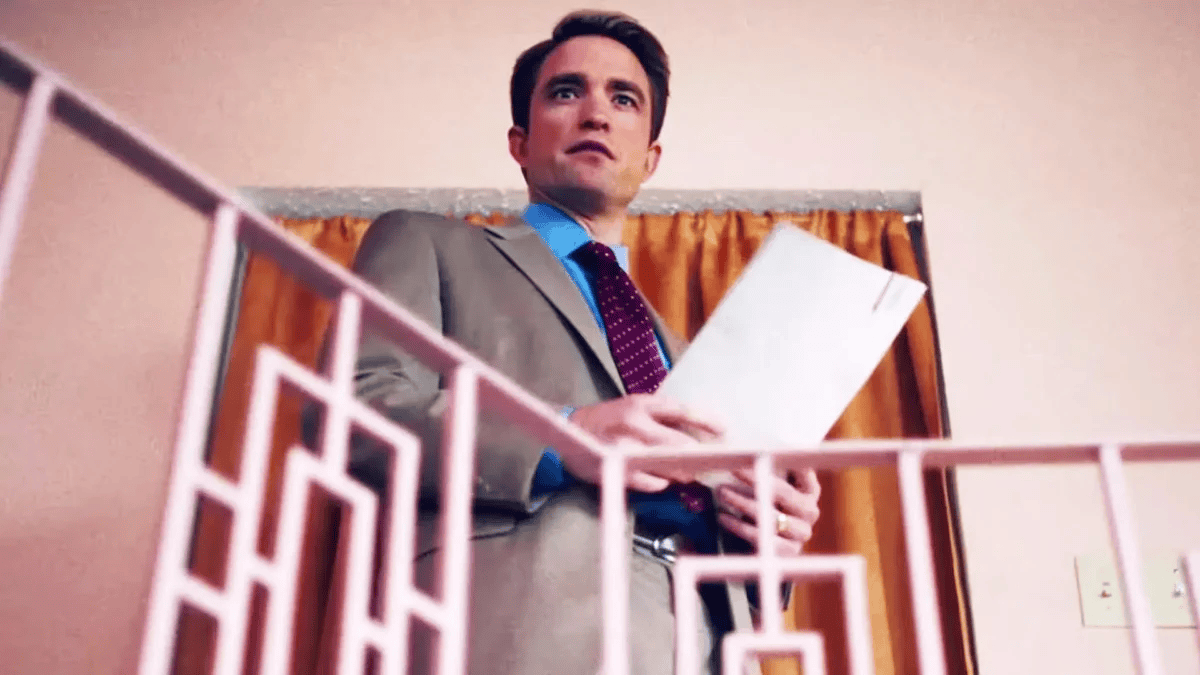
In hindsight, the idea behind Chris Hanson’s To Catch a Predator was brilliant. Take one part reality TV, one part investigative journalism, one part voyeurism, season with righteous anger and presto–out comes huge ratings. The sensationalistic pull of the show was hard to resist. Who wouldn’t want to watch child predators humiliated, handcuffed and dragged away by cops? The show delivered as promised, regardless of the ethical and legal concerns raised along the way. But what effect did the show have on those behind it, who compromised their morals in exchange for success? That’s the question the movie addresses, in the most audacious way possible.
To Catch a Predator was ground-breaking in how it was the byproduct of three entities working together. First was NBC News, who produced the show. The on-screen talent was reporter Chris Hanson (Robert Pattinson), who had ascended to the big leagues from local news. Assisting him was producer Andie Bender (Merritt Wever), who hired decoys like Dan Plum (Skyler Gisondo) and Del (Phoebe Bridgers) who were responsible for luring predators into the trap house.
The second entity involved is Perverted Justice, cyber vigilantes who troll chat rooms looking for men interested in having sex with underage boys and girls. The PJ working directly with TCAP is Xavier Von Erck (Matthew Maher), who trolls chat rooms for perps. Once he gets a willing participant’s phone number, he passes it off to the decoys who bait the hook.
The last group of the TCAP trio is the police, who nab the perp when they try to leave. It’s worth noting that the police are only involved at the tail end of the sting operation, the beneficiaries of the other two group’s work.
The star of the show is Hanson, who confronts each perp with a smug demeanor that borders on comical. In the movie’s opening scene, Hanson calmly tells the perp–an ex-Marine, no less–who he is and to take a seat. Then he confronts him over why he’s there, lacing the conversation with excerpts of the guy’s explicit chat room messages. The perp says that he’s recently divorced, as if that’s any excuse for wanting to rape a child. (Can you feel your blood starting to boil?)
The perp breaks down and begs for mercy. He doesn’t want his life to be over, and certainly doesn’t want to go to jail. Hanson then deceptively gives him a lifeline, saying he’s free to go. That’s when the final crescendo of the episode arrives in the form of law enforcement, who rush in, drop him to the ground, cuff him and drive him to jail.
If you only watched the show, you would think Hanson was a real life superhero in every way, but he’s actually an incredibly flawed human being. As a reporter who’s always on location, Hanson rarely sees his wife Mary (Anna Faris) and their two sons. She knows he’s had affairs, and he promises to be a better husband. His philandering proves to be his Achilles heel, which leads to him making spectacularly bad choices later on.
Hanson is openly envious of NBC Nightly News reporter Stone Phillips, a real reporter who reports live from Afghanistan. In comparison, Hanson is a bottom-feeder who parades degenerates on TV in the guise of “delivering justice”. Unlike Phillips, Hanson commands little respect outside of old folks and backwater types who profess their love for his show.
NBC programming director Jeff Zucker (playing himself) hates Hanson’s show but loves its ratings. NBC needs something to go up against ABC juggernaut Lost, so Hanson’s show is moved to primetime. Take that Stone Phillips! But a prominent evening slot brings enormous pressure, which makes everyone involved go kinda nuts.
The first problem to arise with the TCAP machine is when Del refuses to go on because of some highly questionable merchandise being sold on the show’s website. (Of all the things to have qualms about, a thong with one of the show’s catchphrases emblazoned on the front seems trivial.) Dan Plum, who hails from Fort Meyers, Florida, dreams of being an actor and jumps at the opportunity. He presumes it’s a real acting gig, only to find out that he was hired because he can easily pass for being underage.
On his first day, Dan is thrown directly into the line of fire without a rehearsal. He’s understandably nervous and flips out when the perp reveals he brought his own dessert topping and exposes himself. When Andie’s pep talk fails to calm Dan down, she asks Hanson to befriend him. After giving her his “I don’t mingle with the help face”, Hanson agrees.
Over drinks, Hanson tells Dan why he does his show. Hanson’s story of encountering evil while reporting in India sounds rehearsed, a monologue he’s delivered on cue many times before. It keeps Dan in the fold, which is all that matters. After some coaching from Del, Dan learns to not look at his job as an acting gig, but his chance to help catch bad guys. Another superhero is born!
Unfortunately, Predator is getting beaten by Lost. Making matters worse for Hanson is a reporter from the National Enquirer who threatens to destroy Hanson’s image by revealing his affair. Convinced that a headline-grabbing episode will take the heat off him personally and professionally, Hanson decides to pull out all the stops to land Xavier’s white whale, a prominent elected official. Spoiler alert: it doesn’t end well.
Recommendation
Primetime’s approach to Chris Hanson and To Catch a Predator is very limited. It doesn’t address the legality surrounding the show itself, specifically the troubling use of private individuals and members of a news team in aiding law enforcement. Nor does it ask any probing questions about the fatal incident that resulted in the show being cancelled. If you’re interested in a more nuanced discussion of the show, I highly recommend you watch the 2025 documentary Predators and read the Esquire article “Tonight on Dateline This Man Will Die”.
What Primetime does is focus on how the show’s queasy moral compromises have brought out the worst in all involved, especially Hanson. As gamely portrayed by Robert Pattinson, Hanson sold his soul for fame and turned into a performative ghoul. His on screen persona is a carefully manufactured combination of swaggering reporter and righteous vigilante. When not on camera, Hanson struggles to connect to those around him as human beings, reacting out of envy, rage or fear. I’m not sure I’ve seen a character this outlandishly creepy since Jake Gyllenhaal in Nightcrawler, a possible inspiration for what Pattinson’s going for here. Pattinson’s Hanson is mercurial in the extreme, unhinged and unpredictable at any moment.. The performance is brilliant, among Pattinson’s best.
Representing the lost innocence aspect of the story is Skyler Gisondo’s Dan, or “Decoy Dan” as Hanson calls him. Gisondo is responsible for conveying the film’s underlying theme, which is how easy it is to ignore your conscience in pursuit of success. Gisondo’s performance is the only remotely human one in the movie, and the way he makes us feel Dan’s growing unease with what he’s asked to do is incredibly affecting.
To represent the warped reality of the show, director Lance Oppenheim uses every trick at his disposal to make us uncomfortable. Sets are garishly lit with contrasting colors, the score is unnerving to the point of being irritating, actors are filmed in tight closeups and the camera is tilted at odd angles. The film then uses a 4:3 aspect ratio to make the experience even more queasy and claustrophobic. Movies have used techniques like this before, for dream sequences or when a character is on drugs. In Primetime, however, nearly every scene looks off in one way or another. The bigger the screen you see this on, the more intense the experience will be.
The movie has several other notable performances as well. Merritt Wever is hilarious as the producer, who at one point insists she can work with an on camera suicide. Matthew Maher is sublimely off-putting as the Perverted Justice guy who’s dedicated his waking hours to luring perverts into a trap. I like how Phoebe Bridgers’ decoy Del was a nymph for both sexes and discusses the job with a matter-of-fact casualness. Bokeem Woodbine plays Sheriff Gunn satirically, which I expected with a name like that.
While I was entertained by Primetime, I was frustrated at how conspicuously superficial it was. The movie is too satisfied with its “look at how morally compromised these people are” angle and refuses to dig deeper into these characters and their motivations. What the movie shows is disturbing, but only insofar as making us understand what it would be like to live in a funhouse with freaks as roommates. There’s plenty of style and craft on display, but no context and very little insight.
Robert Pattinson continues his 2026 hot streak with his over-the-top portrayal of Chris Hanson of To Catch a Predator fame in Primetime. The movie effectively depicts what it was like to live within the bubble of the show, but leaves critical thinking at the door. Recommended.
Analysis
As I mentioned above, Primetime provides no historical context for the story it tells. If you walked into this movie cold, with no knowledge of Chris Hanson or To Catch a Predator, the experience probably would be baffling. How did this show come into being?
To understand TCAP, you have to go back to 1947 and Alan Funt’s Candid Camera. If you’re not familiar with the show, Funt and his crew would pull pranks on unsuspecting people with the camera rolling. When the prank had run its course, Funt would emerge and tell the person, “Smile, you’re on Candid Camera!” Funt and the target would share a laugh, telling the audience that the target was fine with being poked fun at. What happened was all in good fun and completely harmless.
My understanding was that the people on Candid Camera weren’t paid for their participation. They were happy with being part of the show because it briefly made them celebrities in the eyes of their friends and family. Being duped was a small price to pay for being on a national television show.
America’s Funniest Home Videos, which first aired in 1989, simplified the concept. Instead of having scripted pranks , the show aired content submitted by viewers. AFHV was much cheaper to produce than Candid Camera while delivering the same kind of viewer experience. People were laughing at other people engaging in various pratfalls, again all in good fun. Those who submitted videos could handle being laughed at.
Then came the arrival of the sensationalized afternoon talk shows like The Morton Downey Jr. Show (1987) and The Jerry Springer Show (1991). These programs paid people to appear and reveal their embarrassing secrets in front of an in-house audience. Usually the participants were given shocking information during filming, prompting hostile reactions. The verbal confrontations often would turn violent. The good-natured atmosphere of Candid Camera and AFHV had been supplanted by antagonism and embarrassment.
The Nineties also brought the arrival of reality TV, with The Real World (1992) providing the template for what followed. These programs made regular people (or non-actors) the stars of the show, with the hook being that the audience would get to them in unscripted situations. That latter part was eventually revealed to be mostly untrue, with producers often being responsible for generating conflict and then editing the outcome for maximum drama.
A common theme of daytime talk and reality shows was entertainment via humiliation. Accordingly, these shows enable the viewer’s sense of superiority over the people on camera. Watching people willingly make fools of themselves makes the viewer feel better about themselves in comparison. I would never do something so stupid. Only an idiot wouldn’t realize his partner was cheating on him. Look at those people doing dumb things after getting crazy drunk. And so on.
Another show that likely inspired TCAP was Fox Television’s Cops (1989), a reality show devoted to law enforcement confronting, pursuing and apprehending suspects. The show was so popular the theme song has become firmly embedded in the cultural lexicon. Cops made watching law enforcement fun because it depicted the confrontations in basic good guys versus bad guys dichotomy, with the handcuffing scene being money shot.
Hanson cut his teeth as an investigative reporter, first for local television stations in Michigan before rising to NBC news and Dateline. I believe I’m safe in assuming that he was very familiar with hard-charging reporters confronting crooks on camera to embarrass them. Local Detroit reporter Rob Wolchek was on WJBK for nearly thirty years and his calling card was his “Hall of Shame” segment.
What Hanson did with TCAP that was unique was to combine reality TV, investigative reporting and law enforcement in one format. He would be the hard-charging reporter, the perps would be the humiliated reality TV show victims, and law enforcement would provide the Cops-inspired closure. In terms of a new formula of entertainment, TCAP was ground-breaking and envelope pushing, both of which would eventually lead to its demise.
Unlike Cops, the sting operations in TCAP involved perps who wanted to commit serious crimes but were secretly entrapped. Additionally, law enforcement wasn’t involved with setting up the stings. That was left to Perverted Justice, a group of private citizens who would troll chat rooms and reel in perps with the promise of underage sex.
The objective of every TCAP segment was the same as any other reality TV show, namely to humiliate people on camera for entertainment purposes. It cloaked that objective with an air of righteous indignation, delivered by Hanson when he walked in on the unsuspecting perp. The men then would cry and beg for forgiveness before being led away in handcuffs. The intent of TCAP was twofold. First, make the audience feel superior to those who are caught with their pants around their ankles, figuratively and literally. Second, make them feel like they are assisting the operation simply by watching the show.
The problem with TCAP was that it can only take things so far. To keep the format from growing stale, it needed to seek out bigger targets, which the movie shows led to Hanson’s downfall. In his pursuit of higher ratings, he sought a visible target in a position of authority. What better way to improve ratings than by leading away a district attorney in handcuffs? And when that perp wouldn’t play the entrapment game, then he needed to be confronted in his home so that he would be sufficiently humiliated in front of the world.
When Hanson’s last target killed himself before could be apprehended, his act represented the unspoken endgame of “embarrassment television”, which is live snuff. If you humiliate someone to the point they see no point in living, killing themselves becomes the only option. In that regard, TCAP was precinct. Years later, the internet and social media would become the source of “kill yourself now” videos that bullied the targets into commit suicide, and some did.
Social media has taken the concept of life death from humiliation to a whole new level. There was a troubling incident back in 2016 where a depressed twelve year-old girl broadcast her own hanging. It took several weeks for Facebook to remove the video, a sign that the platform was reluctant to remove a source of revenue, no matter how disturbing. Recent incidents of live-streamed deaths point to how what led to TCAP’s cancellation may soon come to fruition. Someday, we’ll be able to watch someone die in real time and give a thumbs-up or down on the performance. Maybe Hanson can be the host.
The man and his mask
Having seen and heard Chris Hanson before seeing Primetime, I recognized that Robert Pattinson’s performance is a highly stylized version of Hanson. To paraphrase Spinal Tap, Pattinson turns Hanson up to eleven for maximum effect. Why does he do this?
On one level, Pattinson wants to show how someone like Hanson becomes their public persona. Hanson projects himself as a crusading vigilante, and his mannerisms are his protective armor.. When he walks in on a perp and confronts him with his exaggerated investigative reporter voice, the perps (usually) turn into a quivering pile of goo. Pattinson is showing how Hanson’s voice, gaze and demeanor are his weapons. And with one notable exception, they’re sufficient to keep the bad guys at bay.
Another way of interpreting Pattinson’s performance is that he portrays Hanson as a method actor who can’t turn off the method. He’s played “tough-talking investigative reporter” so much that he can no longer be a regular guy. This would explain the odd behavior Hanson exhibits in the movie. He can no longer communicate with his family as a father or a husband. He doesn’t know how to break things off with his mistress and reverts to treating her as a child. He dramatically spits out his mouthwash. His way of reassuring Decoy Dan is to recount one of his news stories. The “normal” Hanson was subsumed by his alter ego and is no longer available for questions.
Blinding ambition
One aspect of Primetime that comes through loud and clear is that ambition is the reason why everyone involved with TCAP ignores the moral, ethical and legal questions their show raises.
Everyone involved with the show wants something out of it. Hanson wants to supplant Stone Phillips as NBC’s top reporter. Producer Andie wants to be the one getting credit for making the show a hit. Perverted Justice guy Xavier wants bragging rights for landing a white whale. Dan wants his SAG card. Ambition clouds everyone’s judgement. They refuse to see any problems with what they’re doing because the show is their ticket to fame and money. They’ve sold their souls for ratings.
Blurred genre lines
Is Primetime a horror movie? It certainly adapts the cinematic language of horror movies in the latter third, in how Hanson is depicted as a monosyllabic force hell-bent on landing the white whale. He’s often shown standing like Jason or Michael Myers, still but ready to pounce on an unsuspecting victim. The climactic scene at the District Attorney’s house is framed and lit like a haunted house. The movie’s characters also look like they’re inspired by Dracula, with Dan as Jonathan Harker, Hanson and Dracula and Xavier as Renfield. That said, I don’t see Primetime as a horror movie. Wearing someone’s clothes doesn’t make you that person.
Seeing Primetime with a full audience convinced me that they considered the movie to be a comedy. They laughed when Dan affected his “decoy voice”, and he’s shown shaving his chest, for example. These are cringe moments, but not like scenes from The Office.
The audience also laughed at Hanson’s bizarre behavior, like when he shouts “Decoy Dan!” and spits out his mouthwash. Pattinson clearly is playing-up Hanson’s weirdness, so laughs are justified. However, I felt that the audience was laughing at Hanson because they thought he was a wild and crazy guy, like Jim Carrey in his heyday.
The vibe I got from the audience was that they viewed Primetime as a broad comedy, not a dark comedy. I’m not saying the movie isn’t funny or that the audience shouldn’t have laughed, but I felt they were laughing for the wrong reasons, if that makes any sense.

