
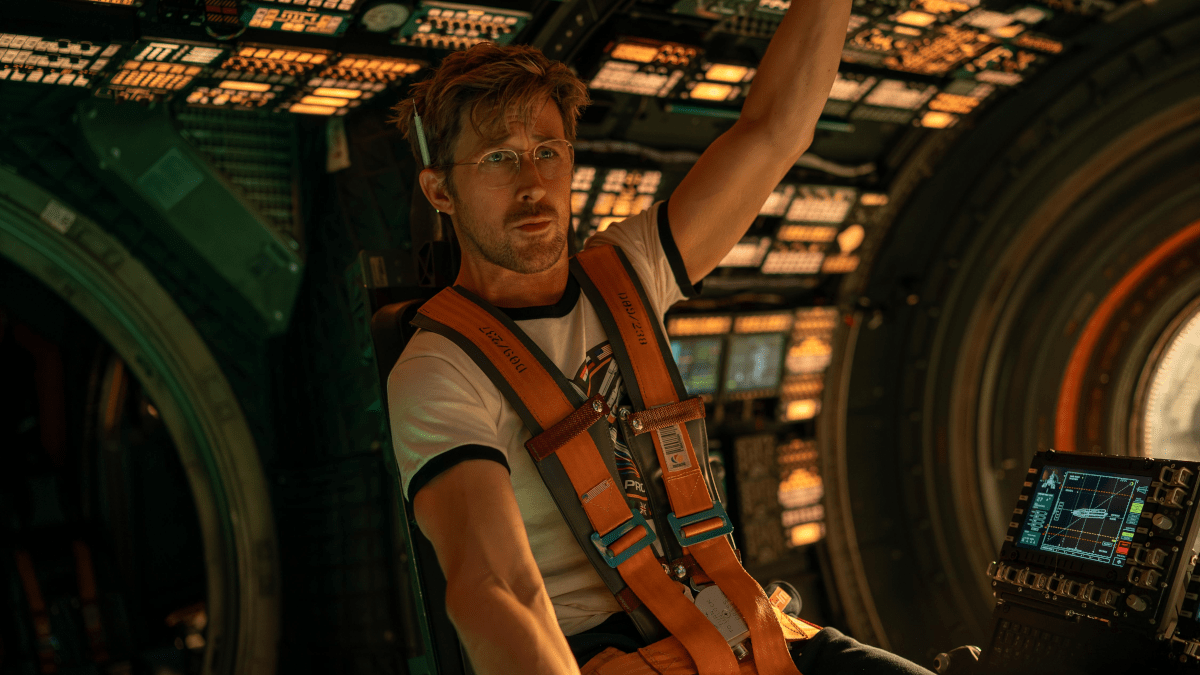
Science fiction doesn’t always need to be about doom and gloom. Yes, pessimism is certainly justified during this period in human history, when lives are increasingly experienced via screens and AI promises to do all of our thinking for us while it consumes our water in the process. That said, science is still important and the scientists who wield it can accomplish great things when called upon. There are reasons to be optimistic about both, which is ultimately the message of Project Hail Mary. That and aliens don’t want to meet us to eat us.
Before getting to the feel-good parts of the movie, of which there are many, we see astronaut Ryland Grace (Ryan Gosling) when he is awakened from hibernation aboard a space craft. He doesn’t remember who he is and is greeted by a handsy robot. As he slowly regains use of his body, he discovers that the other astronauts on board are already dead. Before long Grace figures out via the ship’s computers that he’s 118 light years from earth, so there’s no going back now. If there’s ever a time to hit the hidden stash of Vodka, now’s the time.
Between bouts of existential despair, Grace remembers how he wound up traveling through space. His resurging memory is given in the form of flashbacks, which reveal that before “this happened” Grace was a beloved grade school science teacher. He wrote a paper that insisted that extraterrestrial life needn’t be based on water, which vaporized his career as a molecular biologist. Ironically, Grace’s paper is the starting point of his space journey
For some reason, an alien life form named “Astrophage” has been siphoning energy from the sun and has formed a conga line towards Venus. If left unchecked, the sun would dim in thirty years, threatening all life on Earth. Without sunlight, crops wouldn’t grow. Without crops, there’d be no food to eat. And without food, well, say goodnight, humanity. If the plot reminds you of Christopher Nolan’s Interstellar, you’re not alone.
Grace is approached by Eva Stratt (Sandra Hüller), the head of an international coalition that’s focused on finding a way to stop the Astrophage from doing what they’re doing. They have a sample of the alien species and ask Grace to determine how to kill it. Ironically, Grace discovers that it’s water based, which further discredits his paper. But he also learns that it’s attracted to light and emits energy upon exposure. I won’t spoil why Venus is involved, other than to remind you it’s the most romantic planet in our solar system.
Now that Grace has proven his science bone fides, Stratt reveals that Astrophage isn’t just threatening Earth. The alien species is also behind the dimming of hundreds of stars except one, Tau Ceti. For reasons unknown, that star hasn’t been affected while also having a thread to a nearby planet. Which is why Stratt has commissioned a space craft and trained a crew to head to Tau Ceti. They will observe and hopefully send a cure back to Earth. The kicker is that given the distance and limitations of using Astrophage for fuel, it’s a one-way trip. This explains Grace’s despair in space. The more he remembers, the more he realizes that he’s doomed regardless of whether he saves Earth.
As Grace’s ship approaches Tau Ceti, another ship that’s a weird assemblage of tubes greets him. Grace tries evasive maneuvers, presumably because he’s seen Alien one too many times. The other vessel follows him, however, mirroring his every move. When both stop, the vessel lobs a cylinder over at him. Grace misses the first one, but the alien helpfully lobs a second one more slowly. Grace analyzes the container and discovers that it consists of an earthbound gas, but in solid form. Fascinating.
Upon opening the present, Grace finds small facsimiles of his ship and himself, like puppets. Grace figures that whatever is on board the other ship wants to talk, and his guess is right when the other ship extends a platform connecting the two. Grace wanders over and is scared out of his wits when the alien rushes over to greet him. Grace understandably runs away, but then he sees that the alien, who looks like a spider composed of rocks, mimics his every move. The little guy wants to communicate, which is a relief to Grace because being eaten is no fun.
Stealing a page from Denis Villeneuve’s Arrival, Grace maps the alien’s vocalizations to words, and soon the two are chatting away. Grace nicknames his alien buddy Rocky, because, well, he looks like a pile or rocks. As it turns out, Rocky’s planet is also threatened by the Astrophage, so the two of them have a common mission. Can these two unlikely space buddies unravel the mystery behind Tau Ceti and save both of their worlds? Will Grace learn the value of friendship? Will this movie make you cry? (Mission Control says all are a “go”.)
Recommendation
Movies that depict science, scientists and space travel in an optimistic light are rare. The last one before Project Hail Mary was The Martian (2016), and the two movies are so similar in themes and execution that I probably would have guessed that the former was also adapted from a book by Andy Weir.
Like Martian, PHM is also about a scientist who undertakes a dangerous mission in outer space. Both heroes are not steely-jawed types, but quirky, quippy, resourceful and love science. For these atypical heroes, science is their oxygen. The heroes of these Weir space adventures are nerds. If another one of his books becomes a movie, Weir should get his own sub-category of science fiction: “Weir-d Tales”.
The Martian and PHM do have very different objectives. The former is a survival and rescue mission, while the latter is pure adventure. PHM notably doesn’t focus on science that much, and instead emphasizes the awe of being in space and then meeting an alien species. I read online that PHM is like a Star Trek story and the comparison is appropriate. Like Trek, PHM also presents an optimistic vision of humanity, where people come together to avert an existential crisis, and turn to scientists for help. I hate being cynical, but the movie’s can-do spirit and respect for science feels anachronistic considering how much both have been attacked in recent years.
Much of the movie rests upon Ryan Gosling’s shoulders, and he’s more than up to the task. His performance stands in stark contrast to his closed-off and tightly-wound Neil Armstrong in First Man. This movie lets Gosling let his hair down and he has a blast playing Ryland Grace. He brings the same playful charisma we’ve seen before (Barbie, The Nice Guys), which keeps the movie light and engaging.
Gosling’s recent work reminds me of Bill Murray’s career at his peak. Gosling isn’t as ironic as Murray, but he enjoys playing the class clown. Like Murray, Gosling plays underachievers and goofballs to perfection. You root for Ryland Grace to overcome whatever obstacles come his way because he’s an amusing dude you want to hang out with.
The other half of PHM’s odd couple, Rocky, is a puppet. (James Ortiz provides his “voice”.) Instead of going the easy route of CGI, the filmmakers went with a practical approach, and the results are amazing. Rocky not only looks real, but having it occupy the same physical space as Gosling’s character makes their interactions credible. I don’t know if other studios will follow PHM’s example, but the use of practical effects makes the movie feel authentic.
Co-directors Phil Lord and Christopher Miller, who haven’t directed a live-action film in twelve years, also deserve a lot of the credit for PHM. For a tandem who’ve never directed a science fiction film before, they’re naturals. Although the Earth-bound scenes are very funny, the movie soars when it’s in space. The way Lord and Miller depict space ships navigating the cosmos is beautiful and awesome.
While Project Hail Mary is a thoroughly enjoyable space-set adventure yarn, what makes it special is its unbridled optimism for humanity and science. This feel-good movie unironically believes that when the chips are down, we’ll rise to the occasion. I sincerely hope that’s true. Highly recommended.
Analysis
As someone who’s worked in technology for his entire career, I’m sensitive to how my field is portrayed in the media. Technically I’m a computer scientist, but I call myself a programmer because that’s easier for people to understand than “application architect” or “lead software engineer”. I’m a guy that spends eight hours a day clicking away at a keyboard, writing code for companies who pay me well for the service. It’s been a rewarding career with its ups and downs, but I have no complaints.
For several years now, I’ve been aware that some people have very negative feelings towards science and technology. Not my realm of expertise specifically, but in general. People have become enraged with those fields, sometimes justifiably because of self-induced errors. Other times it’s because of baseless conspiracy theories. In both cases, you have an adversarial relationship with everyday people on one side and science and technology on the other.
There was a time when people enjoyed social media and streaming services. Now, both have been saturated with advertising and driven by algorithms that make the experiences of both unpleasant, to put it mildly. For example, there was a time when advertising on Facebook was minimal. Now it appears constantly, with algorithms minimizing posts by your contacts over those from advertisers. Similarly, streaming services initially promised unlimited content with no advertising. Now you have to pay a high monthly rate to not have advertising.
On the conspiracy side of things, uninformed people loudly insist that they know more than scientists and distrust established scientific advances. Fluoride has been a boogeyman for a long time, and communities have discontinued its use in favor of other methods of protecting teeth that require intervention. Suddenly, something nobody needed to think about now must develop routines in order to prevent tooth decay.
Vaccines have been under fire for a long time as well. Now that there are an increasing number of people exempted from the universal requirements due to their “religious beliefs”, we have outbreaks of the measles the likes of which haven’t been seen in decades.
Climate change is an existential threat to human existence with plenty of scientific evidence, but it’s considered to be a hoax by many. Efforts to lessen its impact on the plant have been diminished substantially, which will only make things harder for the next generation to remediate, if it’s even possible. The regular occurrence of temperature records being broken, the most obvious sign that things are getting worse, also fails to convince the deniers as well.
And now we have AI. After willingly enslaving ourselves to our phones and electronic devices, this technological advance promises to think for us while simultaneously eliminating the need for huge chunks of the workforce. This is without even considering the significant environmental impact of data centers, which is vastly understated by its proponents. A future where nobody can think for themselves, have no job prospects and no clean water to drink doesn’t sound like progress, does it?
As you can tell, I’m pessimistic about the future. Which is why Project Hail Mary struck me as something from a bygone era, in that it has no doubt that science will yield the answer to an existential problem. It also firmly believes in the ability of scientists like Garland, and that his findings are trustworthy. Nobody questions whether he skewed the data to prove a point. There is no disagreement from the team, who accepts his results and moves onto the next problem.
Even more notable is that the international coalition led by Eva Stratt faces no outside interference. They operate independently and have sufficient budget to build a spacecraft and train astronauts. She’s the unquestioned leader of the group and everyone acts respectfully towards each other.
Nobody from the outside tries to sabotage the mission, either. This was a plot point in Contact (1997), when religious types blew up Jodie Foster’s vessel. It also happened in Arrival (2016), when rogue military soldiers bombed the alien spacecraft. When the spacecraft explodes In Project Hail Mary, it’s due to an accident resulting from handling the volatile Astrophage fuel.
Which brings me to the movie’s unlikely hero, Ryland Grace. In another film, Grace would be the quirky sidekick, the guy back on Earth who bails out the actual hero out of a (space) jam. In this movie, he’s the hero, albeit a reluctant one. (More on that in a bit.) His unconventional thinking is what makes the mission possible, helps him bond with an alien, decipher what can kill Astrophage and saves both his and Rocky’s home planets. Project Hail Mary is a love letter to science nerds and how they’re the only thing standing between life as we know it and oblivion.
I don’t know when segments of society became so rabid towards science and technology, but the last movie like PHM was 2015’s The Martian. It too featured an unlikely science nerd as the hero and the entire planet intent upon saving him. The interval between these films has felt like eleven years of rabid negativity towards scientific advances. Hopefully, we won’t spend another eleven years collectively wandering in the wilderness.
All hail the reluctant hero
For the most part, Project Hail Mary is very predictable. The biggest surprise involves the late reveal of how Grace happened to be aboard the spacecraft headed for Tau Ceti. In one of the last flashbacks to Grace’s pre-voyage time on Earth, we see that Eva Stratt was forced to subdue him and force him aboard to save the mission. Grace certainly did heroic things after he accepted that he was never going home, but before then he was a coward who didn’t step up to the plate when asked.
I’m not sure I’d respond differently if I were in Grace’s shoes. What’s better, to die in space alone, or die on Earth in thirty years? It’s easy to say that Grace should have agreed without hesitation, but who really wants to die the way the other astronauts did? At least they had time to make peace with their fate before they signed up for the one-way trip. Grace had all of three hours to decide and then was strong-armed into the role.
A character who begins as a coward but evolves into a hero is a familiar trope in the movies. Without thinking too long about it, I recalled the Hobbits in The Lord of the Rings trilogy, Tom Cruise’s character in Edge of Tomorrow and Joseph Quinn’s character in A Quiet Place: Day One. In each of these cases, characters who were terrified worked past their fear and became heroes. Like them, Grace becomes a hero despite his best efforts. And in eventually becoming a hero, he joins a finite list of characters who were strong-armed into doing the right thing and ultimately delivered.
My friend, the alien
Bugonia marked the welcome return of the sweaty, paranoid thriller about aliens living amongst us. Project Hail Mary belongs to another of my favorite science fiction subgenres, a story about first contact that’s agreeable to both parties. ET is the most popular movie ever made about this theme, but its success only inspired only a handful of movies, like Joe Dante’s Explorers, The Last Star Fighter and Star Man.
Although I’ve used the word optimism repeatedly in this piece, it also fits the movie’s depiction of how humans and alien life forms could learn to work together and even become friends. Science fiction films that feed on our xenophobia of “the other” may be scary and popular, but I’d like to see more films that speak to how things could go well when first contact happens.
The Interstellar connection
Twelve years ago, Christopher Nolan’s Interstellar was released. Like PHM, it’s about a reluctant astronaut who goes into space looking for a way to save humanity from extinction. Both films use practical special effects for the sidekicks (TARS and Rocky), feature realistic space ships and incredible vistas in outer space.
What distinguishes the two is their tone. Where PHM is a rollicking adventure, Interstellar is serious and grim. The difference between these films is due to the nature of the heroes. Ryland Grace is alone and has no family, so his concerns boil down to dying alone in space instead of dying alone on Earth. Interstellar’s Cooper (Matthew McConaughey), however, has a family he’s leaving behind to grow old and possibly die before he returns. While Interstellar has many exciting moments, it’s a sad film, permeated by loss and regret.
Generally speaking, both films are about self-sacrifice. Cooper willingly gives up his family life, while Grace refuses to do so. While it’s great to have people like Cooper willing to give their all to save the world, it also makes sense to have people like Stratt in place who won’t take no for an answer.
 Detroit Cineaste