
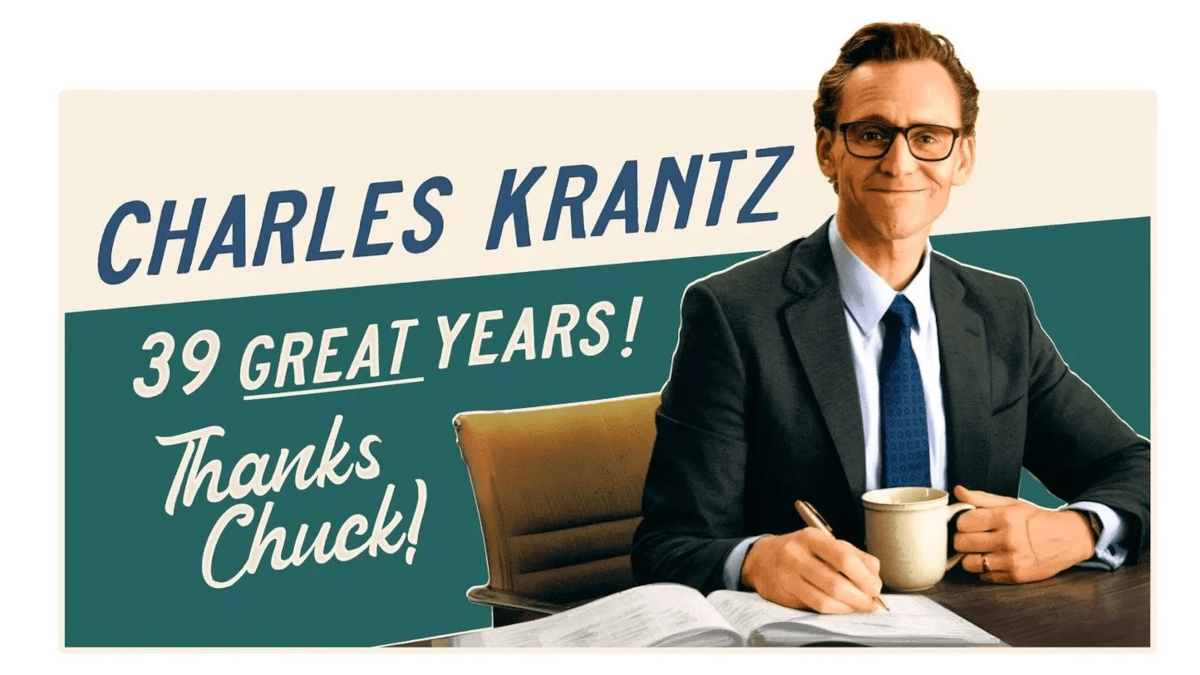
There’s nothing like the end of the world to trigger some self-reflection. If our world was actually dying, I’d probably think about what my life has meant to me and everyone I’ve met along the way. Call it soul searching, or an existential crisis if you’re so inclined, but this is what Life of Chuck is about, pondering the meaning of our lives right before the lights go out permanently.
After the title card states “Act One: Thanks, Chuck!”, we’re taken to Middle-school teacher Marty Anderson’s (Chiwetel Ejiofor) class. A student recites Walt Whitman’s “Song of Myself” when an ambulance screams by. Everyone watches it pass with mild apprehension. Later, news that a chunk of California has fallen into the ocean evokes concern, tempered by the fact that it’s just one of a series of spectacular disasters. The end of the world has arrived, and it’s so overwhelming that people are burnt out by it.
Marty’s also holding parent-teacher conferences, because that’s his job. The parents, however, are too distracted to care about Marty’s assessments. One couple asks how their child can do assignments without the internet, which keeps going out. Marty says that the school library still exists. Ah yes, the ancient technology of books. A single dad bemoans how his wife left him and their son to be with her high school sweetheart, but what really bothers him is not having access to PornHub. “That’s just cruel,” he says, and Marty chuckles.
Nurse Felicia Gordon (Karen Gillan) is also trying to do her job under bleak circumstances. Her colleagues have stopped showing up except for Bri (Rahul Kohli), who mentions that most of his patients are attempted suicides. Like Marty, Felicia and Bri are desperately holding onto the scraps of normalcy that remains, like the musicians playing while the Titanic sank. Routine is all they have left.
The next morning, Marty’s neighbor Gus (Matthew Lillard) advises him to avoid a huge sink hole that just opened up on the main road. Gus adds that there are dozens of cars at the bottom of it with people who aren’t coming out, then laughs nervously. Marty is shocked by this news, and listens patiently while Gus discusses several recent calamities with morbid fascination. It’s interesting when people die, right Don Henley?
That night, Marty is surprised by a call from Felicia, his ex-wife. She’s looking for comfort from Marty, who turns to Carl Sagan for perspective. Sagan once used a calendar to explain that humanity is a blip in the history of the cosmos. Marty points out that what’s happening now only encompasses a few seconds on December 31, implying that their lives are insignificant. Marty may mean well, but I doubt anyone ever invited him to their parties.
Amidst the planet’s death throes, a curious thing has been happening around town. Billboards, signs, television, commercials and even sky writing have thanked someone named Chuck (Tom Hiddleston) for his 39 years. Marty asks a lady from the local insurance company if they’re behind it, but no. Nobody knows who Chuck is.
When all the television stations go offline, Marty decides to walk to Felicia’s house. He meets Sam the mortician (Carl Lumbly) and the two of them have a friendly chat along the way. Considering what’s happening, everyone is calm. Maybe this is the nicest neighborhood on Earth, where everyone has accepted their fate without panicking. When Marty reaches Felicia’s house, the power goes out all over town. The only light is from the stars and images of Chuck beaming from windows.
As Marty and Felicia chat, the movie cuts away to a man in a hospital bed on life support. This is Chuck, and his wife and son are nearby, crying. How is he connected to the doomsday scenario that’s also taking place? Before the movie gives us that answer, stars disappear from the sky above Marty and Felicia. When Chuck’s heart monitor stops beeping, everything goes black.
Act Two (“Buskers Forever”) takes us back nine months earlier, before Chuck’s illness. A wry narrator (Nick Offerman) explains where Chuck is at this point in his life. He works in finance and is in town for a convention, participating on several panels. He enjoys the experience, but keeps to himself afterwards. He’s a fiercely devoted husband, meaning that he never stepped out on his wife while out of town. In short, Chuck is a stand-up guy, a hard worker, a family man and boring.
While Chuck walks around the promenade, a busking drummer named Taylor (Taylor Gordon) Chuck causes him to stop in his tracks. The beat stirs a memory from his childhood and he begins to dance. Not awkward White guy dancing, but actual dancing. A crowd gathers to watch him, and Chuck invites Janice (Annalise Basso) from the crowd to join him.
Janice had been having an awful day before that moment. Her boyfriend broke up with her by text message, which reminded me of Carrie on “Sex and the City” getting word via a Post-it. However, the drumming and Chuck’s dancing helped get her mind off her troubles, and she surprises herself by accepting Chuck’s invitation to dance with him. Turns out they’re both excellent dancers and the crowd is thrilled. When Taylor ends the set, she gives Chuck and Janice their cut of the tips. They try to decline but Taylor insists. She also tries to recruit Chuck and Janice for future gigs, but they decline. Taylor asks Chuck why he danced, and he says he doesn’t know why. Well, Act One will explain why, even if Chuck is too shy to admit it.
I hesitate to say much about Act One because doing so would spoil all of the movie’s surprises. It takes us back to when Chuck (Benjamin Pajak) was in grade school. He recently lost his mother, father and unborn sister to a car accident. Chuck lives with his paternal grandparents Albie (Mark Hammil) and Sarah (Mia Sara). As we observe Chuck’s childhood existence, we find out why Chuck is such a good dancer, how he wound up in finance and what his life has to do with the end of the world. Trust me when I say that everything will make sense in the end.
Recommendation
Every now and then I need to tip my hat to a film that it won me over despite its contrivances and clumsiness. The Life of Chuck is one of those films. The movie relies upon narrative gimmicks to hold our attention from the get-go. The story alternates between whimsy, romanticism and sentimentality. It’s incredibly manipulative and also fails to stick the landing. Despite all that, the movie frequently moved me.
Chuck works because of how well the individual parts work. The apocalyptic opening act establishes mystery and intrigue. The second act features a showstopping dance number. The third act is a sepia-toned childhood remembrance that ties everything up neatly, if not entirely satisfactorily. All of it is improbable, but that didn’t matter because its sincerity ultimately won me over.
All coming-of-age films intend to impart pearls of wisdom, and The Life of Chuck is no exception. The maxims offered up were all reasonable. Devote your life to what you are passionate about, not what is practical. Don’t let tragedy define your life. Be there when your family needs you. Take risks. Never let embarrassment stop you from doing anything. And so on. None of this is new, but the movie conveys its philosophy in such an easygoing manner that it’s impossible to resist.
Tom Hiddleston is the face of the movie, but he’s mostly in the middle third. For those who’ve only seen him as Loki, this movie presents an entirely different side of him. Most of Hiddleston’s performance involves dancing, but when he isn’t he’s pensive and vulnerable in ways I hadn’t seen previously. Based on this movie, I’m convinced that Hiddleston really hasn’t had the opportunity to show us what he’s fully capable of as an actor.
Benjamin Pajak is terrific as the younger Chuck in the movie’s last act. His performance is actually the most critical one in the movie, where he must convince us that he eventually becomes Hiddleston’s version. If he fails at that task, the movie crumbles. Pajak, however, is very moving as a boy governed by curiosity and wonder who eventually becomes a button-down adult. It’s a sensitive and empathic performance that signals great things for Pajak’s future.
The rest of the cast is filled with instantly recognizable actors giving memorable turns. Chiwetel Ejiofor plays a teacher with untapped depths of feeling (see Bridget Jones: Mad About the Boy). Karen Gillan (Nebula in Guardians of the Galaxy, Jumanji) is affecting as a beleaguered nurse. Mark Hamill (a.k.a. Luke Skywalker) holds court as a graying elder statesman. Mia Sara (Ferris Bueller’s Day Off) introduces Chuck to the joy of dance via Eighties pop. Matthew Lillard (Scream) is reliably weird. Mike Flanagan regulars Kate Siegel and Rahul Kohli are affecting in brief roles. Lastly, David Dastmalchian does wonders with a one-scene cameo.
Movies seem to be a better outlet for writer-director Mike Flanagan’s narrative tendencies. Unlike his Netflix limited series, which have grown increasingly listless and bogged down with stagey monologues, The Life of Chuck is purposeful and concise. Flanagan is too reverential of Steven King’s material for his own good, but this movie is a marked improvement over Dr. Sleep.
Like its eponymous character, The Life of Chuck contains multitudes and is difficult to categorize. It’s by turns apocalyptic, fantastical, nostalgic and horrific. Broadly speaking, it’s an existential treatise disguised as a heartwarming coming-of-age tale that ultimately works because its charm and amiability. Recommended.
Analysis
What’s incredible about The Life of Chuck is how easily it could have been a disaster. Tonally, the story is a minefield where one false step would have ruined everything. Its sweetness could have turned saccharine, but it never does. Its gentle nature is rooted in dignity and respect rather than timidity. It’s honest about life and its fundamental unfairness, but never in a cynical or pessimistic way. That the movie accomplishes this in a story that alternates between the fantastical and the whimsical is impressive.
As A Big, Bold, Beautiful Journey proved, this kind of movie is very difficult to pull off. Once a story like this goes off the rails, it’s nearly impossible to get back on track, no matter how hard everyone involved tries. The Life of Chuck doesn’t have that problem because everything about it was guided by sensitivity and compassion for the characters involved. It’s a humanistic movie, except for one supernatural element that should have been left out.
Act Three: The apocalypse
Kicking off a film with an apocalypse definitely grabs our attention. However, what’s notable about this opening act is what it doesn’t do. There are no scenes with people running around in a panic like chickens with their heads cut off. Everyone is remarkably calm, for the most part. Instead, people are either annoyed, irritated or resigned. The internet is down. A new sinkhole forces everyone to take the long way into town, or walking. When all TV channels emit “please stand by” and telephone reception dies, you would think everyone would become unhinged, but no. Life still continues on, albeit warily.
All of the disasters happen off-screen. Instead, inexplicable volcanoes and floods are shown only on television and phone videos. The characters in this act are trying to live normal lives, even when the outside world is making it increasingly difficult to do so. Instead of everyone acting frantically, we get Marty and Felicia, two dedicated professionals just trying to do their jobs. When that becomes impossible, they turn to each other for comfort and reassurance.
The first indication that this act is a fantastical construction meant to symbolize Chuck’s death comes via the various “Thanks, Chuck!” messages popping up all over town. Nobody knows who Chuck is, or why he warrants congratulations, but his growing omnipresence is puzzling. Why is it so important that everyone salutes Chuck at this time?
It isn’t until the end of this act that its symbolism becomes clear. A clue arrives when all of the heart monitors are beeping in unison without being connected to patients. What we have been witnessing is a representation of Chuck’s mind shutting down. Everyone we’ve seen has been in his life in some way. The mystery of how will have to wait, however, because everything goes black, Chuck is dead.
Act two: let’s dance
Now that the apocalypse has happened, the movie confidently segues into whimsy. After the narrator dryly tells us about Chuck and his life, Chuck is spurred to dance by a busker’s drum beat. Then he invites a lady from the crowd and the two bring the house down. It seems incredible that Chuck–a dry, boring financier–would be such a good dancer, but an explanation arrives in the third act.
Until the movie takes us there, we’re asked to consider why someone as physically gifted as Chuck would have wound up speaking on panels at a banking conference. Chuck seems happy, and we’re given no indication that he would feel differently had he pursued a career in theater instead of moving money around for a living. The narrator also doesn’t tell us that Chuck regrets his life in any way. On the contrary, he loves his wife and family. Would he have been happier as a dancer than a financial wizard? Possibly, but he, and we, will never know that because it wasn’t the path he chose.
Act One: gotta dance
This act is the moment of truth for the movie. It has to justify the fantasy and the whimsy of the first two acts in a satisfactory way, and it does. Everyone in the apocalypse is someone Chuck encountered during his life, even briefly. As his English teacher Miss Richards explained, his mind contains multitudes. In the end, they’re all present to bear witness to his passing.
As we observe Chuck throughout this act, we realize that he learned to accept death as a part of life at a young age. The mature way everyone faced the apocalypse in the first act mirrors Chuck’s maturity over his own demise. Chuck accepts his fate at the ripe old age of 39 because that is what an adult does.
As for Chuck’s gift for talent, that was the road less traveled for him. If his grandmother hadn’t died, I could see her encouraging him to pursue a career along those lines. But he respected his grandfather Albie and chose practicality over passion. His choice may have been unfortunate and even sad, but it wasn’t tragic because Chuck died surrounded by those he loved. And he got to experience the joy of dance one last time shortly before he died, so there’s that.
About that ending (or, don’t go in the attic)
For most other movies, an ending as ill-conceived as the one in Chuck would have been fatal. Wrapping everything up on a clunky note isn’t ideal, but it doesn’t damage the movie because it’s not critical to Chuck’s character arc, or our understanding of him. If you ignore what happens, the movie would work entirely the same way. As it stands, it’s a weird coda that is entirely unnecessary.
The fact that the cupola exists at all is a nod to Steven King’s penchant to tie things up with a horrific/supernatural element when can’t find a way to do so organically within the story. The point King appears to be making is that knowing how we’ll die shouldn’t affect how we live, because the journey (or living) is the goal. As insight into the human condition goes, it isn’t worth the time spent setting it up.
A more suitable way for the story to conclude would have been for Chuck to discover that the cupola was where Albie and Sarah stored everything that would have been given to Chuck’s sister had she been born. There would be a bassinet, toys, clothing, and so on. In their grief, Chuck’s grandparents couldn’t part with those gifts and kept them as reminders of the life that could have been, but never was. Giving Albie forbidden knowledge via a supernatural attic just doesn’t mesh with the story’s larger themes. Flanagan should have cut this out, but didn’t probably out of deference to King. Hopefully, Flanagan doesn’t make this same mistake again with his next King adaptation.
These are a few of my favorite things
I love it when filmmakers use a movie to tell us what they like. Chuck has:
- Carl Sagan
- Walt Whitman
- Teachers
- Hollywood studio era musicals
- Wang Chung’s “Dance Hall Days”
The road less traveled
Although The Life of Chuck directly quotes Walt Whitman’s “Song of Myself”, the movie also evokes Robert Frost’s “The Road Not Taken”. Chuck’s death at 39 is tragic because he’s too young to die, but also because he never took his dancing seriously. He took the road more traveled, and now that his life’s been cut short, he’ll never get another chance to show the world what he can do. The only moments when his life shined brightly were at the school dance and on the promenade, nine months before he died.
Like Chuck, I was faced with pursuing a technical career or one involving writing. And like him, I chose the practical path. Fortunately, I’ve been able to pursue writing in different forms after I established myself professionally. That makes me fortunate, in that I was eventually able to explore this side of myself. But the movie made me wonder how my life would have turned out if I’d made a different choice when I was younger.
 Detroit Cineaste