
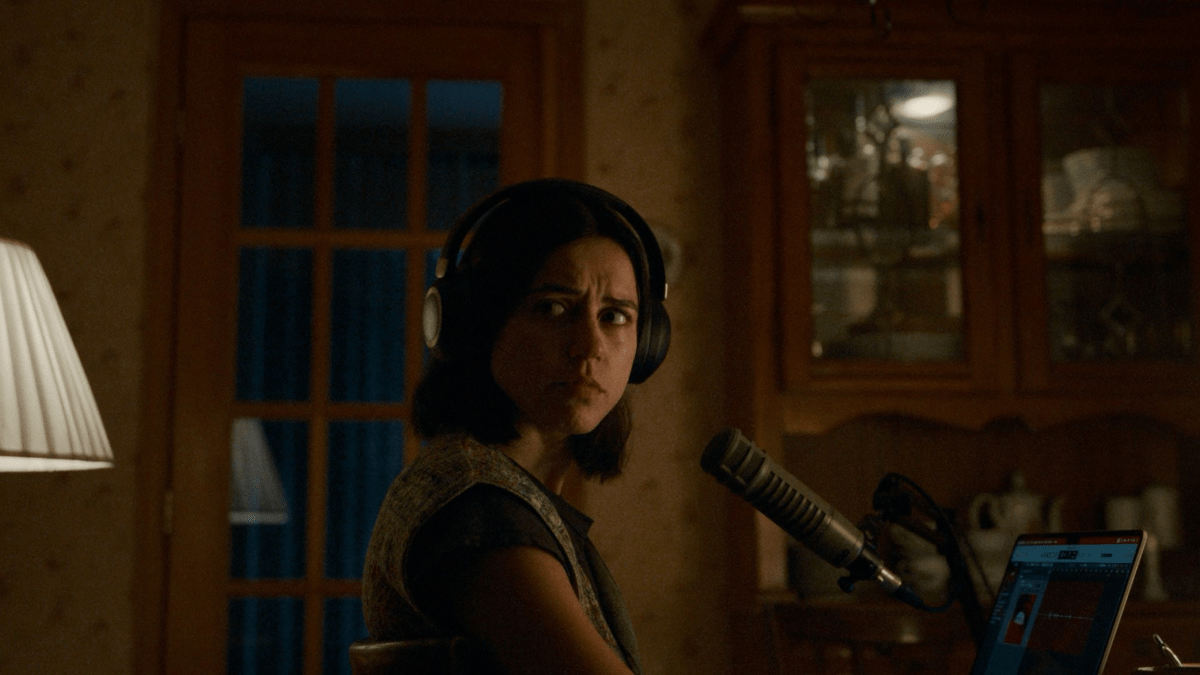
Undertone is one of those horror movies that explicitly tells us not to do something, only for the protagonist to do precisely that. Don’t go in the house. Don’t look in the basement. Don’t answer the phone. Don’t go in the woods. Don’t breathe. For this movie, it’s “don’t listen to those ten audio recordings of a possible demonic possession”. Most people would stop after the first couple, but our protagonist presses on in search of the truth. As inexplicable as her actions may seem, she’s actually performing a vital public service. Now we know that whenever we receive an email like hers, the best response is pressing the delete key.
Undertone opens with a scene that telegraphs how it will try to scare us. Evangeline, or Evy (Nina Kiri), sings “Baa Baa Black Sheep” to a elderly woman who is asleep. The woman’s eyes remain closed and her breathing is the only other sound we hear. With its emphasis on sounds over a visual depiction of horror, the scene is more unnerving than scary, a “less is more” approach that frustratingly holds true for the remainder of the film.
Evy’s mother (Michèle Duquet) has terminal cancer, and she’s moved back home to take care of her. She confides to a nurse (heard off camera) that her mother hasn’t eaten or drank anything for two days, signifying that her death is approaching. The nurse tells Evy to listen for her mother’s breathing becoming raspy. “The death rattle,” Evy responds. What she should do when that happens is unclear.
Being cooped up in the house isn’t a problem for Evy because she’s a podcaster, a job you can do anywhere there’s WI-FI and a table. For reasons I can’t recall, she and her podmate Justin (Adam DiMarco) sync up at 3:00 AM (the witching hour, haha) to discuss supernatural phenomena. We never see Justin, who remains a disembodied voice throughout.
The hook for Evy and Justin’s podcast is that they’re role-playing Scully and Mulder from The X-Files, with her playing the skeptic to Justin’s believer. Once they settle on a topic, they harness the vast powers of the internet while debating whether the thing is real or a hoax. This entails heavy use of Google Search and audio tools to make their case.
Justin recently received an email with ten audio files that purportedly are recordings of a demonic possession. Each one provides a glimpse into the lives of a young married couple named Mike (Jeff Yung) and Jessa (Keana Lyn Bastidas). They start out innocently enough, with Mike recording Jessa to prove that she snores. They quickly take a dark turn, as Mike captures Jessa saying strange things in her sleep. Justin detects odd noises (“bumps”) after the couple fall asleep. He also hears Jessa sing “London Bridge”, which becomes the entry point for the rabbit hole Justin and Evy begin going down.
Justin proceeds to fill Evy in on the insidious meanings hidden children’s nursery rhymes. Apparently, every one of them involves adults doing something bad to children. For example, “London Bridge” possibly describes a ritual involving child human sacrifice. Jessa happens to be pregnant, but why she’s singing that particular rhyme is unclear.
In an odd coincidence, Evy discovers that she’s also pregnant. What doesn’t help matters is that it sounds like she’s on the outs with her boyfriend, Darren (Ryan Turner), who hasn’t helped her at all. From the voice mail we hear, he sounds self-absorbed. His idea of making nice is to throw a party and begging her to come over. Everyone certainly can use a break from 24-hour caregiving responsibilities, but this requires Evy leaving her mother alone overnight. When she returns, she finds her mother in a bad way and feels terrible.
Evy and her mother were estranged before mom received her terminal diagnosis. She was religious, which played a role in Evy leaving home and not returning mom’s calls. The movie never elaborates on how religious mom was, other than a voice mail staging that she was praying for Evy. Given how the movie ends up, this is a plot hole of epic proportions that should have been addressed in some way.
While working their way through the audio files, Justin reveals that Jessa has been saying a demon’s name backwards in her sleep. The demon in question has been associated with the death of children, which gives Justin pause. He believes the files are authentic and that they shouldn’t continue. Evy, however, is dubious and insists that they play them all, because they couldn’t call themselves supernatural podcasters if they chickened out now.
Recommendation
It was only a matter of time until a horror movie was made about podcasting. There were practical reasons behind this approach, which I’ll get to shortly. Using podcasting as the inspiration for a horror movie makes sense because podcasters talk obsessively about all kinds of topics, including the supernatural. Having podcasters make contact with the evil they dissect takes those conversations to their logical conclusion. However, there are severe limitations with this approach, and they are what undoes what Undertone tries to achieve.
There is only so much tension that can be derived from watching one person wearing headphones talk to another person we never see. The movie does everything it can to scare us with creepy noises and having the camera pan towards shadows, but after a point it becomes clear that it’s all a tease.
Undertone takes its inspiration from The Blair Witch Project and Paranormal Activity, two horror movies that famously implied much more than was shown. Moviegoers scared themselves over what they thought was happening, not at what was on screen. While Undertone is similar in its execution, it can’t pull off the same trick because it suffers from a lack of characterization and focus.
The various themes raised within the story–the authenticity of found footage, demonic possession, nursery rhymes, infanticide–are never connected. The podcast structure allows for the introduction of scary things, but there’s no unifying thread connecting them. As such, Undertone resembles a montage of scary scenes set to an impressive array of sounds. The results are modestly effective, but never to the point of being scary.
Writer-director Ian Tuason and actress Nina Kiri do everything they can to keep us engaged. Tuason sets the appropriate tone and relies heavily upon cinematographer Graham Beasley to imply what can’t be shown. Kiri makes for a sympathetic horror movie victim. The sound department deserves recognition for making this movie an aural nightmare. Despite their efforts, Undertone is only harmless funhouse horror.
Since distributor a24 has touted Undertone’s $500k budget, it’s fair to point out that’s the reason why it ultimately doesn’t work. The fact that we only see two actors and only hear the rest is odd. The movie could have utilized a split screen to show us both podcasters at the same time, for example. Also, it makes no sense why everything is driven by audio recordings. (This isn’t 1995.) Taken together with the movie’s overreliance on sound, it becomes obvious that the movie simply doesn’t have the money to show us anything. That said, the movie will be an excellent demo reel for Tuason and an audition tape for Kiri, who should do impressive things in the near future.
If anything, Undertone proves that using podcasting as the basis for a horror movie has minimal returns. While there are spooky moments, the film is a mishmash of ideas that never lead anywhere besides scary noises and shadows. Not recommended.
Analysis
I wanted to go into detail about why Undertone falls short when compared to its sources of inspiration, The Blair Witch Project and Paranormal Activity.
Thin characters
I liked Nina Kiri’s performance as Evy. How she’s able to convey Evy’s inner turmoil without a lot to go on is admirable. Between caring for her dying mother and her unsupportive boyfriend, I’m not surprised that she started drinking again and considered having an abortion. The problem with Evy is that the movie gives us no backstory for her that would explain how she arrived at this point in her life.
The movie implies that Evy and her mom had a falling out at some point, but never tells us what that was about. The only point of contention we know of is her mom’s religious beliefs. Mom is devout while Evy is not. However, the level of mom’s beliefs is only depicted superficially. She has religious iconography around the house and tells Evy on a voice mail message that she’s praying for her. Neither of those things implies that her mom is a religious fanatic, or in league with the devil. In other words, she’s a run-of-the-mill Catholic (or Christian), which some people may consider to be threatening by association, but isn’t enough for me to make that leap.
Evy’s relationship with her boyfriend Darren is also vague. We are told that he isn’t willing to help her care for her mom, which is a negative. He tries to make amends by throwing a party for Evy and insisting she attend to give herself a break, which doesn’t absolve him of not being there for her. But we aren’t told anything else about Darren to understand why Evy feels the way she does about him.
Furthermore, Undertone never tells us why Evy got into podcasting, how she found her partner Justin, how successful they are, and so on. Was she able to support herself on podcasting earnings alone? Where does The Undertone rank on the podcasting download charts? What was their most popular episode? Again, no information is provided.
When the characters in a movie are this thinly drawn, it’s almost impossible to care about them. They’re not authentic, which means there’s no reason for the audience to care about them.
In The Blair Witch Project, we really get to know Heather, Josh and Mike. Some people might say we get to know them too much. I disagree because the movie’s overall impact is due to how well the movie establishes who these people are, what motivates them, what their shortcomings are, and so on. Josh’s disappearance is upsetting because we see his mental breakdown play out in real time. When Heather and Mike are killed in the end, it’s even more upsetting because we know them intimately before it happens.
Likewise, we care about what happens to Katie and Micah in Paranormal Activity because we get to know them before the demon begins to wreck havoc on their lives. We see Katie and Micah throughout the day, witness their interactions, notice how much they are in love, etc. They come off as genuine people. As a result, when the demon finally possesses Katie, we’re scared for her wellbeing and Micah as well. We don’t want to see this cute couple meet a sticky end.
Mythology overload
That Evy and Justin would go down a rabbit hole trying to answer whether the audio files they’re listening to are authentic is expected. However, the movie doesn’t bother tying all of its mythologies together. The movie implies that the demon Abyzou is responsible for what happens to Mike and Jessa, but it doesn’t explain how it comes into their lives. Does Abyzou come when you sing a nursery rhyme? If that’s the case, wouldn’t any pregnant mother who sings “London Bridges” be inadvertently inviting it inside her home?
The nature of Abyzou doesn’t make sense, either. Why does the demon attack Justin if its target is pregnant women?
There’s also the issue of the possession of Evy’s mother. Does this happen because Evy sang “Baa Baa Black Sheep” to her? Did Abyzou possess her mom? Why is that necessary when it possessed Jessa without needing a host? Did mom’s religious beliefs somehow make her susceptible to being possessed? Does mom’s disturbing statue indicate that she was in league with Abyzou, somehow?
Even more curious is why the cursed meme appears on Evy’s TV screen in the end. Why would Abyzou know about that particular meme and how to broadcast it on TV?
Because none of the lore in Undertone adds up, the movie has a stitched together feel to it. Instead of telling us a story, it gives us a quilt of scary stuff culled from better movies.
One of the complaints about The Blair Witch Project was that the movie starts out as an investigation into one myth and pivots to another seemingly unconnected myth. There is no connection made between the Blair Witch and the abandoned house Heather and Mike wind up in that is reminiscent of child killer Rustin Parr. I don’t have a problem with the movie’s incongruity because in my view, the story is about three people who slowly go crazy due to lack of sleep and food. By the time Heather and Mike are at the house with the handprints on the wall, delirium has blurred the line between myth and reality.
The brilliance of Paranormal Activity is that it never gets bogged down with mythology. We’re told just enough to believe that what’s happening to Micah and Katie is real. Instead of trying to explain everything, it remains focused on what the demon is doing.
Undertone introduces so much mythology that I grew weary over trying to tie things together rather than being scared. As The Blair Witch Project proved, it’s not a sin if everything introduced makes logical sense, so long as the context doesn’t overwhelm the narrative or take our focus away from the characters. Undertone overloads the story to the point where I couldn’t follow why any of it was happening.
Cheapness exposed
Given that Undertone was made on a micro budget, it’s understandable that certain things would be left to our imagination. Unfortunately, the way writer-director Ian Tuason does this is distracting because I sensed that he was playing keep away with the audience.
There’s no reason to never show us Darren in person or Justin’s faces. These men are central figures in Evy’s life. I can understand why we only heard the voice of the hospice care nurse off-screen, but not seeing either man even once comes off as a way to save money.
The ending is also surprisingly underwhelming. Instead of seeing Abyzou or what happens to Evy, all we see are drawings on the wall, flickering lights and noise. Besides ripping off the ending of The Blair Witch Project, it feels like a cop-out.
If you’ve seen The Blair Witch Project and Paranormal Activity, you might believe I’m being hypocritical. Neither movie showed us a witch, a demon or the fate of the victims. The difference with those movies and Undertone is that they are found footage films, a convention that allows for a lot of latitude because of how they are structured. We only ever see what the cameras record.
Undertone, however, is filmed like a traditional movie. Tuason’s direction and camera work are very good. As such, I expected to see something in the end because an actual movie is supposed to make good on its promises. I can forgive The Blair Witch Project and Paranormal Activity for their slight-of-hand because they present themselves as very limited views of supernatural experiences. After spending most of its runtime having us listen to voices and noises and looking at shadows, Undertone creates the expectation that it will deliver the goods in the end, but it never does. Perhaps this is unfair, but when you make a real movie, it has to have a real ending.
 Detroit Cineaste