

A great movie doesn’t need a great premise, but it definitely helps. Such is the case with Bugonia, a science-fiction film that suggests that the CEO of a pharmaceutical company is actually an alien from another world. I’ve often wondered if CEOs were human. The way they express themselves with a steady stream of corporate jargon and self-actualization platitudes, delivered with zero passion but loads of certainty and conviction, has always given me pause. Maybe, as this movie implies, they’re aliens from another world who’ve come to Earth with malicious intent. Excuse me while I grab my tin foil hat.
Before things get weird, Bugonia methodically introduces us to both sides of this alien versus human confrontation. In one corner is Michelle Fuller (Emma Stone), the CEO of a pharmaceutical company who lives in an ultramodern glass house in a manicured suburb. Her wake-up routine, inspired by physical fitness influencers, is enough to convince me that she’s not human. Starting at 4:30 AM, Michelle hits the treadmill, dons an infrared skin care mask, drinks a protein smoothie, does kickboxing and self-defence training, and so on. After all that, Michelle arrives at work perfectly dressed and coiffed, ready to lead the troops.
In the opposite corner are Teddy (Jesse Plemons) and Don (Aidan Delbis). They reside in the rural side of town, in a house that’s seen better days. Teddy raises bees, and his monologue to Don (and us) explains his motivation. Bees are having a hard time due to colony collapse disorder (or CCD), which is when bees abandon the queen and her offspring, leaving the latter to starve and die. Scientists believe that CCD is the result of a combination of things, but Teddy knows what (or who) is to blame.
Teddy is gaunt, sports a patchy beard that covers his entire face and is the brains of the operation. Don is on the autism spectrum, suffers from low self-esteem and looks at Teddy as a scraggly prophet. Don goes along with whatever Teddy says, no matter how crazy it sounds, because Teddy has a plan and professes to care about him.
To prepare for their mission, Teddy and Don do strengthening exercises, limit computer usage to mission research only and sharpen their minds in order to repel their target’s formidable mental powers. They also do something to specifically resist their target’s physical allure, but I won’t spoil it other than to say I was shocked by the extremeness of it. I had no idea conspiracy theory nuts were this hardcore.
Teddy and Don’s plan is to abduct Michelle, have her confess to being an alien from Andromeda and contact her ship by the next lunar eclipse for a meeting. Teddy and Don will hold her hostage until she complies, and when she does, Teddy will demand that the Andromedan’s leave Earth to its own devices. Sounds like a sensible plan, right? What could possibly go wrong?
The first step–abducting Michelle–is challenging because she’s in good physical shape and can defend herself. However, it’s two against one and she’s subdued and whisked away to the land of the rubes. While she’s unconscious, Don shaves her head so that she can’t communicate with her kind. Then, when she’s secured in Teddy’s basement, they coat her skin with an antihistamine cream to block any distress signals. The way Teddy discusses these precautions sounds like he’s been down this road before.
Even though Don is actively participating in a kidnapping, he has his doubts that Michelle is an Andromedean. Teddy points out that she has slender feet, thin cuticles, and other specific physical attributes that identify her as such. Teddy spends a lot of time on the internet and listening to conspiracy theory podcasts, which is probably why he knows so much about them. There’s a more sinister explanation behind Teddy’s intimate knowledge of Andromedeans, however. For now, Teddy’s certainty convinces Don that they’re doing the right thing.
When Michelle awakens, she’s stunned that her captors have shaved off her hair. She quickly pivots to CEO mode, keeping her cool and doing her best to talk her way out of this situation. Michelle explains calmly to Teddy and Don that she’s not an alien, and that if they let her go, they won’t face any consequences. Teddy is prepared for this response and insists that she put her confession on tape for the record. Don is worried, but Teddy reassures him that what they’re doing is for the betterment of Humankind.
The tension builds as the movie progressively reveals Teddy’s disturbing backstory. Not only is Teddy an employee of Michelle’s company, Auxolith, but his mother (an unrecognizable Alicia Silverstone) took part in a drug trial that left her comatose. (The movie’s most striking imagery involves Teddy and his mother, and it’s the stuff of nightmares.) The implication is that Teddy blames Michelle for his mother’s condition and is out for revenge, but it’s not that simple.
The central mystery of Bugonia is straightforward: is Michelle really an alien, or has Teddy suffered a psychotic break? The more we learn about Teddy, which includes abuse at the hands of the local sheriff when he was a child, the more it looks like he’s using conspiracy theories as an outlet for his anger. But there’s also the fact no matter how unhinged Teddy acts, there’s something about Michelle that makes his wild claims credible.
Recommendation
Bugonia is quite a genre mashup. Its structured as a “two goofball kidnappers” movie, with an escalating battle of wills between the captors and their captive (think Ruthless People and Fargo). It also has heavy doses of X-Files conspiracy theorizing and Twilight Zone paranoia, scenes of explosive violence and concludes an accusatory note that would have made Rod Serling proud. Aspects of Bugonia are familiar, but the combination of ingredients is decidedly different.
At its core, Bugonia is Earth-bound science fiction, the polar opposite of big scale, IP-driven, CGI-rendered science fiction we get too regularly. It’s the story of two guys and a woman they believe is an alien, with no laser guns, no epic battles in outer space, no laser beams, no robots and no fancy displays of technology. (A solitary spaceship appears briefly.) Bugonia is a sci-fi movie built upon conjecture, paranoia and existentialism set primarily within a single house. The last one of these I could think of was 10 Cloverfield Lane, which was ten years ago. The movie feels like a throwback to when science fiction films were much more challenging than they’ve become.
Bugonia is also a character study about three weirdos and the fireworks generated when they interact, or try to. Accordingly, the movie features three superb performances by Emma Stone, Jesse Plemons and Aidan Delbis that take the lunacy to impressive heights. Emma Stone once again shows how fearless she is when it comes to a juicy role. With her shaved head and big eyes, she looks positively bug-like. (She could also pass for Jeff Bezos in drag.) Stone easily commands the screen with her penetrating stare and deep voice, and after this performance there should be no doubt remaining that she’s one of the best actors of her generation.
I’ve been very hard on Jesse Plemons over the years. After his breakout role in Breaking Bad, he became typecast (and boring) playing doughy, dim-witted, slow-talking men. Thankfully, Plemons gives an entirely different performance here, not entirely because of his dramatic weight loss. He’s mesmerizing as a wiry, sweaty ball of conspiracy theories and rage, a traumatized man who hides his dangerous nature behind internet-addled reasoning. It’s a transformative performance for Plemons.
The third member of the trio is Aidan Delbis, who is neurodivergent in real life. His performance as Don is heart-breaking, playing a man who knows he’s being taken advantage of and consents to it because he sees no other path available to him. Delbis’ Don is willingly trapped, which makes his descent tragic. It’s an incredibly moving performance for its honesty, vulnerability and authenticity.
I’ve looked at director Yorgos Lanthimos as one of Stanley Kubrick’s heirs. His use of fish-eye lenses, jarring classical music and misanthropic world view fit well within Kubrick’s canon. Bugonia isn’t as visually striking as his previous films, but it has its moments. What also distinguishes this movie from Lanthimos’ previous films is its taut pacing. Whereas his other films had a leisurely quality, this one ratchets up the suspense until it literally bursts.
Bugonia fits squarely within the “science fiction as metaphor” tradition, where the question being asked is both philosophical and incredibly consequential. Underneath the alien paranoia and kidnapping plot lies a delightfully quirky character study reflected through a cockeyed lens. As a fan of challenging sci-fi, I loved it. Highly Recommended.
Analysis
Some musings on one of the best science-fiction films in recent memory.
Small-scale sci-fi
Modern science fiction cinema has left me wanting for a while now. For the most part, movies about humans and alien encounters have followed one example: Alien. Instead of meetings between humanity and alien life forms being inspiring, as in Close Encounters of the Third Kind, it’s to be feared. Aliens don’t want to take us aboard their flying saucers for a joy ride, they just want to eat us. Actually, they want to brutally kill us first and then eat us. The only thing that prevents Alien and its descendants from being depressing is that they’re actually horror films. There’s little time to reflect on the lost opportunity when we’re scared out of our wits.
Since Alien was released in 1979, there have been a handful of films that feature human/alien relations in a positive light with minimal spectacle and no devouring. These films are about aliens who find themselves trapped on Earth for one reason or another and spend their time here getting to know us. There are no spaceships or laser blasts featured in these movies, just basic alien/human interaction.
E.T. (1982) is a prime example of this kind of science fiction film. The alien finds themself on Earth, befriends humans and in the process tells us something interesting about ourselves. The alien is as curious of us as we are of it. The Man Who Fell to Earth (1976) is also in this vein. In both cases, the story is Earth-bound and intimate. We see glimpses of science fiction things, but they’re tertiary to the story itself. Paul (2011) is a recent example which I haven’t seen yet but felt compelled to include for completeness sake.
Starman (1984) is another good example of this sub-genre, a film driven by the alien’s curiosity of us instead of its appetite. Unfortunately, instead of getting more films like this, there was Lifeforce (1985) and Species (1995), which were about sexy aliens who forget to wear clothes and set about devouring unsuspecting (horny) men.
Bugonia is a descendant of those films. The premise of the movie is surprisingly similar to The Man Who Fell to Earth, in that both films are about aliens who pass as human and become rich. Both films have minimal science fiction trappings; Bugonia doesn’t show us an actual spaceship until the conclusion, whereas Man only gives us brief glimpses of David Bowie’s character in alien form on his home world. Generally speaking, both movies are about aliens thriving in a world where humanity is easily distracted by shiny objects.
What’s notable about Bugonia and Man is that their stories are about conjecture instead of spectacle. Bugonia asks, what should we do if we discover that aliens not only live among us, but threaten our existence? Should we force a meeting and convince them to leave us alone? On the Andromedean side, they have to decide what should be done with humanity. Can their faults be cured, or should the human experiment be terminated? From Michelle’s perspective, humanity is an ill-conceived race that’s put itself on a fast-track towards its self-destruction. But, she needs irrefutable proof that humanity can’t be redeemed before making that decision.
In many ways, Bugonia feels more akin to television shows like The Twilight Zone and The X-Files. It’s a small-scale story that’s one part cautionary tale, one part alien paranoia. It affirms that aliens live among us and may not have the best of intentions for us. It also forces us to recognize the worst aspects of our behavior through an outsider’s perspective and warns us that we’re on a dangerous path. And while it is true that the punishment handed down is unfair, the writing was on the wall for everyone to see.
The heir apparent
Writer-director Yorgos Lanthimos isn’t the only director working today who’s keeping the spirit of Stanley Kubrick alive. The other would be Todd Field, who gave us the masterful Tár a few years back. Field and Lanthimos have staked out different sides of Kubrick’s cannon. Field’s films focus on the bad karma plot twists that occur regularly in Kubrick’s work. Characters like the eponymous Barry Lyndon, Alex De Large in A Clockwork Orange and Humbert Humbert in Lolita all suffer the consequences of their self-destructive behavior.
Lanthimos’ films share Kubrick’s misanthropic tendencies. Kubrick loved to show us how irrational humanity can be, as with Paths of Glory and Dr. Strangelove. The latter movie actually has much in common with Bugonia. The novel that Kubrick adapted included a framing device involving aliens trying to figure out how humanity destroyed themselves. Kubrick left out that and instead amplified the satire, focusing on how humanity was hell-bent upon its own demise. The underlying message being, we built tools to kill ourselves and put idiots in charge of them. What could possibly go wrong?
Bugonia shares a similar pessimism about humanity. In films like The Lobster, The Killing of a Sacred Deer and The Favorite, Lanthimos has reveled in how idiotic people can be. Poor Things is an exception because it ends on a surprisingly optimistic note, with Bella Baxter becoming a doctor to help alleviate humanity’s suffering. Although Lanthimos didn’t write Bugonia, it’s easy to see why he agreed to direct it. The misanthropy it expresses towards humanity, even its self-annointed saviors, is palpable throughout.
As Michelle tells Teddy, humans are vastly inferior to her race, the Andromedeans. We’re descendants of apes, which makes us emotionally and intellectually inferior by definition. Teddy is an exception in that he’s smart enough to uncover the aliens living among us. Unfortunately, he’s not smart enough to realize that he’s being tricked by Michelle out of self-preservation. Teddy takes what Michelle says at face value and injects his mother with radiator fluid because he perceives her as being superior. In other words, he believes she’s too intelligent to lie. Teddy may be more intelligent than the average human, but in the end he’s governed by his emotions instead of logic and reason.
Perhaps out of pity, Michelle and her colleagues had been working on a “cure” for humanity’s stupidity, specifically the clinical drug trial that included Teddy’s mother as a test subject. Since the test results have been unsuccessful and the remainder hold no promise, Michelle and the rest vote to put humanity out of our own misery. In the end, humanity is just too dumb to continue living as a species. Somewhere in the afterlife, Kubrick must be beaming like a proud father.
Odds and Ends
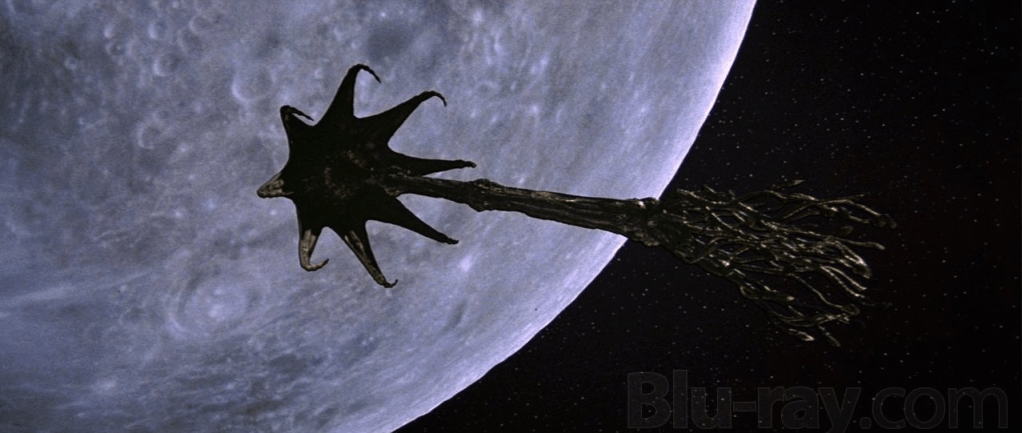
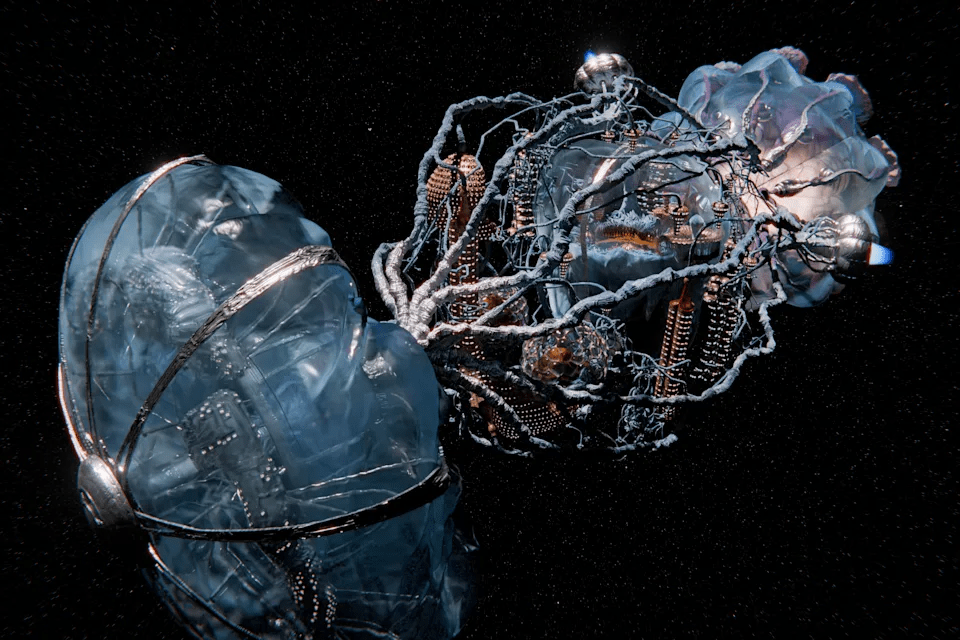
Maybe it’s just me, but the Andromedean spaceship in Bugonia somewhat resembles the one in Lifeforce:
The Bezos Who Fell to Earth


Bugonia’s discussion of CCD is reminiscent of those involving most of the problems in the world today, in that there’s no one root cause. Because of the complexity of the problem, people like Teddy turn to conspiracy theories because they provide answers, no matter how crazy they sound. Think of people pointing to vaccinations as the source of autism. Vaccinations are an easy target to latch onto, whereas saying that the problem is the result of many things, including genetics, environment, etc.
The film Bugonia is based on, Save the Green Planet! (2003), came out 22 years ago. Call me pessimistic, but things have only gotten exponentially worse since then. If I see an Andromedean on the street, I’m going to do my part and beg for humanity’s survival.
I had to look this up, but “Bugonia” means “ox birth” in Ancient Greek. It refers to a folk practice in the ancient Mediterranean region based on the belief that bees were spontaneously generated from a cow’s carcass. Now that Michelle has put humanity out of its misery, the bees Teddy was so worried about will be able to succeed us. Bugging out, indeed.
For more insight into the film’s title, check out this article.
How does this movie not use Emma Stone’s huge eyes as a sign that she’s an alien?
 Detroit Cineaste