
“If I could talk to the animals, just imagine it. What a neat achievement that would be!”
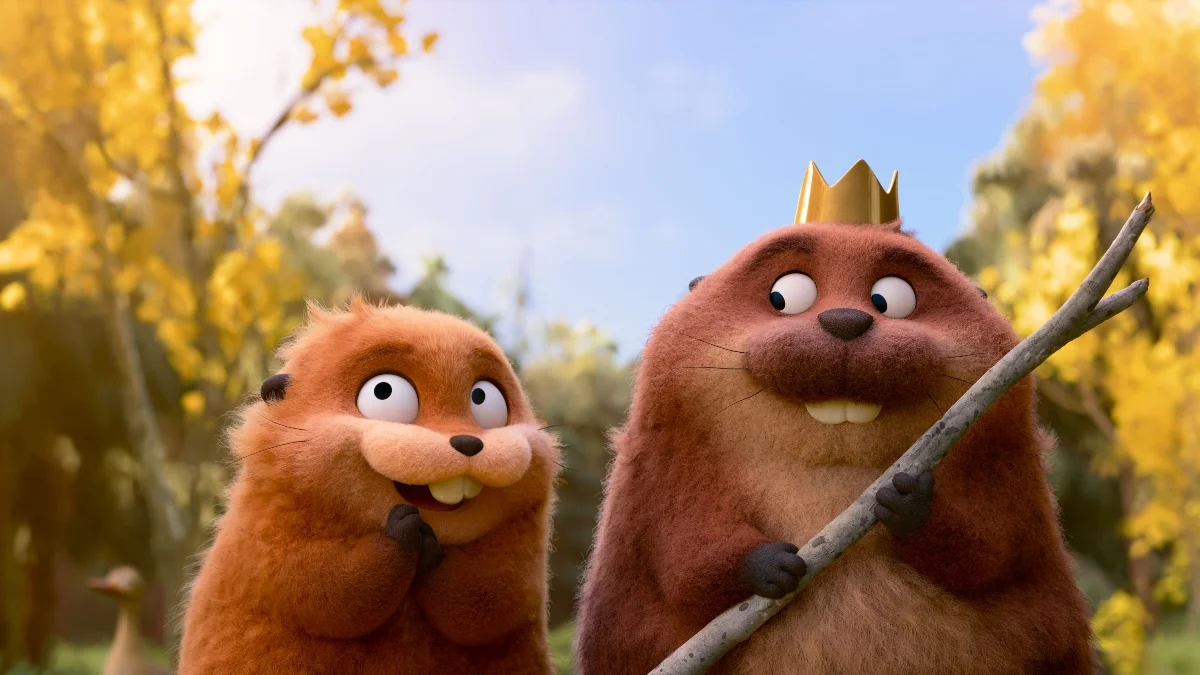
Those lines are from “Talk to the Animals”, the Academy Award winning song 1967 movie Doctor Dolittle. (They’re mostly spoken by Rex Harrison, but the versions by Bobby Darrin and Sammy Davis Jr. make up it.) The idea–or fantasy, if you prefer–of being able to talk to animals is one that’s intrigued mankind forever. Who wouldn’t want to talk to any of the other species living beside us? That sense of curiosity and wonder is largely absent in Hoppers, however, a likeable animated film from Pixar that uses this fanciful notion in the service of a small-scale adventure. Although the movie has its heart in the right place, and is often quite funny, it could have been much more.
The main character of the movie is Mabel, a hellion of a girl who gets into trouble whenever animals are involved. The opening scene has her in grade school removing all of the pets from her school’s classrooms, stuffing them into her backpack and making for the exit. She’s stopped by the adults, who know she’s up to something. The squirming backpack is a dead giveaway. Mabel’s rescue operation is stopped, but not before she bites a teacher.
After a tongue-lashing from the principal and then her parents, Mabel runs to her grandmother (Karen Huie) for solace. Grandma knows just the thing to calm her down, which is the outdoors. She patiently instructs Mabel to be quiet and take in all of the sights and sounds of nature. Feeling like she’s part of something big has always helped grandma get over life’s frustrations, and it works wonders on Mabel. (In a world where a majority of children’s time is being consumed by electronic devices, this is a terrific message to impart.)
Time passes, and Mabel (Piper Curda) is in college. Although her grandmother passed away some time ago, Mabel continues to live in her grandmother’s house because of the glade nearby. Her idyllic life comes under threat by construction that will complete the freeway, a pet project of her nemesis, Mayor Jerry Generazzo (Jon Hamm). The two have butted heads before over projects that impact nature, with Mabel coming out on the losing end every time. Humans love conveniences (like a freeway) and care less about the animals that are displaced by them, and Jerry is happy to oblige them as a mayor of the people.
When Mabel forces construction to shut down, Jerry points out that there are no animals in her glade. This puzzles Mabel, since there were plenty of animals in it just the other day. When she asks her biology professor Dr. Sam (Kathy Najimy) how to entice the animals to return, the answer is beavers. Beavers are a keystone species, and their presence will lure the rest.
With that in mind, Mabel tries to lure a beaver, but she fails because the beaver that shows up isn’t a beaver, but an uncanny simulation. Using 3-D printers and computer tech, Dr. Sam and her staff have created robots that look like the real thing. Even more impressive is that Dr. Sam can also transfer human minds into those robots. And that’s not all! The robots have translation technology that enable humans and animals to converse. This is so incredible that I wondered why Dr. Sam hadn’t won a Nobel prize.
Seeing the tech as the solution for saving her glade, Mabel jacks into one Matrix-style and runs back to the glade, where she’s astounded that she can understand the animals and vice versa. If you’re thinking this portion of this movie was directly inspired by The Wild Robot, you’re not alone. But The Wild Robot was invested in understanding nature, whereas Hoppers and Mabel are singularly focused on the task at hand.
After a funny intervention, Mabel is taken to King George (Bobby Moynihan), leader of the local mammals. Mabel convinces George to bring the animals back to the glade, but they can’t because of a horrible sound that drives them away. Mabel discovers a device that’s behind the animal-repelling noise and destroys it, allowing them to return.
Mabel’s triumph is short-lived, however, as Jerry’s developers put up more devices. This infuriates Mabel, who demands that she and George ask The Council to intervene. The Council comprises the kings of all the different aspects of the natural world: fish, frogs, insects, snakes, and so on.
George advises Mabel to let him do all the talking, which she does initially. But Mabel’s rage takes over when The Council votes against taking action. When she shows The Council that the humans aren’t playing fair, The Council is likewise enraged and votes to squish the human king, which is Jerry. Realizing that she’s made a huge mistake, Mabel tries to talk the Council out of their bloodlust, only to accidentally take out the Insect Queen. (This is the funniest joke in the movie.)
Realizing that she’s turned the entire animal world against Jerry, Mabel has no choice but to convince him to save the glade or he’ll be squished. Doing so while inhabiting a robotic beaver will be no small feat, however (sorry).
Recommendation
There’s something different about Hoppers. It resembles a Pixar film, but the execution isn’t the same. The animation is richly detailed, lively and occasionally beautiful. There are several inspired sight gags. Its message of choosing collaboration over antagonism is a good one to promote. Its pro-environmental theme harkens back to Wall-e, one of the best films Pixar has ever made. The movie is concerned about the present, while offering hope for the future. It’s a good Pixar film, but it feels…different.
The problem with reviewing a newer Pixar film is trying not to compare it to one of their greats. Seeing how Hoppers stacks up to Toy Story, Wall-E, Up, Inside Out and the rest of their classes is hard to resist. But it isn’t fair to this film to compare it to the best the studio has ever released, which include some of the best animated films ever made. So I’ll do my best to judge this film on its own merits, which is how every film should be judged.
My issues start with the main character, Mabel. There isn’t much definition to her personality. She loves animals and becomes enraged when humans threaten them, but there’s no nuance outside of her anime-inspired hair. She’s basically an action figure who runs around frantically trying to save her glade. Idealism and passion are admirable traits, but there should be more to Mabel than that.
The movie’s tone is more aligned with DreamWorks Animation than Pixar’s films in general. The jokes–which are plentiful in the second half–are funny, but they’re almost exclusively rooted in slapstick and physical comedy. Humor derived from insight into animal or human nature is nonexistent. For example, there’s a sight gag inspired by The Birds that I loved, followed by an extended zany chase sequence, but it’s all done in the service of laughs, not introspection.
Lastly, this is the first Pixar film that references their previous films. I found myself mentally ticking off A Bug’s Life, Toy Story 3 and Finding Nemo. None of this is as egregious as Disney’s misguided Wish, but I was unnecessarily distracted by it.
Pixar has been notable for casting actors who are exceptional voice actors and on name recognition. Accordingly, Hoppers features a solid cast including Bobby Moynihan as King George the beaver, Jon Hamm as Mayor Jerry, Dave Franco as the insect Titus, Karen Huie as Grandma Tanaka, Kathy Najimy as Dr. Sam and Eduardo Franco as Loaf the beaver. This is a movie you could listen to and still be entertained by all of the rich characterizations.
Hoppers is an entertaining if thematically slight film. It bears the visual hallmark of past Pixar greats but contains only a smidgeon of philosophical insight and emotional weight of their classics. While it’s fun and its constructive messages resonate, the movie is primarily a cartoon. Recommended.
Analysis
One of the problems with any long-running franchise or, in the case of Pixar, a studio brand, is comparing their latest films with what came before. Living up to the standard set by previous entries is unfair. For example, it’s the reason for the harsh criticism of the Star Wars prequels, which were derided because episodes IV, V and VI exist, making it too easy for fans to spot the quality differences between the two trilogies. The original trilogy set the bar so high, even franchise creator George Lucas couldn’t match it the second time around.
This problem bedevils Pixar as well. Almost all of the films they released between 1995’s Toy Story and 2010’s Toy Story 3 are considered to be classics. (A Bugs Life is borderline.) Eventually, the law of averages struck Pixar, because with few exceptions, the films they released from 2010 to 2020 didn’t achieve the same critical and box office success as their predecessors. Aside from Inside Out and Coco, their output consisted of serviceable sequels (Finding Dory, Incredibles 2, Monsters University) and duds (The Good Dinosaur, Brave). While Pixar made money, the boom had come off the rose.
Since 2020, Pixar has released just two films that can be considered as classics, Soul and Inside Out 2. (The former won the Academy Award for Animated feature, while the latter was the highest grossing animated film until Zootopia 2.) Elemental or Turning Red were good, but they weren’t in the same category as the films from Pixar’s classic run. Hoppers is typical of Pixar’s recent output, in that it’s entertaining, but pales in comparison to the films from the studio’s golden age.
Hence my struggle to review Hoppers on its own merits. It bears the Pixar logo, so I reflexively compare it against what came before. If the film had been produced by DreamWorks Animation or Illumination, I probably would have viewed it differently. Films from those studios typically aren’t as weighty as Pixar’s films. But given that Hoppers is a Pixar film, I expect more than I would from the other animation studios. It’s not fair to the film, but it’s impossible to avoid.
As I mentioned above, what stuck me about Hoppers was how similar and dissimilar it is to prior Pixar films. It features the same craftsmanship as their greats, as well as a superb voice cast. The film contains timely messages advocating for peaceful coexistence between humans and animals, as well as protecting the environment. As King George says, it’s all one place, after all. Even still, the movie’s main objective is to be amiable and funny first, deeply philosophical second. Hoppers nudges you to think about the environment, but never at the expense of being entertained.
In addition to their introspective qualities, the best Pixar films also give us a sense of wonder. They bring us worlds that we’ve never seen (toys, bugs, monsters, the bottom of the ocean, the mind, etc.) and let us take in their visual splendor. They also take time to explain what makes these worlds unique. Hoppers doesn’t do either. The main character gets a brief moment of joy when she realizes what she’s capable of (I can talk to the animals! Whoo!) then reverts to problem-solving mode. While we do learn something about this world in the form of the “pond rules”, it’s used as a running joke, and not an original one at that. Not only was this territory covered by The Wild Robot, but also 2005’s Madagascar.
Hoppers also has a surprising lack of verisimilitude. Much of what happens is done for laughs without concern for how what generates those laughs fit into this world. Having a doctor who can create a robot that interacts with animals and can also transfer consciousness into that robot is a Looney Tunes-inspired plot device. The premise serves its purpose, but it doesn’t make any logical sense within a world modeled after the present day.
The best Pixar films also had a knack of delivering heartfelt epiphanies that struck a chord with audiences. These films were legendary for the emotional wallop they delivered at the climax. Consider Buzz repeating the “falling with style” insult at the end of Toy Story, which calls back to the movie’s themes of sharing and friendship. Woody went out of his way to make Buzz his enemy, only to damage the one thing he prizes above everything else, which is his relationship with Andy. When he’s forced to rescue Buzz, Woody finally learns the value of friendship. And in the end, they become friends and accomplish something incredible, “flying” through the sky to reunite with Andy.
What does Hoppers have to offer? Don’t let rage overwhelm you, which is sage advice. The world is a better place when we work together to solve problems. Also very true. But that’s the extent of the wisdom of Hoppers. Nothing that pulls at our heartstrings, invites soul-searching or makes us question our place in the universe. When you compare Hoppers to a movie like Soul, which had a lot to say about life, humanity and existence, the disparity is striking.
Hoppers is a small-ball Pixar movie that papers over its limited thematic ambitions with action and jokes. It’s much better than Elio, but it’s not in the same league as Soul and Inside Out 2, let alone those classics from Pixar’s golden age. Hoppers is oddly content with being entertaining but never challenging. It’s second-tier Pixar, which is good but not great.
 Detroit Cineaste