
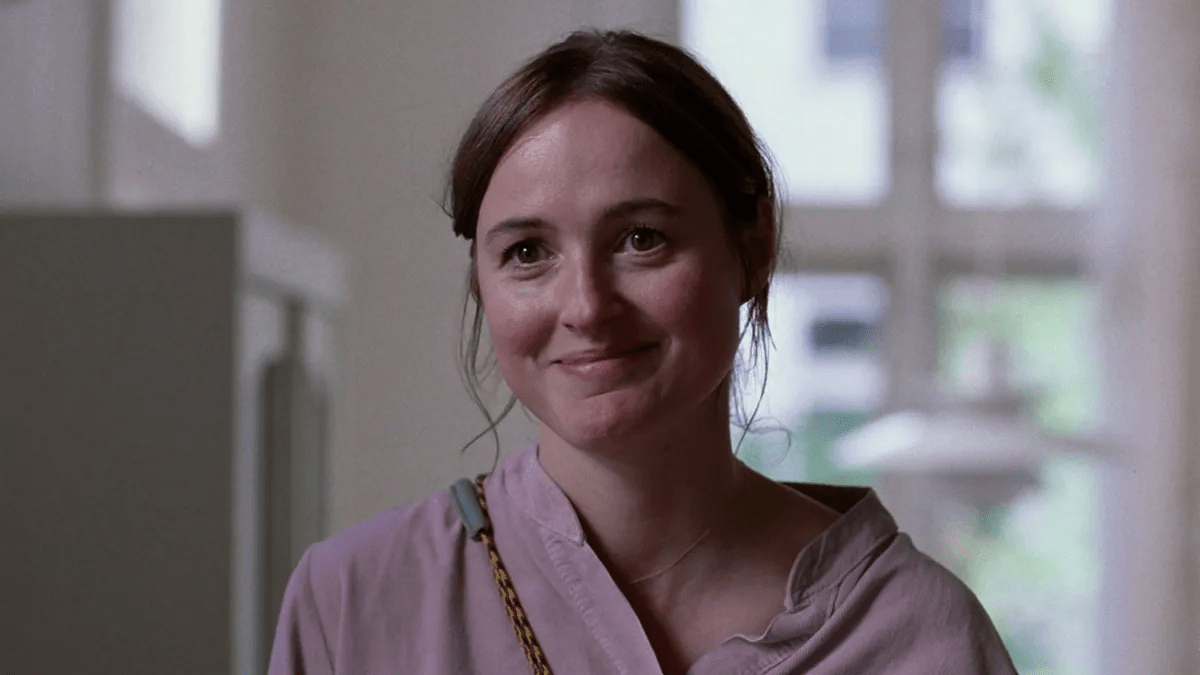
Humans are strange creatures. Instead of getting rid of what makes us miserable, we hold onto it. This is the focus of Sentimental Value, a movie about two artists, a father and his daughter, who keep what hurts them close at hand. One explanation provided is that those hurtful things inform their art. (He’s a director, while she’s a theater actor.) Revisiting their pain makes what they create more honest and true. However, it also prevents either of them from leading fulfilling lives, artistically as well as personally. The movie explores this commingling of art and trauma with a level of maturity, sensitivity and empathy that forced me to look at myself in a way that I’d avoided for, well, most of my life.
The problem of using trauma as a motivator is that you can’t turn your feelings on and off with the flick of a switch. This is the reason behind Nora’s (Renate Reinsve) stage fright. She refuses to take the stage because she doesn’t feel angry enough for the part. So, she makes excuses about her costume and retreats to her dressing room. While she delays, the production’s musical cues stop and restart, the audience gets restless and theater hands express concern. The show literally can’t go on without the star.
Fortunately, motivation comes from Nora’s co-star, Jakob (Anders Danielsen Lie). After exchanging a kiss, she asks for sex, which he shoots down. Nora then asks him to hit her, which he refuses. However, now that she’s suitably fired-up, Nora takes to the stage and delivers a riveting performance. God help Jakob if he needs to do this every night from here on out.
Nora and Jakob are also having a casual affair, and she prefers to keep it that way because there’s no emotional attachment. Jakob’s puzzled by Nora’s compartmentalizing, but doesn’t force the issue because he’s married and knows his place. Nora can get away with her shenanigans because she’s the headliner, whereas he’s replaceable.
The cause of Nora’s behavior is her fractured family. Her father Gustav (Stellan Skarsgård) left home and divorced her mother Karin when she and her sister Agnes (Inga Ibsdotter Lilleaas) were children. Flashbacks reveal Gustav and Karin’s heated arguments, which Nora and Agnes overheard through the home’s heating vents. The house may have been quieter with Gustav gone, but not better. Nora never forgave her father, and his continued absence only deepened her resentment.
Karin dies before the movie begins, and her passing forces long-simmering feelings to the forefront. She never updated the title on the family home, making it Gustav’s property even though he’s been living elsewhere for years. When Gustav returns for the wake, Nora hates how everyone welcomes him with open arms because he’s a world-famous director despite being an absentee father.
Gustav’s current project is actually what triggered his return. He wants to shoot his latest film in the family home. The story is based on Gustav’s mother, who hanged herself after he left for school. That traumatizing event has haunted Gustav ever since, and his film will be the first to address the incident directly. In discussing the project, Gustav implies that it will be his last, a coda to both his life and acclaimed career.
In an unusual twist, Gustav wants Nora to play a character based upon his mother. At first she’s incredulous, because she doesn’t even think he’s seen her act. He has, observing her from the back. Gustav’s request is an obvious olive branch to Nora, an attempt to repair their relationship. Nora, however, refuses and storms off.
Left without a leading actress for his passion project, Gustav appears at a film festival featuring a retrospective of his work. In one of those happy accidents that only happen in the movies, Gustav runs into famous actress Rachel Kemp (Elle Fanning) on the beach while she’s relaxing with her entourage. As the two walk along the shore, she expresses regret over the lightweight roles she’s given. He sagely advises her to take control of her career, because it’s her legacy. And just like that, Gustav has a leading actress and funding from Netflix, with a commitment to a theatrical release. (Take that, Ted Sarandos!)
The film’s pre-production doesn’t go smoothly, however. Rachel struggles with her approach to the part. She attempts an accent, and Gustav politely dissuades her. Gustav recruits his former cinematographer Peter, only to realize that he’s a frail old man. Life for Nora and Agnes has become similarly unsettled. Jakob tells Nora he’s divorcing his wife, but doesn’t want to be with her, which triggers her depression. Agnes learns that Gustav wants to cast her son in the movie, and it brings back painful memories from her own childhood, when she acted in one of his films.
Rachel realizes that she’s a poor substitute for Nora, and apologetically pulls out of Gustav’s project. This sends him into a tailspin and the hospital. With two-thirds of her family on the brink of collapse, Agnes researches the source of her family’s generational trauma, which is her grandmother’s death. It’s only with that knowledge that she can finally help heal the rift between her father and sister.
Recommendation
When it comes to dramas about dysfunctional families, one would expect that the source of everyone’s problems is an unspeakable tragedy in the past. Sentimental Value has several shocking ones, and after seeing the horrific details I fully appreciated why the members of the present day family were struggling, to say the least. That the family was able to recover from the generational trauma that plagues it was a miracle in itself. But this is only one aspect of the story the movie tells.
What makes Sentimental Value more than prestigious melodrama is that the situations the characters find themselves in, as well as how they go about resolving things, are always believable. The solution to everyone’s problems isn’t the father’s new film, but in having difficult conversations. This always sounds simple, but as anyone with difficult family situations will tell you, those conversations are the last anyone wants to have, and the movie captures that truism perfectly.
There’s also the film’s critique of the crippling nature of sentimentality (or nostalgia). Instead of getting rid of what makes them miserable, namely the family home, they inexplicably hold onto it. Artists reopening old wounds as part of their creative process is nothing new, but I appreciated how casually the movie depicts this behavior as self-flagilation. Even more incisive is how the film shows nostalgia as a barrier to happiness. Living in the past may fuel these artists’ creativity, but it also prevents them from leading happier lives.
A film like this lives and dies by its performances, because a single false note would derail its overall impact. Fortunately, the film contains four world-class performances that make the characters genuine and real. Although technically not the lead, everything that happens revolves around Stellan Skarsgård’s commanding patriarch. I first saw him in The Hunt for Red October forty-five years ago, and he’s been good in everything I’ve seen him in since. This is easily one of Skarsgård’s best performances, where his decades of experience enables him to inhabit a character who’s charming, intelligent and worldly, but also incredibly secretive.
Renate Reinsve, Inga Ibsdotter Lilleaas and Elle Fanning are all wonderful in roles that reflect different aspects of Skarsgård’s character. Reinsve’s Nora is a great actress, but has become emotionally stunted and rageful. Ibsdotter Lilleaas’s Agnes is family-oriented and tries to keep the peace between her sister and father. Fanning’s Rachel Kemp is a ray of sunshine who masks her insecurities over her acting abilities, which causes her to seek approval from Skarsgård’s father figure. Fanning’s performance was the biggest surprise for me, an engaging turn that indicates her growth as an actress.
Writer-director Joachim Trier comes off as an actor’s director, and with this cast it was wise of him to let them take the spotlight. Trier does permit himself a few evocative directorial indulgences surrounding the family home. Trier depicts the structure as the omniscient keeper of the family’s history and secrets, sentimental value captured within bricks and wood. I haven’t seen Trier’s prior films, but I suspect he’ll experiment more with representing his ideas visually instead of predominantly verbally.
Sentimental Value is a touching family drama told with an abundance of sympathy and compassion for its anguished characters. Accordingly, it’s an acting showcase for the four co-leads who keep their characters grounded and relatable. Decidedly unsentimental, the film provides unfiltered insight on why we torture ourselves with the past. Recommended.
Analysis
Underneath what is a very mature and sympathetic family drama lies an insightful look at the hidden dangers of sentimentality, which are represented by a house. From writer-director Joachim Trier’s perspective, the house is not just a house, but a conduit to painful moments from the Borg family’s past. It reminds Gustav of his mother’s suicide. For Nora and Agnes, it’s a constant reminder of when their father left and never returned. While the house provides shelter, its existence only elicits unhappy memories. (The house also symbolizes generational trauma, which I get to in a bit.)
The sentimental (or nostalgic) feelings the Borg family have for the house prevents them from leading happier lives. Gustav tried to replace his awful childhood experience with new ones, but failed. His memories were too powerful to overcome, and he settled for distance instead of confronting them. Even his wife Sissel, who is a psychiatrist, couldn’t help Gustav with his internalized trauma. No matter what happened to Nora and Agnes afterwards, the home was never the same after Gustav left.
After family matriarch Sissel passes away, it presents an opportunity for Gustav to confront his childhood trauma head-on. In making his semi-autobiographical film at the family home, he’ll finally be able to excise the ghost that’s been haunting him his entire life. Gustav also sees the project as a way to reconcile with his elder daughter Nora, who he envisions playing his mother.
Unfortunately, Nora is also trapped by her feelings towards the past, and the house. Unlike her father, the house doesn’t represent an unspeakable tragedy, but a life that never was. Nora’s childhood was unhappy, first marked by arguments between her mother and father, then by her father’s abandonment. The house may have been quieter when her father left, but his absence left a hole that was never filled.
Nora turns down the role in her father’s movie not because of anything to do with her father’s skill as a writer and director, but because she’s also trapped by her feelings associated with her childhood. Still angry at her father for not being present, she misinterprets Gustav’s outreach for a bribe. (Sorry I wasn’t there for you, here’s a plumb role in my next movie!) Nora’s nostalgia for her missing childhood prevents her from taking her father’s actions at face value. Nora remains trapped by her past and unwilling to find a way out.
Gustav’s decision to replace Nora in the leading role is curious at first. He obviously wrote the part for her to play, and substituting Nora for the very American Rachel seems counter-intuitive and self-destructive. Gustav, however, does this because Rachel’s involvement insures financing for the production. (Hello, Netflix!) Rachel is ill-suited for the role, but Gustav can’t heal unless he makes the movie, which requires her playing the lead in order for the project to move forward. (A classic Catch-22 situation.) Gustav may never be able to repair his relationship with his daughter, but at least he’ll be able to repair himself.
Nostalgia rears its ugly head again during the pre-production of Gustav’s film. He finds that his longtime cinematographer is no longer capable of doing a lot of hand-held shots within the close quarters. Rachel then leaves the project when she realizes that the role isn’t for her. (Rachel was blinded by her nostalgia for the director Gustav once was.) Without a way forward, Gustav gets drunk, flips-off the house and nearly dies from exposure. Trier shows us that sentimentality is so dangerous that it can be fatal.
What heals the Borg family is a decisive turn away from sentimentality and towards reality. Instead of being haunted by her grandmother Karin like her father, Agnes researches Karin’s past and finds out what probably caused her to kill herself. What seemed inexplicable now makes sense. Agnes then has her sister read their father’s screenplay. Now Nora knows why her father asked her to be in his movie. Finally, Gustav sells the house and films the movie on a sound stage. He’s free to explore his past free of the confines of the family house. Even better, he’s now able to utilize his DP on the film. Once the shackles of sentimentality were broken, Gustav and Nora were able to have an honest and open relationship.
Art from pain
Another theme coursing through Sentimental Value is how artists tap into their pain to create art. For Gustav and Nora, pain makes them great artists. Pain is the catalyzing force behind their creative powers. Without it, they’re unable to create.
Sentimental Value implies that Gustav informed his movies with his feelings towards his mother’s tragic death. For example, the horror of finding his mother dead inspires the horrifying scene in the movie he made with Agnes when she was a child. He equates the experience with Agnes’s character seeing her childhood friend being captured by Nazi’s while she escapes. The horror underlying both is in a child being unable to prevent something terrible from happening, and having to live with that horror for the rest of their lives.
Nora uses the rage she feels towards her father to give emotionally raw performances. When she can’t tap into those feelings, she refuses to go on. It’s only when her lover rejects her advances that she’s able to go out on stage and give a suitable performance.
Gustav and Nora chose to be trapped by the past because it defined them as artists. Anguish became their muse, but they can only create when they reopen their old wounds. However, they’ve become emotionally damaged people as a result. The past may be the wellspring of their creativity, but it’s put them on a downward spiral with no escape besides death. It comes as no surprise that Agnes, the only non-creative member of the family, puts them on the road to recovery.
Generational trauma
For whatever reason, generational trauma became the domain of animated films. Encanto. Frozen 2. Coco. Turning Red. In every case, a tragic event from several generations back is responsible for the problems of those in the present. It’s as if filmmakers see their grandparents as the root of all evil, instead of kindly old people with candy in their pockets and money for toys and ice cream.
While much more serious in nature, Sentimental Value is of the same mold. Gustav’s mother’s suicide not only poisoned her son, but his son’s family. Not understanding why Karin killed herself in such a calculating way haunted Gustav, which caused him to reject his family when he was an adult. He couldn’t handle the vulnerability required with being a husband and father and left.
Gustav’s departure led directly to Nora becoming a tortured actor and emotionally closed-off person. Acting allows her to vent her rage at her father, but his abandonment keeps her from experiencing love and attachment. In other words, the sins of the father have been visited upon the eldest daughter.
Thankfully, the movie shows that the best way to resolve generational trauma is by confronting it directly. While art may help to alleviate it, talking about it is the best therapy. A celebrated film or performance is no substitute for difficult conversations.
 Detroit Cineaste