
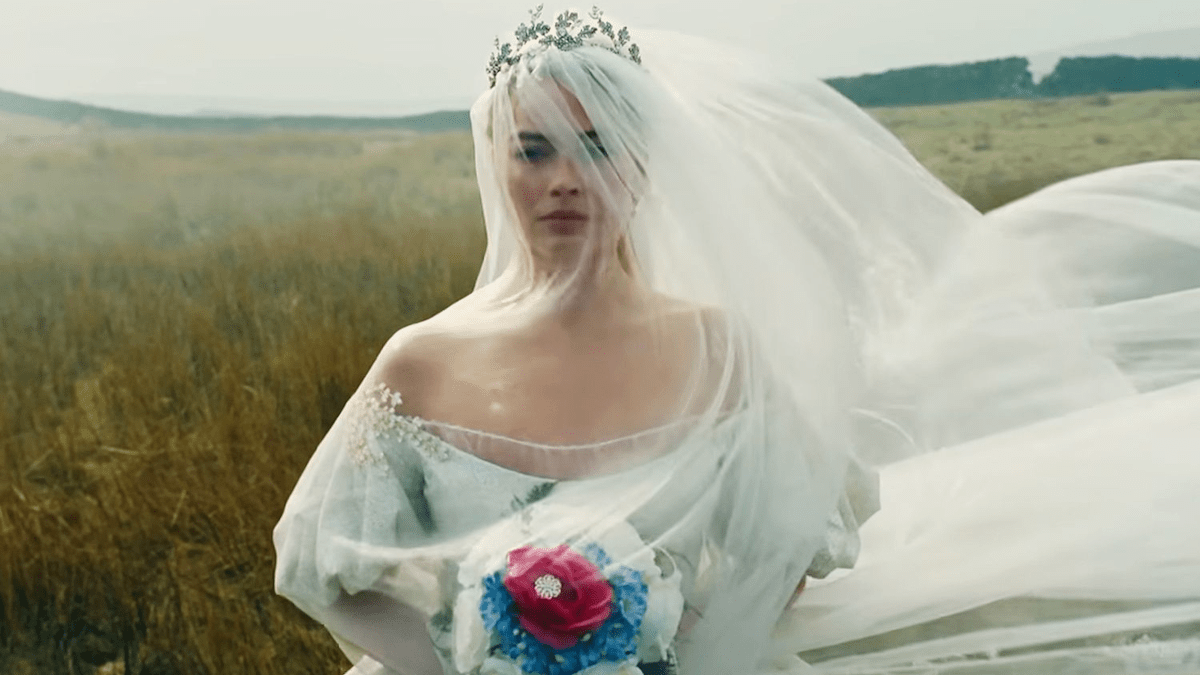
When Emerald Fennell’s adaptation of “Wuthering Heights” was announced over a year ago, I wondered why she included the title in quotation marks. Were they the equivalent of air quotes, implying that her take on the source material would be satirical or ironic? Unfortunately, Fennel wasn’t telling. Like everyone else, I would need to wait until the movie came out. Before I provide my answer, I want to note how this was a genius stroke on Fennell’s behalf. This minor but idiosyncratic alteration made us all curious about yet another adaptation of the well-known book. If the mark of an effective director is grabbing our attention, Fennell aced that assignment.
Fennell’s next move is even more provocative. Over the title cards, the soundtrack has sounds of a man gasping, which is joined by creaking noises. I assumed that both implied the “music of the night”, as it were. (Thank you, Phantom of the Opera.) When Fennell finally shows us what’s behind the commotion, the man isn’t in the throes of coitus, but hanging. His gasps are for air, and the creaking produced by his dangling body’s death spasms. Good one, Fennell. You got me.
As if that weren’t enough, young boys among the crowd call out the man’s huge erection, which they claim is typical. When you watch enough hangings, everything becomes routine. An old nun chastises them for their lack of respect, but then turns and gazes lustfully upon the protrusion. Shocking. If you didn’t realize that this Wuthering Heights wouldn’t be precious and dignified, you should have no doubts now.
Amongst the crowd is a young Catherine Earnshaw, who cheers along with the rest when the man expires (and ejaculates). Unlike the audience, Catherine has no way of knowing how much her life will be defined by sex and death. At this point, she’s just a young hellion who’s left to her own devices by her father, Mr. Earnshaw. He’s a nasty bugger who likes drinking and gambling without judgement. Accordingly, he angrily rebukes his daughter when a nasty joke of his upsets her. When it comes to Mr. Earnshaw, you stay out of his crosshairs, even when he leaves a trail of vomit in his wake (or worse).
Mr. Earnshaw isn’t entirely horrible, though. He’s also capable of pity and charity. Catherine’s companion, Nelly, is the bastard child of a friend. When Mr. Earnshaw sees an orphaned boy being beaten in the street, he takes him home as a “gift” to Catherine. When she names him Heathcliff, she effectively claims ownership of him, like a pet dog. Although the moment looks harmless, it’s the origin of the unbalanced dynamic between Catherine and Heathcliff that will define their relationship until the end.
Catherine and Heathcliff get along fine for the most part, spending of their days running around the vast, fog-covered estate like banshees. However, when Catherine tries to teach Heathcliff to read, her belittling causes him to run away screaming. One day, Catherine insists that the two wait out a rainstorm instead of running home. It’s a sensible decision, but Mr. Earnshaw is furious when they return home after dark. Catherine says it was her idea, but then Heathcliff swears that it was his. For his gallantry, Heathcliff is whipped until he bleeds, but he also earns Catherine’s affection afterwards.
Flash forward a decade or two, and Catherine (Margo Robbie) and Heathcliff (Jacob Elordi) are now “young adults” with raging hormones. (Although Robbie is only seven years older than Elordi, she looks much older than him.) Mr. Earnshaw’s nightly carousing has drained the estate, which is in disrepair. Catherine is still a spoiled brat, used to getting whatever she wants. Heathcliff resembles a wild animal, with his long hair, beard and generally filthy aspect. Nelly (Hong Chau) is still around, but has utterly failed to inspire Catherine to be ladylike.
The arrival of the Lintons next door offers hope to Catherine. She becomes obsessed with being invited to meet them, but when that doesn’t happen she forces the issue. While spying on Edgar (Shazad Latif) and his sister Isabella (Alison Oliver), Catherine falls and twists her ankle. The gambit works, because Edgar takes her in and falls in love with her while she convalesces. Edgar subsequently proposes and given the dismal state of affairs back home, Catherine accepts, despite her love for Heathcliff.
After a heated (and sticky) exchange between herself and Heathcliff on the moors, Catherine confesses to Nelly that she’s accepted Edgar’s proposal. At Nelly’s instigation, Heathcliff overhears Catherine state that marrying Heathcliff would degrade her. However, he leaves seconds before hearing her say that their souls are intertwined. Heathcliff leaves in a huff, while Edgar and Catherine marry.
The movie’s second half delves into Catherine’s bourgeois life, which Heathcliff’s return throws into chaos. Despite being pregnant with Edgar’s child, Catherine and Heathcliff have an affair, which primarily consists of grunts and thrusting. Catherine eventually calls it off, which angers Heathcliff, who sets about tormenting her indirectly through Isabella. Without giving anything away, Heathcliff is a nasty fellow, but the real surprise is how Isabella responds to his abuse. Everything ends tragically, which raises the obvious question as to what it all means. Thankfully, Fennell has answers and isn’t shy about revealing them.
Recommendation
“Wuthering Heights” is so over-heated that I regularly chuckled at its audaciousness. Every scene is eye candy, as if writer-director Emerald Fennell used Spinal Tap for inspiration and took everything “to eleven”. The sweeping, fog-covered vistas are straight out of Eighties music videos, and I waited for the camera to pan and reveal Duran Duran singing a tune. Many shots are so elaborately staged that the movie often resembles a megamix of vintage perfume commercials (Calvin Klein, Chanel).
The excess doesn’t stop there. Most–but not all–of the performances are the definition of scenery-chewing. The soundtrack swoons with drowsy synths and throbbing strings intended to accentuate the erotic tension that permeates the film. (It doesn’t work.) Images beautiful and grotesque are obsessed over. Hands running through uncooked eggs. Rivers of blood. Greasy bread dough. Drenched clothing. Sweat-streaked backs. Even the estate where most of the story takes place is given the ultimate goth treatment, with its shiny black brick exterior encasing the dinginess within.
Someone as sharp as Fennell wouldn’t make a film that’s merely a stylistic exercise. What she was saying with her directorial and writing choices became clearer in the third act, which is also when the film becomes interesting. The following is the best guess I have as to what Fennell is up to.
“Wuthering Heights” is not merely an adaptation of the book, but also meta commentary on the book itself. In regards to the book’s mythic status as one of the best tragic romances ever written, Fennell is of two minds. She’s clearly enamored with the epicness of the story, which is reflected by the movie’s grandiose style. Fennell also accentuates the story’s sexual nature to reflect her main takeaway from the novel, which is that denying one’s desires has disastrous consequences. If you feel good being naughty, be that way, because one day you’ll be dead and nobody will care. Huzzah!
In terms of the leads, Margo Robbie and Jacob Elordi are very handsome and vigorously emotive, but it’s all for naught because they spend most of the movie giving a rendition of “the farmer’s daughter and the stable boy”. (I should mention that they remain fully-clothed during the many humping scenes.) Those who appreciate camp will savor Robbie and Elordi’s performances like a five-course meal. For the rest, the challenge will be to watch these two leering and thrusting with a straight face.
I grew to like Martin Clunes’ Mr. Earnshaw, whose unrepentant wickedness is key to unlocking the movie’s message. So too is Alison Oliver’s Isabella, who has a dog-barking scene that would have made Bill Murray proud. Of the actors forced to play things entirely straight, Hong Chau and Shazad Latif retain their dignity even while they’re dodging (figurative) excrement thrown from all directions. On a technical level, the movie’s production design is amazing, even if it approaches a theme park-level of unreality. The costumes, which are inspired by many eras, are gorgeous. The cinematography is exquisite and my favorite aspect of the film.
“Wuthering Heights” may be the most unromantic and unerotic story about doomed lovers ever made. Its message, about how tragic it is to deny our urges, is delivered with the subtlety of cannon fire. On another level, it offers an interesting, if bombastic critique of the novel upon which it’s based. Not recommended.
Analysis
Until the third act arrived, I wondered if “Wuthering Heights” was a put on. Given that writer-director Emerald Fennell is a natural provocateur, I conjectured that her movie was the equivalent of thumbing her nose at this “Victorian Masterpiece of Literature”. I didn’t see any other way to rationalize the bizarre combination of high brow presentation and low brow delivery. That would explain the seemingly unintentional comedic tone of the film. Maybe the first act was Fennell’s Monty Python take on the material, while the second was Absolutely Fabulous.
Fennell, however, isn’t a satirist, which meant that she was reaching for something besides mockery. The third act was when I figured out what Fennell is up to. (Or, what I think she’s up to.) The intent behind all of her visual fixations, the hyperbolic acting, the oppressively grandiose set designs, and the inclusion of countless sex scenes began to add up.
Fennell is not a subtle director, and has been very overt about whatever she’s trying to get across. Fennell may not spell things out for us, but she does expect us to put two and two together, especially when the numbers are ten stories high. Before delving into the third act, I’ll start at the beginning, which is where Fennell signals her intentions with her preferred shock and awe tactics.
The hanging
Fennell must have thought long and hard (sorry) about this scene, because it symbolizes the themes she draws from the material. What begins with what we think are the sounds of intercourse ends with a hanged man dying with his erection smack dab in our faces. Fennell doesn’t intend this scene to merely shock us, because it contains clues as to what her version of Wuthering Heights will emphasize. The link between sex and death is obvious; “little death”, meet “big death”. In Fennell’s view, sex and death in the lives of Catherine and Heathcliff are inexorably linked. How, exactly, will be revealed in due course.
Then there is the nun. Fennell is again being very obvious with us here, giving us an example of a person defined by her abstinence practically drooling over the thought of sex. As a woman who’s given herself to Christ, sex is off limits to her forever. The nun is old now, her physical beauty long past. In denying herself the pleasures of the flesh, the nun has resigned herself to a life without physical passion, and will die regretting never having tasted the forbidden fruit.
Life in the Heights
Mr. Earnshaw, Catherine’s father, spends his evenings drinking and gambling. He’s unapologetically wicked and chastises his daughter for being a prude. Although he takes pride in rescuing Heathcliff, he beats him for minor offenses. Earnshaw’s bad behavior is so well known, the senior maid tells the new girl to check Mr. Earnshaw’s pants for crap. When there’s vomit, the other also is sure to follow. For his part, Mr. Earnshaw doesn’t care what people think, provided they keep their opinions to themselves. This is his estate, after all. Anyone who wants to judge him can bugger off.
Catherine and Heathcliff spend their childhood running around the vast estate and getting dirty. The two are very far removed from culture and refinement. Coincidentally, this is the period in both their lives when they are happiest, because they love being wild and running free. The only trouble they experience is of their own accord, when they don’t abide by Mr. Earnshaw’s rules. They must be home before dark, so as to not disturb his nightly routine. When they do, there’s hell to pay.
Adulting is hard
The second act introduces Catherine and Heathcliff as handsome adults with the expected urges. While the attraction between them is undeniable, they haven’t acted upon them physically. In place of sex, Heathcliff resembles a feral creature and works in the stables, while Catherine comes and goes as she pleases.
Unfortunately, Mr. Earnshaw’s carousing has put the estate into debt. Although his behavior directly threatens the livelihood of Catherine and Heathcliff, Earnshaw doesn’t care. So long as he can continue to go out at night, he’s happy. He knows what he wants and does it, regardless of the consequences.
Things change dramatically after Catherine accepts Edgar Linton’s marriage proposal. Catherine becomes a married woman of privilege, living in extreme luxury. Her sex life with Edgar is mostly perfunctory, except when he indulges in a little kink. Heathcliff leaves and returns after several years as a changed man. His hair is cut, his beard is gone and he wears fine clothes. He’s determined to win Catherine back, despite the fact that she’s married and pregnant.
Bringing it home
From the opening scene with the hanging man, to the last one with Heathcliff embracing Catherine’s corpse, Fennell has reconstructed Wuthering Heights as a cautionary tale against denying our natures. All of the characters in the movie exemplify this credo. Those who freely indulge in what they enjoy end up happier than those who resist what calls them. This is exemplified by the fates of Mr. Earnshaw and Isabella Linton.
Although Mr. Earnshaw dies penniless, Fennell makes a point of placing his dead body in front of two towering piles of bottles. Earnshaw spent his days doing what he loved, which was drinking and gambling. He was a terrible father, but enjoyed life to its fullest before he died. Those piles symbolize how he succeeded in living his life on his terms.
When we first met Isabella, she was an insecure doormat. She had no clue as to who she was. Her obsession with Romeo and Juliet implies that she’s an incurable romantic, or that she thinks she is. When she becomes involved with Heathcliff, however, her true nature finally asserts itself. She doesn’t care that Heathcliff is only marrying her as part of his twisted revenge plot, or that he doesn’t even love her at all. All that matters to Isabella is that Heathcliff torments her, hard. Taking part of a sadomasochistic relationship makes her feel alive, and Isabella gladly lets Heathcliff do his worst. She’s so happy living this way that she has to be dragged out of Wuthering Heights.
Conversely, Fennell uses the tortured relationship between Heathcliff and Catherine as an object lesson of how not to live our lives. The two are clearly meant for each other, but do not live happily ever after. Instead of admitting the obvious and running off together, Catherine dies horribly, with her dead baby poisoning her body. Heathcliff is left a broken man hugging and kissing her lifeless body. They denied themselves of each other’s pleasure, which had fatal consequences.
This leads to Fennell’s second theme: get your rocks off while you can, because we all wind up dead in the end. Whether you find yourself dangling at the end of a rope, lying in your own piss or with a dead baby in your womb, the last thing you want passing through your mind is regret. So live, drink and be merry, because one day you’ll be dead. Fennell’s belief system may be crude, but at least she’s honest.
Heir Apparent
There’s a touch of the late Ken Russell, a.k.a. the “Wild Man of British Cinema”, in Fennell’s directorial choices. Like Russell, she loads her film with hyper-stylized symbolic imagery. Fennell also prefers to film her set pieces positioned in the center of the frame. Additionally, Fennell prefers to use all of her cinematic tools to advocate for humanity’s naughtiness. (Being bad is so much fun!) Most importantly, Fennell considers nuance and subtlety to be signs of weakness.
Following are examples from Russell’s films that make my case:
Gothic
Crimes of Passion
Lair of the White Worm
Tommy (The first 9:30)
 Detroit Cineaste