
After decades of racing to the bottom, capitalism has recently discovered that it can save even more money by replacing workers with programs. Today, you can’t look at your social media feed without being confronted with the impact of AI. Billionaire CEOs state with certainty how the technology will steal your job from right under your nose if you don’t get on board. How comforting. All those years spent toiling away for your company, doing stuff executives don’t want to be bothered with, the loyalty you’ve shown your employers, all mean nothing to the tsunami that is AI. This is the premise of No Other Choice, a movie that uses today’s “profits over people” environment and takes it to its logical conclusion.
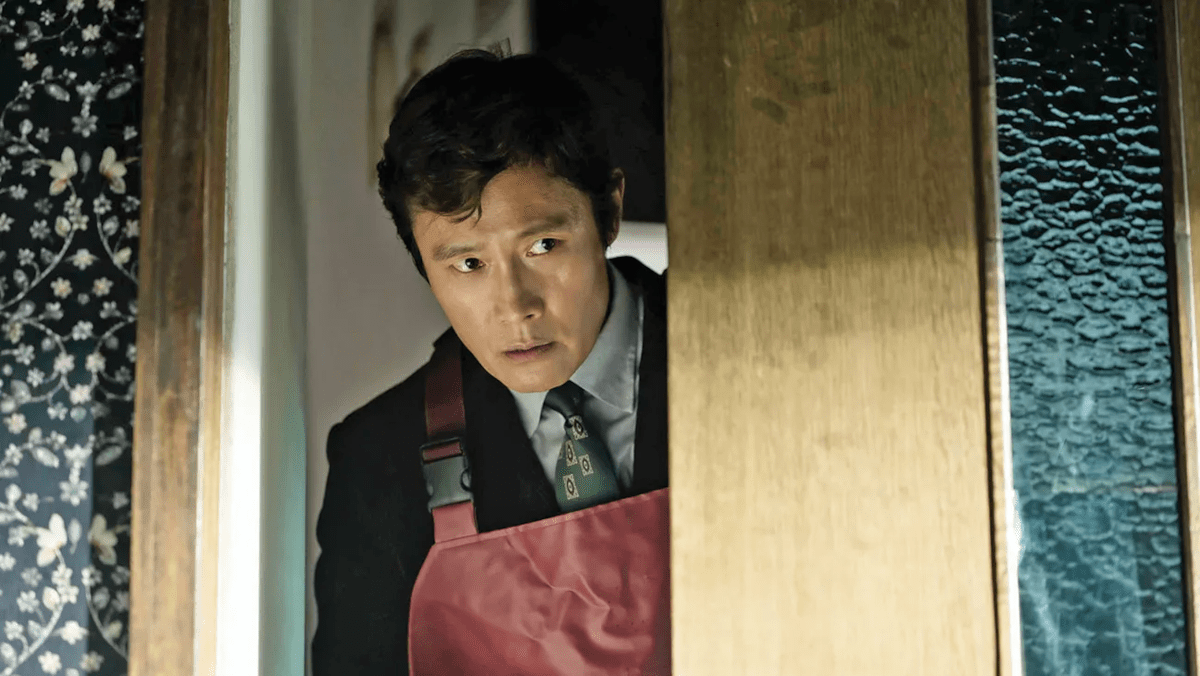
Man-su (Lee Byung-hun) had nothing to worry about, or so he thought. He’s worked for the same paper manufacturer for decades, earning an income sufficient to afford a nice home and comfortable life for his family. He has a yard big enough for the dogs to run around and family barbecues in the sun. Why, he even got a special present from the company for his twenty-fifth anniversary, some lovely eel, complete with a congratulatory message printed on fine paper.
Generally speaking, life is good for Man-su. His wife Miri (Son Ye-jin) is beautiful, happy and engaged. Son Si-one (Woo Seung Kim) is a moody teenager, which is to be expected. Daughter Ri-one (So Yul Choi) is a special case, a cellist prodigy who only repeats what others say. (She’s neurodivergent, but the movie never clarifies in what way.) The family isn’t perfect, but they’re together and share a warm, group hug.
That moment of bliss was too good to be true, because when Man-su returns to work on Monday, he learns he’s being cut as part of the new American owner’s strategy to reduce costs. Man-su works on his argument in the parking lot, but the owners drive off too fast for him to say anything. Sorry, Man-su. We appreciate your loyalty, but you’re too expensive.
After Man-su delivers the bad news, he attends a support group designed to lift his self-esteem. Thirteen months later, Man-su is working in a retail warehouse. Finally, a ray of light arrives in the form of a spot interview. He’d be reporting to his former subordinate, but a step down is better than carrying around boxes all day. Unfortunately, he can’t be excused from his current job for the interview, and is forced to resign.
Further evidence of how capitalism humiliates the unfortunate comes during the interview. Man-su is required to answer nonsensical questions with sunlight shining in his face. He gets the always fatuous “what is your weak point” question, to which he replies with a joke. Unfortunately, nobody gets it and he doesn’t get the job.
Concerned over foreclosure notices, Miri institutes austerity measures on the family budget. Anything not needed is eliminated, including the Netflix subscription, her dancing lessons, the expensive car, etc. The dogs are passed “loaned” to Miri’s parents, much to the chagrin of her allergic father. Ri-one is upset over losing the dogs, but change is necessary if they’re to keep the house. (The house is where Man-su grew up as a child.)
Back home, Man-su follows the Instagram profile of Seon-chul, a manager at former rival company Moon Paper. Seon-chul documents how he’s living the good life and Man-su comes up with an idea. He’ll eliminate Seon-chul and take his place. His attempt at offing his competition goes comically awry, but it makes him think. Seon-chul being dead won’t guarantee Man-su a job. There are other men who have been laid off from paper manufacturers who are more qualified than him who could get the plum opening.
The plan Man-su devises to guarantee success is diabolical. He places a help-wanted ad for a fictional paper company, sizes up the applicants and determines who his competition is. After setting on two, his idea is to kill them off, thereby ensuring he’s the most qualified applicant for the opening. The only problem with Man-su’s plan is that he’s never killed anyone, and he doesn’t appreciate that it’s not as simple as it sounds. You have to look them in the eyes, make sure there are no witnesses, dispose of the body, leave no evidence, etc.
It goes without saying that Man-su’s initial foray into assassination doesn’t go smoothly. Rival #1 is Bummo (Lee Sung-min), who has become a drunkard. His exasperated wife is Ara (Yeom Hye-ran), who once dreamt of being an actress. Man-su stalks Bummo with the subtlety of Wile E Coyote, but when the time comes to do the deed, he can’t pull the trigger (literally). Fortunately for him, he’s bailed out by an unexpected accomplice. That’s one down, two to go.
From here, Man-su races against the clock to prevent foreclosure. Pressure also comes in the form of a possible suitor for Miri, her young and handsome boss at her new dental assistant job. And there’s trouble with the kids, as Si-one turns to crime and Ri-one withdraws without her cello lessons. Fortunately for Man-su, he has a mantra to help see his plan to fruition: he has no other choice.
Recommendation
By all accounts, I should have relished No Other Choice. It has so much going for it. Park Chan-wook’s direction is full of bold, formalistic touches. The cast is excellent. The story is told with a playful combination of dark comedy, sharp satire and gruesome slapstick. I also agreed with its message of how capitalism turns its adherents into rapacious psychopaths, as well as how AI is the logical next step for the system’s worst inclinations. However, the movie lost me midway, when it became grim and vicious.
To be clear, I’m not against movies that abruptly change tones. Jonathan Demme’s Wild Thing and Clint Eastwood’s Space Cowboys are examples of movies that start one way and turn into something very different by the end. The problem I have with No Other Choice is that what it becomes is very dark and malevolent. The movie wants us to see that late-stage capitalism instills (requires?) a kill-or-be-killed mentality, which is fine. Unfortunately, writer-director Chan-wook doesn’t deliver this message using the wickedly comedic sensibilities that propelled the first half, and it’s a miscalculation in my view.
There was much about No Other Choice that I admired, though. Chan-wook’s direction grabbed me with his inventiveness and formalistic bombast. There are scenes that evoked the free-wheeling lunacy of the Coen Brothers, or the silent comedy greats like Buster Keaton and Charles Chaplin. Other scenes show a weirdly obsessive eye for detail. Having not seen Chan-wook’s previous work, I finally understood why he’s earned rave reviews from critics and cinephiles. No Other Choice has a zany, anything goes energy that is exhilarating to behold. Chan-wook makes the camera dance and the effect is intoxicating.
Lee Byung-hun is wonderful as the hapless husband-turned-serial killer Man-su. His pinball mood swings and manic energy reminded me of Jim Carrey during the late 1990s. (This would be a perfect role for Carry, if the movie is ever remade for American audiences.) I couldn’t anticipate which direction Byung-hun’s performance would go from one scene to the next. Not to be outdone is Son Ye-jin as Byung-hun’s saucy wife Miri. Ye-jin never oversells her dominant position in the relationship, but makes us aware of it often. She’s a “dame to kill for”, literally and figuratively.
Lee Sung-min and Yeom Hye-ran are hilarious as Man-su’s first target Bummo, and his spouse, Ara. They share a wonderfully odd, anti-romantic relationship, with him as an unemployed sad-sack audiophile and her a wannabe actor. Together, they indirectly comment on the dysfunctional marital dynamics between Man-su and Miri, epitomizing how couples are rarely on the same wavelength, even after spending decades together.
Behind the camera, Kim Woo-hyung’s cinematography is intensely stylish. The film was edited with lethal precision by Kim Ho-bin and Kim Sang-beom. Cho Young-wuk’s chamber music score is spare, moody and insinuating. Together, they give the movie the atmosphere of Hitchcock at his most operatic.
No Other Choice is a tale of two movies. I enjoyed the satire and slapstick-filled first half, less so its cold and didactic second half. Overall, the movie’s dizzying style and committed performances won me over. Recommended.
Analysis
When it comes to dark comedies, I have a general rule. The characters who are killed off must “deserve it”. They should be guilty of something in order to receive the ultimate punishment. Conversely, innocent victims should be off limits, because when a film goes down that road, it’s difficult to maintain a comedic tone. Instead of making us laugh, the film needs to bring justice to the evil-doers. Wrongs must be made right, scores must be settled, etc.
This isn’t a hard-and-fast rule. A film can break it if they don’t make us feel sympathy for the victims. A good example of this is Fargo. Gaear (Peter Stormare), kills several witnesses in the early going. His actions are shockingly brutal, but I felt almost no sympathy for the victims because I wasn’t emotionally invested in them. I’m not sure we’re even told their names. Near the end, Gaear kills Lundegaard’s abducted wife Jean (Kristin Rudrüd), but it registers as gallows humor because I didn’t know her well enough to care. (It helps that she was a bit annoying.)
Few black comedies are as brilliant as Fargo, however. The rest usually ensure that those who die deserved it. For example, in The Menu, everyone that Chef Slowik (Ralph Fiennes) kills is worthy of scorn. They’re entitled, self-absorbed and predominantly rich. Who better to turn into s’mores? The only innocent in the movie is Margot (Anya Taylor-Joy), and Slowik lets her leave after she appeals to his humble grill cook origins.
Killing innocent people in furtherance of the plot did upset me with No Other Choice. Man-su’s victims weren’t completely innocent, but they didn’t deserve to die for their transgressions.
When we are introduced to Man-su’s first target, Bummo, he’s an alcoholic and a slob. However, when Bummo has an interview scheduled with Man-su, he dumps his booze and cleans himself up. Bummo even takes his wife Ara on a picnic to make nice. She resents that Bummo is more interested with paper than her, but she’s taken matters into her own hands with a man on the side.
Man-su is hilariously bailed out of his incompetence by Ara, who kills Bummo, disposes of his body and lies to the police. At this point, Man-su hasn’t killed anyone. The notion that he’s a hilariously inept hit man made me sympathaize with his failure. How will he ever afford little Ri-one’s expensive cello and lessons if he can’t do the deed?
Things change dramatically with Man-su’s second victim. Unlike Bummo, Si-ju is clean-cut and polite. He has a job at a shoe store, a sign that he’s humble and has no qualms doing what’s necessary to support his family. When Man-su pretends to have car trouble, Si-ju offers to help and even compliments Man-su on his appearance. Then Man-su kills Si-ju, binds him like a pig and buries him in the backyard. Si-ju certainly didn’t deserve that fate.
Man-su’s last victim is Seon-chul, who has the job Man-su covets. Seon-chul’s sins are that he’s arrogant, vain and might be embezzling from his company to support his extravagant lifestyle. (The latter is just an accusation.) During their night together, Seon-chul reveals that he’s lonely and homesick. He’s never even used the firepit outside until Man-su suggested it. Seon-chul isn’t a saint, but he didn’t deserve to be killed, either.
At this point, you’re probably thinking I’m missing the point of the movie. Man-su’s actions are intended to represent late-stage capitalism. Killing his rivals is no different from how corporations fire loyal workers and replace them with automation, and then AI. They’re both psychopathic murders in a sense, killing without pity or remorse, like the Terminator.
No Other Choice becomes too mean-spirited to make that point, however. The sympathy I felt towards Man-su disappeared after he became a monster, and I felt sorry for his victims. The movie tries to give Man-su cover for his murders when it reveals that Si-ju and Bummo were involved in a ruthless bidding war, but by then it was too late.
A better example of what No Other Choice sets out to do is the Michael Caine starring A Shock to the System (1990). It covers the same ground as No Other Choice, but with better results. Caine plays Graham Marshall, a corporate executive who’s passed over for a well-deserved promotion. In the wake of his humiliation, he sets out to take what’s rightfully his through murder. He does kill off one innocent, his wife, who’s only offense is being a bit of a nag. I forgave the movie for this because it’s a nod to the joke men have made since the beginning of time about knocking off “the old ball and chain”. The rest of Graham’s victims are unsavory corporate types, so no harm done there.
The key difference between Shock and No Other Choice is that the former maintains its tone throughout, which allows us to savor Graham’s revenge as every step of the way. Additionally, Graham’s actions are justified because he’s eliminating unethical people who stand in his way. Man-su’s murders, however, epitomize capitalism’s ruthlessness. His victims’ guilt or innocence never factors into his plan, which sabotaged my overall enjoyment of the film.
So, what did I like about it?
I’ve spent most of this space criticizing a film that I’m recommending. Below I expand on what I enjoyed about it.
The movie’s early satire of corporate life is deadly. The loopy support group with its “power of positive thinking” mantras. Silly awards like “Pulp Man of the Year”. Man-su being forced to return his work uniform on the spot, leaving him standing in his boxer shorts. Man-su’s disastrous job interview portrayed as cringe comedy. Goofy corporate promotional videos.
Man-su’s plan to eliminate his competition was both ingenious and insidious. I wondered if he was familiar with Sweeney Todd.
I appreciated how formidable Miri is. Instead of being a stereotypically nagging wife when the chips are down, she exhibits strength. She takes control of the family budget, finds a job and keeps the family together while Man-su goes on interviews. Miri also has style and class, as evinced by the ballroom dancing scene. Miri is also emotionally intelligent, capable of having a platonic relationship with the opposite sex. The same can’t be said for Man-su, who gets jealous over her dancing with her boss.
I really liked the scenes where Man-su tries to kill Bummo. Park Chan-wook brilliantly frames the first encounter with Man-su clumsily lurking in the background while Ara and Bummo are blissfully unaware of his presence. The second encounter is full of unexpected twists and turns. I loved that Man-su thought that wearing several gloves would muffle the gunshot. Have Ara, Bummo and Man-su fighting over the gun was exceptional slapstick.
The revelation that Man-su isn’t the only devious one in the family was a welcome surprise. Si-one helps his friend Dong-ho to steal phones from his father to sell. Miri removes her bra before talking to Dong-ho’s father as a way of sweet-talking him out of pressing charges against her son. Too bad the movie doesn’t take this further by having them play a role in Man-su’s plans.
I appreciated that the movie has several characters quote the title as their justification for making the worst possible choice. Laying off long-time employees to cut costs? No other choice. Holding out for a job that’s disappearing? No other choice. Running an entire plant using AI? No other choice.
Ara’s a very interesting character. She kills her husband and gets away with it by putting on a convincing performance for the police. (Her acting skills finally paid off!) I’m at a loss to think of another supporting character who plays such a pivotal role in the main character’s plans without ever working on his behalf.
No Other Choice is at its best when it focuses on the marital history between Man-su/Miri and Bummo/Ara. Learning that Man-su worked so hard that it turned him into a violent alcoholic, who Miri chose to save instead of divorcing. Seeing Bummo and Ara fell in love during a blackout, only for him to turn into a slob after loosing his job. The movie could have been an exceptional tragic-comedy if it had remained focused on the inner lives of these couples.
 Detroit Cineaste
RE “I also agreed with its message of how capitalism turns its adherents into rapacious psychopaths”
Yes. And psychopaths designed and created capitalism…
By FAR the most vital urgent and DEEP understanding everyone needs to gain is that a mafia network of manipulating PSYCHOPATHS (or sociopaths) are, and always have been, governing big businesses and institutions (eg official medicine, big academia, big tech, big banks, big religions), governments and the world — the evidence is very solid in front of everyone’s “awake” nose: see “The 2 Married Pink Elephants In The Historical Room”… https://www.rolf-hefti.com/covid-19-coronavirus.html
“We’ll sit on the edge of our seats watching made-up tales about psychopathic killers while psychopathic killers rule the world.” — Caitlin Johnstone, Independent Journalist
And psychopaths are typically NOT how Hollywood propaganda movies (or the Wikipedia/WebMD propaganda outlets) have showcased them. And therefore one better RE-learns what a psychopath REALLY is. One’ll then know why they exploit/harm everyone, why they want to control everyone and have been creating a new world order/global dictatorship, and many other formerly puzzling things will become very clear.
The official narrative is… “trust official science” and “trust the authorities” but as with these and all other “official narratives” they want you to trust and believe …
“We’ll know our Disinformation Program is complete when everything the American public [and global public] believes is false.” —William Casey, a former CIA director=a leading psychopathic criminal of the genocidal US regime
But global rulership by psychopaths is only ONE part of the equation that makes up the destructive human condition as the cited article above explains.
Without a proper understanding, and full acknowledgment, of the true WHOLE problem and reality, no real constructive LASTING change is possible for humanity.
And if anyone does NOT acknowledge, recognize, and face (either wittingly or unwittingly) the WHOLE truth THEY are helping to prevent this from happening. And so they are “part of the problem” and not part of the solution.
If you have been injected with Covid jabs/bioweapons and are concerned, then verify what batch number you were injected with at https://howbadismybatch.com
“There are large numbers of scientists, doctors, and presstitutes who will sell out truth for money, such as those who describe people dropping dead on a daily basis as “rare” when it it happening all over the vaccinated world.” — Paul Craig Roberts, Ph.D., American economist & former US empire official, in 2024
“If we have learned anything in the past six years, it is that vaccinologists, doctors, and the government in general do not have good intentions and never did. The clear intention of everyone concerned was and is to make as much dirty money as possible, letting any amount of collateral damage slide, including a genocide and mass poisoning [with Covid-19 jabs]. The fact [is] that Big Pharma just murdered millions of people, with the full support of government, media, and “science”. With Covid, everyone is part of the fraud, many of them paid off, so no one has any reason to expose it, and big reasons to bury it.” — Miles Mathis, American author, in 2025
LikeLike