
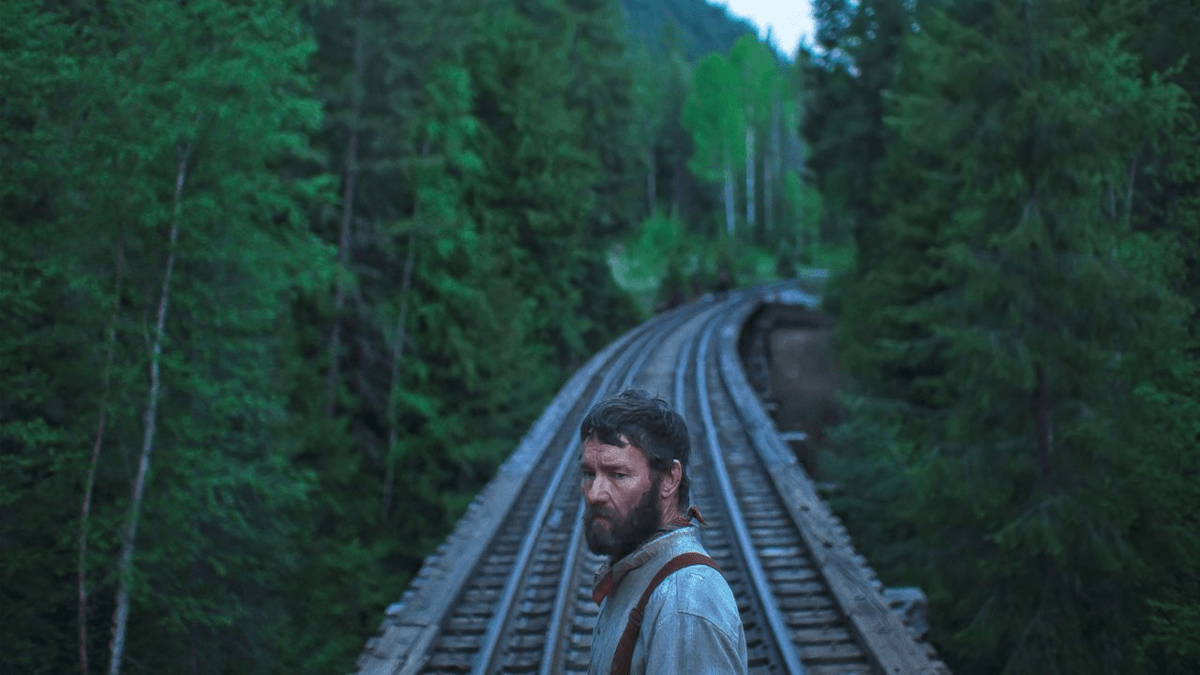
If you talk to anyone who’s eighty years-old or older, I bet they’d have an interesting story to tell. That person would have met some interesting people, seen and done things that few others had, witnessed great change over time and experienced every emotion under the sun, only to admit they have more questions than answers. That’s Train Dreams in a nutshell, a tale of an unremarkable man who built railroads and bridges to support his family, only to find everything that mattered to him gone in an instant. While his story is uniquely his, he’s also an everyman who forces us to reckon with life as we know it.
The story of Robert Grainer begins inauspiciously enough. Orphaned as a child in the late 1800s, he never learned what happened to his parents, or even what his actual birth date was. Like most children, the things he sees leave a life-long impression. For example, he sees a two-headed calf and stares at it in stunned silence. It speaks volumes that one of the few images from his childhood isn’t of his home, school or his adoptive parents.
Robert proceeds to drop out of school and skips around aimlessly, doing odd jobs to get by. When he’s an adult (played by Joel Edgerton), he meets a beautiful woman named Gladys (Felicity Jones). Why she’s so taken with him is difficult to ascertain. Robert speaks little and his beard covers most of his face. Perhaps Gladys was drawn to him because of the kindness in his eyes, his respectful demeanor, his modest attire or his gruff yet gentle voice. Maybe she received a signal from God. (The movie is firmly areligious, though.) Whatever the catalyst, Gladys asked Robert to share his life with her, and he wisely never questioned her decision.
They build a cabin near the Moyie River in Idaho, a location that is rustic and idyllic. After their child Kate arrives, Robert looks to the burgeoning railroad industry to support his family. Robert is strong and can handle cutting down trees for a living. Although the work is physically demanding and dangerous, it’s one of the few jobs where a relatively unskilled laborer like him can make decent money.
Being a logger at this time in history gives Robert a unique perspective on both the American landscape and its people. During the day, he fells trees that are hundreds of years old. At night, he sits beside a fire and listens to stories from the older members of the crew. He’s most comfortable with Arn Peeples (William H Macy), who alternates between setting off explosives and acting as the camp’s philosopher.
The logging industry attracts men of all kinds who are willing to trade their sweat for money. As a worker for Spokane International Railway, Robert comes into contact with men from China. Although he can’t speak their language, Robert respects their work ethic and their silence. Unfortunately, white men view the Chinese as threats to their livelihoods, which leads to the shocking death of a Chinaman by a mob right in front of Robert. From that point on, Robert always felt guilty over whether he should have done something to stop it. However, he follows the example of the other white men around and never discusses it.
As Kate grows, Gladys asks Robert to spend more time at home. He obliges, but work is hard to come by after the end of WW1. He helps a shopkeeper in town named Ignatius Jack (Nathaniel Arcand), and the two become friends over their shared stoicism. When money gets tight, Gladys asks if she and Kate can join him at his work site. Gladys proposes that can earn money washing and mending clothes. Robert is against it because he knows how dangerous his works sites are. (This is why we’ve seen no women or children at his sites.) Other loggers have gotten killed by runaway logs, and one was shot in the back to settle a family score.
The next time Robert is away, tragedy randomly strikes Arn. As Robert watches Arn waste away, he realizes that he’s working on borrowed time. When Arn is gone, that makes Robert one of the older workers on the site. When he returns home, he and Gladys decide to build a sawmill. They’ll need a loan and the money from Robert going out one more time, though.
Troubling omens appear at Robert’s next site. First Robert has trouble operating a chainsaw, then an older man who knew Arn doesn’t remember that he died. Robert makes himself useful, but knows his time is up. On the train ride home, Robert sees a wildfire in the distance. Smoke fills the air at the train stop, and Robert searches for his family amidst the flames. Just as inexplicably happiness found Robert, fate snatches it away.
Suddenly without a home, a family or a job, Robert struggles adjusting to his new reality. Should he wait indefinitely for his wife and daughter to reappear? Should he give up hope and move on? And if that makes sense, where would he go? Fortunately for Robert, life hasn’t forgotten him. With the help of an old friend and a new one, Robert keeps on living while not having a clue as to what life wants from him.
Recommendation
In Train Dreams, we bear witness to roughly eighty years of a man’s life. Instead of being a vehicle for us to reexperience societal changes over time, like The Curious Case of Benjamin Button or Forrest Gump, it remains focused on the protagonist. Things happen to him, some good, some bad, some terrible, and the audience is left to infer meaning from them. For as simple as I’m making this film out to be, it’s deeply spiritual and philosophical. When it pauses for us to take in all of its wonderful little moments and sumptuous details, it wants us to recognize how universal this man’s experiences are. It’s a movie intended to trigger introspection and reflection, and I was thoroughly captivated by it.
The films of Terrence Malick are an appropriate analogy. His films aren’t about conflict per se, but how we internalize narratives in our search for answers to life’s mysteries. From a metaphysical perspective, Train Dreams speaks directly to the larger questions we have about life. If we come away as perplexed and bewildered by it all as the protagonist of Train Dreams, at least we can take comfort in knowing that we’re not alone in that assessment.
What struck me most about Train Dreams is its steadfast refusal to attribute a larger meaning to anything that happens. Other films would have leaned on coincidence, fate, God or what have you to explain why things turn out the way they do. Instead, it depicts the seeming randomness of life, where we’re left to make sense of the senseless, take meaning from the meaningless. There’s no comfort offered here, only confirmation that that life goes on without regard to the individual.
The movie is constructed around a remarkable performance by Joel Edgerton. He’s one of those actors who’s been in countless films but never left a strong impression upon me. Edgerton’s more rugged than handsome, with a face that looks like it was carved out of stone. His self-contained performance is a model of restraint and intent, relying only upon glances and very few words to clue us into what he’s feeling. We see his character’s soul emerge over time, and it’s incredible to behold.
Felicity Jones plays Robert’s wife, a ray of sunlight that enters his life and gives him the purpose it had been lacking. Jones’ best roles have been those that bring out her vitality and femininity, and she’s delightful here as a partner who compliments Edgerton’s quiet strength. William H. Macy is endearing as the old logger Arn, another one of his memorably loopy and broken down characters. Nathaniel Arcand is quite moving as Native American Ignatius Jack, who acts as Robert’s spiritual healer. Kerry Condon is wonderful as Robert’s kindred spirit in tragedy. Will Patton deserves special recognition for his wry voice-over narration, a humorous stand-in for the stoic protagonist.
Adolpho Veloso’s cinematography fills the movie with the natural beauty of the forests of Spokane, the rural countryside of Iowa and the spectacular trees that comprise them. The story is primarily told through faces, and Veloso perfectly captures the emotions that ripple behind them. Writer-director Clint Bently’s patient direction serves the material well, in how he hints at the larger picture of the disappearing West while focusing on the lives of a handful of characters.
Train Dreams tells an ambling, pensive and melancholy story through beautifully lived-in performances and stunning natural photography. The movie evokes our sympathy and compassion for everyone left puzzled by life’s inscrutability. Highly Recommended.
Analysis
The magic of Train Dreams is how it uses a very simple story to introduce metaphysical questions that humankind has grappled with since the beginning of time. Very subtly, the movie wants us to see what happens to Robert as being universal to the human experience. (As someone past middle-age, what takes place has even more poignancy.) As we witness Robert’s journey from the beginning to the end, we’re left to ponder what it all means not only within the context of his life, but our own. The movie notably does not provide any answers, and its resistance to doing so is what gives the movie its powerful resonance. The story is structured like a parable, but with the moral left open for us to fill in.
Live happens when you’re making other plans
When Robert and Gladys discussed their plans for the sawmill, I knew something bad was going to happen to them. Some of that precognition can be blamed upon seeing too many movies, but it also comes with life experience, direct and indirect. Anyway, the adage that precedes this section certainly applies to Robert. Just when he thought he had it all figured out, life proved otherwise.
When bad things happen to good people
Robert’s life was defined by periods of joy and grief, both of which came as surprises. When Robert was drifting aimlessly through life, Gladys arrived and gave him purpose and love. Robert never questioned it. Then, after everything was taken away from him by the wildfire, he wondered why. As Robert struggles to make sense out of the dramatic turn his life has taken, the movie asks the same question we all have when something terrible happens to us. If we consider ourselves to be fundamentally good people, why does God let bad things happen to us?
Guilt and sin
Even though Robert is areligious, I assumed he was familiar with the basic tenets of Christianity, including the concept of sin. Robert can’t forgive himself for not intervening in the murder of the Chinaman, and his lingering guilt over the incident manifests itself in visions of the dead Chinaman. In Robert’s mind, his inaction is a sin that he’s never been absolved of, and it led to the death of his wife and daughter.
Robert also feels guilty over refusing to let Gladys and Kate join him on the site. He knows that logging sites are inherently dangerous, but he regrets his decision in the wake of their deaths. He believes that if he was home at the time, he could have saved him. Or if he’d let them come along, they’d still be alive. Taken together, the two incidents leave Robert haunted with guilt and convinced that he’s being punished for his sins.
Guilt, sin and absolution
Unfortunately, since Robert doesn’t practice a faith, only he can absolve himself of his sins. Robert must accept that his family didn’t die as a result of his transgressions, but from an unavoidable natural disaster. As such, there is no meaning to be found in Gladys and Kate’s death, or purpose in his continued existence. The harsh reality for Robert is that there is no grand design to his life or anyone’s life, only random events.
Faced with this existential crisis but without a faith to comfort him, Robert isn’t sure what to do. Ironically, he lies in the ashes of his home just like Job, another good man who also asked why terrible things happened to him. After Ignatius Jack helps Robert get past his grief, Robert holds onto hope that they’ll return. Robert may not have found religion in a traditional sense, but his belief in miracles keeps him going. It also prevents him from moving on from the tragedy.
Robert mistakenly believes that his hope (or faith) was rewarded when he finds the young girl with the broken leg. However, after she disappears without a trace the following morning, we know that his hope has prevented him from accepting reality and moving on. Until he does that, Robert is unable to accept the meaningless nature of his existence.
Life goes on
The mystery that plagues Robert after Gladys and Kate’s deaths is why he’s still alive. What is the purpose of his existence without them? Should he move on and allow himself to be happy? In that regard, Train Dreams offers a simple philosophy. Whether he was experiencing joy, despair or something in between, life was proceeding in the background. However, instead of reengaging with the world after the tragic death of his family, Robert settled for existing. The movie tells us that life is meant to be lived, regardless of the circumstances.
When Robert met Claire, either fate or divine intervention brought those damaged souls together. When the movie quietly revealed Robert never pursued a relationship with her, I was surprised because the movie seemed primed to give him a happy ending. However, during their last scene together, it’s obvious that Robert is too paralyzed by grief and to accept a second chance at happiness and love. He hasn’t forgiven himself for what he’s done and allows the opportunity life has given him to pass him by. This development, which is implied by Claire’s absence, is so heartbreaking that it left me stunned.
The movie’s closing scenes emphasize how a life stuck in limbo is just as tragic as one that ends suddenly. After many years pass, Robert finally leaves his cabin and takes the train into Spokane. He sees John Glenn in outer space on television, then indulges in an airplane ride. Robert finally allows himself to experience joy again, but it’s too late. He dies alone in his cabin, a symbol of what happens when we let our past define us and rob us of our future.
 Detroit Cineaste