
In The Choral, a small British town struggles to put on their annual choral program as WW1 steadily depletes their ranks. The theme of an unlikely bunch of characters overcoming adversity to accomplish something amazing is both conventional and familiar, and given the context, you would expect this movie to be very respectful and sentimental. Well, not entirely. On the one hand, what the movie says about the importance of music during dark times is very thoughtful and touching. On the other hand, the movie delivers that message in a very unexpected way. While there is no doubt the British had sex during WW1, the movie goes out of its way to show that the British were quite randy back then. In fact, the only time they’re not thinking about sex is when they’re singing.
An indication of how ribald this movie arrives in the opening scene, where the young Ellis (Taylor Uttley) follows his mate Lofty (Oliver Briscombe) as he bicycles around town delivering posts from the military. Each stop unfolds the same way. Lofty knocks on the door, a horrified wife takes the letter, reads it, sobs and closes the door. It’s obvious that she received the worst possible news, that her husband died in battle. Ellis tells his mate that he should take advantage of these situations to lose his virginity. There’s no easier way to score than with a widow in need of emotional support.
That advice initially struck me as crass, but I reminded myself that these hormonal teenagers will soon be off to fight in the trenches. They’re living under extreme circumstances, after all, which the following scene drives home. The two lads happily say goodbye to a trainful of youthful conscripts heading off to war. Another train arrives seconds later, filled with injured survivors. Yes, those horney kids deserve some slack.
It’s not just boys whose thoughts are preoccupied with rumpy-pumpy, though. Bella (Emily Fairn) sings a bawdy number when auditioning for a spot on the choir and complains to a friend that she’d like to move onto another fella, but she can’t because she doesn’t know if her boyfriend Clyde (Jacob Dudman) is dead. When he shows up missing his right arm, Bella has already turned her affections to Gilbert (Thomas Howes). Clyde may have survived the war, but it cost him a limb and his girl. You can’t get any more unsentimental than that.
Mrs. Bishop (Lyndsey Marshal), the town’s lone sex worker, has such a busy schedule that she’s forced to stagger visits from the leaders of the town’s choral program, Alderman Bernard Duxbury (Roger Allam) and photographer Joe Flytton (Mark Addy). Both men are haunted by the war in different ways. Bernard’s son died in the conflict, leaving his wife (Eunice Roberts) in perpetual mourning. Joe takes pictures of the recruits before they head off to war. Mrs. Bishop also plays in the local Ramsden Choral Society, which is experiencing difficulties due to a shortage of male participants.
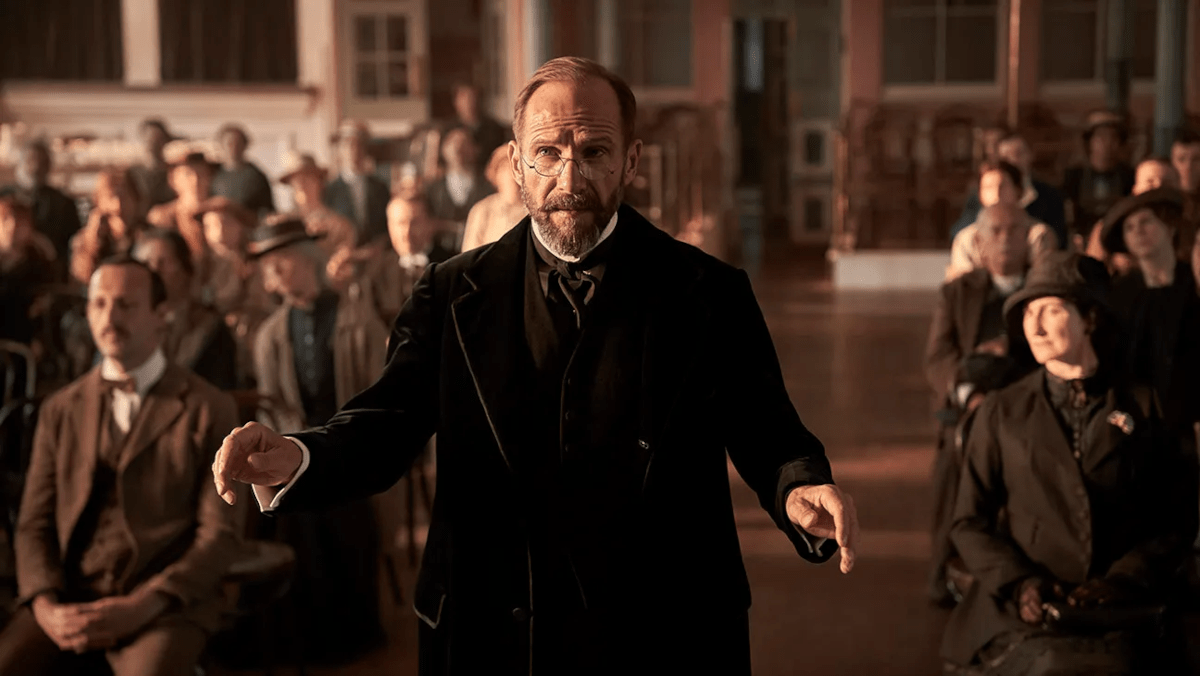
Speaking of which, Bernard is tasked with finding a new conductor after the current one is off to war. Their best option is Dr. Henry Guthrie (Ralph Fiennes), who recently returned from Germany under a cloud of suspicion. The movie never comes out and explicitly says why he had to leave, but the reason becomes obvious as the townspeople gossip over his lack of a wife and the presence of his tweedy musical partner, Robert Horner (Robert Emms).
Bernard and Joe recruit Guthrie away from his current residency at his hotel, where he plays piano for his supper and unlimited dessert cakes. The choir desperately needs Guthrie, who agrees provided he has complete control over the program. The first order of business is selecting the right piece of music. The “St Matthew Passion” by Bach is out because he’s German. Any composer with Germanic ties is similarly verboten, which is further extended to Jews. (A deft bit of foreshadowing there.)
Guthrie settles on Sir Edward Elgar’s “The Dream of Gerontius”, a piece for choir and orchestra that has been ignored since its disastrous initial performance. Guthrie then has everyone re-audition because he wasn’t involved the first time around. The scarcity of male voices needs immediate attention, which is where the young lads we met before come in. There’s also a funny scene where Guthrie recruits men belting out drinking songs in the pub. So long as they have strong voices, Guthrie can teach them technique.
Among the repeat auditioners is Mary (Amara Okereke), whose angelic voice is the perfect match for the Angel in Elgar’s piece. Bernard has long been the choir’s lead tenor, but Guthrie bristles at Bernard’s thin voice. A recruiting visit to the local hospital ward yields three more tenors who convincingly sing a number from Gilbert and Sullivan’s The Mikado. Clyde is also a resident and former choir member, but hasn’t returned due to his awkward situation with Bella. In one of the movie’s best scenes, Guthrie convinces Clyde that although he’s been dealt some rough cards, his ability to sing is a consolation prize that shouldn’t go to waste.
With Clyde now occupying the lead tenor spot, it’s up to Guthrie to refashion Sir Elgar’s piece to fit a minuscule orchestra and Clyde being much younger than the part he’s playing. Inspiration comes from Roger, who suggests tying the piece’s themes of death and dying to the war and its casualties. Guthrie, who has been stubborn and exacting in his approach to the performance, is taken by Roger’s insight and agrees. But can Guthrie pull off a miracle with only two weeks of rehearsal remaining? And what will Sir Elgar make of the liberties taken to his work?
Recommendation
The Choral is the story of an outsider who coaches a group of ordinary people to accomplish something amazing. While that familiar formula plays out, the movie offers a very unsentimental and unromantic view of civilian life during WW1. This peculiar mixture of the conventional and the unconventional felt like I was watching two very different films that had been spliced together. To my surprise, everything comes together in the film’s climax, a brilliant set piece that affirms the transcendent power of music to heal and unite us during dark times.
Appreciating this movie requires accepting its unconventionality. To be honest, I was anticipating something dignified along the lines of Downton Abbey or a BBC production. As such, the movie’s frank discussion and depiction of sexual matters felt out of place in a genre piece like this. Eventually, I realized that the purpose of the film’s mildly racy content was intended to challenge my preconceived notions of what a WW1 film can be.
In place of sentimentality, this movie realistically depicts people dealing with the one urge that can’t be conquered by war, which is sex. There are no lovey-dovey scenes, where the gleam of love and romance offers hope for the future. Instead, these characters pursue physical connections whenever they’re not practicing for the choir. And when those romantic plans are thwarted, it’s tragic. Happy endings–in the literal sense–are few and far between.
In addition to The Choral’s belief in music’s transcendence, it also openly advocates on behalf of artistic license over purity. It states that music adapted in accordance with the times ensures its ongoing relevancy, whereas music that remains “trapped in amber” faces obscurity. To that point, I hadn’t heard of Sir Edward Elgar’s choral piece before seeing this film, but now, I would gladly pay to see a stage reproduction of the film’s climactic performance by itself. Freely adapting Elgar’s work has given it new life that it wouldn’t have otherwise had.
The cast is uniformly good throughout in what is an ensemble piece. Although Ralph Fiennes is the marquee name, his character is more of a catalyst than the lead. Similar to his work in last year’s Conclave, Fiennes’ Dr. Guthrie is another one of his unfussy and finely crafted performances. Fiennes is the perfect match for characters with a prickly facade who gradually reveal depths of feelings hiding underneath. Roger Allam is quite good as the lead tenor who reluctantly adapts for the greater good of the choir. The other standout performance is Amara Okereke’s Mary, the Salvation Army worker with the voice of an angel.
When the world is on fire, thank goodness there’s art to temporarily remind us of the beauty of life. This is the heart of The Choral, a WW1 period piece that evokes universal truths about art and the horrors of war. Ralph Fiennes delivers another memorable performance as the arrogant conductor tasked with the impossible. Recommended.
Analysis
Art comes out of art
Dr. Guthrie states the above after Sir Edward Elgar withdraws his approval of the Ramsden Choral Society’s performance of The Dream of Gerontius and leaves in a huff. In context, Guthrie is asking Elgar to understand that his music can gain surprising new relevancy through Guthrie’s adaptation. Unfortunately, his plea falls on deaf ears, as the only thing that matters to Elgar is fidelity to his composition. However, this scene and Guthrie’s impassioned words encapsulate one of the movie’s critical themes, which is how derived art (or inspired art) serves a useful purpose to both the original artist and society.
Even with my limited knowledge of classical music, I know Elgar was the composer of the Pomp and Circumstance Marches. Based upon his Wikipedia page, I assume that Elgar was knighted based upon the reception of that work. In the movie, Guthrie proposes that the choir perform Elgar’s Gerontius because it’s the only choral piece he can think of that’s not composed by someone with Germanic heritage.
This early turning point in the movie aligns with the history of the piece. Gerontius had a disastrous initial performance at the Birmingham Triennial Music Festival in 1900, and the piece’s Roman Catholic themes made performances in Anglican cathedrals a challenge for the following decade. Few Englishmen would have heard it. However, after Gerontius was translated into German, performances in Düsseldorf were well-received in 1901 and 1902. This would explain why Guthrie would be familiar with it enough to propose it as an alternative.
When Elgar granted the Ramsden Choral Society permission to perform his work, it came with the implied understanding that they would perform it as he composed it. Although his legend at the time is largely based upon his Marches, he’s a proud man who doesn’t appreciate his work being altered in any way. Elgar becomes enraged at how Guthrie adapted his work to fit within the limitations of the choir because Guthrie had the nerve to change his work. It doesn’t matter to him if that particular piece remains forgotten in his home country; all that matters is that the performance is faithful to his composition.
Elgar’s vanity aside, what struck me was how Guthrie’s adaptation goes directly against the traditionalist approaches to classical music in his time. After Guthrie supplanted Bernard with Clyde as the tenor of the piece, he modified it so that it would be about a young man’s experiences in the war, not an old man on his deathbed. Guthrie further transformed the work into a piece of performance art by introducing costumes and adding scenes where non-singers enact the horrors of war. With these dramatic changes, Guthrie transformed the piece from being forgotten to incredibly relevant.
Guthrie’s reworking of Elgar’s piece represents a modern view of art and music. Guthrie applying a new and unrelated context to Elgar’s work epitomizes how art and music has evolved over the past forty years. Musicians routinely sample other musicians. Andy Warhol famously repurposed celebrity images with his lithographs and appropriated the Campbell’s soup can for one of his most famous paintings. The cinematic adaptations of Shakespeare’s plays are more broadly known than their traditional stage equivalents. In my lifetime, it’s commonplace to consider art that is derived from art as legitimate as the original, a notion that would drive a traditionalist like Elgar crazy.
More sex please, we’re British!
Is The Choral the horniest movie set within WW1? I haven’t seen them all, so I can’t make that assertion with confidence. However, nearly all of the characters are defined by their sexual preclivities during the course of the story. Consider:
- Ellis coaches Lofty to take advantage of widows
- Ellis’s pursuit of Mary, to the point where he begs her to have sex with him before he goes off to war.
- Lofty has sex with Mrs. Bishop, so that he won’t be a virgin on the front lines.
- Bernard and Joe see Mrs. Bishop so regularly that she has to schedule them.
- Bella hooks up with Gilbert because she can no longer wait for Clyde’s return.
- Clyde asks Bella for one last hand job
- Guthrie scans the daily papers to see if his German lover in the navy has been killed.
- Robert turned to Guthrie for affection, only to be rebuffed.
Although the movie never directly says as such, this preoccupation with sex may represent how the people turned to physical pleasure to escape the horror of the war.
No happy endings
The Choral is decisively unsentimental and unromantic. Outside of Bernard’s wife finally shedding some of her grief in the end, none of the characters experience a happy ending. Consider:
- Ellis does not have sex with Mary before he leaves.
- After Bella satisfies Clyde’s final request, she leaves him in tears.
- Clyde is alone after the choral performance.
- Bella’s new beau Gilbert heads off to war, implying that she’ll be single soon enough.
- Joe resumes taking pictures of the young men before they depart.
- Guthrie returns to his newfound obscurity, presumably playing piano at the hotel.
- Robert is arrested for being a conscientious objector and imprisoned.
- When a priest tells the boys that they’ll be home by Christmas, we know that the war will continue for another two years.
Having the movie concludes so somberly goes directly to Guthrie’s early quote of Goethe:
“A man should hear a little music, read a little poetry, and see a fine picture every day of his life, in order that worldly cares may not obliterate the sense of the beautiful which God has implanted in the human soul”.
Although the performance provided only a brief respite from the war, nothing can take the beauty of that moment away from those who experienced it. The transcendent power of art will see everyone through the dark times, soldiers and civilians alike.
 Detroit Cineaste