
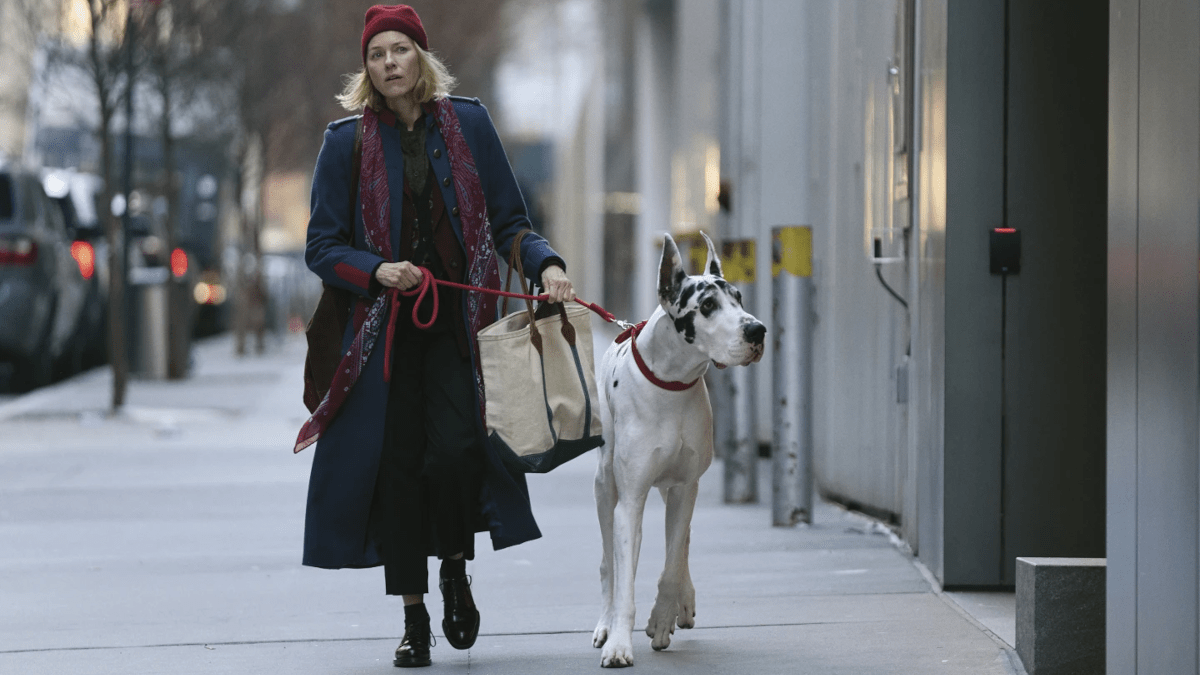
What do you do when your friend asks you for a favor above and beyond what you would normally do for them? For example, “Would you look after my dog after I’ve checked out?” That kind of request can affect your life dramatically, especially when that dog is a Great Dane, you live in a small studio apartment and the building has a no pets policy. How do you turn down your friend’s dying request? And more importantly, what does the dog think about this arrangement?
Before we get to the death or the dog in question, there’s a dinner party. It’s one of those gatherings where everyone’s having a nice time drinking wine, eating, telling funny anecdotes and laughing. Notable author Walter (Bill Murray) is holding forth at the dinner table, telling a humorous story. He exchanges a knowing glance with Iris (Naomi Watts), who smiles back. Something’s going on–or has gone on–between the two, but we don’t know the particulars yet.
Sometime later, Iris replays a voice mail from Walter and cries. His message is an innocuous one, asking for help getting his laptop to work. It turns out that Walter committed suicide, and that voice mail is the last Iris will ever hear from him. However you characterize life, it can be darkly comedic at times.
Unfortunately, the bad news doesn’t end there for Iris. Walter’s second wife, Barbara (Noma Dumezweni), invites her over to her apartment, presumably so they can discuss Walter’s tragic death. After a brief exchange, Barbara gets to the point. Walter told Barbara that if anything happened to him, he wanted Iris to take care of Apollo. Iris is incredulous. Why would Walter ask her to take care of his Great Dane? Barbara agrees that it’s not ideal that Walter asked Iris to do this, but it’s what he would have wanted. Besides, Apollo wasn’t happy at Barbara’s apartment. Or maybe it was the other way around, because Barbara stashed Apollo in a kennel because she couldn’t handle him. Barbara has a very nice apartment, by the way. Iris isn’t about to push back and agrees to take the dog off her hands.
There possibly isn’t any sadder sight than an animal in a cage. When Iris approaches Apollo, he looks at her with eyes that say, “I have no idea who you are, but please get me out of here.” Apollo doesn’t make things easy for Iris. First he resists getting out of the car, then he refuses to get in the apartment elevator. Note that Watts maybe weighs one-hundred pounds, which is probably less than Apollo. There’s zero chance Iris can strong-arm Apollo to do anything he doesn’t want to do.
The conflict in the movie boils down to what Iris will do with Apollo. The building super Hektor (Felix Solis) reminds her over and over that no pets are allowed, to which Iris responds that she’s putting him up for adoption. Unfortunately, adoption organizations for Great Danes are full up, so it will take a while. Meanwhile, Apollo isn’t sure what to make of his new owner. He was present when Walter died, and people tell Iris that Apollo is in mourning. Regardless, he commandeers Iris’ bed, leaving her to sleep on an inflatable mattress.
Iris may not have a family, but she does have a full life. She’s an English professor and is out most of the day. She’s also a writer suffering from writer’s block on a novel titled “Eastern Block”, which is incredibly ironic. Perhaps Walter gave her Apollo so that he could give her advice from the great beyond, because the first day she leaves Apollo alone, he mauls the notes for her book. Iris tells Apollo that Walter didn’t like it either, so no big deal.
Before Walter’s death, he connected with his only daughter, Val (Sarah Pidgeon), who is not the product of any of Walter’s three marriages. Presumably as a consolation prize for not being around during her childhood, Walter asked Val to go through his thousands of emails and compile the best ones into a book, under Iris’ mentorship. Val’s drifting aimlessly through life, with no job, no serious relationships and no place to live. Clearly, Walter hoped some of Iris’ maturity would rub off on her. Walter knows Iris is a kind and responsible person who can’t say no to a friend, but who also needs an injection of “life” in her life, which would explain why she wound up with Apollo.
So what was the nature of Iris’ relationship with Walter, exactly? Like all of his other female relationships in his life, it was complicated. Walter’s ex-wives couldn’t be more dissimilar. His first, Elaine (Carla Gugino), is warm and friendly. Barbara is stern and controlling. His last wife, Tuesday (Constance Wu) is flaky and self-centered. The scene where the three toss his ashes into the Hudson left me wondering how the same man could possibly love all three of them. Somehow, Iris’ friendship with Walter outlasted all of his marriages. This leads to the other question Iris is trying to answer, which is why Walter didn’t reach out to her before he killed himself?
Alas, Walter is no longer able to answer questions from Iris, or anyone else. All that’s left is for Iris to come to terms with his death and decide whether to keep Apollo. The apartment building’s management company has filed a notice of eviction against Iris, which puts her at a crossroads. She can only afford to live there because it’s rent-controlled, and if she’s evicted, her commute would be impossible. Which brings us back to Apollo, who Walter loved. How can Iris honor Walter’s wishes without both of them being thrown out onto the street?
Recommendation
There have been countless movies about the impact a pet has on their owners. On that level, what The Friend has to say on the subject is nothing extraordinary. Before the dog’s arrival, his new owner is stuck in a comfortable rut. The dog’s unwieldy presence acts as a catalyst, forcing her to rethink her life and make changes. The fact that the owner receives the dog under tragic circumstances isn’t new ground, either. Despite how familiar this story is, it still manages to be affecting and entertaining.
What’s notable about The Friend is how dignified it treats the premise. The juxtaposition of the slight Naomi Watts and the ginormous Great Dane she cares for would have been an unending source of laughs in a different movie. This one, however, isn’t interested in sitcom-level jokes. Instead, the movie tracks the bonding that takes place between this particular owner and this particular dog. As a study of human-pet relationships form and grow, the movie’s approach is sensitive and respectful to both sides. It wants us to care about these two and see them come to a mutual understanding, and it accomplishes that without sentimentality or contrivance.
The role of the put-upon Great Dane owner is a different one for Naomi Watts. She delivers a sympathetic, lived-in performance as a lifelong solitary New Yorker who was content to live out her life that way. The movie is a nice showcase for Watts’ ability to evoke a wide range of emotions bubbling under the surface. This certainly isn’t Watts’ most challenging role, but it’s nuanced and relatable.
There’s something ironic about watching a movie with Bill Murray where he’s already dead and experienced through flashbacks. Did Murray see his role as a sardonic response to those who consider his acting career as being dead outside of the Ghostbusters sequels? Whatever the case, Murray is good in this movie. He’s affable but contained, with a few funny lines that remind you of what he’s capable of. The days when Murray was the main attraction appear to be over, but he’s still magnetic in small roles like these.
I would be remiss if I didn’t mention that the movie makes Manhattan and other locations in New York state look beautiful. Whatever tax credits the New York Film Bureau put towards this movie were money well spent, because the film at times plays like a commercial from the NY Department of Tourism. “Planning a visit to New York? Come see Manhattan, the Brooklyn Bridge and many other locations known the world over!”
How a pet and its new owner finding each other in The Friend is very familiar ground, but it works because the story is told with empathy and sensitivity. Naomi Watts and Bill Murray are touching as a professor and her mentor, who both accept a Great Dane into their lives. A charming little drama. Recommended.
Analysis
In the absence of anything specific to analyze with The Friend, I reflected on the film’s two stars and how they got to this point in their careers. Twenty years ago, if anyone would have told me that Bill Murray and Naomi Watts would headline a film about a Great Dane, I would have said they were crazy. Well, here we are.
The Incredible Shrinking Actress
Ironically, the performance that remains the best of Naomi Watts’ career almost went unseen. I’m referring to David Lynch’s Mulholland Drive (2001), and its journey from rejected television pilot in February 1999 to feature film premiering in Cannes in May 2001 is the stuff of legend. Watts’ performance in the dual roles of Betty and Diane was mesmerizing and earned praise from critics and moviegoers alike. At the time, I was convinced that Watts would become a movie star, but that never really happened.
Watts went on to have a brief run as a headliner in the years that followed. She starred in the buzzy horror movie The Ring (2002), Received her first Academy Award nomination for 21 Grams (2003), starred in Peter Jackson’s King Kong (2005) and The Ring Two (2005). For the next seven years, Watts’ career tapered off. Although she worked consistently with top directors, her films had little cultural impact. Clint Eastwood’s J. Edgar (2011) was poorly received. She co-starred in David Cronenberg’s Eastern Promises (2007), a movie most remembered for Viggo Mortensen’s full-frontal nude scene and its graphic violence. There was an underwhelming Woody Allen film (You Will Meet a Tall Dark Stranger, 2010) and Michael Haneke’s shot-for-shot remake of his own film, Funny Games (2007).
Watt reemerged with her harrowing performance in The Impossible (2012), which garnered her second Academy Award nomination. But her career took another downturn immediately afterwards. She appeared in five films in 2013, but the only one people remember is the heavily-panned Diana. Her turn in Birdman (2015) indicated a larger problem to industry perception of her as an actor. Of the four leading performances in the movie, only hers was conspicuously not nominated for an Academy Award.
I really like Birdman and felt that Michael Keaton, Emma Stone and Edward Norton deserved the praise and recognition they received for their performances. Watts, however, looks out of place throughout the movie, a sign that she was either unable or unwilling to match the manic energy of her costars. Instead of rising to the challenge, she defers and fades into the background. To me, her forgettable performance in Birdman explains why Watts’ career never really took off. She’s rarely comfortable with demanding the spotlight in a scene, even when the opportunity presents itself.
Looking back on Watt’s performance in Mulholland Drive, Lynch is the one director who fully leveraged all of her acting strengths. Watts has a knack for showy, artificial performances, which constitutes the Betty character. She’s also exceptional at playing hurt and/or anguished characters, which is Diane. Through Lynch’s direction, Watts gave a tour de force performance, and she hasn’t come close to matching it since.
Although director Gore Verbinsky highlights Watts’ beauty extensively in The Ring, her performance is compelling because her character has agency. As Rachel, she’s a reporter trying to figure out the mystery behind the nightmarish videotape that curses everyone who watches it. She’s trying to repair a tense relationship with her creepy son. Watts’ character is an active participant in the movie, a key ingredient in all of her memorable performances.
Watts looks great in King Kong, but she’s confined to being the object of the great ape’s desire throughout the movie. In Eastern Promises, her character is intent upon determining the family of an orphaned baby, a notable exception. In Funny Games, she’s set upon, tortured and killed. In The Impossible, she’s a wounded survivor of a tsunami trying to get herself and her son to safety, another reactive role. She played a prostitute taking care of Bill Murray’s St. Vincent (2014). Watts is fine in all of those roles, but she doesn’t command our attention. With few exceptions, her characters rarely affect the outcome of the story. She’s a beautiful and friendly presence, but not much else.
Her work in the Divergent films (2015 and 2016) unfortunately coincided with the end of Hollywood’s obsession with turning juvenile fiction books into franchises. Perhaps her worst luck was starring in Colin Trevorrow’s The Book of Henry (2017) a film so bad it inflicted lasting collateral damage on the Star Wars film franchise. From there, Watts has appeared exclusively in independent films, with none of them equaling the impact her work in Lynch’s magnum opus twenty-five years ago.
I probably owe it to myself to watch more of Watts’ recent films, because she is good in The Friend. Iris is forced to take control of a difficult situation. She can’t be passive with a Great Dane because it will rule her life if she lets it. There’s even a little showy “performance within a performance” scene near the end, where she confronts Murray’s character in a fictional sequence for her book. Watts’ performance in this movie may not be her best, but it reminded me of what she is capable of when she’s not content with being a wallflower in her own movie.
Oh, Watts gets an “I still got it” moment in The Friend, where we can admire her slim figure through a textured glass door.
The Humbled Gonzo Funnyman
I’ve been a fan of Bill Murray since he was on Saturday Night Live and have seen most of his films since he left the show. He’s one of the funniest actors I grew up watching in comedy classics including Ghostbusters, Stripes, Caddyshack and Scrooged. He’s also proven his dramatic chops in Lost in Translation, Broken Flowers and the aforementioned St. Vincent.
Although he was regarded as a great comedic actor for decades, public opinion of him took a turn around the MeToo movement. I know this because I tried to excuse his behavior towards Lucy Lu on social media as him “having a bad day” and got dogpiled. When I did some digging, I found he had many troubling incidents that, in total, have led people to view him as a bad person who’s gotten a pass because of his stardom.
I agree that Murray’s past bad behavior does warrant him being viewed in a harsher light. His on-set antics on Aziz Ansari’s film Being Mortal, regardless of how innocently he characterized them, were enough to torpedo the project. Since then, the only Hollywood productions Murry has appeared in were Ant-Man and the Wasp: Quantumania and Ghostbusters: Frozen Empire. I wouldn’t say that Murray has been “cancelled” by the major studios, because he had been working primarily in smaller, independent films for a while before the Ansari debacle happened.
Whatever the case may be, Murray has implied during interviews that the way things went down on Ansari’s movie humbled him. I wonder if that failed movie project informed Murray’s performance in The Friend in some way. His character looks like he’s been worn down by life. To be fair, Murray is now 75, with a wrinkled face and gray hair. And while Murray does exhibit some of his unique energy in the movie, it’s at a much lower register. His performance seems intentionally designed to not offend anyone. Murray is operating in safe mode, but he’s still worth watching, for me anyway.
 Detroit Cineaste