
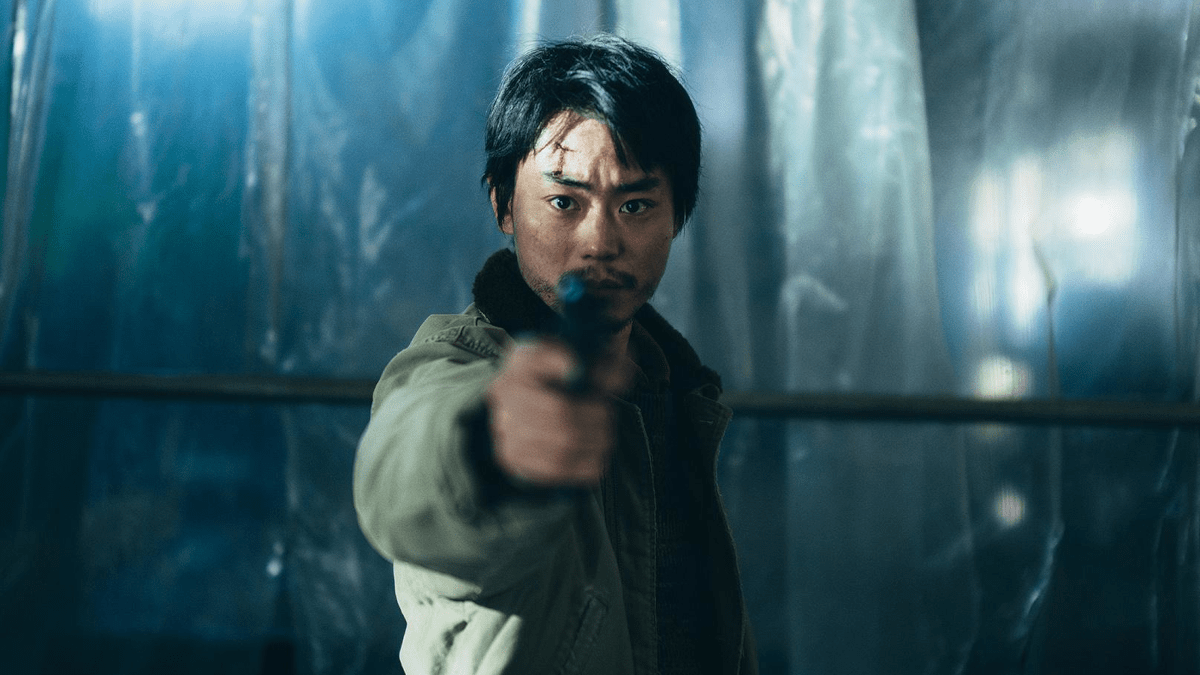
In the old days, people who sought out back-alley bargains knew what they were getting. In the era of digital commerce, however, buyers only know a seller’s user name and can’t tell whether what’s for sale is legitimate or not until a package arrives. Conversely, sellers don’t know who they’re scamming or how their victims will react to being swindled. Cloud takes a harsh look at the perils of ecommerce in the cloud era, where new-fangled criminality hides behind anonymity and revenge is sought through on-line doxxing forums. It’s a canny, secretive film that progressively builds towards a shocking climax.
If there’s one message that’s driven home repeatedly in Cloud, it’s that nobody is what they seem. In the beginning, the movie’s protagonist, Ryôsuke Yoshii (Masaki Suda), successfully pressures a medical device manufacturer to accept far less than their production cost. Yoshii knows that the man can’t afford to store his goods indefinitely, and has no choice but to accept being fleeced. Yoshii’s is ruthless because he can sell the merchandise on the internet, while the manufacturer cannot.
When Yoshii returns home, he posts the items on his digital marketplace with a price that will land him a healthy profit. The items sell out in minutes, proof that he knows how to game the system in his favor. Despite what we just witnessed, Yoshii lives humbly. He only dabbles in internet reselling when his bank balance gets low. His actual day-to-day job is working for a company that manufactures dress shirts. (This is only the first surprise of many in store for us.)
Yoshii wants to be promoted into management, but he’s stymied by his traditionalist manager Takimoto (Yoshiyoshi Arakawa) who wants him to be a Junior Staff Leader first. Takimoto confides to Yoshii that the current senior management team are tired, worthless old men, implying that he’ll be promoted before long. Yoshii declines Takimoto’s offer and the raise that comes with it, telling him “I’m just unasserted. It only looks like I’m committed.”
On his way home, Yoshii updates his bank passbook (these still exist?) and now has six million Yen in his account. When he arrives at his very modest apartment, his girlfriend Akiko (Kotone Furukawa) is already there. She says she’s moving in with her parents because she can’t afford rent and doesn’t want to live in Yoshii’s cramped place. Akiko’s comfortable with how he makes money on the side, and Yoshii’s promise of making enough to allow her to quit her job pleases her. “There’s so much I’d like to buy,” she says.
Later that day, Yoshii visits Muraoka (Masataka Kubota), his vocational school senior, at his dingy apartment. Muraoka says that a classmate of theirs was caught scalping tickets. “Taking risks like that never ends well,” Muraoka says glumly. On his way home, Yoshii is knocked off his scooter by a trip wire in his path. Was it placed there with him in mind?
The following morning, Yoshii tells Takimoto that he’s resigning. Takimoto is hurt by the revelation because in his world, business is built upon relationships, which young people like Yoshii don’t value. At home, Yoshii tells Akiko that he worked at the factory for three years and was wasting his time. However, he now has a “sweet little plan” that will allow them to spend more money. Ah Yoshii, if only you knew that money can’t buy you happiness or love.
When Yoshii visits Muraoka again, his place is messier than before. Muraoka pressures Yoshii to fund his new auction platform, insisting it’ll make them easy money. Instead of showing enthusiasm, Yoshii stares into the distance. His mind is elsewhere…perhaps in the clouds? (The movie alludes to clouds throughout.) Akiko meets them at the bus stop, where Muraoka asks Yoshii if he plans to marry her. Yoshii says he intends to and shows her their new house on his phone. A stranger behind them also takes a quick look before exiting the train.
Things go according to plan for Yoshii at first. His new home is a beautiful glass castle situated by a lake and comes with storage space for his merchandise. He hires the unassuming Sano (Daiken Okudaira), a local, as his right-hand man. Akiko is surrounded by luxury. Yoshii puts a set of fake designer handbags up for sale and waits for the money to roll in, but they don’t sell. A metallic object is thrown through their window one night, scaring Akiko, who pleads with Yoshii to move back to Tokyo. When Yoshii reports the incident to the local police station, the officer asks him if he’s the guy selling knock-off merchandise. In a panic, Yoshii dumps his handbags and delivers them to the shipper himself.
Despite returning to legitimate merchandise, Yoshii’s life continues to spiral out of control. Akiko is bored and flirts with Sano, who discovers a doxxing forum filled with people asking for Yoshii’s whereabouts. Yoshii learns that Sano used his computer and fires him despite Sano’s warning to watch his back. Muraoka is angry at Yoshii for ghosting him to pursue his own business. Behind the scenes, several people Yoshii mistreated gather to discuss violent ways to exact their revenge.
The last act is filled with brutal violence and several shocking twists, culminating with a scene that reveals the cold, harsh truth that the movie has been building towards from the start. If you think you know what it means to be a criminal in the cloud, guess again.
Recommendation
Cloud is the work of a master storyteller. Writer-director Kiyoshi Kurosawa constructs his film like a mosaic, with each scene adding to what came before until its main concerns are revealed when the last piece is in place. Until then, Kurosawa’s film is an effective suspense thriller, with an air of uncertainty hanging over everything we see. Scenes have a palpable sense of dread, but what they portend remains hidden until Kurosawa shows us the big picture. As such, watching this film requires patience while it resolves its underlying mystery.
This is not to say that what transpires is inscrutable, because the plot is fairly straightforward. The protagonist’s evolution from an uncommitted factory worker to a full-time internet reseller is rooted in opportunism, with a belief that nobody gets hurt by being scammed. The latter speaks to the overarching theme Kurosawa wants us to reflect on, which is that crime is harmful regardless of where it takes place.
Although Kurosawa’s elaborate screenplay and taut direction propel Cloud, the performances from the actors bring his story to life. Masaki Suda is brilliant as Yoshii, the timid internet reseller who quickly gets in over his head. It’s an unsympathetic yet captivating performance, defined by self-interest, a glib disdain for ethics and zero apprehension. Kotone Furukawa is wonderfully superficial as his consumerist girlfriend, a beautiful yet simple-minded creature whose purpose in life is to buy things.
There are many memorable performances throughout the eclectic supporting cast. I liked Masataka Kubota’s portrayal of Muraoka, Yoshii’s sketchy and highly resentful former mentor. Yoshiyoshi Arakawa is hilarious as Takimoto, Yoshii’s former boss who becomes psychotic over Yoshii’s disrespect. Daiken Okudaira is deceptively casual as Sano, Yoshii’s erstwhile assistant and bridge to the gangster underworld. Toshihiro Yagi steals his only scene as the highly suspicious police officer Hojo.
On the technical side, Takuma Watanabe’s haunting score, Yasuyuki Sasaki’s moody cinematography and Kôichi Takahashi’s editing combine to create a murky atmosphere filled with tension and paranoia. I want to call out Norifumi Ataka and Kyoko Matsui’s production design, which had me marvelling at the attention to detail given to the locations used throughout the film, from Yoshii and Akiko’s sublime glass house to Muraoka’s trash-strewn apartment with its half-dead plants. Everything in this movie feels incredibly real, another example of why location-based filmmaking is superior to CGI sets in every aspect.
As a crime thriller, Cloud has plenty of intrigue, hidden motivations and shocking violence to satisfy fans of the genre. However, writer-director Kiyoshi Kurosawa elevates the material by turning it into a puzzle that ultimately reveals a bleak message about the universal nature of criminality. A brilliant film. Highly recommended.
Analysis
What makes Cloud so intriguing is how Kurosawa progressively enhances the story like a painter filling out a canvas. Like a painting, individual segments of Kurosawa’s film are interesting in and of themselves, but are more meaningful in totality. In the beginning, the movie appears to be about the life of a digital era criminal, Yoshii. Then, as things quickly unravel for him, it’s about how his unscrupulous practices have karmic repercussions. Finally, when Kurosawa arrives at the end, he pulls the camera back to reveal his message: cyber criminals and gangsters are cut from the same cloth.
Kurosawa intentionally obscures what his film is actually about until the end. However, I don’t believe he’s doing to confuse or frustrate us. He wants the audience and Yoshii to arrive at the same epiphany at the same time. Until then, he builds his argument deliberately, trusting in our capacity to put the pieces together without having to spell things out for us. His film is filled with hints, some obvious, some less so, and I admit that I only recognized what they meant after a second viewing.
After presenting itself as many different things, Cloud is ultimately a parable. What Kurosawa is telling us is that today’s criminals are just as dangerous as old school gangsters. If you’re scamming people, you better have a gun handy. Even better, hire an actual gangster to show you how it’s done.
Act 1: Yoshii, the budding criminal
In the early going, Cloud is about Yoshii’s conversion from disinterested factory worker into a full-time cyber criminal. There’s something peculiar in how he strong-arms the medical device manufacturer and his wife into accepting far less than he initially agreed to for the goods. Yoshii isn’t an imposing figure at all. He looks young, with a slight build and a pitiful beard. Honestly, the older couple could easily beat him up if they had the nerve.
What Yoshii does have is leverage over the manufacturers, and he wields it ruthlessly. Unlike them, Yoshi can quickly put their merchandise up for sale on his digital marketplace. If they don’t sell their goods to him, he knows they will need to pay for storage while they look for another seller, costing them money they don’t have. Yoshii drives a hard bargain because he is devoid of ethics and only cares about himself.
Cloud implies that Yoshii resells goods online to augment his salary from the factory, which isn’t much. (Before his big triumph, his bank balance was minuscule.) Yoshii wants to be promoted to management, but doesn’t want to go the established route. He refuses to manage subordinates in order to climb the corporate ladder. After three years of folding shirts, he’s convinced he’s wasting his time, doesn’t need to prove himself anymore and quits. As a full-time reseller, Yoshii can make big money quickly, with little effort, which will enable him and his girlfriend Akiko to afford a luxurious lifestyle.
The problem is that Yoshii likens internet reselling to a child’s game like Old Maid. He believes what he’s doing is a victimless crime. There’s no harm in someone buying a knock-off designer handbag, and if a buyer complains he’ll claim ignorance because he doesn’t knowingly sell fake merchandise. It’s all a game, with winners and losers but nobody gets hurt, or so he thinks.
Yoshii’s career shift from the factory to being a digital reseller mirrors the macro trends of the world’s economy. The factory represents the old way people built a career, which was over years and by building relationships. In the new economy, success is measured in minutes and relationships are predominantly anonymous. All that matters is that the merchandise looks good, buying is easy and your order ships to your door. Quality, which was important in the old economy, no longer matters. With digital reselling, the prevailing motto is “buyer beware”.
Symbolism
Throughout Yoshii’s transformation, Kurosawa playfully references cloud metaphors to draw us into the mystery.
All of Yoshii’s reselling activities take place in what we describe as “the cloud”. Unlike “the internet”, “the cloud” is a friendlier nickname for the digital frontier. It aligns Yoshii’s view that what he does is ephemeral and harmless, like a cloud.
Early on, when Muraoka is trying to convince Yoshii to help fund his plan for an alternative marketplace, Muraoka catches Yoshii daydreaming, or having his “head in the clouds”. Muraoka promptly rebukes Yoshii for acting “above this”.
Before things take a turn for the worse, a dark cloud passes over Yoshii and Akiko’s new home. As we soon see, Yoshii’s reseller activities have been happening under a cloud of suspicion, and storm clouds will appear in the form of the people he’s mistreated.
Yoshii’s desire to get rich quickly clouds his better judgement. He promptly ruins his on-line reputation by selling counterfeit goods.
Later, when Yoshii is confronted, the guy who lives in the internet cafe kiosk tells him, “People keep billowing up around Ratel, like clouds in the sky.” What Yoshii once considered to be harmless has engulfed him.
Old school gangsterism
Before Yoshii is captured, Kurosawa drops hints that everything isn’t going as smoothly for Yoshii as he thinks. A dead rat appears on his doorstep. A trip wire knocks him from his scooter on his way home from Muraoka’s house. A stranger takes a gander at Yoshii’s phone to see the location of his new house. One night, a young man throws a car part through a window. All of these incidents increase Yoshii’s paranoia, but he doesn’t see the connection between his criminal activities and the old school reaction from his buyers.
Anonymous, but not safe
One of the funnier aspects of Yoshii’s reseller activities is that his account name is “Ratel”, which is another name for “honey badger”. He chose the name of a fearsome animal to shield his identity, which is ironic considering how he reacts when people come after him. Eventually, Yoshii’s feeble attempt at online anonymity doesn’t protect him. He ends up getting doxxed by people who follow him, take his picture and leak his address on-line.
New school, meet old school
The parallel Kurosawa has been making between Yoshii’s nouveau digital crime and old school criminal activities becomes explicit when the “fellowship of the wronged” appears to kidnap him. Instead of going to the authorities, they take him to an abandoned warehouse to torture him to death. It may be the 2020’s, but nothing satisfies like exacting revenge in person, just like in the old days. In a modern twist, they tell Yoshii they’ll live-stream it so that others who couldn’t take part in person can enjoy the results.
When Sano rescues Yoshii, it heralds Yoshii’s transformation from digital criminal into a gangster. At first, Yoshii tries to not get killed while Sano calmly shoots whomever is in their path. As he watches Sano, Yoshii becomes emboldened and ends up killing the device manufacturer, Takimoto and Muraoka at close range. Yoshii has graduated into being a cold-blooded killer just like Sano, but he still has one more test to pass.
The final piece of Yoshii’s transformation into an old school gangster is when Akiko reappears. Yoshii thinks she still loves him, but she’s pissed at being neglected and wants Yoshii’s money. In other words, she’s a gangster’s moll who wants what she’s owed. When Sano kills her to save his boss, Yoshii sobs, and it’s the only emotional display he’s exhibited besides fear. Now that the only person he loved is dead, Yoshii graduates to a cold and detached killer like Sano.
It’s fitting that Yoshii and Sano ride off together in the end. They’re both gangsters who’re willing to kill anyone who stands in their way. Just like the gangsters of yesteryear, he knows that he’ll go to Hell for his sins. (“Look Ma, I’m on top of the world!”) In the criminal world, there is no real distinction between the Yoshii’s and the Sano’s, except that their crimes now take place in the cloud.
 Detroit Cineaste