
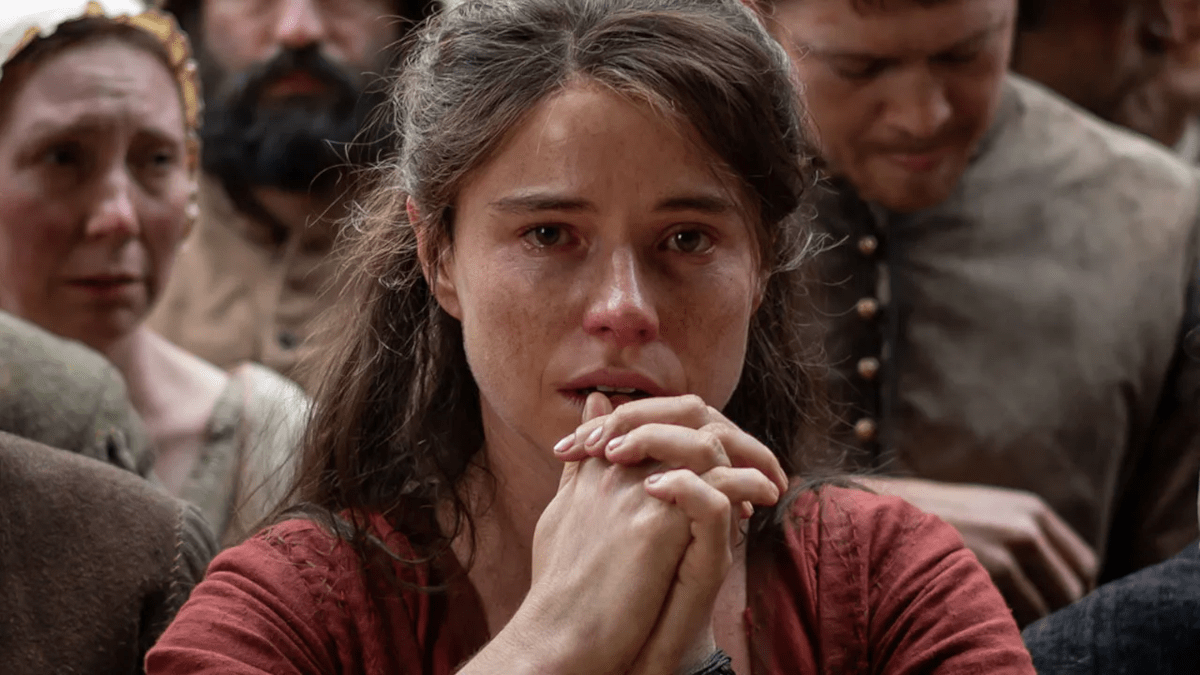
“What inspired William Shakespeare to write Hamlet?” is the sort of question that propels historical fiction, a genre that reflections the modern mind’s insistence on understanding everything. The origins of a consequential work of art simply can’t remain a mystery after so much time has passed. With that mindset, if we take the clues (a.k.a. historical facts) and align them with the play, an answer will surely reveal itself. Superficially, putting the puzzle pieces of history together is what Hamnet is about. However, the movie is much more than that; it’s also a thoughtful discussion about art, life and how both affect us in distinctly different ways. As such, Hamnet is part literary detective work, part metaphysical curiosity, and the results are spellbinding.
In the beginning, we see Agnes (Jessie Buckley) in the forest, a place more comfortable to her than her family home. As the wind animates the trees, Agnes summons a hawk. It lands gracefully upon her glove and she feeds it, smiling approvingly. Agnes’ relationship with her hawk symbolizes the one she has with the natural world, one that is intimate and harmonious. All communication between them is based on feelings, senses and instinct. She’s Eve and the forest is her Garden of Eden, with Adam arriving second.
Forcing his way into Agnes’ world is a young William Shakespeare (Paul Mescal). He’s drawn to her upon first sight. She recognizes the same intense feelings within herself and pushes him away, an attempt at delaying what she feels is inevitable. While wooing Agnes in the forest, William tells her the story of Orpheus and Eurydice, the classic Greek tragedy of love twice-thwarted by death. Agnes is moved by it and William’s gift for storytelling. He’s good looking and intelligent, a combination that is increasingly impossible for Agnes to resist. Her second sight tells her that William will be a success, which convinces Agnes to allow their feelings for each other to manifest physically.
Although Agnes and William’s love is genuine, their parents object to their marriage because their union would be far from ideal for both of them. Agnes is young and beautiful and probably could have married a man of means. While William is college educated, he currently works as a tutor to help pay off his father’s debts. When Agnes reveals that she’s pregnant, however, all concerns are put aside and they’re allowed to wed.
As we saw early on, Agnes’ relationship with nature is a special one. Her mother was described as a “forest witch”, and Agnes has followed in her footsteps. (Her mother died when she was a child.) Agnes knows how to make cures from plants, but also that those born in the forest receive a form of protection. Her upbringing ties directly into one of the movie’s most challenging scenes, the birth of Susanna.
With her baby on its way, Agnes runs into the forest to deliver the baby by herself. As William and her brother Bartholomew (Joe Alwyn) search for her, Agnes goes into labor. Her contractions reverberate through the landscape, with nature seemingly helping Agnes give birth to the baby. This scene implies that Agnes is a literal force of nature, with the ability to create life. This parallel directly ties into the movie’s thematic comparison of the creative powers of a woman (natural) and that of man (artistic).
Unfortunately, William is unable and unwilling to support his family through manual labor. He’s terrible at making gloves, his father’s business, and nearly comes to blows with him after quitting. A night’s drinking reveals his depression to Agnes, and she insists he go to London to establish himself. Agnes knows that if she keeps her husband from his dreams, he’ll leave her. She understands that the city directly feeds his artistic creativity, whereas her creativity is directly tied to nature.
Time passes, and William and Agnes are happily leading separate lives. He’s a playwright, while she raises Susanna in Stratford. Agnes becomes pregnant again, but when the time comes heavy rainfall produces flooding. Her mother-in-law Mary (Emily Watson) prevents her from leaving the house out of safety for Agnes and her baby, but it goes directly against her mothers teachings.
The arduous birth produces a boy, Hamnet, but then Agnes surprisingly goes into labor again. Mary coaches her to deliver a twin girl who initially appears to be stillborn, but Agnes pleads with external forces to not let her baby die and he stirs to life. While Agnes is joyful that her daughter Judith is alive, having twins worries her because an earlier vision foretold that only two of her children would be at her deathbed.
William’s growing success in London enables him to buy a house for Agnes and their children, but she refuses to relinquish the direct connection to nature that her childhood home gives her. William is disappointed but agrees, because Agnes is content and his three children are doing well. Hamlet is his favorite child, a handsome, adventurous and thoughtful young boy. William teaches him how to playact swordfighting before he leaves for London, and directs Hamnet to safeguard the family in his absence.
While the Bubonic Plague ravages London, it also finds its way to Stratford. (The movie isn’t conclusive as to whether William brought it with him.) Judith first contracts it, then Hamnet, but not Susanna. Despite Agnes’ attempts at natural cures, Hamnet dies painfully. Agnes describes the tragic event to William when he returns, and he apologizes profusely for not being present.
The following morning, William says he must leave due to commitments of his theater company, and Agnes is understandably furious. Back in London, William is overcome with guilt and grief over the death of his son, but finds a way to channel his feelings into his latest play, a tragedy about a young prince Hamlet.
Recommendation
If Hamnet were content with being a well-made piece of historical fiction, it would be enjoyable enough. The performances by the cast are uniformly excellent. The cinematography evokes the lushness of Renaissance paintings. The intimate sound design brings out every detail of this world. In terms of its subject matter, the mystery surrounding what may have inspired Shakespeare to write Hamlet is an intriguing subject. On this level, the film reminded me of Scott Cooper’s The Pale Blue Eye, which concerned itself with the possible origins of Edgar Allan Poe.
What elevates Hamnet above that and similar films is that it has more on its mind than conjecture. Instead, the film uses the psychoanalytical aspects of the plot as a springboard for a discussion on how art and life impact us in profoundly different ways. The results are a remarkably layered visual narrative, one that focuses on everyday events with breathtaking immediacy while also asking us to consider them from a philosophical perspective.
The film’s lyrical construction is a reflection of writer-director Chloé Zhao, who took home two Academy Awards for Nomadland back in 2021. Like that film, Hamnet uses an unobtrusive plot to explore a wide range of emotions, and tells its story with the moody pacing of a reverie. Also like Nomadland, this one slowly builds towards an emotionally-charged climax that left me devastated. This film’s underlying sadness moved me in a way that few films ever have.
Jessie Buckley’s performance as Agnes Shakespeare is one for the ages. She’s received critically-acclaim for her dramatic work before, notably in HBO’s Chernobyl, The Lost Daughter and Women Talking, and was also hilarious as the troubled, foul-mouthed single mother in Wicked Little Letters. Buckley’s acting in Hamnet represents her at top form, a showcase for her ability to portray lightness and darkness, physicality and spirituality, fierceness and vulnerability, carnality and motherhood with remarkable agility. It’s unequivocally one of the best performances by an actress in a leading role this year.
Paul Mescal is similarly excellent as a young William Shakespeare on the cusp of greatness. The role perfectly fits Mescal’s ability to portray sensitive, troubled men (see: Aftersun), and atones for his awkward turn in Gladiator 2. Although Mescal is just a supporting actor here, his performance is critical towards the film’s themes involving creativity, experience and transcendence. Mescal masterfully brings out the early Shakespeare’s emotional complexity, creating a sympathetic portrait of an artist who can only process tragedy by making art from it.
Hamnet is a poetic film, one that uses the language of cinema to speak to us about art, life and the disparate impact they have on us. It’s also a beautifully made film with memorable performances throughout, featuring Jessie Buckley at her peak. One of the best films of the year. Highly recommended.
Analysis
Hamnet reminded me of something I hadn’t thought about since I was an undergraduate taking humanities classes. No matter how brilliant a story, poem, painting, photograph or a movie might be, they are all merely an artist’s representation of the real world. For example, Van Gogh’s “Starry Night” is a reproduction of an actual nighttime landscape in painting form. Oscar Wilde’s The Picture of Dorian Gray is a distillation of his life experiences, specifically the people he met, the places he’d been, and so on. All art is derived from nature–or reality–in some way, shape or form.
This is also true of Hamnet, a work of historical fiction about Shakespeare and the origins of one of his most famous plays. The movie concludes that he used actual events from his life and channeled them into Hamlet. This approach is often employed in biopics as a way of filling in the blanks of the historical record. What’s offered over the course of the film may not be factual, but it could be. While this speculative storytelling is both entertaining and captivating, the dialog the movie wants to have with us is more nuanced than that. Beneath its historical fiction trappings, the movie is a thoughtful examination of the dichotomy between how art and life affect us, and uses Agnes and William to explore those differences.
The natural world
As a forest witch and a playwright, Agnes and William interact with the world around them fundamentally differently. Agnes’ life is defined by her connection to nature. Although she lives with her family, her home is the forest. She has a pet hawk. She harvests plants for food and cures. She’s the definition of a biophile, a person who feels a strong attraction for or emotional attachment to the living world. William, however, is detached from nature. He appreciates it only for what it provides, which is food, transportation and shelter.
Feminine versus masculine
The movie uses feminine and masculine archetypes to highlight the differences between Agnes and William. She is depicted as an Earth mother, one who lives in harmony with the natural world. Agnes only takes what she needs for herself and her family to survive. William, on the other hand, interacts with the natural world in masculine ways, in the form of penetrative acts. When William first sees Agnes, he deliberately enters her personal space in an effort to satiate his desires. After she rebuffs him, he seduces her in her forest. Lastly, he (consensually) physically penetrates her in her family home.
Inspiration
The way that Agnes and William exist with nature also reflects how they are inspired by it. Agnes’ close connection to nature gives her clairvoyance, the ability to see what will happen in the future. Conversely, William’s inspiration is based on what has already happened, or the past. He processes what he’s seen, heard and read to write his plays.
The environment
The environment also determines the importance of art in Agnes and William’s lives. Agnes lives in the country, which is filled with natural wonder. She doesn’t need art to remind her of what is beautiful, because beauty surrounds her every day. Agnes’ existence contrasts sharply with William’s London, a place that is dark, dank and disease-ridden. Regardless, William dislikes the country because it interferes with his creativity. When Agnes sends him to the city, he can create because he’s free of the responsibilities of the natural world, or being a father.
Creation
Like nature, Agnes has the power to create life. The movie explicitly links the two when Agnes gives birth to Susanna in the forest. In that moment, she is one with the primal forces of life itself. William’s creative powers involve recreating life in a medium. He takes what has happened in life and renders it with words.
Susanna, Judith and Hamnet are Agnes’ creations. She accepts responsibility for them and raises them. For Agnes, life as a mother is rewarding and meaningful. William also loves his children, but his life revolves around his plays. Being a playwright is more rewarding and meaningful to him than being a parent.
Creativity and transcendence
The results of Agnes’ creativity–her children–have a direct impact on herself and her family. Hamnet’s traumatic death affects the Shakespeare family, but not anyone outside their immediate circle. William’s plays, however, affect people with no connection to him or his family. While Agnes’ ability to create children is powerful, so too is William’s ability to create a story that makes complete strangers feel sad over the death of someone they’ve never known.
The closing scene is where the movie’s comparison of art and life reaches its dramatic, gut-wrenching conclusion. As someone whose existence has been defined by what takes place in nature and reality, Agnes initially takes offense when the actors invoke her son’s name as part of playacting. Her hostility lessens when she realizes that William created the character of Hamlet to honor their son. Then, when Agnes witnesses the effect Hamlet’s death has on the audience, she finally understands the unique power of William’s creativity and his art.
Imitation that exceeds reality
When the play is over, Agnes looks around her and laughs at how Hamlet’s fake death has brought the audience to tears. Her reaction is due to the strange power art has over people. While people who didn’t know Hamnet can sympathize with Agnes over his death, they wouldn’t have the same emotional response the audience has over Hamlet’s death. Only William’s artistic imitation of their son and his death causes people to react that way.
Additionally, the way people react to Hamlet is comical in its irony. Agnes knows that Hamlet’s excruciating death is purely an invention on William’s part, since he wasn’t present when Hamnet died. What happens in the play is his interpretation of what Agnes told him, which is twice-removed from the actual event. Only a brilliant artist can take what he learned second-hand and turn it into something transcendent.
Dualing powers of creation
The movie makes several artistic choices that indicate who the filmmakers believe have the more impactful creative powers, Agnes or William.
The movie is told almost exclusively from Agnes’ perspective. There are only a few scenes with William on his own in London.
At several points in the movie, William takes a seated position below Agnes. This positioning is also present in the movie’s poster.
Although Agnes is moved by the play, her reaction implies that she sees through what William has done. Unlike her child who actually lived and died, his play is an elaborate trick. While art can be moving and transcendent, nothing compares to the experience of having a child die in your arms.
The artist’s intent
In William’s defense, he didn’t exploit his son’s death as a way of achieving fame and making money. The movie shows that he wrote the play with the best intentions. First, he wanted to pay tribute to his son. Second, he wished to apologize for his not being present when Hamnet died. Finally, he wanted to immortalize both of his actions for all time.
To his credit, William doesn’t use Hamlet to excuse his shortcomings as a father. Instead, he does what great artists do when faced with tragedy, they turn it into art. The results of which have had audiences crying over Hamlet/Hamnet’s death for centuries. If Hamnet is to be believed, Hamlet was the greatest mea culpa ever created, with the world listening to William’s apology (as the dead king) and grieving for the tragic death of Hamnet ever since. We don’t know whether Agnes accepted William’s theatrical apology, but if anything she can take some comfort in knowing that her son’s life touched others. With art, that’s the best you can hope for.
 Detroit Cineaste
2 thoughts on “Hamnet”