
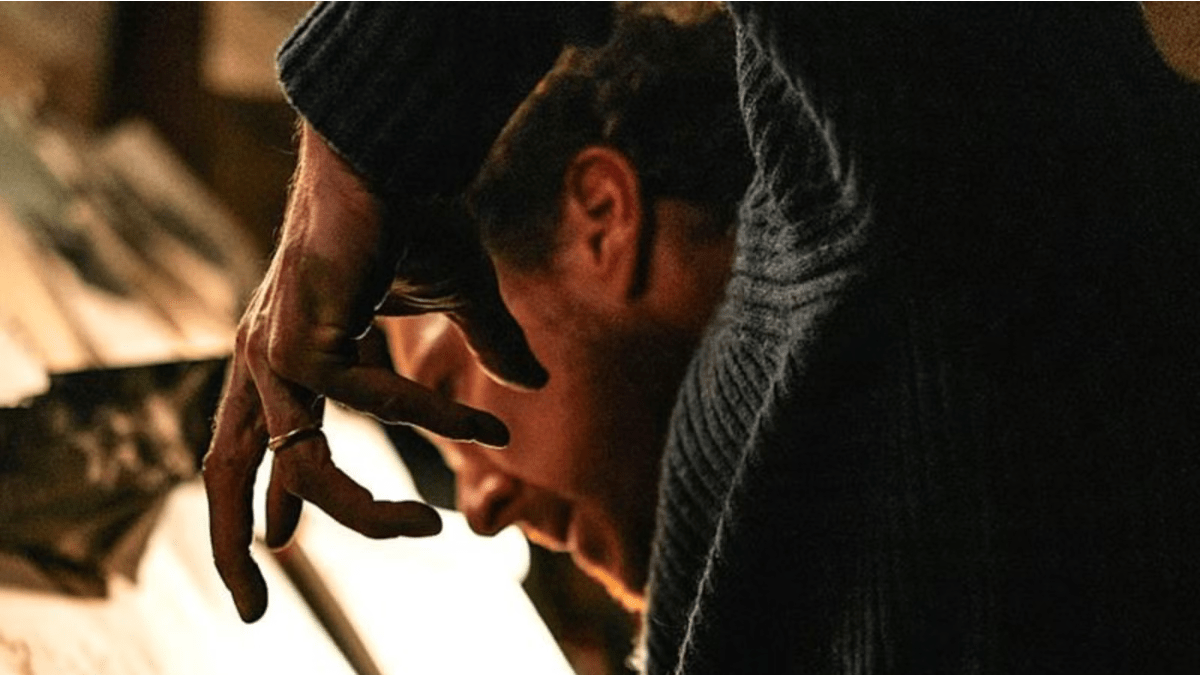
If grief appeared before me as a gangly, foul-mouthed, eight-foot tall crow who spewed insults, I’d assume I was done for. Which is what makes The Thing With Feathers so oddly compelling. The crow doesn’t appear before the Sad Dad in this film (played by Benedict Cumberbatch) to harm him, but help him. The crow wants to shock him out of his grief so that an even worse creature doesn’t do him in, Despair. As far as therapy options go, this one beats Yoga and keeping an “emotion journal”, either of which would push me off the deep end.
At the beginning of the movie, Dad and his two sons (Richard Boxall and Henry Boxall) have arrived home after the funeral for mom. Saying goodbye to Mom certainly was hard, but even harder work awaits, which is beginning a new life without her. They sit down and Dad gives them a “stiff upper lip” compliment, “I thought you did really well.” The boys glance at him and look down. Unfortunately for them, things will only grow increasingly tense from this point on.
A flashback reveals that Mom died suddenly at home. Dad found her lying on the kitchen floor with blood running from her head. She’s not breathing and he calls emergency services. When the boys return home from school, he tells them that their mother is gone. They respond with stunned silence, because they don’t comprehend the finality of death. At one point, one of the boys tells us that he thinks Mom is on the other side of the mirrors.
Dad, however, is fully aware of how much their lives have changed. In the blink of an eye, he’s gone from having a happy family to being a full-time caregiver. Mom took care of everything. Now Dad is responsible for fixing breakfast, getting his sons dressed for school, dropping them off, doing laundry and all of the housework. His sons are young and dependent upon him for everything that Mom did. It’s a massive change for Dad and he’s having a hard time adjusting to it.
Before Mom’s death, Dad was a typical dad. He worked while Mom took care of the boys and the household. He pitched in as dads often do, by playing with them. Another flashback reveals that when Mom was sick, he took the boys outside in the winter. It wasn’t easy, but he did it. Dad says that he didn’t realize it at the time, but that day was a dress rehearsal for what his life is now.
Dad never noticed how Mom got the boys to do what she needed them to do. He gets frustrated with the boys goofing off and ignoring him, so he yells at them. Dad never learned Mom’s soft diplomacy skills. For the boys, playtime Dad is gone and has been replaced by a less likable Dad who’s stern, angry and aloof.
Dad has no clue as to how to raise his sons. He tries to resume his career as a graphic novel artist while they’re at school and after they’ve gone to bed. For some reason, his output consists of crows. Sometimes he caws like a crow while drawing, or when he thinks he’s alone. The boys don’t understand the meaning behind Dad’s obsession with crows. All they know is that Dad’s behavior is concerning. Nothing escapes the eyes and ears of children.
Others try to help Dad and the boys, but have little impact. Dad’s brother Paul (Sam Spruell) visits and takes the boys for a spell. A psychologist (Leo Bill) tries to guide them through the grieving process. The boys ignore his suggestions of the aforementioned Yoga and emotion journals. Dad chafes at the suggestion of “coming to terms” with his wife’s loss. He doesn’t want to accept his situation, which is a problem because the boys will do the same.
A crow flies into the boy’s room one night. It awakens the younger one, who cries out to Dad. Dad consoles him and puts him back to bed. The crow, however, is still in the house and appears before Dad. It towers over him (Cumberbatch is six feet tall), speaks with a deep-throated grumble, and looks like a Dementor on loan from Harry Potter.
In this case, appearances are deceiving. This crow isn’t malicious and is there to help Dad out of his grief. When the boys are off with Uncle Paul, Dad gets drunk while listening to sad blues songs. The crow taunts Dad, telling him he just wants to wallow in self pity. The truth hurts, but doesn’t shock Dad out of his free-fall. The crow has Dad pegged as a “Sad Dad” who only wants to float along on waves of grief. He’s pathetic, the crow would say.
Others appear and try to console Dad. Mom’s best friend (Vinette Robinson). Dad’s in-laws. Dad’s publicist. To them he’s a weird, unapproachable bird. How ironic. Everyone worries about Dad, but all they can do is console him. Only he can fight through his grief. Thankfully, there’s a gigantic crow who won’t take no for an answer.
Recommendation
The Thing With Feathers falls into a very small category of films where a character’s turbulent mental state is externalized as a darkly menacing entity. In The Fisher King, Robin Williams’ grief took the form of a fire-breathing knight on horseback. A Monster Calls had Liam Neeson voicing an ancient yew tree. The Babadook transformed a mother’s depression into an inky monster lurking in the shadows. This movie takes a similar approach in its depiction of mental illness, and while the results are undeniably over-the-top, it works for the same reason as those other films. I’d much rather see the character’s interior struggle represented visually than watching them talking to themselves.
Writer-director Dylan Southern also brings a Terry Gilliam sensibility to the material, counterbalancing the film’s difficult moments with a wicked sense of humor and horror movie tropes (see: The Fisher King, 12 Monkeys, etc.). It’s a difficult high-wire act to pull off, and while Southern isn’t at the level Gilliam was in his heyday, he does well enough. Like Gilliam, Southern is using audacity to keep sentimentality and melodrama at bay, because both would overwhelm a story like this one within minutes and turn it into a weepy mess. Southern is always sincere, no matter how outlandish his film may look at times.
Few actors today are as convincing at playing emotionally distressed characters like Benedict Cumberbatch. Although he’s widely known for playing Marvel’s Dr. Strange and callous pricks like Sherlock Homes, Alan Turing (The Imitation Game) and Julian Assange (The Fifth Estate) among others, he’s at his best when he throws himself into characters who are anguished and suffering. Similar to his performance in the limited series Patrick Melrose, Cumberbatch’s portrayal of the grief-stricken father in this movie is a tour de force. There are scenes where Cumberbatch expresses his character’s grief with a level of raw, unfiltered pain that I couldn’t help but feel sympathetic towards him. Unlike the roles he’s become known for, this one offers indisputable proof as to why he is a great dramatic actor.
My sole issue with the film was its curious use of a 4:3 ratio, which makes the film look unnecessarily constricted. There are numerous scenes that all would have benefited greatly with a normal film aspect ratio that look artificially boxed-in. I suppose that was the point, but the film suffers from that creative choice. Otherwise, cinematographer Ben Fordesman’s work is beautiful, and I liked Zebedee Budworth’s taut and jangly score.
Cumberbatch is in peak form in The Thing With Feathers, where he brings the emotional turmoil of the widowed father to gut-wrenching life. The film’s literal depiction of grief and despair, as well as Dad’s battle to overcome both, is as audacious as it is honest. Recommended.
Analysis
When it comes to representing severe emotional distress in film, the tendency has been to do so visually. In The Fisher King, A Monster Calls and The Badadook, the grief experienced by the main character is manifested as a monster. For The Thing With Feathers, grief comes in the form of a gigantic crow, and despair as a black, humanoid figure with long, sharp claws for fingers. However, in the moments when I’ve experienced grief, I’ve never imagined anything like what these films suggest. A crow didn’t appear to cajole me out of my misery, and nothing tried to rip my heart out with its claws.
The Thing With Feathers symbolizes the incongruity with how films present grief and how we experience it personally. In the real world, if we were spying on Dad (Cumberbatch) it would look nothing like what the film presents. For example, in the scene where he gets drunk while listening to a blues album, he would have been by himself while he sobs, throwing things across the room, and talks to himself. That is grief as I know it. It finds you when you’re alone, grabs hold of you and doesn’t leave until you’re a wreck.
While I have no doubt Cumberbatch would have been equally good in that scene if there hadn’t been a crow around to taunt him, it wouldn’t have been as effective. I’ve seen countless scenes of characters sobbing over a loved one, and they all tend to look the same. Without a crow, the movie would have been treading very familiar territory. With the crow, however, the movie becomes allegorical. Seeing grief depicted in this way makes the movie more compelling than if it had gone with a sensitive and conservative approach.
The crow does more than symbolize grief, however. It has a purpose, which is to shock Dad out of his grief. Even though Mom has been gone for several months, Dad hasn’t gotten over his grief. The transition to him as the boy’s sole caregiver has been disastrous because he hasn’t found a way to process Mom’s death. The boys are growing increasingly disrespectful towards him, and he responds by being either mean or aloof. Since the fate of the family hangs in the balance, the crow appears to force him out of his dark mental state into one that accepts the situation as it is. Mom is gone and not coming back, and he’s solely responsible for taking care of the boys.
The movie visualizes Dad’s struggle with grief as an intense, sometimes violent conflict between himself and the crow. Unless the crow gets Dad to accept the situation, he’ll fall into despair. At that point, all will be lost and we can assume the worst possible outcome for Dad and the boys.
The crow is trying to prevent that from happening by getting under Dad’s skin. It confronts him in an attempt to get a rise out of him, which hopefully will cause his survival instinct to kick in.
Showing grief as a battle of wills between a man and a crow is undeniably a very sensationalized approach to subject matter. I would understand why people would describe what this movie does as being ridiculous. Seeing Cumberbatch being taunted by a crow is an incredible sight, one that I never expect to see again. But that’s precisely why the movie worked for me. The symbolism of the crow and the allegorical nature of its fight with Dad forced me to think about grief in a way I hadn’t before, which is what the movie wants to accomplish.
The Thing With Feathers wants us to consider grief in a different light. We all grieve. It’s a normal, healthy reaction to the loss of a loved one. What the movie does is show that prolonged grief can be unhealthy and destructive, and that getting out of it can be extremely difficult. And if it takes an angry crow yelling “bollocks!” to come to our senses, then so be it.
Internalized versus externalized, take two
I would also defend The Thing With Feathers for externalizing Dad’s grief as a crow by comparing how two films depict the main characters’ schizophrenia: A Beautiful Mind and Spider.
I realize I may be getting myself into trouble by loosely equating mental trauma with mental illness, but here goes.
In A Beautiful Mind, John Nash’s deteriorating mental state is depicted through three people that only he can see. While it is a very simple way of visualizing how schizophrenics say they “hear voices”, it is a very effective cinematic device for several reasons. It enables actor Russel Crowe to interact with other actors instead of only himself, which fools us the same way the disease fools Nash into believing that the voices they hear are actual people.
Conversely, John Cronenberg’s Spider has the eponymous character played by Ralph Fiennes spend the movie talking to himself. While this approach avoids simplifying the disease, it also makes Fiennes’ character inscrutable and the movie a chore to watch. While I have no doubt Spider has its admirers, and Fiennes is incredible in a very difficult role, there’s something to be said for how the visual language of cinema can make something like schizophrenia relatable to general audiences.
Benedict Cumberbatch is miserable
Well, not literally. If you’re interested in seeing him in roles where he’s anguished, suffering or both, check out:
- The Imitation Game (2014). The role earned him his first Academy Award nomination. The suffering begins in the third act.
- Patrick Melrose (2018). A four episode limited series on what was Showtime. He plays a man whose sexually abusive father died, which brings up all sorts of negative emotions and bad decisions.
- The Courier (2020). His character endures a Russian prison/gulag.
- The Power of the Dog (2021, Netflix). Earned him his second Academy Award nomination for a sexually repressed cowboy pretending to be the macho variety.
- Doctor Strange in the Multiverse of Madness (2022, Marvel). His character finally allows his sarcastic facade to drop when he reveals that his controlling nature is due to his sister drowning when they both were children.
 Detroit Cineaste