
A year ago, I wondered how the sequel to Wicked would incorporate the source of its inspiration, The Wizard of Oz. The answer arrives with Wicked: For Good, a noisy and unwieldy contraption that sabotages much of the goodwill from the first movie while it furiously crams the classic movie into the plot. Despite all of its clunky contrivances, the film is still modestly entertaining due to Ariana Grande and Cynthia Erivo, who save the film from collapsing under its own weight. If it weren’t for them, I would have prayed for flying monkeys to pluck me out of the theater and carry me to safety.
The movie begins on a dark note that’s only the first of many to come. After Madame Morrible (Michelle Yeoh) delivers statist propaganda over the old school Universal logo, we’re taken to the construction of the fabled Yellow Brick Road. It’s not a happy construction site, where Oz stormtroopers decked in emerald force horned animals to cart bricks around. This struck me as odd, because why would Oz need slave labor when he can manufacture amazing machines like the high-speed rail lines? If this is a show of strength, then why do it where nobody can see it?
Elphaba (Cynthia Erivo) swoops in, attacks the jackbooted thugs and frees the animals. In the “twelve tide turns” since the last movie, Elphaba has transformed into a superhero/revolutionary. But why is she waging her solo war on the Wizard (Jeff Goldblum)? Before the movie addresses that question, we see the Wizard’s propaganda machine pulling out all the stops in its smear campaign against Elphaba. Morrible denounces Elphaba as a terrorist while printing presses spew out pamphlets confirming her evil intentions for the citizens of Oz. If you think the movie would have anything substantive to say about its themes of media manipulation and scapegoating the weak, guess again.
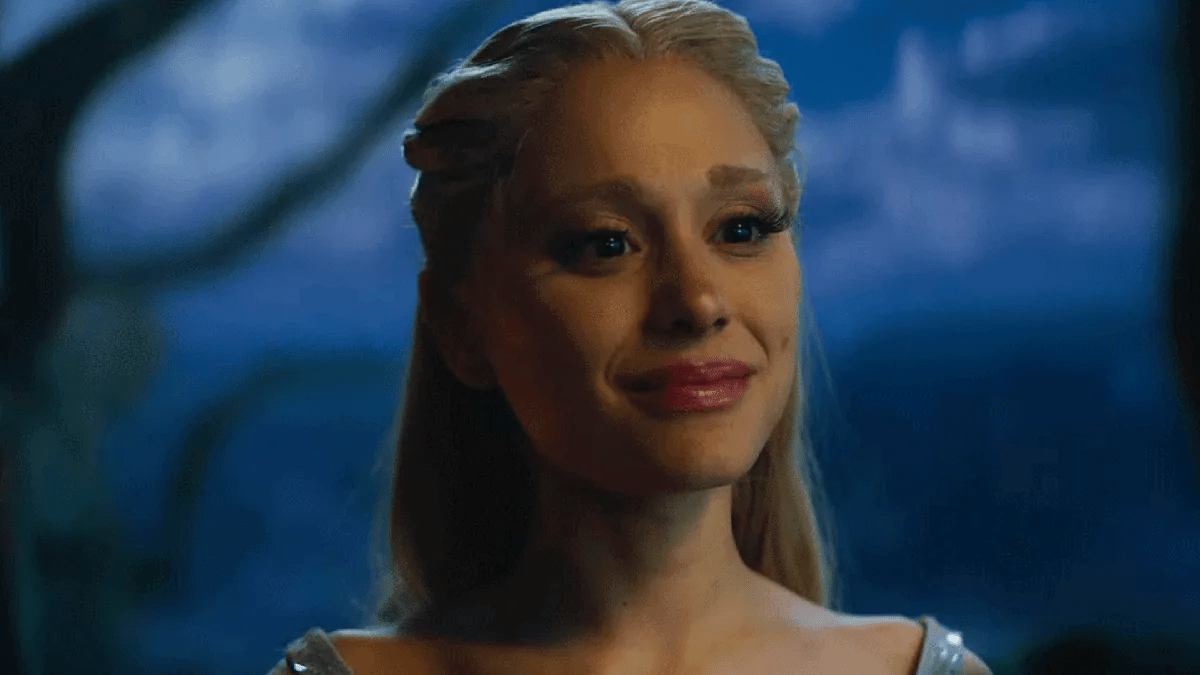
The enlightenment Glinda (Ariana Grande) obtained at the end of the first movie has vanished. She’s become a public relations flak for the Wizard in exchange for a life of luxury. (She has her own personal pink train car. Perks like these are hard to turn down, she sheepishly admits.) Since Glinda doesn’t have any magical powers, Morrible gifts her with a bubble levitation device and a fake wand, which will give the illusion that Glinda is a magical vehicle for goodness. Glinda has wanted to be magical since she was a little girl, and has sold her soul for fancy props to achieve it.
Fiyero (Jonathan Bailey) is now the captain of the Gale Force, a job that somehow doesn’t include a single “breaking wind” joke. At the grand unveiling of the YBR, Fiyero learns that he’s engaged to Glinda at the Wizard’s request, another PR stunt to make the people feel happy about the state of things. This comes as a surprise to Fiyero, who presumably accepted working for The Man as a means of finding his true love, Elphaba. Sorry to break it to you dude, but you’re in the machine now.
Elphaba disrupts the ceremony by writing an anti-Oz slogan in the sky, only for Morrible to twist it into a malicious one directed at the people. Fiyero’s Gale Force and the monkeys chase Elphaba into the forest, and she escapes their clutches with next-level broom riding. If I didn’t know better, I’d say Elphaba was a Jedi.
Back at her secret headquarters, Elphaba’s frustration boils over. She’s an army of one whose messaging is being twisted against her. She needs allies, but who? Elphaba finds the animals streaming into a tunnel that leads to “the place beyond Oz”. When pressed by Dulcibear (Sharon D. Clarke) over why she stays, Elphaba sings that “there’s no place like home” and won’t leave without a fight. Sister, you’re not the one who’s being caged and losing the ability to speak.
Just when the animals are about to join Elphaba’s revolution, the Cowardly Lion (Colman Domingo) spoils everything. It was she that gave the monkeys their wings, and by extension the Wizard his spies. Elphaba admits to being duped, but the animals aren’t convinced. Better to start a new life elsewhere than be carried away by monkeys.
Elphaba’s sister, Nessarose (Marissa Bode) is now the governor of Munchkinland. She’s facing pressure to sign the “Animal Anti-Mobility” bill, which would ban animal travel without a permit. Bok (Ethan Slater) cautions against it, but Nessarose doesn’t want to be seen as aligned with her sister, the revolutionary. But wait–things get darker! Nessarose still has feelings for Bok, who’s still crushing on Glinda. To prevent Bok from leaving, Nessarose decrees that Munchkins can’t travel without her approval. What’s a little fascism in the name of love, eh?
Elphaba visits Nessarose to see if she’ll help recruit the Munchkins to her cause. Nessarose, however, just wants to feel like she did when she and Bok danced in the first movie. To cheer her up, Elphaba enchants her sister’s shoes so that they turn red and levitate. (No prizes awarded if you guess where this is headed.) When Bok asks to leave so that he can profess his love to Glinda, Nessarose casts her own spell on Bok that turns disastrous. Elphaba tries to counteract it, and Bok Woodsman becomes–wait for it–The Tin Woodsman. Sigh.
The movie gets progressively worse as it “borrows” mythology from The Wizard of Oz. I knew that this enterprise would have to pay the piper for its fan fiction origins, but this is ridiculous. When all’s said and done, the movie will try to convince you that Dorothy is a villain. Bah. At least Glinda comes to her senses and supports her sister in the end.
Recommendation
Maybe splitting Wicked into two films wasn’t a good idea after all. Where the first movie was fun, Wicked: For Good is oppressively downbeat. Elphaba and Glinda’s spunky college days and their unlikely friendship has been replaced by a dark reality intent on subjugating them both. While the plot of this movie does reflect act 2 of the musical, the film feels like a prolonged march towards an inevitable conclusion.
The way the movie (and the musical) shoehorns the events of The Wizard of Oz into the plot is particularly egregious. Having not seen the musical, I imagine that having the second act only last an hour works in its favor. Wicked: For Good, however, goes on for two hours and fifteen minutes, which is too much time to think about what’s happening. I’m all for giving old stories a new twist, but to reduce Dorothy to being merely a pawn in a totalitarian plot was misguided. Even worse is the sacrilegious way the story treats Dorothy’s compatriots, the Tin Man, Scarecrow and the Cowardly Lion, which left me in stunned disbelief.
I wasn’t a fan of how the first movie’s washed-out palate, and this one is more of the same. Colorful scenes that should pop are reduced to shades of brown and gray. To be fair, the Yellow Brick Road is bright yellow and Oz is still emerald, but the resistance towards using brilliant colors remains unjustified. Maybe in a few years someone will release a properly color-graded version of these movies. Until then, very few scenes in this movie qualify as eye-catching.
The saving grace of this movie is Ariana Grande and Cynthia Erivo. Together, they give this movie its heart as two besties trying to find their way out of the machinery. Their singing is excellent, with Grande’s bittersweet “I Couldn’t Be Happier”, Erivo’s duet with Jonathan Bailey on the sultry “As Long as You’re Mine” and the ladies’ regret-tinged duet “For Good” being the highlights.
Among the supporting performances, only Jeff Goldblum improved this time around. His performance of “Wonderful” explains what the filmmakers saw in him for the Wizard, a kindly, inebriated flim-flam artist with no pretensions. Michelle Yeoh has more to do as a version of Lady MacBeth, but she’s still miscast and a woeful singer. Jonathan Bailey is handsome but clueless as to how to express his character’s feelings. The rest of the supporting cast is angry and unremarkable. At one point Bowen Yang gets pecked by a bird. Huzzah!
The subplots involving the Munchkins and the animals never amount to anything substantial. Both disenfranchised groups have zero agency and exist only to garner our sympathy. I laughed when the movie showed the animals taking a tunnel to what looked like the desert world of Arrakis, or maybe it was the Saturn from Beetlejuice? If only Timothee Chalamet or Michael Keaton were there to greet them on the other side.
Wicked: For Good is a morose conclusion to this duology, which has been theme park filmmaking at its worst. What saves it are the heartfelt performances of Ariana Grande and Cynthia Erivo and a handful of good songs. Dorothy deserved better. Mildly recommended.
Analysis
While it may be premature to assess the legacy of the Wicked films, I think it will come down to two things. First, that Cynthia Erivo and Ariana Grande were more than capable in the leading roles. They are the main reason why I enjoyed these films as much as I did. Their charming performances helped me get through an almost five hour experience that is poorly shot, murky and unnecessarily busy. Of all the filmed musicals I’ve seen, these two look the worst by a wide margin. Whenever the dispiriting visuals of these films started to weigh on me, along came Erivo and Grande to elevate the production with their performances.
Second, dividing a play into two films was unwise from a narrative perspective. Although Wicked managed to work as a stand-alone film, Wicked: For Good doesn’t. This is because the weaknesses of the second act are glaring within the context of a separate movie. This point I’m making is moot because everyone knows the play was divided only to maximize profits, not to improve upon the story.
Regarding the plot of this movie, Elphaba has no character arc to speak of. At the conclusion of Wicked, we knew that she would be the Wizard’s adversary going forward. Aside from a brief moment when she’s fooled by the Wizard’s lies, her perspective never changes. Then she’s forced to act in accordance with The Wizard of Oz. Instead of being a fully-realized character, she’s a cog in a story consumed with meeting its obligations to the original movie.
This is true for many other characters as well. The plot needs a Tin Man, and Nessarose and Elphaba transform Bok into that character. Elphaba turns Fiyero into the Scarecrow because that’s the best spell she could come up with in a pinch. There must be a Wicked Witch of the East wearing ruby slippers, so the plot plugs Nessarose into that role. Dorothy’s house must land on Nessarose, so Morrible brings her to Oz. While all of these contrivances do evoke the 1939 film, they make no logical sense within their new context. They are merely semaphores of a much better movie.
The only character in the movie with an arc is Glinda. While she eventually becomes engulphed by The Wizard of Oz plotline like the rest of the characters, Glinda does undergo a dramatic transformation beforehand. She evolves from being a playful narcissist to having awareness of other people’s feelings and how easily she’s being manipulated. Glinda emerges as the story’s unlikely hero because she has agency outside of the oppressive machinery of the plot.
Wherefore art thou, Fiyero?
While Fiyero isn’t completely controlled by the Oz plot line, his choices make little sense because the movie never bothers to explain them. For example, at the end of Wicked, it’s obvious that Fiyero’s heart is with Elphaba, not Glinda. He also was aligned with Elphaba’s cause. So I was surprised to see Fiyero is an Ozian soldier who meekly acquiesces to marrying Glinda to keep the peace. If it weren’t for Elphaba interrupting their wedding, the two would be married.
It is true that the Wizard pressures Fiyero to marry Glinda. However, after a year of searching and coming up empty, he seems to be in “love the one you’re with” mode. Until he runs into Elphaba after the disastrous wedding ceremony, where his love for Elphaba is rekindled. If Fiyero still felt so strongly about her, I don’t understand why he settled for a consolation prize.
The puppet master of Oz
After Wicked gave Madame Morrible (and Michelle Yeoh) nothing to do except look uncomfortable, I was pleasantly surprised when she was revealed to be the actual ruler of Oz. Why she does this is never explained, though. I assume she appreciated secretly lording over everyone, but why does she need to go about things this way? Why Morrible would put up with having to babysit a silly drunk all the time instead of taking charge herself is a mystery.
Keep the booze flowing
Strangely enough, the Wizard remains the one character whose actions are easy to understand. He knows that if he returned home, he’d resume scratching out a living. Being a figurehead is a far better option, because he gets to live in a castle, wear the best clothes, drink a river of booze and have everyone love him. He’s an amoral, self-centered opportunist who sees Morrible’s arrangement as the gravy train he’s always wanted.
Dorothy deserved better
Another frustrating aspect of the movie for me was how it treats Dorothy. While I do follow the movie’s logic of depicting her as being another cog in Morrible’s campaign against Elphaba, everything that made Dorothy one of the defining heroes of cinema is omitted in favor of turning her into a dupe. If that’s not enough, Elphaba refers to her as a “hick farm girl”. Later, Glinda loses patience over Dorothy’s interruptions and says, “Ugh, it never ends with that girl.” The mean-spirited tone directed towards her character was completely unjustified.
I love The Wizard of Oz. I watched it while completing this review and the movie–and Dorothy’s journey within it–still moves me. Dorothy experiences a remarkable transformation from a self-absorbed little girl on a farm to an adventurer curious about everything. She befriends strangers not because she needs their help, but so that they can have their wishes granted. And while Dorothy is often scared, she’s always brave in the face of danger and stands up for her friends when they’re mistreated. And while her journey is incredible, Dorothy remains steadfast to her goal of getting back home to Auntie Em and the people who love her.
I don’t know the reasons behind the grudge the play and the movie have against Dorothy, but it felt disrespectful, a way of thumbing one’s nose at a classic film. If you’re going to stand on the shoulders of greatness, respect should be a given. While I’ll admit that the concept behind Wicked is clever, it needn’t have come at the expense of its inspiration.
Yellow bricks
The only other sequel that takes its characters for a similar walk on the dark side is Back to the Future 2.
What will the animals have for sustenance after emerging from the tunnel beyond Oz? There’s never a drop of rain on Arrakis, so nothing grows there.
When Elphaba sings “No Good Deed”, why does the movie make it look like she’s in Hell?
After being doused by water, how does Elphaba manage to drop through a trap door while also pantoming that she’s melting?
Nessarose banning travel for all Munchkins seems like overkill to keep Bok around. Why not just lock him up in jail instead?
How does Elphaba feel about spending the rest of her life making love to a burlap sack?
Bown Yang has an enviable movie career. He gets to boast that he’s appeared in two huge blockbusters without doing any acting in either of them.
Dr. Dillamond is conspicuously mute at the end of this movie. Universal couldn’t afford to pay Peter Dinklage for delivering a single line of dialog?
The Animal Anti-Mobility Act is the Wicked Universe’s version of “the trade routes are in dispute” plotting that drove the Star Wars prequels.
I hope Colman Domingo got paid well for his embarrassing cameo vocal work in this movie, which is just as embarrassing as his cameo in The Electric State.
 Detroit Cineaste