
Just when I’d convinced myself that a classic monster story like Frankenstein was hopelessly outdated, along comes Guillermo del Toro (or GdT) to prove me wrong. With Frankenstein, he’s achieved what I’d long considered impossible, which is to retain its Victorian-era setting while accentuating themes that remain relevant today. It’s an old tale reinvigorated with enough verve and panache to overcome its shortcomings.
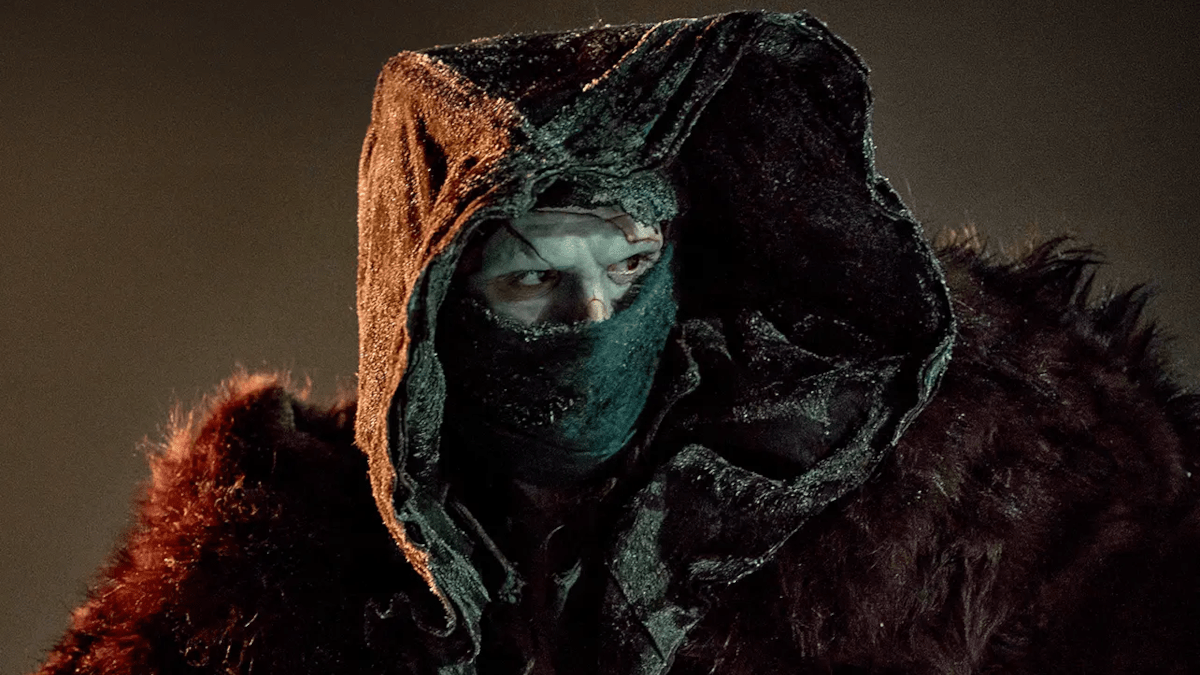
Most films that adapt Frankenstein omit the novel’s Arctic-set framing device. GdT, however, brilliantly uses it to kick things off with a riveting action sequence. A ship bound for the Arctic Circle lays stuck in the ice. The crew witness an explosion on the ice, and when they venture out to the spot they find a broken man. When they get him back to their ship, a tall, hooded figure approaches and disregards warnings from the captain (Lars Mikkelsen). After surviving several rounds of gun fire, the creature attacks and boards the ship. A blunderbuss drives him overboard, and a shot aimed at the ice below sends the figure into the icy waters, presumably to his death.
That won’t stop him, the broken man advises. He is Victor Von Frankenstein (Oscar Isaac), and he proceeds to tell the captain what brought him and the unstoppable figure to this godforsaken place. It begins with Victor’s unhappy childhood. Long story short, Victor’s father Leopold (Charles Dance) was a stern, demanding bastard who married Victor’s mother Claire (Mia Goth) for her money. When Claire goes into labor, Leopold is able to save only the baby. Victor doesn’t believe him and vows to both eclipse his father’s accomplishments by cheating death. This mildly interesting stuff only manages to sap the movie’s momentum for ten minutes.
After Leopold dies, Victor and his brother William are separated. William goes to live with relatives while Victor heads to England to study medicine. Flash forward several decades and Victor is animating corpses in front of the Royal College of Surgeons of Edinburgh. His gruesome stunt gets him expelled, but it attracts a wealthy benefactor in Henrich Harlander (Christoph Waltz).
A former army surgeon, Henrich is a wealthy arms dealer who’s attracted to the seamier side of life. He’ll gladly fund Victor’s experiments, provided Victor does a favor for him if they are successful. I won’t give away what favor Henrich is after, but his explanation at a very critical moment is especially funny.
While Victor builds out his steampunk laboratory, his younger brother William (Felix Kammerer) arrives with his fiancee, Elizabeth (Mia Goth in a dual role). She’s Henrich’s niece, outspoken, keen on science and attracted to Victor. The two would be a perfect match for each other but for one problem, she’s betrothed to his brother.
After a breakthrough, Victor decides to take the experiment to the next level. Victor constructs a man using body parts harvested from hanged men and dead soldiers. With a lightning storm approaching, Victor prepares to bring his creation to life. Henrich interrupts to call in his favor, but Victor refuses. Henrich dies after a brief struggle, leaving Victor alone to watch his experiment fail. Or not.
Victor is amazed by his creation at first. Then he quickly grows frustrated with the care and feeding involved and the creature’s limited intelligence. (If only dad could see him now.) The arrival of William and Elizabeth forces Victor to explain Henrich’s untimely death, and he pins the blame on the creature. When Victor sees Elizabeth treating the creature with kindness and sympathy, he decides that his experiment and everything connected to it should be destroyed. He sets the laboratory ablaze and assumes that the creature was killed in the explosion, but not so fast.
This brings us to the more compelling half of the movie, narrated by the creature. He tells of his narrow escape from the laboratory, how he is promptly shot by hunters and finds refuge hiding at a nearby farm. Welcome to the outside world, creature! To show his appreciation towards the family he’s secretly living with, the creature acts as their mysterious benefactor by night. During the day, he learns how to speak and read while observing an old blind man (David Bradley) teaching his granddaughter. When the family leaves to hunt down the wolves killing their flock, the creature cautiously befriends the blind man. The creature solemnly describes this time as the only peaceful one of his existence.
Under the blind man’s tutelage, the creature’s self-awareness grows. Curious about his origins, he visits the ruins of the laboratory. There, he discovers how he came into being, as well as the address of his father/creator, Victor Frankenstein. (Some things always magically survive a huge fireball unscathed.) When the creature returns to the farm, wolves have mortally wounded the blind man. Hunters arrive and assume the creature is responsible for the blind man’s death and shoot him, but the creature rises yet again.
Realizing that he cannot die, the creature seeks out Victor and asks him to create a companion for him. The creature’s reasoning is that only a monster can befriend a monster, which makes sense. Victor, however, is unwilling to revisit his mistake, and their mutual hostility towards each results in several very unfortunate fatalities. Victor’s pursuit of the creature brings them both to the Arctic Circle, which is where we came in.
Recommendation
Guillermo del Toro is one of the few directors working today who can take a well-known story like Frankenstein and turn it into a movie that’s fresh and exciting. His movie is epic in scope, operatic in tone and constructed with exceptional craftsmanship. There are recognizable actors in every significant role, adorned in beautiful costumes and placed within elaborate sets. While there’s a lot I love about the movie, it surprisingly fails to achieve greatness despite the ideal pairing of director and material.
The problems I had with Frankenstein weren’t trivial, however. For example, Oscar Isaac isn’t the right actor for the performance asked of him. Isaac is at his best when he unleashes his brooding intensity. This Frankenstein has two modes: flamboyant rebel and wild-eyed obsessive. Although Isaac tries very hard, he’s unconvincingly playing against type here.
I also disliked how the movie was filmed. Frankenstein was shot digitally, as was the case with the creepy and evocative Nightmare Alley. However, everything in this movie is rendered in high definition, making it look distractingly artificial. The movie simply looks too bright and too sharp for what should be a dark, Gothic horror piece. The multiple instances of lens flare were obnoxious. For a film by a master craftsman like GdT, this one looks like a typical Hollywood blockbuster.
Of the elements of the movie I admired, Jacob Elordi’s performance as the monster was the best among the cast. I’d only previously seen him in Priscilla, and while he was very good in it I wouldn’t have guessed he was capable of such a complex performance. The physicality of his acting here is fascinating in how he simultaneously embodies both the stiffness of his construction and his childlike mentality. The movie also wisely makes use of Elordi’s 6’ 5” frame, showing him towering over everyone in the cast. Of all the performances in this movie, Elordi deserves whatever industry recognition he receives.
Mia Goth is very good as Elizabeth, providing the movie with its conscience in a small role. Having her also play Frankenstein’s mother was a gambit that didn’t add anything in the end. Christoph Waltz and Charles Dance are always fun guests at period-themed parties like these, even when they’re hitting very familiar notes. David Bradley is heartbreaking as the blind man. Felix Kammerer, so moving in All Quiet on the Western Front, is curiously nondescript.
Like GdT’s other films, the craftsmanship of the movie is remarkable. The physical sets are richly detailed. The makeup used for the monster effectively makes him look like he was assembled from disparate puzzle pieces. The costumes are gorgeous. This is a movie made with care by human hands. I didn’t like how cinematographer Dan Laustsen captured it, though. Alexandre Desplat’s score appropriately soars alongside the movie’s turbulent waves, although the kettle drums were a bit much.
In Guillermo del Toro’s Frankenstein, the myth roars back to life in this mostly successful adaptation. Jacob Elordi’s performance is a standout, while Oscar Isaac is miscast. Filled with beautiful and grotesque imagery, the film struggles for greatness and occasionally reaches it. Recommended.
Analysis
I’m not one of those purists who become enraged at how a filmmaker adapts a book. I remember reading an interview years ago where an author described his feelings about how his novel had been adapted into a movie. To paraphrase, he said the book is the book and the movie is the movie. The implication being that since authors don’t expect fidelity between the two mediums, neither should I. This mindset has helped me whenever I watch a movie version of the few books I’ve read. The filmmakers and the author rarely are the same person, and the resulting movie reflects their differing artistic perspectives, as well as the differences in the mediums.
This is certainly the case with Guillermo del Toro’s Frankenstein. His movie isn’t a slavish adaptation of the novel, which he uses as a framework to tell a similar-yet-different story. GdT puts his stamp on the material, which I was open to because I’ve enjoyed most of his films. Ultimately, all that matters is whether the story that GdT tells works. Overall, I would argue it does.
Even the changes that I don’t think worked that well were fine. For example, the origin story for Victor wasn’t necessary because it doesn’t say much about Victor aside from its broad Oedipal allusions. However, I hadn’t seen a Frankenstein film that had given Victor a childhood, or one that attempted to explain his behavior by way of his traumatic formative years. I appreciated GdT’s attempt, regardless of the outcome.
Given that it’s been many years since I read the novel, I won’t bother with providing a side-by-side comparison of the two to point out their differences. I’m confident there are dozens of these articles already on the internet, anyway. (This one on /Film is good.) Instead, what I’ll focus on below are the aspects of Frankenstein that resonated with me.
The patriarchal cycle of violence
Victor’s origin story does work as a depiction of abused children reenacting the horrific treatment they received. In the movie, Leopold is strict, abusive, impatient, distant and self-absorbed. When Victor creates his own child, he promptly turns into his father. He becomes frustrated as the creature repeats his name instead of saying other words. Victor whips the creature when it refuses his commands. He withholds his love from it because he’s embarrassed by its crudeness.
Victor manages to exceed his father’s cruelty when he tries to destroy it. Even Leopold didn’t try to kill his sons. Somehow, Victor grew up to be worse than his father, which is not the accomplishment he had in mind.
The irresponsible father
When Victor rejects his creation, Victor shirks all of his responsibilities as a father. The creature may not be a normal child, he initially acts like one after his “birth”. The first word he learns is his father’s name, and he makes sounds like a baby. He’s fascinated by simple things, like leaves and the drain. He cowers when Victor is angry at him. For all intents and purposes, the creature is Victor’s offspring.
Although Victor is initially proud of his creation, he becomes frustrated with its lack of development. Victor also hates taking care of him, which includes shaving him and presumably changing his underclothes on a regular basis. Victor doesn’t want to take care of his deformed, mentally impaired child. He would rather kill it and move on than fulfill his parental obligations.
Victor’s fraught relationship with the creature symbolizes the unknowns that come with fatherhood. When a man fathers a child, there’s no guarantee that the child will be handsome, intelligent or able-bodied. The fact that the child may not meet the father’s expectations doesn’t absolve the father of his obligations. Victor brought the creature into this world, and it falls upon him to care for him as best he can. In rejecting his duty as a father, Victor is revealed as the real monster of the story.
The irresponsible creator
The relationship between Victor and his creation is also analogous to that of God and humanity. The creature is perplexed over why he was created in his maker’s image, but rewarded with a harsh life. The creature learns that men fear him because of his shocking appearance. They shoot him on sight and force him into hiding. The creature compares his existence to that of wolves, creatures hated for their fearsome appearance and doing what comes natural to them.
When the creature asks Victor for the one thing that would make his existence tolerable, companionship, Victor declines. Victor’s request is no different from prayers to God going unheeded. Like God, Victor is responsible only for creating life, not how it unfolds.
The ending encapsulates GdT’s view of the relationship between God and his creation. Although God wills life into existence, he has no control over the outcome. All God can do is ask his creations for their forgiveness while reminding them that life is to be treasured, no matter how challenging it may be.
The irresponsible doctor
One of the interesting deviations from the novel is the Henrich Harlander character. Henrich wants Victor to “cure” him of his Syphilis by transplanting his brain into the body of the creature. Unfortunately for Henrich, Victor refuses, stating that his disease has infected his entire body, including the brain. Victor’s assessment effectively condemned Henrich to a life consumed by insanity. Henrich’s plight shows that Victor is an irresponsible doctor who is motivated by glory, not the welfare of his patient.
GdT telegraphs early on that Victor cares only about his accomplishments. The human suffering of those being hanged or who lie dead on the battlefield don’t move him. He’s only interested in obtaining body parts for his experiments, regardless of their origin. Later, when presented with an actual patient, he refuses on grounds that are muddled at best. Victor doesn’t know for a fact that Henrich wouldn’t be cured. After all, he believes that dead tissue can be reanimated, something that established medical doctrine says is impossible.
Victor’s medical endeavors have always been driven by his obsessions, not medical care. He refuses to help Henrich because it might jeopardize his triumph. Victor ignores his oath as a doctor by condemning his friend to a cruel death instead of trying to help him.
The perils of scientific discovery
Although the central idea in Frankenstein–that dead tissue can somehow be reanimated–is preposterous, the story and the movie still speaks to the general recklessness of scientific pursuits. Victor’s action results in a creature with superhuman strength who is immortal, a lethal combination that puts the result of humanity in danger. I wonder if GdT saw this story as a cautionary tale that also applies to AI, a technology that is being pursued without concern for its potentially harmful impact on humanity. Like Victor, the people behind AI speak to how beneficial it will prove to be, but those assurances are based on vague assumptions. And like Victor, we’ll only know how dangerous it is after it’s been unleashed upon the world.
A monster reborn for the modern age
The last film that managed to be a (relatively) faithful and satisfying adaptation of Frankenstein was Roger Corman’s Frankenstein Unbound from 1990. The intervening thirty-five years had made me skeptical I’d ever see anything like it again. While Dracula has made sporadic appearances, Frankenstein has been relegated to B-movies and cartoons like Hotel Transylvania.
When movies like Poor Things and birth/rebirth successfully appropriated the Frankenstein myth to tell feminist stories, I’d assumed this would be how Frankenstein would be represented going forward. But as Robbert Eggers showed with Nosferatu and now GdT with Frankenstein, a classic monster can be reinvigorated with a modern interpretation.
Bits and pieces
The film’s cold opening (sorry) brought back memories of season one of AMC’s The Terror, starring Jared Harris. Another ship trapped in the ice, another captain dead-set on discovery regardless of the human toll.
After watching GdT reduce the charismatic Bradley Cooper to an impenetrable cypher in Nightmare Alley, I wondered if GdT was overcompensating by letting Isaac go crazy here.
I shouldn’t be surprised that GdT found a way to marry his love of monsters and superheroes with this movie. Victor is the supervillain, while the creature is the de facto superhero.
When Victor states that his father was cold towards him and his mother because of their French appearance and aspect, I laughed. “Our raven dark hair, our deep, dark eyes. Even our quiet, at times nervous disposition seemed to exasperate him to no end.” Oh, those exasperating French people!
I don’t know what to make of both Leopold and Claire being buried in a chrysalis instead of traditional caskets. Then there’s Elizabeth’s fascination with insects. Maybe GdT is having fun with the Christian notion of the body’s resurrection after death. Or that he sees insects as mankind’s successor.
I loved the image of the fiery, blood-red angel, which I assume represented mankind’s hubris.
Did people in the 1800s really cheer prisoners paraded out of prison and subsequently hanged as if they were at a football match?
A movie starring Waltz and Dance as an Eighteenth Century odd couple, with Waltz playing Oscar to Dance’s Felix, would be hilarious.
Milk: it not only does a body good, but it keeps a mad scientist sharp!
Between Oscar Isaac’s curly dark hair and the mechanical nature of his laboratory, I wondered if the actual inspiration for GdT’s movie was Tim Burton’s Edward Scissorhands.
 Detroit Cineaste