
For twenty years, lyricist Lorenz Hart was a celebrated figure in American culture. As Blue Moon shows us, people from all walks of life could sing his songs, like “Blue Moon”, at the drop of a hat. The plays he created with collaborator and composer Richard Rogers (A Connecticut Yankee, Babes in Arms) made him rich and famous, until Rogers decided to work with a new creative partner. This left Hart on the outside looking in while Rogers achieved unparalleled success without him. The night when this humbling turn of events becomes a reality for Hart is the focus of Blue Moon, where we see the artist’s tragic free-fall happening in real time.
On the opening night of Oklahoma!, Hart (Ethan Hawke) expresses his contempt for the production and leaves early for the at Sardi’s. When seated at the bar, he engages in his current profession, that of a barstool gadfly. While doing his best to not drink, he opines on the musical he just witnessed, among other topics. Regarding the former, he dislikes everything about it, from its use of an exclamation point in the title to its sentimentality. Hart also ridicules its Western-themed analogies, including “as high as an elephant’s eye”. Why would anyone use that reference in a place where there are no elephants? “I like elephants,” counters bartender Eddie (Bobby Cannavale).
Hart also takes aim at Casablanca and the line “a precedent is being broken”, which makes no sense. The movie does have a line he admires, “No one ever loved me that much,” because it encapsulates his worldview perfectly. To date, Hart’s love life has been a series of disappointments, but he holds out hope that a co-ed he’s been mentoring will become something more tonight. Their age difference–she’s twenty, he’s forty-seven–forces him to admit his chances are slim, but incurable romantics like himself don’t give up that easily.
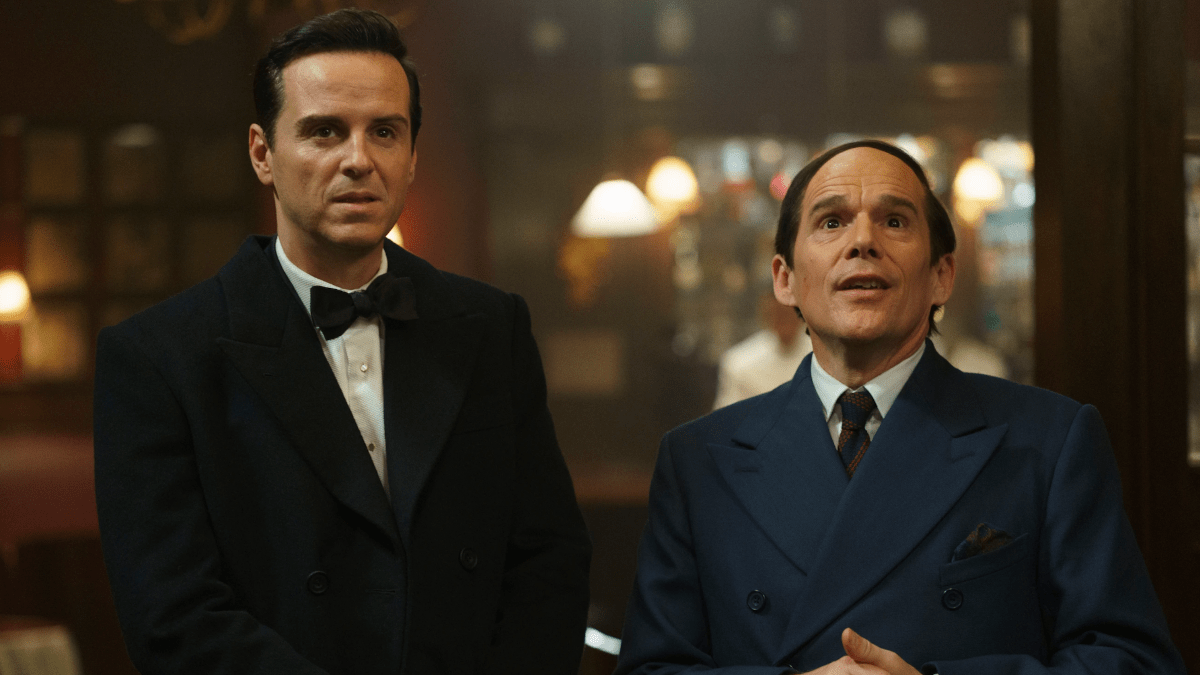
Hart’s professional life has also recently hit a low point, having been cast aside by his longtime partner Richard Rogers (Andrew Scott). To add insult to injury, Rogers’ latest musical with his new partner, Oscar Hammerstein (Simon Delaney), the aforementioned Oaklahoma!, is a huge success. It will go on to eclipse all of Hart’s collaborations with Rogers, which makes Hart both bitter and hurt. His only compliment of the play is a back-handed one, that it will be a staple of high school productions for years.
What Hart does have going for him is the continued adoration of people who love his songs, like “Blue Moon”. But that’s not what Hart wants. When Morty (Jonah Lees), an enlisted man on leave, begins playing it, Hart can’t resist being critical of it. The title was a throwaway idea he tossed out to a simple-minded producer. Some of the lyrics were constructed with multiple feminines, which I admit I didn’t understand. What’s clear is that Hart doesn’t like being eulogized, which is what everyone is doing in an effort to cheer him up. Much to his chagrin, Hart’s already viewed as an elder statesman and he’s not even fifty.
Which brings us to Hart’s desperate Hail Mary play at regaining his relevance, Elizabeth Weiland Margaret Qualley). She’s young, blonde, pretty and has artistic leanings of her own. Hart tells everyone that she’s a poet, but since we never hear any of her poetry we have to assume that he’s being kind. Why? Because he’s in love with her and wants the two of them to consummate what he believes is their mutual attraction for each other. Never mind that he’s known for being gay, he insists that he’s “omnisexual”. Hart claims that as a lyricist, he’s required to love everyone and everything.
What’s obvious after listening to Hart’s account of a weekend the two spent together, is that Elizabeth is politely using him to gain access to his famous former partner, Rogers. Is she stringing Hart along? Perhaps, but she respects him and loves him, just “not in that way”. (The movie is spot-on in how it identifies those four words as the literal dagger driven into many a man’s heart.)
Sitting at a nearby table quietly observing everything is writer EB White (Patrick Kennedy), whom Hart notices and invites over for a drink. White confides that his essays, while respected, aren’t helping him to make ends meet. He’s thinking about writing a children’s novel, and Hart off-handily gives him the inspiration for what will become Stuart Little. There’s a lesson there for struggling writers like Hart, about graciously accepting defeat while being open to trying new things, but he’s too busy feeling sorry for himself to notice.
When Rogers, Hammerstein and a party of well-wishers arrive, it’s showtime for Hart. He needs to get himself back into his former partner’s good graces and win over Elizabeth before he makes the introduction he promised. The honest and emotionally raw exchanges that take place prove two things to Hart: friendships, no matter how difficult, can endure, while love remains as elusive as ever.
Recommendation
What distinguishes Blue Moon within the genre of biopics is how it refuses to be a biopic. Instead of dutifully following genre conventions, the movie tells us about its subject using the structure of a one act play. While this gives the story its undeniable stagy qualities (one primary location, constant dialog from beginning to end), the overall effect is one of immediacy and urgency.
Instead of ticking off Lorenz Hart’s accomplishments while walking us through the key events of his life, as biopics are wont to do, the movie wants us to understand who he is by putting us in the position of a confidant. With each passing minute we learn more and more about this fascinating person, until we are left with an unvarnished portrait of a fallen artist. While the impact of this approach is sometimes overwhelming, the movie is uniquely engrossing as a result.
A movie like this requires a bravura performance in the lead, and Ethan Hawke delivers. I honestly was amazed that he had a performance this grandiose in him, a compelling mixture of vanity, playfulness, desperation, cattiness and fragility. In tandem with his equally arresting return as the Grabber in Black Phone 2, Hawke shows his chameleon-like ability to disappear into a wide-variety of roles. The only negative I had with this performance, which is not Hawke’s fault, is the movie’s attempts at shrinking his 5’ 10” frame into that of a diminutive man are thoroughly unconvincing. Linklater should have known that the results would be comical, and seriously considered casting a naturally shorter man in the role.
The supporting cast perfectly complements Hawke’s performance. Andrew Scott is pitch-perfect as Richard Rogers, who tries his best to be cordial with his former partner but can’t keep his frustration in check. Margaret Qualley stuns in a role that’s both a throwback to Hollywood’s glamorous age and a convincing argument that she would have been a star back then. Bobby Cannavale is fun as a New York bartender, garnering laughs whenever his character can get a word in edgewise. Lastly, Patrick Kennedy is memorable as author EB White, a wonderfully subtle portrayal of a writer always on alert for inspiration.
Richard Linklater’s greatest skill as a director is in capturing memorable performances. For the most part, his direction is naturalistic and unobtrusive, rarely drawing attention to itself. Linklater allows himself a few indulgences here, particularly in the beautifully lit and exceptionally framed scene that takes place entirely within a coat check room. The problem is that everything he does to disguise Hawke’s height fails. It’s a glaring flaw that turns what could have been a great film into something that’s slightly lesser than, which is a shame.
Blue Moon is an engrossing snapshot of the artist in free-fall, with a delightful performance by Ethan Hawke at its center. Its insistence on shrinky-dinking Hawke down to size is a humorous distraction, but not a fatal one. Margaret Qualley radiates glamour as his potential love interest and lifeline. Recommended.
Analysis
The rise and fall of the once-celebrated artist has been a durable storytelling formula in movies for a long time. For example, the original version of A Star is Born was released in 1937 and was followed by remakes in 1954, 1976 and 2018. Despite each movie taking place at different times in American history, each of them basically tells the same tragic story. The artist works hard, is recognized for their talent and becomes famous, only to crash back to Earth due to their personal failings. It’s the polar opposite of Horatio Alger’s rags-to-riches stories, where we anticipate watching a talented and successful person receiving a kick in the pants.
The reason behind the ongoing appeal of movies like A Star is Born and Blue Moon is an interesting question. It might be linked to the religious leanings of the audience, who believe that those who are born talented deserve to be punished for their transgressions, which are an affront to their God. Or perhaps it’s rooted in jealousy, where we want to see those who have achieved more than us be taken down a peg. Witnessing the rich and famous being reduced to ordinary citizens like us certainly qualifies as wish fulfillment. Another possibility is that audiences sympathize with successful people who lost everything due to their personal failings because it proves that even people like Lorenz Hart are human after all.
When taken into account with the widening wealth gap between the super rich and everyday people, I’m confident that movies like this one won’t go out of style anytime soon.
When it rains…
In Blue Moon, Hart is facing an existential crisis in every facet of his life. Professionally, his last job was on By Jupiter. Although the movie never states as such, I assumed that word got out that Hart had become an alcoholic and was difficult to work with, which made him unemployable. Romantically, he’s single and has placed all of his chips on his tentative relationship with Elizabeth. Culturally, he’s recognized for what he did years ago, not his recent work. (Everyone knows “Blue Moon”, but not Pal Joey.) If Hart doesn’t turn the corner in at least one of those areas over the course of the evening, the implication made is that he won’t be around much longer.
The play’s the thing
The film that bears the closest resemblance to how Blue Moon is Danny Boyle’s Steve Jobs. Both films tell their story using the structure and cadence of a play, but utilize original screenplays. Steve Jobs was created by playwright Aaron Sorkin. Robert Kaplow, who wrote Blue Moon, isn’t a playwright that I can tell, but his screenplay has all the earmarks of being adapted from a play. There’s an undeniable stageyness to both films, which feature wall-to-wall dialog and characters maneuvering within a few defined spaces. If someone had told me either movie was based on a play, I would have had no reason to doubt them.
My hunch is that Blue Moon was written as a play in disguise for the same reasons as Steve Jobs. The artifice of applying a play-like construction to a screenplay has its advantages. First, it keeps the budget low because there are no location changes and few exterior scenes. (Blue Moon only has one scene that takes place outdoors.) Second, all of the backstory is conveyed as efficiently as possible, with dialog. There’s no need for flashbacks because everything regarding the characters and their motivations is revealed through conversations.
Next, having events unfold in real time keeps us attuned to Hart’s mindset throughout the movie. We experience every aspect of his personality unfiltered and uninterrupted, especially his mania. The desperation that’s driving him is unrelenting, effectively turning the movie into an emotional high wire act.
Lastly, the one act play structure emphasizes how this night is a critical turning point in Lorenz Hart’s life. As such, everything he says and does has meaning and deserves our complete attention.
Hart as cartoon character
As someone who watched many cartoons while growing up, an image kept coming to me while I observed Hart flailing against his impending doom. I can’t point to a specific cartoon, but several have a scene where a character finds themselves in a rowboat drifting towards a waterfall. When that character realizes what’s happening, they begin frantically rowing in the opposite direction, only for them to be carried over the waterfall to the rocks awaiting below. It’s known as the “inevitable waterfall” trope.
In the movie, Hart knows he’s drifting towards obscurity (the waterfall) and is fighting as hard as he can to stay relevant. This is why he lays his heart bare to Elizabeth and Rogers. Unless he fights for a place in their lives, they’ll leave him behind. To a limited extent, his entreaties do work. Although his designs on Elizabeth don’t bear fruit, he does get a commitment from Rogers to work on five new songs for a relaunch of A Connecticut Yankee.
About Hawke’s height
While I understand that Linklater sees Hart’s height as the basis for his insecurities, I think Linklater should not have tried to shrink Hawke down to size. The use of oversized clothes and furniture simply doesn’t work. Linklater should have had Hawke convey Hart’s feelings in another more subtle way. It is possible for men to be 5’ 10” and insecure.
A writer writes, always.
One aspect that I liked about Blue Moon is it shows two writers at a crossroads in their careers. Hart has been cast aside by his longtime partner, while White is having a hard time earning a living as an essayist. While Hart has settled for feeling sorry for himself and taking shots at others, EB White is looking for an alternative. To the movie’s credit, it never forces the contrast between the two. It shows in a few minutes that artists should never let failure define them. Instead, they should be open to trying new things and always being receptive to inspiration, which can come from anywhere, at any time.
 Detroit Cineaste