
When The Black Phone did well at the box office in 2021, it was a foregone conclusion that a sequel would be coming. This posed a challenge to writer-director Scott Derrickson and co-writer C. Robert Cartill: how to continue the story with a dead villain? For Black Phone 2, the solution was to delve into the origins of the Grabber (Ethan Hawke). While there’s no evidence of an unhappy childhood, we do see how he honed his skills before taking up residence in a Colorado suburb. Practice makes perfect, right?
The first clue that Black Phone 2 will be playing fast and loose with reality comes in the opening scene. A young woman named Hope (Anna Lore) makes a call at a pay phone near a frozen lake. The girl on the other end nervously asks, “Who are you? How did you get this number?” and so on. The caller says that the number was etched onto the lake. Before the two can come to an understanding, the line becomes distorted and the call ends. As far as cold openings go, this one is undeniably mysterious and attention-grabbing, and left me with many questions. When did this call take place in the past or the present? Who was Hope talking to? What does all this have to do with the Grabber?
In the present, in the early Eighties, we catch up with our heroes from the first film, Finn (Mason Thames) and Gwen (Madeleine McGraw). The last movie ended on an optimistic note, with Finn apparently having traded in his meekness for confidence. Unfortunately, Black Phone 2 reminds us that happy endings rarely lead to happy lives.
Finn has become a violent bully who relishes beating the crap out of a schoolmate who dares to question his toughness. Finn only stops his pummeling when Gwen begs him to. Finn’s explanation is that the sight of blood makes an impact on the crowd, indicating that he learned the wrong lessons from his now-deceased friend Robin. Finn also smokes weed in an effort to numb the PTSD he still suffers from being the Grabber’s captive. Its the same self-medicating tactic that his father Terrance (Jeremy Davies) used after their mom’s suicide. Funny how people become the things they hate.
For her part, Gwen is turning into her mother, who also was tormented with visions while she slept. Gwen’s dreams feature three young boys being gruesomely murdered by a faceless attacker, and she wakes up screaming after every one. When she tells Finn she had a bad dream, he tells her it was just a dream. Finn is not very sympathetic, either.
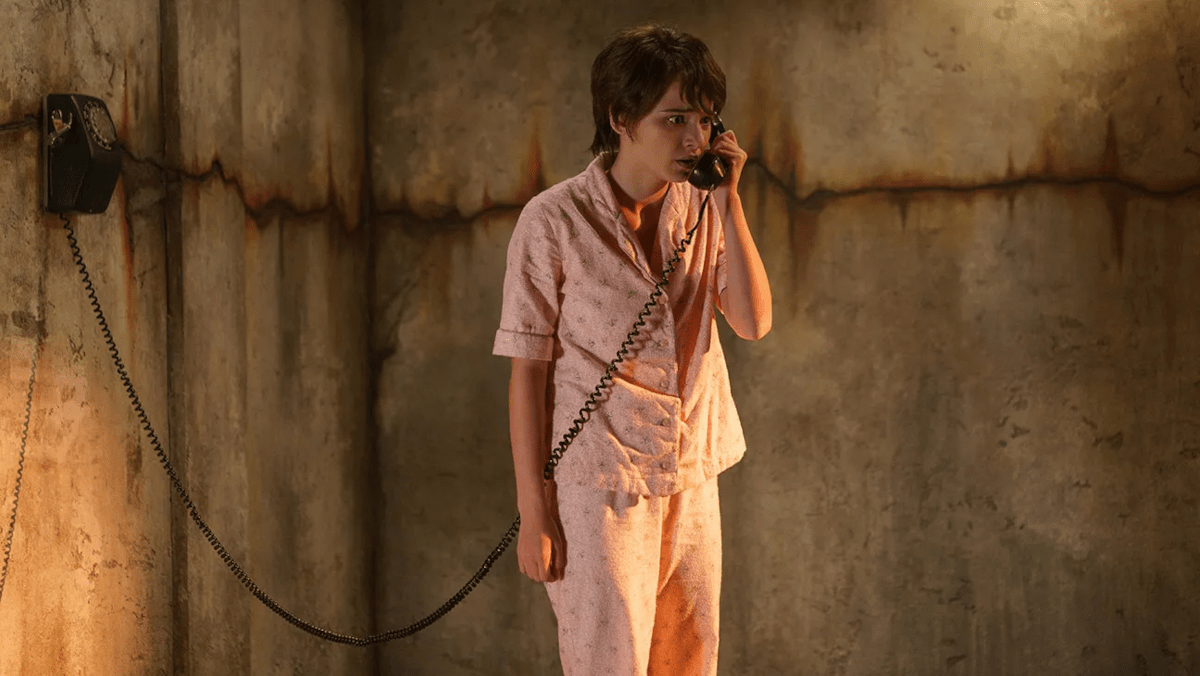
Gwen’s nightmares soon include sleepwalking. One night, Gwen finds her way into the basement of the Grabber’s house, where the black phone is ringing. When Gwen answers, she’s talking to Gwen from before. When the call disconnects, she runs into Grabber’s brother Max (James Ransone), who was killed in the original. He warns her to leave, but then hears the Grabber’s footsteps. Thankfully, Finn wakes her up before anything bad happens. He curiously downplays the situation, as if there’s nothing concerning about the two of them being in the Grabber’s basement in the dead of night.
The following morning, Gwen tells her brother that she received a call from their deceased mother Hope from a place she worked at when she was younger, Alpine Lake. Gwen believes that the call and her bad dreams are connected, which is plausible dream-based logic. She asks if the two of them can get jobs there as CITs, or counselors in training, so they could snoop around Scooby-doo style and get to the bottom of the mystery. Finn initially refuses, but goes along to keep Gwen out of trouble with their father, who’s been sober for nearly three years. (The movie’s willful reclamation of his character is almost as incredible as how Don’t Breathe 2 turned the blind man the hero.)
Tagging along for the assignment is Gwen’s kinda-sorta boyfriend Ernesto (Miguel Mora), who knows she’s weird and says he likes it. (Oh, Ernesto, you have no idea what’s in store for you.) The three arrive at Alpine Lake during a blizzard to find no kids there and only a fraction of the staff on hand. There’s camp owner Mando (Demián Bichir), his daughter Mustang (Arianna Rivas) and a married couple of office workers/Bible thumpers, Barbara (Maev Beaty) and Kenneth (Graham Abbey). Yeah, this combination is sure to make sparks fly.
That night the pay phone rings while Finn is hitting the Devil’s Lettuce. (I stole that from Mando.) It’s the Grabber, and he’s pissed at Finn for killing him and sending him to Hell, which is colder than Colorado in the wintertime. The Grabber says he wants to hurt Finn by taking away what he cares about most, which is Gwen. Meanwhile, in Gwen’s latest dream, The Grabber reveals a heretofore unknown link between himself and her mother. It’s the least he can do before he kills her, he says politely.
Finn wakes Gwen up before the Grabber can do any significant damage, and she reveals why they were called to Alpine Lake. They must free the souls of the Grabber’s first three victims, who’ve been appearing in Gwen’s dreams. Adding urgency to the search and rescue mission is how the Grabber is getting closer to killing Gwen each time she falls asleep. This motley crew of ghost-busters must find the bodies of the Grabber’s victims fast, or Gwen will be murdered faster than you can say A Nightmare on Elm Street.
Recommendation
The best thing about Black Phone 2 is that it doesn’t take the easy way out and recreate the original movie. Instead, the sequel has an entirely different plot, narrative focus and tone. While this approach ensures that the resulting movie wasn’t a tired rehash of what we’ve already seen, it still falls short of achieving the scary heights of the original.
This time the spotlight is on Finn’s sister Gwen, with Finn relegated to more of a supporting role. Gwen’s ability to have visions while sleeping drives a plot that’s directly inspired by the Nightmare on Elm Street movies. The filmmakers understand what made the Elm Street movies uniquely scary and follow the same pattern. As such, Black Phone 2 is both a blatant rip off and a loving homage, neither of which affected my overall enjoyment of the movie.
The same cannot be said of the film’s obvious nostalgia plays. First, it includes more than a few stylistic references to other horror movies from the early Eighties. Second, it acknowledges that decade through numerous cultural references. Filling a movie with “knowing winks” can be fun for the audience, provided that’s the tone the movie is aiming for. It perfectly suited James Wan’s, Malignant, for example, because that movie was intended to be a horror movie pastiche. However, they needlessly distract from Black Phone 2’s serious subject matter, and prove that Derrickson and Cargill were correct in resisting these inclinations the first time.
The force that drives the movie is Madeleine McGraw’s performance, which gives the story its emotional center. She handles being the lead extremely well here, and her acting is so raw and gut wrenching that it reminded me of another young screen queen’s breakout role, Jamie Lee Curtis in Halloween. McGraw’s so good that she compensates for Mason Thames’ underwhelming performance. It’s not that Thames is bad, but he seemed at a loss at how to portray a character consumed by inner turmoil, and turns Finn into a one-note character for most of the movie.
On the supporting side, Jeremy Davies delivers another one of his trademark off-kilter performances. Davies specializes in playing troubled characters who aren’t inherently likeable, and he’s been an asset in these movies. Having Ethan Hawke back as the Grabber is also a plus, although some of his dialogue was garbled by his mask. Anna Lore and Miguel Mora made a good impression in their smaller roles as mom and boyfriend, respectively.
Director Scott Derrickson leans heavily on his signature method for depicting horror, which consists of grainy, jerky camera footage set against a collage of ominous industrial noises on the soundtrack. While he does this very well, it’s become very familiar with his films and he needs to come up with something new for Black Phone 3. Showing all of the gruesome stuff that he usually leaves to the imagination isn’t the answer.
Black Phone 2 manages a difficult balancing act of continuing the story while also taking things in a new direction. As a love letter to A Nightmare on Elm Street and Eighties horror movies, it’s scary but not as tense as the original. Amidst all the blood and gore, Madeleine McGraw emerges as an actor to watch. Recommended.
Analysis
I can’t fault writer-director Scott Derrickson and writer C. Robert Cargill for not doing everything they can to make Black Phone 2 a successful sequel. Other than having the same characters as in the first movie, this sequel couldn’t be more different. Even the characters have undergone significant evolution in the intervening three years of screen time. Gwen has become an outcast, picked on by the mean girls at school for her clairvoyance. Father Terrance has gone sober and is trying to make amends to his family for the brutal way he raised them.
Finn’s transformation is the most extreme, however. He’s no longer the shy, introverted space nerd we saw in the first movie. He’s become a fists-first problem solver, choosing to settle scores with punches instead of finding a non-violent way to resolve his differences with his fellow classmates. Additionally, he’s turned to weed to chase away the fear he can’t shake after being the Grabber’s captive.
As I mentioned above, Finn has effectively become the two types of people he hated: bullies and drug users. This could have been an interesting thing to build upon in the movie, but it is largely forgotten until the very end of the movie. Before the final confrontation with the Grabber, Finn admits in a tearful monologue that his recent behavior has been his way of coping with the trauma from his horrific experience. While it’s great that Finn eventually had a breakthrough, it carries little weight in the outcome because the plot requires Finn to defeat the Grabber again by beating him up.
I suspect that when Derrickson and Cargill realized that Gwen’s journey was more compelling than Finn’s, they trimmed his material and increased hers. This would explain how Finn went from being the center in the first movie to being a secondary character in the sequel, as well as why he turned in such a muted performance in it.
I love the Eighties
When I saw the Black Phone 2 trailer, the sight of the Grabber on ice skates reminded me of a horror movie I’d seen long ago in the Eighties. Thanks to Uncle Google, it was the movie Curtains from 1983. While watching the movie, the sight of the back doors of the Grabber’s van flying open reminded me of The Hearse (1980). The dead kids scratching out the initials of The Grabber’s name steals from the Salem’s Lot mini series from 1979. When I see the movie again, I’m sure I’ll find more things that remind me of other films from that era.
I understand that Scott Derrickson is using this movie to express his love for the films that inspired him, but I wish he hadn’t. As I mentioned above, the first movie worked so well because it played everything straight. Any references made to the late Seventies fit within the confines of the story. In the sequel, Gwen and Ernesto discuss their love of Duran Duran. Finn watches Night Flight. I’m reminded of one of Tony Soprano’s famous lines from the show, “Remember when is the lowest form of conversation.” It’s not that making references to the past is inherently bad. They are extremely useful when cluing us about the time period. However, when they call attention to themselves, they break the engagement I’m having with the story. They’re gimmicks and a filmmaker like Derrickson should know he doesn’t need to use them to keep our attention.
Jeremy Davies appreciation
The first time I saw Davies in a movie was Saving Private Ryan. Since then, he has a habit of choosing difficult roles involving characters who are peculiar and often not likeable. Davies’ is one of those rare actors who you can’t take your eyes off of, but you wouldn’t want to get within ten feet of.
His work in both of the Black Phone movies is particularly daring. In the first one, he perfectly captures what being an alcoholic is all about. He effortlessly switches between being mean while sober and somewhat cool while inebriated. In the end, he becomes a pitiable figure who took out his anger over his wife’s suicide on his kids. Few actors would touch a role like this, but Davies is fearless.
In the sequel, Davies transforms Terrance into a teetotaling weirdo who’s trying to do right by his kids. Finn and Gwen don’t trust him, with good reason, and mostly tolerate him. However, when the movie implies that Terrance is going to fall off the wagon, it pulls a fast one on us. Instead of taking the television commercial’s directive and heading for the Mountains of Bush, he gets a snow plow and goes to the camp to fetch his children. While this grand gesture doesn’t absolve him of his sins, the idea that even someone as awful as Terrance could make up for his bad behavior fits within the movie’s exploration of Christian themes.
A turn towards Christianity
The most surprising element Derrickson and Cargill include in Black Phone 2 is a direct dialog about Christianity. The first movie only mentioned Jesus, but only within the context of Gwen’s Jesus Play House and her pleas for visions. It never implied that Jesus was answering her prayers or behind her visions. Additionally, the movie tip-toed around the notion of the afterlife, with the deceased kids being depicted as ghosts.
Black Phone 2, however, is incredibly overt in what it has to say about Christianity. Bad people like The Grabber who die wind up in Hell, which he describes as being incredibly cold. Good people like Hope are in Heaven. The Grabber’s first three victims reached out to Gwen with the hope that she can free their souls so that they can move on to the afterlife. In a way, the movie is an incredibly gory episode of Ghost Whisperer.
In regards to the living, Derrickson has Mando pace before a huge illuminated cross to drive home that he practices what he preaches. Barbara and Kenneth, however, are quickly revealed to be Christians in name only. They are scolds and judgemental, initially refusing to help find the bodies of the dead children. At one point, I think it’s Mustang who calls out their hypocrisy. The movie couldn’t be more explicit in stating doing the Lord’s work means doing more than chastising others. If I didn’t know better, I’d think the filmmakers were inspired by the recent political climate in America. If so, good for them.
Home movies
In both Sinister movies and now two Black Phone movies, Derrickson makes heavy use of his home movie footage stylistic trademark. While these scenes are undeniably creepy, I’m not sure what he’s trying to communicate with this aesthetic. Is it that the horrors lurking within everyday can only be revealed by analog technology? If that’s the case, why does he augment these scenes with industrial background noises. Could it be that Derrickson feels that the combination of the past (analog) with the present (digital) is “unholy”?
Freddy Krueger, rest in peace
Horror movie fans are a unique breed. On social media, they long for another entry in the (currently dead) Friday the Thirteenth and A Nightmare on Elm Street franchises. You would think that nine films with Freddy Krueger would be enough for diehard fans, but no. Personally, I’d rather have a remake like Black Phone 2 than to see another tired attempt to resuscitate the dead. What else could Freddy Krueger, Jason Vorhees, Michael Myers and Leatherface have to tell us at this point? For the love of all that’s unholy, let them rest.
Insidious inspiration
In Insidious and Insidious 2, the character played by Patrick Wilson goes back and forward in time through his journeys into The Further. He meets his younger self, and vice versa. In Black Phone 2, Gwen has a phone call with her mother from the past. When you’re in a dream state, anything’s possible.
Where do we go from here
The Black Phone franchise has so far given us a “child abduction/escape room” film and a “ghost haunting your dreams” film. After seeing the Grabber die once again, I wondered where Derrickson and Cargill could take things next. Then it hit me: demonic possession. The twist would be that the Grabber possesses Terrence. Who wouldn’t want to see Jeremy Davies play a possessed dad, where he could take his talent to play menacing weirdos to the extreme?
 Detroit Cineaste