
For writer-director Paul Thomas Anderson, no subject is too unwieldy for a movie. In his latest film, One Battle After Another, Anderson explores revolution, something most of us have only either read about or experienced from a safe distance. He wants us to understand what it’s like to be a revolutionary and embeds us within a violent political movement so that we experience the emotional roller-coaster of their daily existence. In his view, revolutionaries aren’t a faceless group of angry radicals wielding guns, but ordinary people who live and breathe a cause.
If One Battle were a story chronicling the rise and fall of “bad guys”, it would have started with the humble beginnings of the revolutionary group called the French 75. There would have been scenes of members meeting each other for the first time, getting to know each other, training, going on their first mission, learning from their mistakes and so on. Something along the lines of Martin Scorsese’s gangster films, like Goodfellas or Casino. Paul Thomas Anderson, however, skips all that jazz and shows the gang at the outset of a critical mission. (It’s the first of several bold narrative decisions Anderson makes here.)
Anderson is too formalistic of a director to adopt a true cinéma vérité style in his films, but he comes close with this one. The group attacks a detention center heavily guarded by the military. The French 75’s aims are twofold: free the undocumented immigrants detained there and embarrass the soldier boys responsible. Everything goes smoothly, proof that the group is both well-trained and planned things out sufficiently. But strange, even inexplicable things can happen when in the heat of battle.
After Perfidia Beverly Hills (Teyana Taylor) subdues Col. Steven Lockjaw (Sean Penn), she notices that he’s interested in her. Even though the two couldn’t be more different and represent opposite sides of the conflict, there’s undeniable electricity between them. Maybe it’s because they’re warriors meeting on the battlefield for the first time. Whatever the reason, you know that these two are destined to cross paths again.
With the mission a success, Anderson dials things down to introduce members of the group. The aforementioned Perfidia is a force of nature and the group’s de facto leader. Junglepussy (Shayna McHayle) and Laredo (Wood Harris) are her brash lieutenants. “Ghetto” Pat Calhoun (Leonardo DiCaprio) is the explosives wiz and Perfidia’s love interest. (He’s later awarded with the nickname “Rocked Man” for setting them off during the group’s raid.) Mae West (Alana Haim) is the white lady nobody would ever suspect someone of causing trouble. Howard “Billy Goat” Sommerville (Paul Grimstad) is the communications expert and gizmo maker.
While the French 75 executes a series of targeted bombings, Lockjaw has been keeping an eye on them, specifically on Perfidia. He approaches her while she’s in the middle of placing an explosive at a bank. He tells her that he doesn’t care about her blowing up buildings and will let the French 75 continue to do its thing, provided she meets him at a motel. If she doesn’t, Lockjaw will take her group down. Perfidia makes what turns out to be a fateful choice and goes through with the sordid arrangement, effectively taking one for the team. Or did she go through with it because she wanted to on some level? Revolutions make for strange bedfellows.
Time passes and Perfidia becomes very pregnant, and Pat glumly remarks that she acts like nothing has changed. When the baby arrives, Pat mistakenly believes that Perfidia will hang up her combat boots and help raise their daughter. She responds that she’s always been about herself and her cause. Revolution is what she lives for, and she can’t stop fighting any more than a bird can stop flying.
Perfidia leaves Pat and their baby to go on one last mission–a bank robbery, a decision that becomes far more consequential than she expected. A civilian is killed during a heist, an outcome that prevents Lockjaw from looking the other way. Perfidia makes a deal with Lockjaw in order to avoid going to prison, and members of the group are subsequently captured or killed. Those that aren’t are forced into hiding, including Pat and baby Charlene. Perfidia reneges on her arrangement with Lockjaw and heads for Mexico, leaving Lockjaw with a huge loose end that he hopes will remain secret.
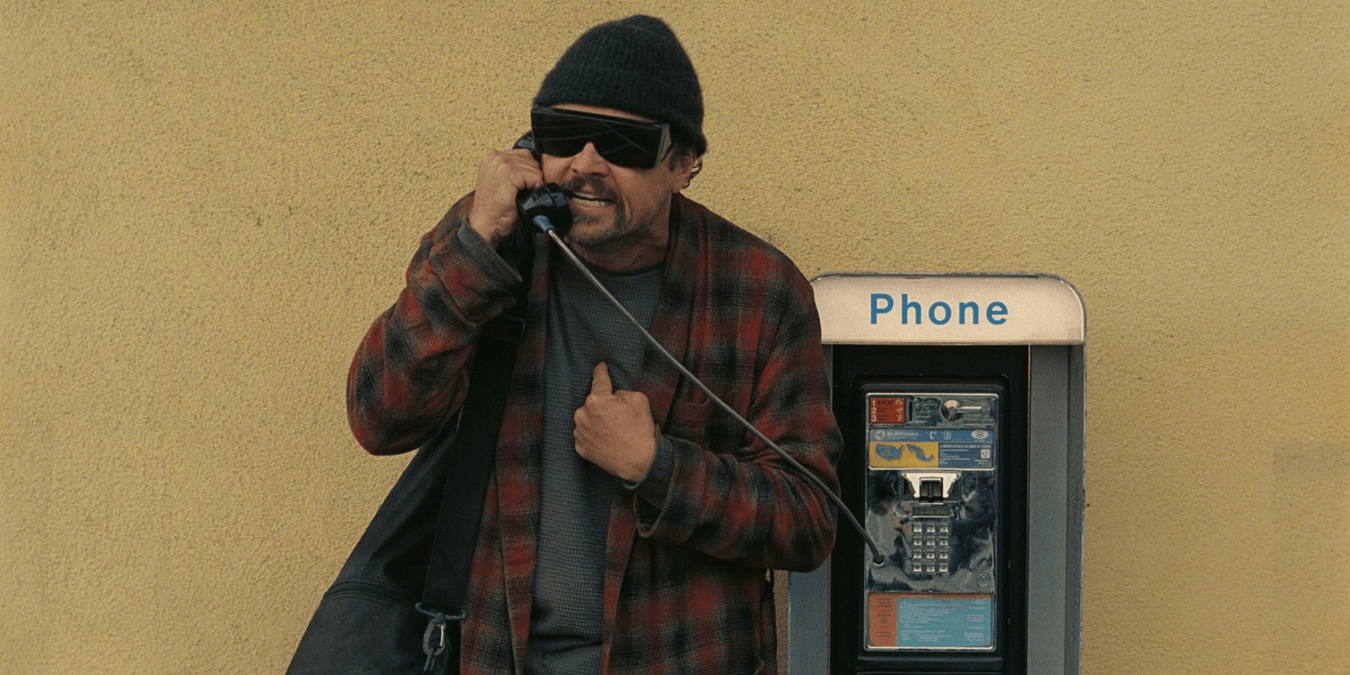
Fast-forward fifteen years, and a teenaged Charlene (Chase Infinit) is learning karate from Sergio St. Carlos (Benicio del Toro). She and Pat live as Willa and Bob Ferguson in the (fictional) sanctuary city of Baktan Cross. The years spent in fear have turned Pat a pothead, and he loafs around their house in his bathrobe. Meanwhile, Lockjaw has asked to become a member of a society of White Supremacists called the Christmas Adventurers. Virgil Throckmorton (Tony Goldwyn) tells Lockjaw that he can only join the club if he hasn’t engaged in intimate relations with a Person of Color. Uh oh.
Throckmorton says that the group will perform their own internal investigation and tells Lockjaw they’ll be in touch. Worried that the dalliance he had years earlier will block his inclusion in the kitsch hate group of his dreams, Lockjaw concocts a military mission in Baktan Cross. Outwardly, he’ll use the military to round up undocumented immigrants under the auspices of stopping illegal drug trafficking. That will give him cover while he tracks down Charlene, who could be his daughter. Sorry young lady, but Father’s Day is going to be really awkward from now on.
Recommendation
At risk of being dragged into the street by film nerds and beaten to a pulp, I admit that I’ve never loved Paul Thomas Anderson’s work. I admired the five films of his I’d seen prior to One Battle After Another, but I never fully lost myself in them. (If pressed, There Will Be Blood is my favorite.) I always felt the deliberateness of the storytelling, saw the wires, heard the gears turning, if you will. Anderson is a brilliant filmmaker, but to me he’s a magician performing what was obviously an elaborate trick, hoping that I’d believe it was magic.
The tide nearly turned for me with the casually silly Licorice Pizza, but the movie was undone by Anderson’s insistence at having amateur actors in the leading roles. Although completely different tonally, One Battle After Another feels like an extension of LP in that the story flows naturally, with the film’s subject matter and narrative rhythm in perfect alignment. Most importantly, Anderson’s direction never upstages what’s happening in the moment. His “look at me!” filmmaking tendencies are still present, but he calibrates them to fit the requirements of the scene. Anderson can still wow us, which he does with the film’s gripping action sequences, but he’s stopped using every scene as an excuse to show off.
Throughout his career, Anderson has always gotten incredible performances from his actors. This movie has several, starting with Leonardo DiCaprio’s goofy turn as a revolutionary-turned-stoner dad. If someone would have told me twenty years ago DiCaprio’s midlife output would be devoted to a series of memorable losers, I never would have believed it. Sean Penn’s stick-up-his-ass Col. Lockjaw is a brilliant creation where his performance’s showiness is totally appropriate for his character. Anderson wisely lets Benicio Del Toro be his low-key, effortlessly cool self. Teyana Taylor manages to steal scenes away from DiCaprio and Penn, proof that she’s a star in the making. That Anderson coaxed a raw and vulnerable performance from Regina Hall is a minor miracle. Chase Infiniti is the breakout star of this ensemble, accomplishing what Alana Haim could not. (Haim is present here, but only in a small supporting role.)
My issues with the film are few. Johnny Greenwood’s score, while suitably jazzy, is too incessant at times. The film’s energy sags in the middle portion while setting the table for the riveting last act. And the fate of the main villain is a bit too karmic to be believed. (It’s funny, but Anderson’s trying too hard to please.)
Brimming with expertly-staged, gripping action sequences, One Battle After Another is a funny, sexy and insightful look at revolutions and the people who fight in them. A bold and confident throwback to the political thrillers of the Sixties and Seventies, it speaks directly to the dangers of our currently hyper-polarized political climate. Recommended.
Analysis
As was the case with Paul Thomas Anderson’s previous films, I can describe One Battle After Another at length but would fail miserably at categorizing it. Referring to it as a drama or an action-comedy would greatly oversimplify what Anderson is doing here, even if his film is both of those things. I would describe it as an experience because it made me see things differently. It is insightful to a degree that few films are, and explains its point of view in a casual way that belies its underlying seriousness. Anderson is telling us how he sees things while making it all thoroughly entertaining as he goes.
The movie reminds me of lectures given by some of my favorite professors in college. There’s an undeniable pull when a knowledgeable person is holding forth, which is what watching this movie was like to me. It’s a free-wheeling treatise on all things pertaining to revolutions, explained within the structure of a movie. That the movie covers so much ground so effortlessly is remarkable. After seeing this movie, I feel like I understood revolutions better than I ever had before, and for that I’m grateful.
Revolution as a musical movement
In the movie, Anderson describes a revolution as a series of movements, like a musical piece. Each movement builds upon what came before, and it isn’t until the movie concludes that we understand what was conveyed.
One Battle is essentially a piece told in four movements, each of which reflect a stage of a revolution. In the beginning, the revolution is on offense, causing havoc and making people take notice. The French 75 operate with impunity, catching their targets completely off-guard. They release prisoners, capture and taunt the military and blow up buildings linked to fascists. Everything is going according to plan.
In the second movement, the revolution is forced into retreat due to a tactical error. When Perfidia kills the security guard, it changes the perspective of the group from troublemakers radicals to killers. This turn of events enables Col. Lockjaw to hunt the French 75 down and subdue them with deadly force. Some members are killed, while some manage to elude capture.
Next, the movie shows us the revolution in exile. Pat is living with his daughter Charlene in Colorado under assumed names. Howard “Billy Goat” Sommerville keeps a low profile while coordinating an immigrant underground railroad operation. Perfidia is somewhere in South America. Deandra is active but has gone underground. The surviving members of the group are biding their time, trying to survive while waiting for the right time to reemerge. In their absence, others not directly affiliated with the group pitch in when necessary. For example, Sensei Sergio and his followers help Bob avoid capture because it’s important for the spirit of the revolution to continue.
The last movement is about the revolution fighting for its life. The fascists have become all powerful and are hunting down the remaining members of the French 75 with no regard for civil rights. Pat and Charlene become locked in a fight to the death with Lockjaw, who must eliminate her in order to join the Christmas Adventurers Club. Pat and Charlene’s survival enables her to take her mother’s place and continue what the French 75 started. Like the phoenix, the rebellion is reborn.
Revolution is the drug I’m thinking of
Revolution is a stimulant that gives its members the energy to continue their fight. It’s an opioid that delivers an endorphic high when missions are successful. It’s an aphrodisiac that brings Pat and Perfidia together and turns counter-revolutionaries like Col. Lockjaw.
Revolution is an addictive and all-consuming endeavor, directing the revolutionary’s every thought and action towards the cause. The day-to-day concerns of normal citizens–family, work, responsibilities, no longer matter. The revolutionary lifestyle controls every aspect of the person’s life until they either kick the habit or are killed by it.
Revolution versus fascism, the eternal struggle
The movie notably doesn’t show the revolutionary forces eventually defeating fascism. Instead, the struggle between the two is a never-ending struggle defined by ebbs and flows on both sides. The forces of revolution and fascism will push and pull against each other in a symbiotic relationship that extends into the future, with no end in sight.
As a longtime science-fiction fan, the struggle between the French 75 and the fascists reminded me of two episodes from the Star Trek original series. First is “Let that Be Your Last Battlefield”, in which two members of different races, distinguished only by their alternating black/white skin colors, fight until their entire civilization is destroyed.
The other episode is “The Alternative Factor”, where the crew of the Enterprise confront an alien being in two forms: one from their universe and one from an alternative universe. In order to keep both universes from being destroyed, the crew trap both versions of the alien in a dimensional corridor. Once there, the two fight each other for eternity, effectively safeguarding each universe.
While One Battle isn’t as pessimistic as either of those two episodes, it shows that both sides of the revolution are opposed to each other at an atomic level and are destined to fight each other forever, because there is no common ground to be found.
The revolutionary’s retirement plan
What happens when a revolutionary decides they want to get off the revolution train? Pat does this when he tells Perfidia that they can’t be revolutionaries anymore because they have a child. They need to put their family first and let the others continue the fight in their place.
Perfidia, however, refuses to let her new role as mother dictate her actions. When she signed up for the revolution, it was a lifetime commitment. She’s dedicated her life to achieving the revolution’s goals. If she quits, all of her actions would have been for nothing.
The movie argues that leaving a revolution isn’t a viable option, because the fascists won’t stop until they settle things in their favor. No matter how well Pat and Charlene hide, they will eventually be caught. Despite living under assumed names for fifteen years, it only took one rat to expose them.
Revolution optics and the coolness factor
The movie shows that white revolutionaries will never be considered as being cool. Even though Pat risks his life the same as the rest, he’s nicknamed “Ghetto” and “Rocket Man”. Howard Sommerville is just a nerd who fiddles with electronics. Mae West is the “frump girl” that other white people ignore. The fact that the white revolutionaries also freak out under stress is very uncool. Pat perfectly epitomizes this, in that the fifteen years of living in hiding have reduced him to a stoner who then proceeds to run around in his bathrobe while trying to avoid The Law.
On the other hand, the Black revolutionaries are cool for the most part. They get all of the attention because they’re loud and flamboyant. However, they take undue risks and don’t plan for when things go sideways. Even worse, they also turn into rats when the chips are down.
The Latinos turn out to be the coolest revolutionaries of them all. As Sensei Sergio tells Pat, they’ve been besieged many times over the years. They know how to handle adversity and never let it bother them. (“Ocean waves.”) Sergio calmly leads an evacuation of immigrants before troops arrive, recruits others to help Pat escape over rooftops, then helps him escape from custody in the hospital. Finally, Sergio helps Pat avoid capture one last time when the two are spotted by troopers. When Sergio does a little dance while surrendering, it’s obvious that Latinos know how to do revolution the right way.
White nationalism, fascism and racism will never be cool
It doesn’t matter how much firepower they have, how arcane their rituals are, how fancy their underground bunkers are, how smart their uniforms look or how hateful their words are, white nationalists, fascists and racists will always be the opposite of cool.
The pernicious threat of White Nationalism
One Battle is very deliberate in connecting White Nationalism to fascism. It shows that the worst thing for America is when the former takes control of the country. When that happens, the people in power are free to use the military to enact their racist agenda towards immigrants and subdue dissenting citizens, even children. They can make up whatever nonsense justification they need to send the military to the suburbs, because nobody will hold them accountable. There’s a meth lab operating out of the chicken nugget factory? Mobilize the National Guard! High school kids are protecting revolutionaries? Lock them up without due process!
One of the scariest moments in the film is when the members of the Christmas Adventurers agree that immigration is destroying the planet. Clearly, there’s no reasoning with someone who holds views as illogical as that.
Decoded messages
Modelo is the beer of revolutionaries.
The members of the Christmas Adventurers say “Hail Saint Nick” because even Satan doesn’t want to be associated with this bunch.
No matter how dangerous things are, there’s always someone who insists upon everyone following the rules.
Pat needing to constantly prove he’s who he says he is by remembering arcane phrases is emblematic of the customer service experience today.
One of the oldest cliches about revolutionaries is that whenever we see them on screen, there must be jazz playing either on a record player or on the soundtrack, preferably Miles Davis. Greenwood’s score is a direct reflection of that.
Although I have no problem with the Christmas Adventurers killing Lockjaw, I didn’t buy that a Colonel can be “disappeared” that easily.
I wonder where the revolution would stand if it weren’t for bounty hunter Avanti’s nagging conscience. He died to rescue Charlene when he could have looked the other way, as he did countless times before. Maybe that’s a message for all of us, to stop looking the other way and get involved.
I’ve only read Thomas Pynchon’s The Crying of Lot 49, but I could tell within minutes that the movie reflected the source material. Pynchon loves characters with weird names, strange rituals and subversive activities.
 Detroit Cineaste