
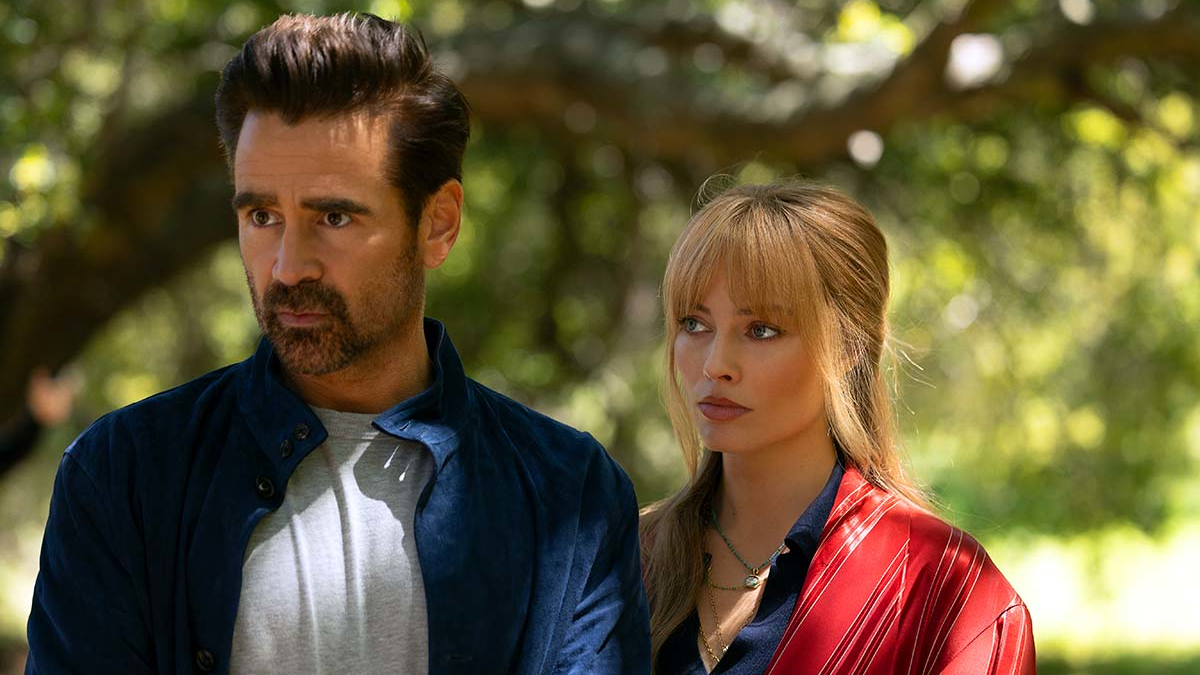
In When Harry Met Sally, the characters are blocked from taking the logical next step in their relationship by their neurosis. Eventually they come to their senses and there’s a happy ending. A Big, Bold, Beautiful Journey has basically the same premise, except that this time the couple spend the movie undergoing couples therapy before winding up together. Call it When Harry and Sally Went to Psychoanalysis. While this alternative take on the rom-com formula is intriguing, the movie’s emotional impact is underdone by its episodic nature and awkward tonal shifts.
Although we don’t know that David (Colin Farrell) is miserable, there’s something not right about him. Despite being roguishly handsome, he lives alone and the only person he talks to is his mother (by phone). Clearly, something must be wrong with him to be single. Turns out there is and it will be revealed shortly.
David’s plan for the day is to drive to a wedding, but destiny has made other plans for him. A wheel boot on his car forces David to look for another way to get on the road, and a flyer for “The Car Rental Agency” (complete with a cartoon broken heart) offers a solution. If I were in this movie, I would ring Enterprise, Hertz, Avis or Budget in this situation. Why David is drawn to a place he’s never heard of is odd, but this movie is all about whimsy.
The agency is a strange one, situated within a cavernous building with only two Saturn Model S in stock. The agents themselves are an odd couple, a lady (Phoebe Waller-Bridge) who mostly shouts in different accents and a graying old man (Kevin Kline) who barely speaks. If this were the real world, David would probably walk out and Uber to a real agency, but the plot requires him acquiesce to the strangeness of it without question. After the lady curiously twists David’s arm over including a GPS device, David drives off.
At the wedding, David encounters Sarah. It’s obvious they’re meant for each other because they’re both gorgeous. However, they’re unable to talk to one another. (Allergic to small talk, maybe?) When they meet again on a balcony, they adopt courting facades in an attempt to break the ice. Devilish charmer, meet the maneater. Their performances fail miserably, so much so that David declines her invitation to dance. While he observes her from afar, he brushes off advances from other women. That night, David goes to bed alone while Sarah hooks up with a guy she just met. (Oy, do these two have issues!)
The morning after, David sets off and is immediately confronted by his car’s GPS. “Do you want to go on a big, bold, beautiful journey?” After he emphatically agrees, the device instructs him to pull over and eat a cheeseburger at a fast food restaurant. (Oddly specific.) At Burger King, David notices Sarah also eating a Whopper. She joins him and the two make another attempt at conversation. David can’t remember the last time he was at BK, while Sarah says she eats cheeseburgers every day. (Yeah, right.)
Something is preventing David and Sarah from connecting, and the supernatural forces intent on getting them together decide to intervene even more forcefully on their behalf. Sarah’s Saturn promptly fails to start, and David’s GPS orders him to pick her up. David and Sarah surprisingly continue to play along, because this GPS simply won’t allow them to not wind up in each other’s arms. (Did TomTom GPS have this feature?)
When the GPS tells David and Sarah that they’ve arrived at their next destination, there’s nothing around but wilderness. They leave the car, wander into a field and find a door standing in the middle of nowhere. There’s nothing on the other side of the door, but when they open it and walk through, they find themselves at a lighthouse David once visited. When they reach the top, David tells Sarah that he vacations alone, and she says she does the same. David confides that when he first looked out from this spot–which is beautiful, by the way–all he felt was alone.
The next door they encounter opens to a museum Sarah used to visit with her mom after closing. (A security guard friend would let them in.) Sarah tells David that this was her mom’s favorite place to visit when she was alive. Sarah stopped going after her mom died, which she missed because she was selfish. Sarah is also a beautiful-yet-sad and lonely person, just like David. Equally important to note is that these doors aren’t just portals into the past, they’re vehicles for psychoanalysis.
The next doors David and Sarah go through reveal why they’re both incapable of love. When David was in high school, he was a musical theater geek and had his heart crushed by a girl in the play. (This section of the movie is its high point, by the way.) Since that moment, David has defined love as the quest for the unobtainable. Sarah’s choices when her mother was in the hospital made her feel she was unworthy of being loved because she satiated her desires at an unfortunate time. No wonder the supernatural is trying to make things right for these two lost souls.
Now that we know why both David and Sarah are emotionally closed off, it’s up to the doors to unblock them, which they do by introducing role playing. Yes, the movie is advocating on behalf of performance art as therapy, which would be novel if Woody Allen’s Sleeper hadn’t gotten there first. (Allen does it entirely for laughs, but it still counts.) Does all of this supernatural meddling finally bring David and Sarah together in the end? Spoiler alert: yes. All of that therapy wasn’t for naught, for them at least.
Recommendation
Every now and then, a movie comes along that doesn’t work but is worth watching, when time permits. A Big, Bold, Beautiful Journey is one of those movies. It has a lot going for it but it never comes together in the way the filmmakers intended. It’s the cinematic equivalent of visiting a curio shop while on vacation–there are plenty of interesting things to look at but nothing worth buying. The movie is very much less the sum of its parts, despite the beauty of several scenes and the overall craftsmanship on display. Together, however, it’s a well-intentioned misfire.
The problems begin with Colin Farrell and Margot Robbie, two actors the camera adores but exhibit little chemistry for each other in this movie. They did manage to hold my attention because they are movie stars, born with that undeniable magnetism that makes them watchable no matter what they’re doing on screen. Even though Farrell and Robbie nail all of the varying emotional states the movie asks of them, they can’t overcome the movie’s severe case of tonal whiplash.
On a visual level, Kogonada delivers one perfectly-framed scene after another. This might be one of the best-looking films I’ll see this year. (Although films viewed as failures are rarely recognized, cinematographer Benjamin Loeb deserves to be.) Whenever Kogonada isn’t mooning over Farrell and Robbie, he gives us breathtaking views of the California terrain, with tree lined roads, quaint walk-ups, coffee shops, and so on. There are times when the movie adopts a painterly aesthetic, dabbling in surrealism, impressionism and other art forms. The film is a feast for the eyes. Even Farrell and Robbie’s costumes are perfect.
Unfortunately, no matter how hard Farrell, Robbie and Kononada try, nothing in the movie gels. This is due to how the story is structured. Having two characters simultaneously explore the formative moments from their childhood that left them scarred emotionally takes away from both. The dialog is overly verbose, perhaps striving for the rhythm of a film from the Forties. Whatever the intent, it sounds out of place in a modern world.
Despite presenting itself as a romantic comedy, the movie is only fleetingly interested in being either. For the most part, the movie is a serious emotional drama, an examination of two people who can’t experience love. Aside from the dramatic moments, every other tone the movie reaches for feels off. The whimsy is forced, the romance timid and the comedy mild. The movie’s sweet-spot is its therapy-influenced sequences, which are effective but never build towards an emotional release.
A Big, Bold, Beautiful Journey fails because its story is neither cohesive nor captivating. However, if you’re curious and have time on your hands, the movie creates a beautiful world for Margo Robbie and Colin Farrell to wander through at their peak handsomeness. Not Recommended.
Analysis
What intrigues me about A Big, Bold, Beautiful Journey is that it doesn’t fail in obvious ways, which makes it more interesting to talk about than a movie everyone loves. Examining a failed film can be even more rewarding than a great one, because it involves understanding why films work on many levels: direction, performances, screenplay, editing, music, etc. With that in mind, why does Big, Bold not work?
Narrative structure
The film is constructed as a road film, with David and Sarah driving across California in search of doors. Each door takes them back to critical moments in their lives, all of which collectively left them emotionally stunted in adulthood. I don’t have any problem with this narrative approach, since road movies are typically episodic in nature. What struck me is that no matter how emotionally moving all of the door sequences are, they never build towards an emotional crescendo.
I think the problem is twofold. First, too much time passes between the door scenes. There’s driving, then a door, then more driving, then another door. Whenever David and Sarah hit the road, the impression made of the previous door scene fades into the distance. For these door scenes to amount to something, they needed to come one after the other in quick succession. The time spent in between these scenes diminishes their impact.
Strangely enough, Thunderbolts* does exactly what this movie should have done. In the climax of that superhero movie, the team is brought into Bob/Sentry’s mind where they experience the traumatic events of his life. This approach works because every recollection scene immediately follows the next one, which enables their emotional weight to build. The equivalent scenes In Big, Bold are too spread out to have the same effect on the audience.
Second, having two characters undergo a spiritual journey together diminishes both of their journeys. The movie constantly forces us to mentally toggle between scenes of David’s pain and Sarah’s pain, effectively dividing our attention between the two. First we feel sorry for David, then Sarah, then David, then Sarah. If the movie had settled the story being about either David or Sarah, it would have made it far easier for us to have sympathy for them.
Ping-ponging between two characters going through roughly the same emotional beats is difficult to pull off. There’s a reason why A Christmas Carol is about Scrooge and not Scrooge and Cratchit, and why It’s a Wonderful Life is about George Bailey and not George and Mary. Those movies are emotional powerhouses because they limit themselves to a single character being the lead. Big, Bold shows why having a lot of solid material can’t cover up for a lack of narrative focus.
Forced whimsy
I like the whimsical tone the movie attempts. Visually, Kogonada is trying for a spare, surreal style that reminded me of Tim Burton’s earlier films, specifically Edward Scissorhands. The movie has a wealth of visually striking imagery. But instead of trusting the audience to understand what the images signify, the movie constantly reminds us how strange everything is with additional stuff intended to emphasize that point.
For the car rental agency, having Phoebe Waller-Bridge and Kevin Kline talk in funny accents is completely unnecessary. They’re veteran character actors and can make a scene quirky and interesting with minimal effort. There’s also no reason to have Waller-Bridge shout her lines in German and French accents. And while I love Kevin Kline, his character serves no purpose in the story. The one scene where he hands the keys over to David and Sarah could easily have been handled by Waller-Bridge.
When David and Sarah approach the first door, there’s no need for them to prattle on about how odd it is, because we can see it for ourselves. There’s no need for them to say things like, “Hey, that’s a door.” “Yeah, that’s strange.” “Where do you think it leads?” “Do you think it’s safe?”
Too clever by half
The movie gets itself into a trap when it delves into role playing. Instead of having the characters observe key moments in their lives, it has them reenact them in ways that draw more attention away from the emotional context of the scenes and instead to how contrived they are.
The scene where both David and Sarah relive their breakups in the same cafe is the first example of this. These moments would be awkward and painful for David and Sarah to watch, just like it was for Scrooge. Instead, the scene quickly devolves into a role-playing therapy session, with the dumpees asking David and Sarah tough questions. It was this scene when the movie decided to stop telling a story and instead became a couple’s therapy session.
The climactic scenes were overwrought for the same reason. There’s no need for David to play his father talking to his younger self when the outcome likely mirrors what happened in real life. (I’d think that David’s actual father told him he was going to be OK.) Likewise, having Sarah be her twelve year-old self talking to her mother about “man issues” amounted to nothing of consequence, because Sarah’s mother had no explanation. Compared to what came before, these scenes are the equivalent of acting class exercises, convenient ways for Farrell and Robbie to show us their acting chops rather than convey actual emotions.
Peaking too soon
My favorite door scene is when David returns to high school and performs in How to Succeed in Business Without Really Trying. While I suspect that Farrell wasn’t actually singing, it didn’t matter because this entire sequence crackles with energy. The tension between David and his high school crush Amanda (Lucy Thomas) is palpable. The scene elevates above its maudlin beginnings when Smitty (Michelle Mao), a girl who has a crush on David but that he’s completely oblivious to, starts singing to get things back on track. When Sarah reveals her musical inclinations and chimes in as well, I thought, this is fantastic! It made me want to see Farrell and Robbie in an actual musical.
But then the two leave David’s high school and continue on their journey, and the movie never achieves the energy ever again again. The next door scene is a ghastly one, where Sarah talks to her mom’s corpse while David reassures his father while he (David) is just a baby in intensive care. This leads to my next issue.
Wild tonal shifts
Big, Bold isn’t the first film with a variety of tones. However, it is unique in how every scene is limited to only expressing a single tone. There are scenes that are funny, whimsical, romantic, melancholy, sad, wrenching, and so on, but there isn’t a scene that is both funny and sad, for example. Or romantic and whimsical. Each scene introduces a tone and is followed by another scene with a different tone, a pattern followed until the end. This makes me believe that the screenplay originated as a collection of scenes joined together without the glue necessary for them to feel like a cohesive whole.
Doornobs
I failed to understand the significance of having the characters drive Saturn. Is it symbolic of how they’re running their lives? That they’re at risk of becoming obsolete? That the screenwriter just loves Saturns?
The movie’s other weirdly specific element was having David and Sarah eat a cheeseburger at Burger King. Why this and not any other fast food chain? Was this done solely as product placement?
Why are the deer’s innards made of yarn?
Both David and Sarah are fans of musicals. Too bad the movie only uses that concept in one scene.
Was the talking GPS stolen from Wim Wenders’ At the End of the World?
 Detroit Cineaste