
The fact that Weapons begins with its most haunting images tells you something about what writer-director Zach Cregger has in store for us. The movie is ostensibly about seventeen children who disappeared at the same time, but Cregger’s ambitions extend beyond that. Although Weapons is a horror movie, it’s also surprisingly insightful in what it says about how tragedy affects us, the risks associated with everyday human kindness and the lonely plight of victimized children. And on top of all that, it’s very funny. Weapons is a big canvas horror movie that takes big swings and connects every time.
Weapons opens with images that immediately grab our attention. One night at 2:17 AM, seventeen children flee their homes into the darkness. They run with their arms bent backwards, making them look like birds. (These images are set to George Harrison’s “Beware of Darkness”, which only increases the strangeness of it all.) According to the off-screen narrator, the children are never seen again. As far as horror movie hooks go, this one is sublime.
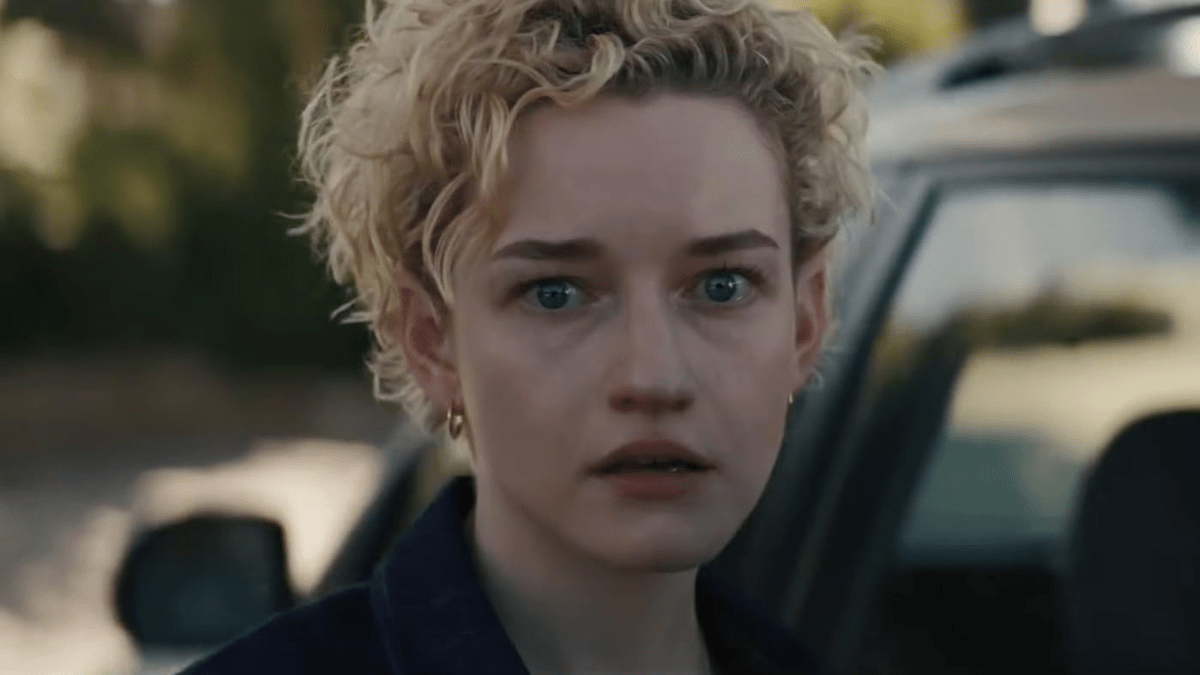
The story unfolds as a series of chapters, each focusing on an individual in the community. Some have been directly affected by the incident, while some weren’t. (Why the movie does this becomes clear with each subsequent chapter.) The first chapter is devoted to Justine (Julia Garner), the teacher whose classroom contained all of the children who ran off. (The one child who remains, Alex, gets the final chapter.) Although the school reopened a month after the incident, Justine was not included. Instead, principal Marcus (Benedict Wong) placed her on paid administrative leave until there’s no concern that she’ll trigger the children or the parents.
Although Justine hates living in isolation, Marcus was right to be cautious. At an all-parents meeting one evening, the anger and suspicion directed towards Justine is palpable. (I love it when a movie indulges in Twilight Zone-inspired paranoia.) One parent, Archer (James Brolin), yells accusations at her while she speaks. What was happening in her classroom? What does she know that she’s not telling us? Justine reiterates that doesn’t have any answers, which only enrages the parents more. She’s escorted out of the auditorium by Marcus, who tells her to go straight home. She doesn’t, stopping by a liquor store for medicinal supplies.
At home, Justine is tormented by unseen pranksters rigging her doorbell and knocking at the front door. When she falls asleep, Justine dreams of her classroom, where all of her students are asleep save Alex (Cary Christopher). He stares at her and smiles, wearing what looks like clown makeup. When Justine awakens, she briefly sees a disturbing apparition on the ceiling. (Unfortunately, describing that vision in any detail would give the movie’s twist away.)
The next day, Justine asks Marcus if she can speak with Alex, but Marcus refuses because he feels it would be inappropriate. With nothing but time on her hands, she settles on two courses of action. She first rekindles her relationship with ex-boyfriend Paul (Alden Ehrenreich), a police officer. They meet at a bar, and a fling is definitely on the table. What has any of this to do with the missing children? It plays directly to another theme in the movie, about how bad things often go unnoticed because of life’s distractions.
Because the investigation has stalled, Justine decides to play detective. She watches Alex on his way home and rings the doorbell after he goes inside. Nobody answers. Justine notices that all of the windows are covered with newspaper. When she spies through an opening, she sees Alex’s parents sitting motionless on a couch in a darkened living room. Scared out of her wits, she calls Marcus and tells him to perform a welfare check on Alex, who begrudgingly agrees.
The movie’s perspective shifts to Paul, and we learn that he’s married to the police chief’s daughter. When Paul’s not answering to his ovulating wife, he’s trying to make nice with his boss and father-in-law. It doesn’t help matters that Paul isn’t a particularly good cop either, and he overreacts when he sees drug addict James (Austin Abrams) breaking into a building.
We see Paul and Justine meet up at the bar again, their fling and the aftermath of Paul’s poor judgement. His wife is pissed at him and attacks Justine at a party store. The gist of Paul’s chapter is that he’s a very distracted person, juggling family commitments, husband responsibilities and work. He’s so distracted that he spent the night with Justine to distract him from his other distractions. After having made his life significantly worse, Paul takes his frustrations out on James, who he spies walking towards the station.
Subsequent chapters for James, Archer, Marcus and Alex, follow the same pattern of Justine and Pauls. They start at some point in the past, give us a window into that character’s life and circle back on prior scenes. With each chapter, the movie brings us closer to answering the mystery behind the children. Once that is revealed, the movie culminates with a slam-bang ending that is the definition of poetic justice.
Recommendation
What makes Weapons so entertaining is its narrative construction. After showing us “the incident”, writer-director Zach Cregger takes an unusually circuitous route through the lives of the townspeople before revealing WTF happened. The plot is revealed through the perspectives of multiple characters, each with their own point of view, beginning at different points in time, with overlapping events. Describing how the plot works and how everything fits together is a challenge. It evokes a spirograph, a conspiracy wall, a pachinko machine and the funnel ball game. As someone who appreciates movies with complex plots, this one kept me enthralled throughout.
What Cregger is after with his plot gyrations becomes clearer as each individual storyline plays out. He’s focusing on how a tragedy affects different sides of the community, namely those who were directly impacted and those who were not. In the former camp are a teacher, a father who lost his son and the only member of the class that was impacted. They each want to move on but can’t because they can’t break their connection to “what happened”. For the others (represented by a principal, a drug addict and a police officer), they ease back into their normal routines, a dichotomy Cregger shows as being both unfair and reasonable.
In addition to examining the fallout of an inexplicable tragedy, Cregger also exposes how evil often takes root unnoticed. When we get to the last character POV, Cregger shows that something was obviously wrong, but that people either misinterpreted the signs or never noticed them. The only thing missing were closing scenes with the townspeople on camera stating, “I had no idea such and such was going on in that house.”
Although the subject matter of Weapons is serious, it’s a very funny horror movie. Some of this comes from moments of shocking violence and and gore, but most of the laughs come while we observe the adults flail about in their everyday lives. (I want to believe Todd Field’s Little Children was an inspiration.) The movie’s villain is a creation so thoroughly outlandish that I found myself nervously laughing at their every appearance. Finally, the movie’s jaw-dropping climactic scene–a minutes-long visual gag–perfectly bookends the story.
Whenever I watch a film by an auteur, I know I’m in good hands. That is how I felt while watching Weapons, that writer-director Zach Cregger has arrived. I hesitated to describe him as such after Barbarians, even though it’s an ingenious horror movie. The sample size was too small to start throwing around the “a” word. Now that Cregger has done it again, it’s safe to say that he’s quickly become a director whose films I anticipate seeing because they’re at the helm.
There’s obviously more to Weapons besides Zach Cregger that makes it special. It’s evocatively shot by Larkin Seiple. Joe Murphy’s editing is masterful. The soundtrack by Hays Holladay, Ryan Holladay and Cregger is tantalizingly sparse and eerie. The entirety of the film’s cast delivers solid performances throughout. As the leads, Julia Garner and Josh Brolin evoke the emotional toil a tragedy has on those who can’t escape it. Benedict Wong, Austin Abrams and Alden Ehrenreich are hilarious as unwitting dupes. Cary Christopher is exceptional in how subtly he communicates his character’s emotional turmoil throughout his ordeal. Lastly, the scene-stealing performance by the actor portraying evil personified is one for the ages.
Writer-director Zach Cregger is firing on all cylinders with Weapons, a thoroughly creepy and scary horror movie with a dark sense of humor. The movie’s layered, nonlinear plot structure, haunting imagery and memorable performances make for a spellbinding experience. Highly recommended.
Analysis
When a movie begins with attention-grabbing images like Weapons, it’s natural to assign to them an outsized significance. The sight of children fleeing into the night towards an unknown destination beg for metaphorical interpretation. Do they represent school shootings, or maybe human trafficking? Could also be a stand-in for illegal drug operations, which also take place in suburban neighborhoods and use children as dealers? As plausible as any of those explanations might seem, they ignore Alex and his central role in what transpires. Examining his experiences is critical towards understanding what writer-director Zach Cregger’s movie is actually about.
Before Gladys (Amy Madigan) arrives at Alex’s home, he was a quiet kid with loving parents. Although he was bullied at school, his teacher handled the incident appropriately. Aside from some mild verbal taunting, there isn’t enough evidence in the movie to assume that Alex sought revenge for being bullied. His classmates were merely a means to an end to his existential problem. In the mind of a child like Alex, the calculus was simple. He sacrificed his classmates in exchange for his parents and a return to his normal life.
Aside from resolving the circumstances surrounding the mass disappearance, Cregger drops numerous clues that look trivial until we consider them in the proper context. After Gladys asserts her will on Alex’s parents, they are rarely seen in public. Alex begins buying food at the local grocery store. He’s become increasingly withdrawn at school. His father neglects to pick him up from school one day. Something is wrong with Alex, and while some adults express concern, nobody pushes for answers. All of the adults around him are too distracted by their own problems to see that Alex is suffering from abuse. This is what Cregger is driving at, how child abuse happens in nice neighborhoods, with children who have good parents, in broad daylight, right under our noses.
Coincidentally, before seeing Weapons I’d been watching the Peacock documentary John Wayne Gacy: Devil in Disguise (2021). The connections between Gacy, who lived in a nice Chicago suburb and dressed up as a clown to entertain children, were unavoidable. Like Gacy, Gladys is a clown-like figure who operates from within a nice neighborhood. As kindred spirits who prey on children while the people around them go about their business completely unawares, the connection between the two is explicit.
Cynicism, or reality?
Someone I follow on social media described Weapons as a “deeply cynical movie”. The fact that the movie devotes individual chapters to the trials and tribulations of Justine, Archer, Paul, James and Marcus certainly can lead us to that interpretation. The narrative thrust of those chapters reminded me of Todd Field’s Little Children, a movie that is very cynical about the maturity of the adults it fixates on. While Weapons also skewers the lives of the distracted adults, it does so with a much lighter touch because it sympathizes with their plight.
All of the adults in Weapons want their lives to return to normal after the incident. Justine has been excommunicated by the community and is forced to live a life of isolation. It’s understandable that she would seek escape through drinking and affairs, because she wants to dull the pain of loneliness. However, the movie shows that she did care about Alex, and that her desire to find the missing children isn’t driven exclusively by her own needs.
Like Justine, Archer’s life has also spiraled downward since the mass disappearance. Although the incident has directly impacted his job and marriage, Archer genuinely loves his son and wants him back. That he and Justine are having a heated discussion when Marcus shows up wild-eyed isn’t a coincidence. They’re the only adults actively looking for the children, partly out of self-interest but because they care about the children. Weapons recognizes that people are complex, imperfect and do things for a variety of reasons.
The movie uses Paul, Marcus and James to represent how people who weren’t directly impacted by a tragedy compartmentalize it to get on with their lives. Paul does his best to get through his self-imposed hell with a wife hell-bent on getting pregnant while working for his father-in-law. Marcus and his husband Terry enjoy the simple pleasures of domestic life. James is driven by his drug addiction. Because none of these people have the means or the authority to resolve the mystery themselves, they put it out of their minds and pretend everything’s normal. Cregger shows that while this behavior is unfortunate, it’s normal within the context of the community. For better or worse, self-interest is what keeps communities like the one in Weapons functioning.
Kindness
While I wouldn’t describe Weapons as cynical, it does have a cruel streak. Over the course of Alex’s chapter, it shows how diabolically Gladys exploits every kindness she receives. First she takes advantage of Alex’s parent’s, then Alex and finally Terry and Marcus. In that sense, the movie makes an argument that people should be wary and skeptical towards people asking for help. You never know if that strange looking old lady at your door is actually a witch.
Children, their future and ours
Weapons is very pessimistic about the notion that adults can protect or save children from evil. Although Archer and Justine try to come to Alex’s rescue, he winds up rescuing them instead, along with his classmates. If it weren’t Alex, Archer, Justine and the children probably would have wound up dead. In the end, it fell upon Alex to get himself out of his abusive situation and save everyone else.
Trying to extrapolate a director’s world view from a movie is risky business, but maybe Cregger is telling the audience in a roundabout way that only tomorrow’s adults can get today’s adults out of the mess we’ve gotten ourselves into.
Finger pricks
I fully expect someone to write an incredibly long think-piece that links the lyrics of George Harrison’s song to the plot of this movie. After reading the lyrics for the first time, the best I can say is good luck.
Cregger having Marcus and Teddy watch a show about how a fungal parasite overcomes ants was a brilliant way of representing what Gladys is doing to Alex’s parents, and later the children.
The way Alex turns the tables on Gladys and rescues everyone reminded me of another Stephen King story, The Shining. Like Danny, Alex shows incredible courage and resourcefulness under duress.
The scenes of the screaming children running after Gladys, bursting through doors, windows and fences until they ultimately drag her down and tear her to pieces, made me think of a movie from my childhood, The Bad News Bears. Since Cregger got his start in comedy, I wonder if he thought that turning the Bad News Bears into homicidal maniacs would be hilarious. And he was right!
 Detroit Cineaste