
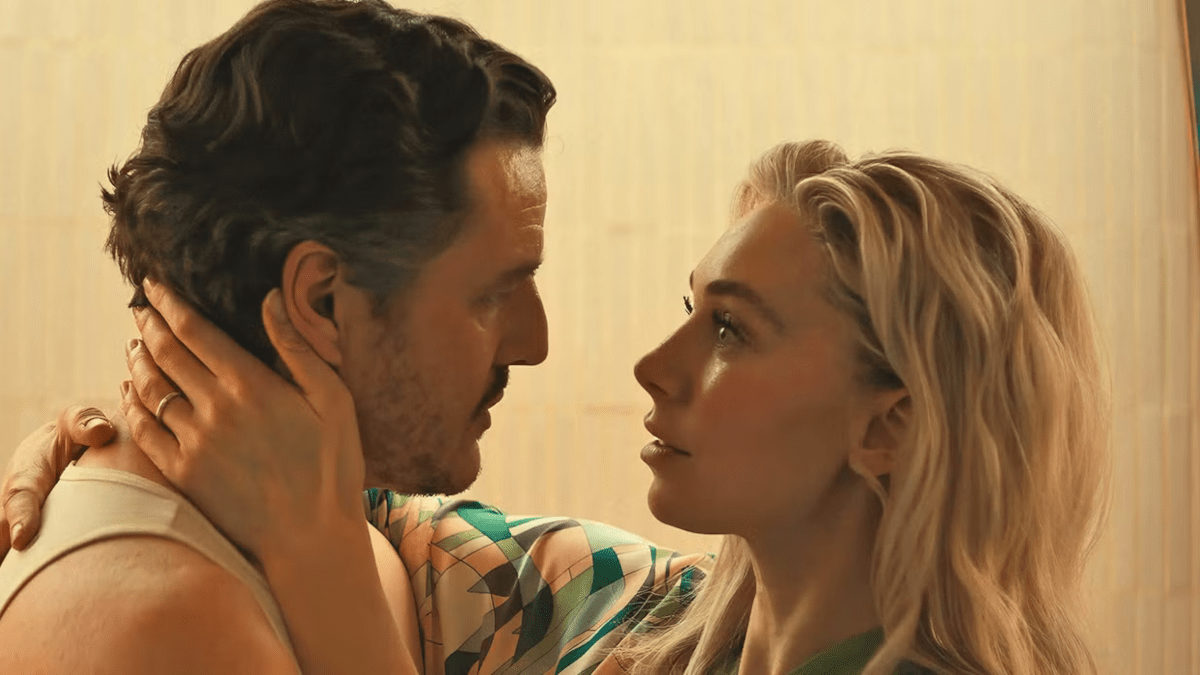
Fantastic Four: First Steps represents a clear break from the Marvel formula, in that it requires no knowledge of existing shows or movies. All of its characters are introduced as “fresh faces”, even though the team appeared in three Fox films prior to the Disney acquisition. You don’t need to bother with watching them before seeing this movie, because there’s not even a single Deadpool and Wolverine meta reference alluding to their existence. If Marvel had a sense of humor about themselves, they would have called the movie Fantastic Four: No Homework Required.
In a refreshing change of pace, Fantastic Four is very interested in us getting to know its superheroes before delivering the goods. The opening scene signals that the primary focus of this movie will be the importance of family, specifically motherhood. Husband Reed Richards (Pedro Pascal) searches for something in the bathroom while his wife Sue (Vanessa Kirby) awaits the results of a pregnancy test. (Yes, this is a Marvel movie.) After giving Reed the news, Sue insists that her new status won’t change anything. Sure. Every mother watching this movie knows how false that assumption will be. Fantastic Four: Baby Watch.
A television montage (on Disney property ABC) explains what’s transpired in the previous four years. Turns out that Reed, Sue, her brother Johnny (Joseph Quinn) and Reed’s best friend Ben Grimm (Ebon Moss-Bachrach) went into space, where their DNA was swizzled by cosmic rays. They returned as instant superheroes. Reed’s body can stretch any which way. Sue can become invisible and project force shields. Johnny can ignite flames over his body and fly. Ben received super strength, but unlike the others his skin was dramatically transformed into bricklike rubble. Strangely, they are never referred to by their comic book nicknames, Mr. Fantastic, The Invisible Girl, The Human Torch and The Thing. Fantastic Four: No Monikers.
The montage also acclimates us with Earth 828. (Our Earth is 616.) This Earth has the aesthetic of our Sixties, where the cars are long with fins, women wear pill hats and men go everywhere in suits and ties. Someone on the internet probably has already compiled a list of all of the brands in the movie, but Pan Am was a conspicuous one, a bit of science fiction trivia. This Earth also doubles as a hipster paradise, with analog technology like cathode ray television sets, newspapers, land lines, cassette tapes and vinyl records. Fantastic Four: Retro Chic.
Before the crisis hits, the foursome have a minor kerfuffle over dinner. The family swore to have dinner together, echoing the period’s traditional values. Ben figures out that Sue is pregnant, and everyone is overjoyed by the news. This is a big moment for the MCU, because she’ll become the first mother in the franchise. Even more importantly, her motherhood will be the focal point not just of her family, but the entire world. Fantastic Four: Family First.
After some light comedy involving the family robot Herbie child-proofing the family apartment, we get a window into Reed’s personality. His mind is ruled by science and equations, and he’s concerned about the DNA of Sue’s unborn child. As such, he’s created an ultrasound machine to get a look. Sue, the empathic one in the relationship, uses her powers to reveal her baby. It’s a quietly beautiful moment that Marvel should try to do more of going forward.
The serendipity of the Fantastic Four is shattered by the arrival of a celestial figure (Julia Garner) in the form of a nude woman with silvery skin, riding a surf board. She’s never called the Silver Surfer in the movie, but Johnny refers to her as the “naked space lady” at one point. (For my money she’s the most overtly sexualized character in the MCU by far.) She’s a herald for Galactus, the devourer. With understandable gravitas, she tells everyone that her boss is on his way to consume the Earth, that nothing can stop him and recommends that the citizens of Earth hold their loved ones close. When she flies away, Johnny pursues her beyond Earth’s atmosphere, where she knocks him off her board. Fantastic Four: Freaky Aliens.
A born problem solver, Reed tracks the energy signature of the Silver Surfer to five recently destroyed planets. Reed jump-starts the team’s return to space, where he hopes that they can convince Galactus to dine elsewhere, or punch him out. Reed tries to dissuade Sue from joining them because of her pregnancy, but she’s coming, no matter what. The scenes set in space feature impressive visual effects and will remind you of several classic science fiction films. Fantastic Four: An Interstellar Space Odyssey.
As befitting his name, Galactus (Ralph Ineson) is huge and travels in a planet-sized spaceship that is basically an enormous forge. The group’s tet-a-tet with him takes a dark turn, with Galactus offering to skip the Earth in exchange for Sue’s unborn child. (He has the “power cosmic”, which enables him to take Galactus’ place. Refer to the comics for more details.) That’s obviously a no-go, and the team narrowly escapes him and the Silver Surfer. Sue gives birth while in transit, and the team delivers a stunning admission of failure when they return home. Galactus is on his way, but if he thinks the Fantastic Four are going to give up baby Franklin without a fight, he’s as dumb as he is big. Fantastic Four: Fight the Devourer.
Recommendation
Fantastic Four: First Steps is a looking glass version of what we’ve seen in the previous thirty (forty?) MCU films. On the Earth that the FF call home, there’s no strife between regular, everyday humans and superheroes. There’s no animosity between the members of this team other than family bickering. Aside from Ben Grimm occasionally looking sad over his lot in life, everybody gets along swimmingly. (I kept wondering what Tony Stark would think of all this.)
Until the tense third act arrives, the movie’s expression of positivity and goodwill is constant. There’s nothing to be glum about when the Fantastic Four can seemingly do anything and always has everyone’s best interests at heart. This “can do” attitude is put to the test when Galactus shows up, but before then the Fantastic Four handle every adversary with ease. In a novel twist, the Earth-shattering event isn’t the alien who wants to eat their planet, but Sue’s pregnancy. That and the birth of her son are critical elements of the plot, which positions Sue as the fulcrum for everything revolves around, a notable shift from the typically male-centric storylines Marvel is known for.
On a technical level, the film’s production design and visual effects are excellent. Its retro-futuristic depiction of Earth (circa the early Sixties) is colorful, detailed and wonderfully tactile. Given how the FF have been defined by their space travels from their beginning, the off-world scenes had to be great. The sense of grandeur and spectacle the movie evokes reminded me of Star Trek, Interstellar and 2001: A Space Odyssey. This movie loves science fiction and does the genre proud.
Among the cast, Vanessa Kirby is the standout. In fairness to the rest, she gets the most to work with because her character is the center of the movie. As a woman balancing being a wife, mother and superhero, Kirby brings convincing warmth, sexiness and ferocity to her character. Ebon Moss-Bachrach is pitch-perfect as the resigned-yet-hopeful Ben Grimm. He makes the most of the few scenes that explore the melancholy of his character. Pedro Pascal struggles to find the right tone for Reed Richards, playing him either too light, too cerebral or too passive. I wouldn’t say Pascal is miscast, but his performance is underwhelming. Joseph Quinn is fine as Johnny Storm, but his performance needed more of the wild man electricity he brought Stranger Things. As the Silver Surfer, Julia Garner gives her fantasy object character a surprising amount of gravitas and pathos.
In charting a new way forward, Marvel shrewdly looks to the past with Fantastic Four: First Steps. The movie is a fun joy ride, with memorable characters, a wonderful production design and exciting action sequences. One of the best science fiction films in years. Recommended.
Analysis
Fantastic Four is so fundamentally different from the rest of the MCU, I have my doubts that it really was produced by Marvel. After having spent the past seventeen years watching nearly all of their films, this movie is the polar opposite of what I’m used to getting. The only other MCU movie that comes close to it is Eternals, which struggled valiantly to break away from the Marvel formula only to knuckle under in the end. Fantastic Four is the better film because instead of trying to bend the formula to its will, it does the exact opposite at every turn.
Tortured superheroes
Marvel is known for its tortured superheroes. Steve Rogers became Captain America to help defeat the Nazis, but he sacrificed his life in doing so. Peter Parker became Spider-Man, but lost his Uncle Ben. The X-Men are feared and hated by a world they have sworn to protect. Bruce Banner is almost invincible as the Hulk, but became an outcast. The list goes on and on.
The Fantastic Four are different in that they are adored by almost everyone on their Earth. The foursome’s superpowers don’t frighten anyone and they are encouraged to use them. While some of their acceptance can be attributed to the fact that Reed, Sue and Johnny appear normal when not doing heroic deeds, the same also applies to Ben Grimm. Despite being horribly disfigured, children greet him with cheers and ask him to pick up automobiles. The Fantastic Four are celebrities that are universally loved and appreciated.
Zero team infighting
As co-leads of The Avengers, Tony Stark and Steve Rogers frequently butted heads due to their different leadership styles. Tony was the unilateralist who had unwavering faith in his ability to make the right choices for others. Conversely, Steve was an institutionalist who trusted existing power structures (the US military, SHIELD) and the decision-making abilities of those in leadership positions. Despite their different philosophies, the two always came together for the greater good.
A similar situation exists with the X-Men, where Cyclops and Wolverine constantly irritated each other. This was true because of their mutual affection for Jean Gray, but their personalities clashed in team settings as well. Cyclops insisted on commanding the team as their field general, while Wolverine preferred to act independently.
Comparatively speaking, the Fantastic Four are a breath of fresh air. Aside from some light familial bickering, everyone gets along well. Reed’s leadership of the team is unquestioned and they work together to solve problems. The team trusts each other and respects each other. They’re the model superhero team because they are also a family.
People and superheroes, coming together
Although things started well enough for the Avengers in the first movie, their existence as an independent superhero team was met with pushback in subsequent films, as their actions resulted in tragic outcomes. In Avengers: Age of Ultron, Tony and Bruce’s dream of protecting the world lead to the complete destruction of the country of Sokovia. Next, Wanda Maximoff unintentionally killed the leader of Wakanda in Captain America: Civil War. These twin disasters lead to the Sokovia Accords, which required superheroes to operate under civilian authority or be declared outlaws.
In the X-Men films, Professor Xavier worked with members of congress and counseled the President against the Mutant Registration Act. Humanity feared being subplanted by mutants and insisted upon knowing who they were, what their powers were and so on. While presented under the guise of ensuring public safety for humans, it became a vehicle to discriminate and persecute mutants.
In The Fantastic Four, the team is universally revered as leaders of humanity. Sue Storm orchestrates world peace. Reed’s inventions improve the world for everyone. People regard the Fantastic Four as fundamentally good, morally upstanding people who always make the right decisions on behalf of everyone.
Some critics mention that the way the Fantastic Four are presented in this movie as unquestioned leaders of their Earth as advocating fascism. I wouldn’t go that far, but noted that none of the three branches of the US government were mentioned over the course of the movie. This could be due to the Fantastic Four’s Earth having a different system of government than our Earth, something the movie doesn’t take suitable time to explain.
Motherhood
Fantastic Four is the fourth Marvel movie with a leading female character. The first was Captain Marvel and was followed by Black Widow and Thunderbolts. Unlike those films, Fantastic Four doesn’t stop with making a woman the center of the superhero action. It’s the first Marvel movie to feature a fully-realized female character, one who juggles the responsibilities of being a wife, mother and superhero at the same time. (The parallels between the Helen Parr/Elastigirl character in The Incredibles and Sue Storm border on theft.)
Before the appearance of Sue Storm, the depiction of female characters in the MCU films left much to be desired. For the most part, those characters were potential love interests who fought other superheroes. The emotional journeys of Natasha Romanoff and Wanda Maximoff have been criticized by fans. Natasha agreed to be sterilized in order to become a Black Widow. Her lingering bitterness over her decision came out in Avengers: Age of Ultron, when she referred to herself as a monster. Her character arc culminated in her sacrifice in Avengers: Endgame, when she sacrificed herself because Clint Barton had a family to un-blip.
Wanda’s anger at having lost her soul mate Vision in Avengers: Infinity War led to her downfall. First she enslaves an entire town to live out her fantasy of being a mother, then kills a lot of people in pursuit of substitute children in an alternate universe. While Wanda’s pivot towards evil makes sense within the context of the television show and Doctor Strange: In the Multiverse of Madness, I understand why some were upset at how Marvel punishes her character.
Fantastic Four, on the other hand, embraces motherhood. Both times when Sue announces she’s pregnant are joyful occasions. When she gives birth to Franklin, it’s depicted as a triumph over adversity. Later, when the world turns against the Fantastic Four for not surrendering her son to Galactus, Sue defends her decision the same way as any mother would. For her, being a mother isn’t something Sue can put in a drawer and forget about. Franklin is Sue’s responsibility, and she would rather die fighting for him than make the expedient decision. Fantastic Four may be about a family of superheroes, but its focus on motherhood put it in a category by itself within the MCU.
A Möbius strip of inspiration
That The Incredibles was inspired by the Fantastic Four is obvious. Jack Parr is as strong as The Thing, Helen Parr is a gender-swapped Mr. Fantastic, and daughter Violet has the Invisible Girl’s powers. What’s bizarre is how much of The Incredibles inspired Fantastic Four: First Steps.
Both films share an early-Sixties aesthetic. Both films espouse traditional, conservative values. Both films feature female characters who epitomize the plight of working mothers. And both feature an underground villain who hates the world above ground. (Mole Man, meet the Underminer.)
Given that Pixar stole from Marvel, which in turn stole from Pixar, is corporate synergy at its strangest, a Möbius strip of inter-departmental creativity. Thankfully, both are owned by Disney, so the chances of a lawsuit are nil.
 Detroit Cineaste