
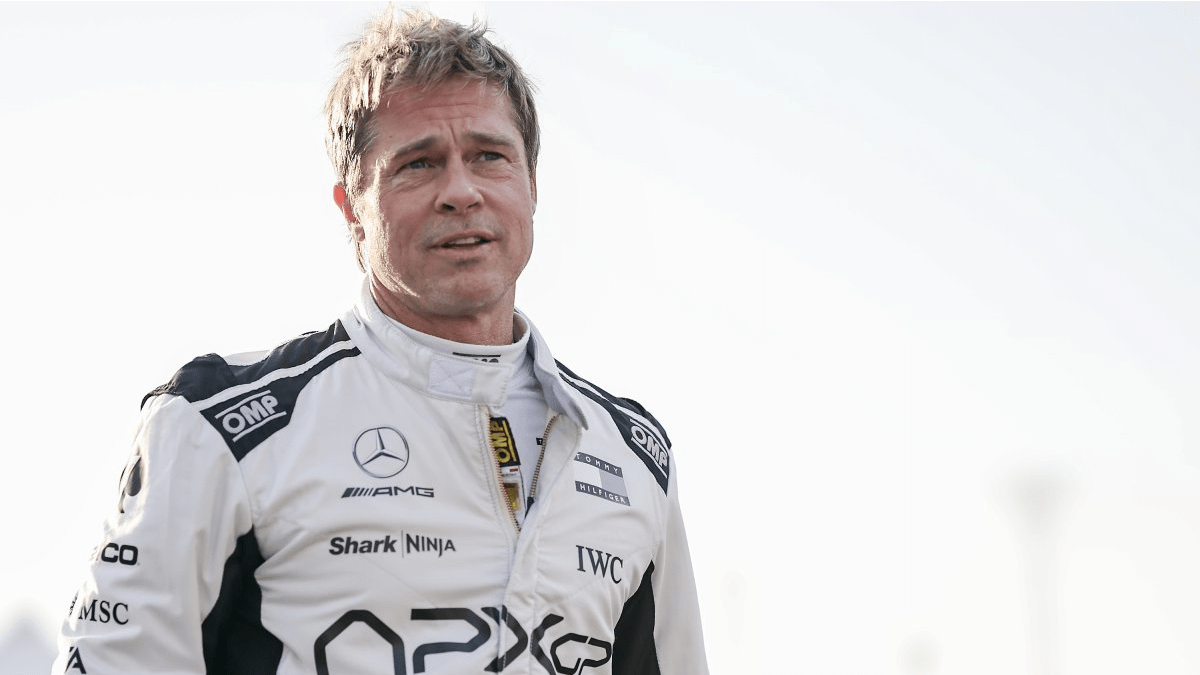
F1: The Movie would have been an entertaining movie regardless of who was cast in the leading role. It’s infinitely better with Brad Pitt in the driver’s seat, though. As one of the few remaining actors who is also a star, Pitt gives the movie its electricity. It also helps that he’s comfortable with putting his rugged good looks on display again. If Pitt had insisted upon obscuring his good looks with glasses, a beard and long, scraggly hair, few would want to see that movie. (If you got my reference to Pitt’s supporting turn in The Big Short, congratulations!)
Thankfully, Pitt is once again in handsome rebel mode in F1. As someone who’s seen his films starting in 1991, a movie with a handsome and cocky Pitt at its center tends to be a winning combination. Ocean’s Eleven (and its sequels, to a lesser extent) is propelled by his confident swagger. That’s what made the silly Grecian sword-and-sandals epic Troy worth watching, and won him an Academy Award for Once Upon a Time…in Hollywood. As is the case with Tom Cruise (Top Gun: Maverick and the Mission: Impossible franchise), audiences want to see stars being stars. Although F1’s racing scenes are exciting and worth the price of admission, Pitt’s star power makes the movie an event.
Before we get to the Formula 1 stuff, the movie begins with Sonny Hayes (Pitt) winning the 24 Hours of Daytona. On the podium, Pitt curiously refuses to touch the trophy. He then turns down an invitation from owner Chip Hart (Shea Whigham) to re-up for next season. The reason for both of Sonny’s actions is that he has other races ahead of him that he’s intent on winning.
While Sonny is at a laundromat, he studies an advertisement for a Baja driver. Would he really go from NASCAR to Baja? That decision is delayed when Rubén Cervantes (Javier Bardem) saunters through the door. Rubén and Sonny’s friendship began in the Nineties, when they raced for Lotus. Back then, Sonny was widely considered to be the next great driver. Unfortunately his risk-taking left him with serious physical injuries that derailed his career, and he spent the past several decades getting into and then out of trouble (bad marriages, gambling, etc.).
Rubén casually explains to Sonny that his APXGP F1 team is $350m in the hole, and he needs Sonny to help him win a race. Without a victory, the team will be sold and Rubén will be out of a job. Sonny laughs, because F1 racing almost got him killed some thirty years ago. Sonny initially turns Rubén down, but he reconsiders because all Sonny ever wanted was a second chance to win at the highest level and lose the “greatest driver who never was” moniker.
Being the experienced driver that he is, Sonny takes the car for a test drive and immediately identifies problems with the car’s design. Although technical director Kate (Kerry Condon) isn’t interested in Sonny’s opinion, team principle Kaspar (Kim Bodnia) recognizes Sonny’s talent and agrees to bring Sonny onto the team.
If you’re familiar with the “old veteran getting one last shot at glory” formula, F1 has another you’ll recognize. In addition to advising the team, Rubén wants Sonny to mentor Joshua (Damson Idris), a talented young driver who’s brash and self-centered. Naturally, Joshua resents having a mentor forced upon him and insults Sonny during their initial press conference. The young pup sniping at the old dog? That’s a basic requirement in films like this.
After an initial racing skirmish between Sonny and Joshua leads to both getting a Did Not Finish, Sonny helps Joshua win the next race by pushing the boundaries of the F1 rules (a.k.a. cheating). Now that Sonny has proven that he’s a team player, Kate agrees to modify the car for “combat”. That adjustment and Sonny’s risk-taking gets Joshua in a position to win their next race, but he ignores Sonny’s critical instructions and crashes.
While Joshua is sidelined by injuries, Sonny leads APXGP to top ten finishes in the next three races. This fuels Joshua’s resentment and he forces Sonny to crash during his first race back. Sonny confronts Joshua over his selfish behavior, reminding him that it threatens everyone’s job, especially Rubén’s. You know, the Big Guy who’s paying them to not crash and win races.
The remainder F1 features our two alpha males bonding over poker, an expected hookup, evidence of personal growth, disastrous angry driving and corporate sabotage. Everything comes down to either Sonny or Joshua winning the last race in Abu Dhabi to save APXGP, which is exactly how it should be.
Recommendation
F1: The Movie delivers exactly what I want from a blockbuster, and does it so well that it makes me wonder why Hollywood doesn’t release movies like this on the regular. Of course, making the perfect summer blockbuster is harder than it looks. F1 certainly has all of the ingredients necessary for an entertaining blockbuster, with a star in the leading role (Brad Pitt), a supporting cast of recognizable faces (Javier Bardem, Kerry Condon, Tobias Menzes and Sarah Niles), an exceptional action movie director in Joseph Kosinski (Top Gun: Maverick), composer Hans Zimmer (Gladiator, Dune, Inception), world-class cinematography (Claudio Miranda) and editing (Stephen Mirrione, Patrick J. Smith).
However, making the perfect blockbuster is about more than assembling the best talent and spending hundreds of millions of dollars. The movie also has to be fun and exciting, which F1 certainly is. The racing scenes, filmed inside and outside the vehicles, are riveting. Similar to Ford v. Ferrari, F1 condenses the action and makes it intimate, so that we feel what it’s like to be behind the wheel and on the track. As a purely sensual experience, F1 is unparalleled.
Aside from its sights and sounds, what makes F1 go is how expertly it uses all of the storytelling formulas that make up the story. If I were being sarcastic I would say that the movie should have been named F3 or maybe F5. Regardless, this turns out to be one of the movie’s strengths. Formulas make it very easy to get into an original movie like this. Before Hollywood started devoting most of its energies towards churning out sequels, formulas were one of the things that attracted audiences to movies. The plot of F1 will instantly make sense to frequent and casual moviegoers alike.
A reliance on formulas does make the movie predictable, but no more so than recent movies about automotive racing (F versus F, Cars) or even movies about other sports (Major League, Tin Cup, The Wrestler, The Karate Kid, etc.) Within minutes I had a good idea how every character arc would turn out, as well as how the movie would probably end. However, F1 works because of its underlying sincerity. It genuinely respects and cares about its characters, and I felt the same way.
A big reason why F1 works is that it has Brad Pitt in the driver’s seat. The role of Sonny Hayes is a perfect match for his combination of handsomeness, cockiness and recklessness. That the character’s name references both Pitt’s blonde hair and good old boy persona leads me to believe the part was written with him in mind. Pitt is the rare actor that feels dangerous despite being so good looking. At 61, the wrinkles have set in but they’ve made him look interesting, like Harrison Ford or Sean Connery. When Pitt smiles his winning smile in this movie, it evokes those things that you only get when you’re older, namely experience, wisdom, regrets and disappointment. Pitt’s performance may begin with his star power, but it’s fueled by the vulnerability and sadness that underpins it in every scene.
Sometimes, lightning strikes twice. In 2022, director Joseph Kosinski’s Top Gun: Maverick, was the perfect summer blockbuster. Although his F1: The Movie, won’t be as huge at the box office as his previous film, it deserves the same title. Kosinski has become his generation’s version of Tony Scott, a director who understands how to deliver exciting, big-canvas entertainment that everyone can enjoy. Just like his TGM could have been mistaken for a film from the Nineties, so too could F1. If his next film is as good as TGM and F1, he should be considered as the King of the Summer Blockbusters.
F1: The Movie is the kind of blockbuster Hollywood used to make: bold, flashy, loud and incredibly fun. Although the story is formulaic, everyone from leading man Brad Pitt on down is totally sincere in what matters most, which is entertaining us. F1 is easily one of the best made action movies of recent years, the definition of big screen entertainment in every sense of the word. Highly recommended.
Analysis
There’s irony in how formulaic F1: The Movie is. Although the movie is technically an original story, it’s constructed with plotlines that have been used and reused for a long time. Of the sports movies I listed above, The Karate Kid is the oldest, having come out in 1982. But F1 reminds me of films besides those about athletes and sports, like The Right Stuff, a movie about the Apollo astronauts and Chuck Yeager (Sam Shepard). It also bears a strong resemblance to The Color of Money, where “Fast” Eddie Felson (Paul Newman) teaches Vince (Tom Cruise) the ropes about being a professional pool hustler. That all three films use the same formulas isn’t a coincidence.
Formulas play a significant role in why all of those films and others attract moviegoers. We recognize the characters and have an inkling as to how the story will turn out. Aside from a level of predictability, the use of familiar character archetypes and plotlines isn’t a problem with F1 but a feature. While I appreciate an original story as much as anyone, a familiar story can be just as much fun, provided that it’s done the right way.
Sonny Hayes, the aging former star
This is the main formula (or plot) of the movie. The others I describe below are encompassed by it and complement it. Sonny’s character arc is no different from Chuck Yeager or Fast Eddie. They’re all past their prime but still trying to achieve the glory that eluded them when they were younger. We pull for Sonny to win for the same reason we want Yeager to break Mach 3 or Eddie to win the big tournament. We want to believe that life will offer us one more chance at greatness, another shot at redemption, and that we’ll emerge triumphant. Like Sonny, we refuse to believe that our lives are over when we hit middle age, that great things await us and that we’ll be ready when the opportunity presents itself.
F1 makes it easy to root for Sonny. He’s a good yet flawed human being, something most of us can relate to. He’s made mistakes, but the wounds appear to be self-inflicted. Since the movie doesn’t provide us with any details behind his failed marriages, we assume they ended amicably. Sonny wouldn’t be the first person to lose money gambling, either. He doesn’t hide from his past, but he doesn’t dwell on it either. When the cheeky reporter confronts him about his sketchy past, he admits to every sin but refuses to go into details. He’s not looking for sympathy, only the chance to win.
When the movie shows Sonny struggling with his aging body after a race, I could relate. A decade ago, I could drive non-stop for over an hour and jump out of my car. Now I feel like Sonny, where I’d rather stay where I’m at than slowly ease myself out. Although he exercises regularly and is in terrific shape, he can’t undo the damage from his youth, as well as father time. I want Sonny to be victorious because he’s paid for his indiscretions and time is running out for him to do something special with the talent he has.
Joshua Pearce, the young hotshot
If a movie has an aging veteran character, you can be sure there’s an impatient young buck for him to teach the ropes. Joshua has talent, but believes he’s the straw that stirs the drink. He treats his team disrespectfully and looks ahead to when he’ll be free to join a winning program. While he’s undeniably arrogant, he’s a good person. He loves and respects his mother and has a strong relationship with his promoter cousin.
Joshua is like Sonny when he was a brash young man, in that he has the wrong priorities because he hasn’t faced any actual adversity. He believes that making money and growing his fan base are more important than racing. It isn’t until he crashes and his car bursts into flames that he understands how quickly everything can be taken away from him.
The way Joshua behaves towards Sonny is regrettable but also very familiar. The young buck acting like they know everything, shrugging off the advice of a past-their-prime mentor is a staple of movies. “What can this old dude teach me? I’m already awesome! I don’t need anyone to teach me anything.” When Joshua dissed Sonny during their initial press conference, I knew that Joshua had a lot to learn. I also knew he would eventually succeed because as Mr. Miyagi once quoted, “When the student is ready, the teacher will appear.”
Learning the ropes
Nearly every sport is a team undertaking. It’s the team that wins or loses, not one person. This is the main lesson Sonny imparts to Joshua. Although Joshua is the one behind the wheel, his success depends upon the team doing everything it can to help him win. When Joshua criticizes pit crew member Jodie for a costly mistake, Sonny quickly comes to her defense. He knows that the pit crew’s performance is vital for the team’s overall success, and that being supportive will help to improve their lack of confidence.
Another teachable moment is when Joshua returns and intentionally takes out Sonny’s car. Joshua resents Sonny’s success while he’s been recovering from his injuries and wants to win the race all by himself. After the race, Sonny physically confronts Joshua and reminds him that if he hadn’t finished the race, that outcome would have been a disaster for the entire team. Additionally, making Sonny crash also costs Ruben money. Sonny puts Joshua on notice, telling him that he’ll do whatever is necessary to protect his friend Ruben and the rest of the team from any further selfish behavior. Joshua may have finished the race, but his actions put the team’s season and future at risk. While Joshua is out, Sonny endeared himself to the team because he’s a team player, not a glory hog.
The team that can’t get its act together
In addition to mentoring Joshua, Sonny’s other role is to help Team APXGP perform to the best of their ability. When he arrives, team APXGP is dysfunctional and the car is described as a bucket of bolts (or something to that effect). In order for APXGP to win a race before the season is over, every aspect of the team must improve, including the car’s design. Ruben specifically recruited Sonny because he knew Sonny would introduce a spirit of collaboration and provide much-needed leadership.
Sonny’s years of racing experience enable him to do what Joshua couldn’t, which is work directly with all areas of the team and offer suggestions for improvement. He’s supportive of Jodie and the rest of the pit crew, because he knows how important it is to get out of the box quickly. Sonny encourages crew chief Fazio to let him bend the rules and embrace risk-taking. He works with technical director Kate to reengineer the car for combat. When it comes to winning by a second or a fraction of a second, every little thing matters, even using the right tires.
One of the best moments in F1 is during the first pre-race meeting after Joshua’s accident. Sonny tells everyone that if everyone executes their role perfectly, they can each shave half a second off of his drive time. And if they do that, they–not Sonny–can win the race. While everything Sonny has done up to that moment has been to help the team win, his motivational speech epitomizes everything he’s done to help a losing team become winners.
The big-hearted boss and the duplicitous corporate henchman
Whenever Brad Pitt and Javier Bardem appear in a scene together, talking like old friends and flashing their broad smiles, it’s movie magic. Even though both of them are basically playing themselves in F1, there’s something about seeing two veteran actors having a good time on screen. Their camaraderie is instantly contagious, and we want to see them come out on top because they are so likable.
Casting Bardem as the owner of APXGP was brilliant, because Bardem can play the big-hearted, gregarious type with ease. Don’t believe me? Watch him dance and sing in Lyle, Lyle Crocodile. Although he’s best known for playing villains in Skyfall and No Country for Old Men, Bardem has made a career out of playing characters who are full of life, a bit mad and driven by romantic notions. He’s the kind of guy you would expect to greet you with a bear hug and promptly recruit you to join the revolution.
Because Ruben is a former driver, we believe him when he says that Sonny can help the team. Ruben doesn’t recruit Sonny for sentimental reasons, but because Sonny’s experience and competitive spirit can unite the team. All of the right pieces are in place, but the team can’t get out of its own way. Ruben recruits Sonny because he wants to win above all else, despite the odds stacked against him and his team. Ruben is in it for the glory, not the money.
His opposition is board member Peter Banning (Tobias Menzies), a duplicitous, back-stabbing, mealy-mouthed corporate worm. We want to see Ruben win because it would put an end to Peter’s plans to buy the team on the cheap. If you didn’t want to see Ruben celebrating his team’s improbable victory in the end, you have no soul.
The outsider who must prove themselves
The formula behind technical director Kate is another familiar one. She’s the outsider who gave up a safe career for a riskier one with a chance for glory. Although Kate is brilliant, she’s regarded as inferior because a) she’s a woman in a predominantly male field, and b) she hasn’t won anything. Accordingly, she’ll only earn the respect of others when her car wins. Of all the principles in the movie, she has the most to lose if APXGP is disbanded.
I give F1 a lot of credit for taking what could have been a minor character and making Kate a fully-realized character, with personality and dreams of her own. Even though I knew from the moment Sonny and Kate first met that the two would end up in bed together, the movie handles their relationship with maturity. They’re adults who hook up while in Las Vegas, with the mutual understanding that they still have jobs to do and won’t walk off into the sunset together. Sonny and Kate enjoy each other’s company and move on like adults, with no emotional strings attached.
The young hotshot finally learns what’s important
From the moment we are introduced to Joshua, it’s obvious that all he cares about is himself and winning. In movies like F1, the young hotshot must come to appreciate one of the oldest cliches in sports: it’s not whether you win or lose, but how you play the game. Like many young studs before him, Joshua realizes that being a good teammate is ultimately what wins races and earns the respect of others.
I admit that I didn’t know who would win the big race and was genuinely surprised that the movie took inspiration from Cars. In hindsight, Joshua’s self-sacrifice made perfect sense, because it meant that he finally accepted everything Sonny was trying to teach him. Respect the team. Be open when others are trying to teach you. Always put the team first. Winning isn’t everything. Do the right thing, always. Never do anything for the money. I can’t argue with any of the wisdom imparted by F1 because I’ve heard it many times throughout my life.
As I mentioned above, F1 is formulaic, but that doesn’t matter because it sincerely believes in all of the formulas it uses. It views its characters and the formulas that they operate within as intrinsically valuable and fundamentally relatable. To dismiss F1 because it is formulaic is anti-cinema, because it denies what movies have been about from the beginning: stories about familiar characters learning how to overcome the obstacles that stand between themselves and achievement. Whether these stories involve a game of pool, a Formula 1 race or breaking the sound barrier, these stories are what we go to the movies to see, and will continue to do so, provided they’re as well-made as F1.
No stock character
F1 could have simply presented Sonny as an old guy with a tortured past and proceeded with the racing scenes and surrounding drama. However, the movie gives Sonny little personality quirks that combine to make him an interesting character to observe. Like most athletes, he has his superstitions and routines. Sonny refuses to touch trophies. He never states why, but I assumed it was because doing so would jinx him from winning his next race. Before every race, Sonny takes a random card from his deck and pockets it without looking at it and places his watch next to a picture of his father. He’s old school when it comes to exercise and never uses machines while working out. After a race, his aching back forces him to lie down. He hones his reflexes by throwing tennis balls against a wall. Sonny takes a page out of Gladiator and picks up stones on the track to get a feel for it. And in a nod to Ocean’s Eleven, Sonny’s van has a Little Trees air freshener. All of these little details combine to make Sonny fascinating to watch.
One last thing: F1‘s de-aging of Brad Pitt is the best use of that technology in a movie to date.
 Detroit Cineaste
Your review was excellent hunny. Nice job. Loved how you tied it all up in the end. In three words I can sum up everything I’ve learned about life: it goes on. Robert Frost.
LikeLike