
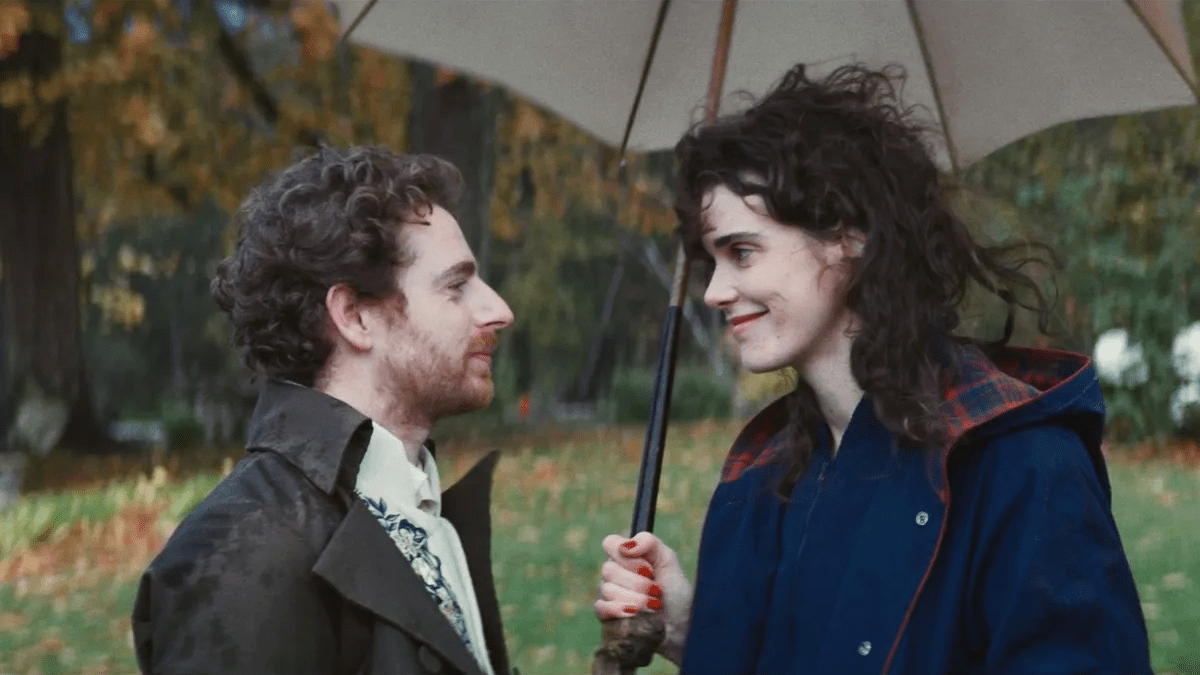
In Jane Austen Wrecked My Life, a thoroughly charming romantic comedy in French and English, we’re shown how problematic it can be to expect life to unfold like a plot in one of Ms. Austen’s works. Agathe (Camille Rutherford), the tortured writer at the center of the film, has been waiting for an unexpected turn of events that will propel her past her insecurities and doubts. Life, however, refuses to cooperate and Agathe drifts along without purpose. Fortunately, her loved ones take the initiative to force her out of her self-induced inertia, which sets Agathe on a journey remarkably similar to one of Austen’s heroines.
Initially, it isn’t clear how Agathe’s life has been “wrecked” by her favorite author. When we observe her dancing around the bookstore where she works, she seems happy. We soon learn that Agathe is only comfortable when she’s alone or with her very small circle of friends and family. Unlike her sister Mona (Alice Butaud), who manages to have an active sex life despite being a single mother, Agathe has no interest in dating. Her only close friend is her coworker Félix (Pablo Pauly), whom she’s known for ten years and looks upon as a brother.
One day, when dining alone at a Chinese restaurant, Agathe has a romantic daydream and is inspired to write the first two chapters of a novel. Even though Félix says what she’s written so far is terrific, Agathe hesitates to take it further. Recognizing that his friend needs a “kick in the butt”, Félix submits her work to the Jane Austen Residency. When Agathe receives a letter of acceptance into the two-week program, she initially refuses to go out of fear. She changes her mind that night when Mona gives her a direct pep talk.
Getting to the residency presents a familiar challenge to Agathe, because it requires her to travel by car. (She’s cycled everywhere after a tragic car accident six years ago.) Félix drives her to the Channel ferry, where he offers words of encouragement and, to Agathe’s surprise, a romantic kiss. Could love finally be blossoming ten years into their friendship?
When the Ferry arrives at the England shoreline, Agathe is greeted by Oliver (Charlie Anson), a distant relative of Jane Austen’s. As required by law for all rom-coms, the two have an unbelievably awkward meet-cute that confirms that these two will somehow wind up together. Oliver’s car breaks down on the way, and more sparks fly. Oliver opines that Jane Austen is overrated. Agathe is quick to defend her favorite author with a succinct and well-reasoned rebuttal. Agathe insults him in French while talking to Mona on the phone, and Oliver reveals that he can speak the language fluently. After sleeping overnight in the car, an apple farmer’s truck takes them the rest of the way.
The Jane Austin Residency provides aspiring authors like Agathe the two weeks of room and board, hopefully inspiring them to write their masterpieces. Unfortunately, Agathe suffers from writer’s block and is intimidated by her fellow authors, who can conjure sentences out of thin air. When not staring at her blank laptop screen, we are given proof of Agathe’s clumsiness. She falls down while exploring the grounds, gets attacked by lambs and accidentally walks into Oliver’s room disrobed.
There’s nothing as effective as a little surprise nudity to create sexual tension, and despite their icy exchange afterwards, their growing attraction is undeniable. When the two meet at a bookshop in town and exchange painful anecdotes of how messed up their lives have been, it’s obvious that they’re meant to be together. However, there’s the matter of the unanswered racy text message Agathe sent to Félix when she arrived, as well as a garbled follow-up phone conversation that left things unresolved. Until events take a turn befitting a movie named after Jane Austen.
After taking some time to process the newfound nature of their relationship, Felix decides to surprise Agathe by seeing her on the eve of the annual Jane Austen themed ball. Given that the movie is about a woman who idolizes Jane Austen, it makes perfect sense for her to experience the fantasy of being courted in wearing period-appropriate dress and engaging in English country dances. However, the sparks that fly during the event (and afterwards) only make Agathe’s decision more difficult. Will she choose the comforting familiarity of Felix, or the intellectually stimulating Oliver? And what of Agathe’s novel? The movie answers both questions in ways that would make Austen proud.
Recommendation
When the title of a movie includes the name of a famous author, that movie better be special. That’s precisely what writer-director Laura Piani has done with Jane Austen Wrecked My Life, a modern take on Austen’s themes that is very funny and thoroughly charming. In many ways, Piani’s film parallels another modern interpretation of Austen’s Pride and Prejudice, Bridget Jones’ Diary. Like Bridget, Agathe is insecure, dreams of a fulfilling career and finding true love, and ultimately must choose between two attractive suitors. The difference with Piani’s film is that Agathe’s insecurities are rooted in tragedy.
Even so, the movie is witty and bawdy, with moments as hilarious as anything in Bridget Jones. The difference between these films is that the humor in Jane Austen arises from realistic situations and behaviors, and not sitcom setups. And when the movie does indulge in a flight of fantasy, I was fine with it because the movie had earned my trust.
Camille Rutherford is captivating as Agathe, delivering a rich performance that effortlessly pivots between her raunchy, sarcastic exterior and her pensive interior. Rutherford’s wonderfully expressive face communicates Agathe’s feelings at every turn, offering revealing glimpses of Agathe’s longing, sadness and self-doubt that churn below the surface.
Pablo Pauly and Charlie Anson are equally endearing as Agathe’s competing love interests Félix and Oliver, respectively. Although both are funny playing according to type, they also imbue their characters with refreshing levels of maturity and empathy. Alan Fairbairn and Liz Crowther steal every scene they are in as retreat proprietors Todd and Beth, who provide Agathe with insight–or a laugh–whenever she needs it.
My only complaint is that the movie should have been longer. I would have appreciated a flashback or two of Agathe’s parents, whose absence weighs heavily on Agathe. And while I loved how passionately and eloquently Agathe speaks about literature and writing, the movie never provides the same opportunity for her fellow writers. Although we see them in fits of creativity, a scene where they casually discuss what inspires them would have been appropriate.
What elevates Jane Austen Wrecked My Life above the typical romantic comedy is its approach. The film unfolds at a leisurely (European) pace, which allows its richly drawn characters, keen observations, sharp dialog and earthy humor to win us over. It’s an unassuming little gem that respects its characters and the audience’s intelligence in equal measure. Highly Recommended.
Analysis
Following are several observations I had while marveling at Jane Austen Wrecked My Life.
Dueling suitors
A well-worn trope of romantic comedies is that one of the men seeking the heroine’s affection is eventually revealed to be a cad. That moment turns what had been a perplexing choice into an obvious one, which is to be with the nice guy. Thankfully, Jane Austen doesn’t opt for the easy route. Instead, the movie positions both Félix and Oliver as mature, sensible men who bring different things to a relationship. Each has their plusses and minuses, with neither having clear advantages over the other.
Agathe has known Félix for ten years. She works with him and hangs out with him afterwards. He even sleeps over at Agathe’s house, presumably when the evening gets late. Agathe is very familiar with Félix, and their relationship is so close that one could mistake them for siblings. Like Agathe, Félix is well-versed in literature and talks knowledgeably on the topic. He cares about Agathe and is very complementary and supportive of her writing. He’s a good friend who always treats Agathe respectfully.
Oliver is the new man in Agathe’s life. Unlike Félix he is English but he speaks fluent French. As a professor of literature, he is an expert in her field of interest. Although he is arrogant at first, Oliver becomes intrigued by Agathe when they discuss Jane Austen, her favorite author. He proceeds to treat her politely and respectfully. He declines her sexual invitations when she is drunk and retreats after Félix arrives. He’s a gentleman who would prefer that Agathe choose him for the right reasons.
When Agathe initially settles upon Félix, it’s due to her overriding familiarity with him. Félix is a nice guy who she could be happy with, but their interactions lack the spark that Jane Austen describes in her novels. It also turns out that they are incompatible sexually, with her introducing a dash of kink that Félix is uncomfortable with. As a result, Agathe ends their romantic pairing as quickly as it began. The last thing she wants is a relationship where they would be friends who occasionally participate in a mutually boring sex life.
Thankfully, Oliver isn’t chivalrous to the point of being passive. When he makes a grand gesture to win Agathe’s heart in the end, she accepts because Jane Austen has said time and again that a relationship must be kindled with passion in order for it to succeed. While Agathe and Oliver definitely feel passionately for each other, the movie concludes without telling us whether they share similar tastes in bed.
About that dance
In the third act, the proprietors of the Jane Austen Residency hold a ball in their namesake’s honor. Agathe and her fellow writers participate dressed in era-appropriate clothing. This fits perfectly within the context of the story, which to that point had been firmly grounded in reality. A costumed ball gives everyone involved, as well as people from the town nearby, a chance to celebrate the conclusion of another program.
The event quickly turns into fantasy when Agathe, Félix and Oliver demonstrate that they are fluent in English country dancing (or Regency dancing). It seems unlikely that the three would have learned this outdated form of dancing in school. The movie also doesn’t establish that the residency was giving the participants lessons before the ball. Even if they had, it is also unlikely that they would become proficient in less than two weeks.
For those who are familiar with Austen’s works, a dance like the one in the movie serves a critical purpose. It establishes whether or not the heroine and either of her suitors are compatible and, even more importantly, share a spark.
While Félix proves to be an adequate dance partner, he’s primarily amused by the experience. When Oliver dances with Agathe, the passion they express towards each other through their glances and touches is undeniable. Which is why I was surprised by Agathe’s decision to settle for Félix.
As I discussed above, Agathe’s choice between Félix and Oliver isn’t a simple one. Even though she recognizes her feelings for Oliver, choosing him represents risk. Ever since Agathe’s parents died in a car crash, she’s been retreating from the world around her. Agathe prefers the comfort of her sister and Félix over taking chances that could be mentally damaging.
When Agathe decides to consummate her relationship with Félix, she’s making a choice that goes against what her favorite author advocates in her novels, which is choosing love over expediency. Even though Agathe wants to be in a relationship like those in Austen’s novels, she rejects the opportunity when it finally arrives.
Even though the nature of the dance itself is far-fetched, the movie earns the right to indulge in this moment of fantasy because it unites all of its themes so poetically.
What’s in a joke?
I mentioned above how Jane Austen and the Bridget Jones films cover the same ground, but do so with a completely different sense of humor. Where the former makes us laugh with situations that are grounded, the other delivers broad-based jokes that are more in line with sitcoms.
For purposes of this discussion, I’ll compare similar jokes between Jane Austen and Bridget Jones: Mad About the Boy. To be clear, these comparisons only serve to illustrate my point, not to be mean towards the Bridget Jones film, which I enjoyed.
Fun with technology
In Mad About the Boy, Bridget is perplexed over how to respond to Roxster’s suggestive emojis and responds with an incongruous combination of her own. The joke being that Bridget, who certainly is savvy with texting, knows nothing about sexually suggestive emojis.
In Jane Austen, Agathe types out a suggestive text and accidentally sends it when she intended to revise it to be less overt. It’s relatable because it realistically could happen to anyone.
The awkward meet-cute
In Mad About the Boy, Bridget meets Roxster after she has unwisely climbed into a tree to rescue her children. The joke is that she’s not graceful and winds up helpless with her backside jutting out at an unflattering angle.
In Jane Austen, Agathe throws up on Oliver’s shoes when she’s confronted with driving in his tiny sports car. The movie had previously established her fear of driving, so this is understandable.
Clumsiness in nature
In Mad About the Boy, Bridget falls down almost immediately during the outward bound school trip, missing a step while prattling on to Mr. Walliker.
In Jane Austen, Agathe falls down when she attempts to twirl in the forest, something she’s probably seen Victorian ladies do in movies and television shows. Fortunately, Agathe’s alone while this happens.
Sex jokes
In Mad About the Boy, Roxster finds Mabel’s doll in bed and states, “But I used protection!”
In Jane Austen, when Agathe and Félix are having sex, she remarks that the walls of the building are very thick. She’s telling him without explicitly telling him that their lovemaking is boring.
Again, I liked Mad About the Boy for what it is, a very broad comedy with obvious jokes. The humor within Jane Austen is much more clever because it is derived organically within the context of the material.
On Rutherford
If Camille Rutherford had been born a few centuries earlier, her beguiling appearance certainly would have been immortalized in an impressionist painting.

For example, she would have been an ideal subject for John Singer Sargent:
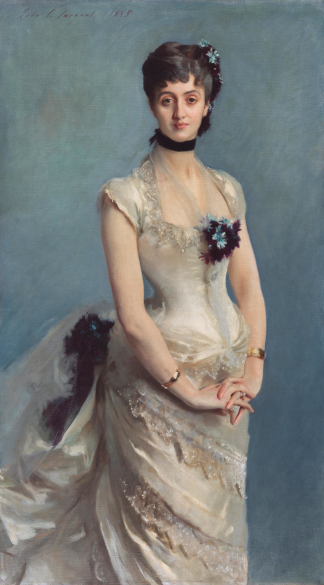
Madame Paul Poirson, 1885
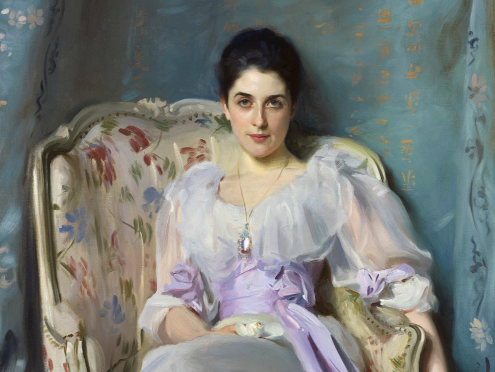
Lady Agnew of Lochnaw, 1892
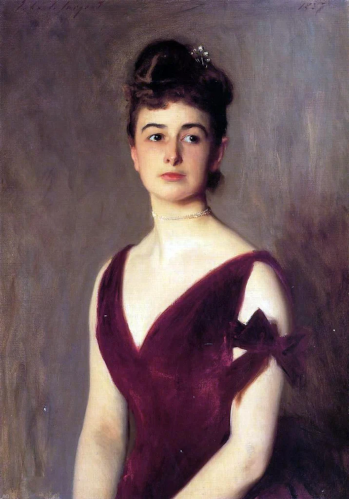
Mrs. Charles E. Inches (Louise Pomeroy), 1887

Elizabeth Winthrop Chanler (Mrs. John Jay Chapman), 1893
 Detroit Cineaste
One thought on “Jane Austen Wrecked My Life”