
For a movie that recalls suspense thrillers of yesteryear, it’s fitting that Drop begins with an eye-catching opening title credit sequence. In it, a series of items slowly rotate against a black background, with the breakable ones shattering. This sequence, a pun on the movie’s title, also hints at what’s in store for us. (There’s a reason for the inclusion of a spinning chess piece and dice.) It’s a nice touch, but unfortunately what follows never tops it.
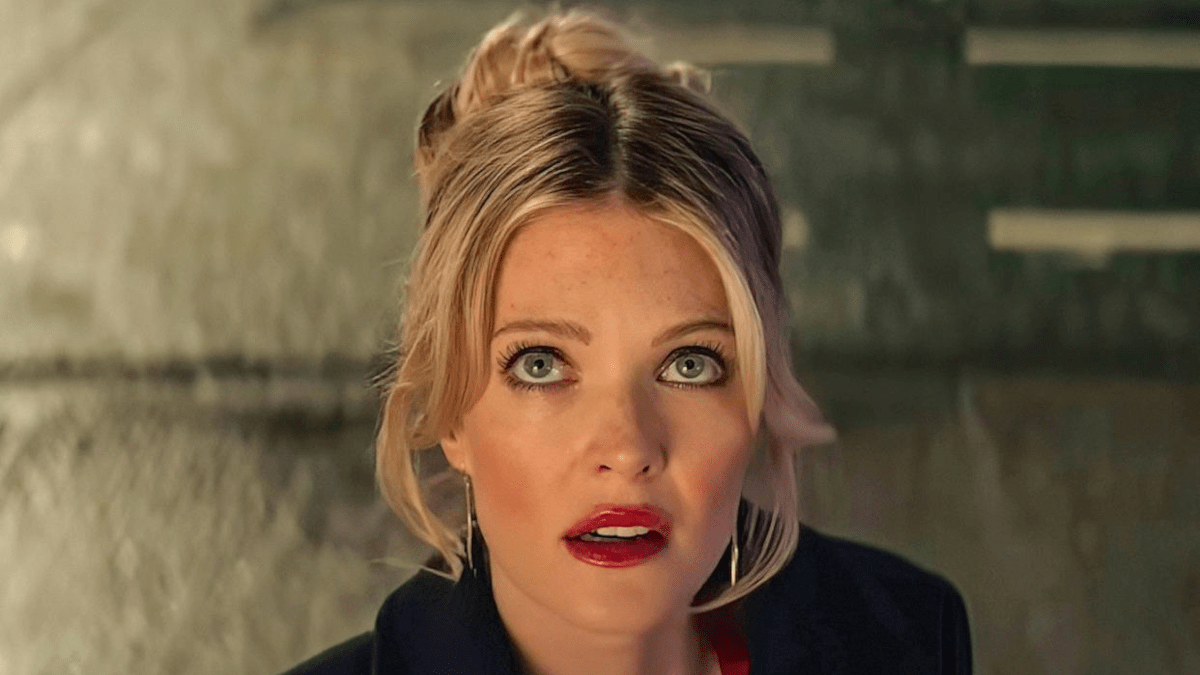
The movie opens with a very dark scene, involving a violent confrontation between a bloodied and dazed Violet (Meghann Fahy) and her agitated husband Blake. Why he’s angry with her is never explained, but he threatens to shoot her while their young son cries in the background. The movie curiously returns to this episode again in an attempt to create mystery as to how things turned out, but it doesn’t work.
Some time later, we see Violet talking to an abused woman on her laptop. Violet’s troubled past inspired her to become a therapist, and she treats her patients via web conference. Violet’s son Toby (Jacob Robinson) is still alive, which is a relief. He’s grown into a cute, bespectacled kid who she dotes over. Her sister Jen (Violett Beane) pops over to watch Toby while Violet heads out for a first date. As is often the case in movies with supporting female characters, Jen is Violet’s exact opposite. Jen is a gregarious, tattooed bohemian in a rainbow-colored yarn jacket and denim overalls. She insists that Violet wear an outfit with a plunging neckline, because Violet won’t get past that ugly episode with her ex until she gets laid. This advice is a bit glib advice after what we just saw. (Also, as was the case with Bridget Jones: Mad About the Boy, this is the second movie I’ve seen this year where one woman tells another woman that getting laid will solve her problems.)
Violet’s romantic destination is a restaurant named Palate, located in downtown Chicago at the top of a shimmering building. The place is a bit extravagant for a first date, but Violet is fine with it. Her date Henry (Brandon Sklenar) texts that he’s running late, so she waits at the bar. There, she meets fellow first date adventurer Richard (Reed Diamond) and offers him some encouragement. (This rang true because therapists like Violet are comfortable helping complete strangers.)
Henry arrives soon after and the two get a table with a view of the city skyline. He’s ruggedly handsome, friendly and unassuming, all signs that point to Violet hitting the dating app jackpot. That is, until someone keeps sending her memes insisting she accept his airdrop app invitations. Violet keeps hitting decline, and the person on the other side grows increasingly testy. Fun fact: airdrop only works within a fifty feet radius. Henry knows this and searches the restaurant to find the person on the other side, to no avail. Unfortunately, Violet accidentally accepts an invite, and her evening immediately takes a sharp turn for the worst.
The airdrop pest tells Violet to check her home security cameras. When she spots a masked intruder with a gun, the person on the other end tells Violent that if she tells anyone what’s going on, her son and sister will die. While this effectively creepy setup begs for insight about how omnipresent technology has rendered Violet completely helpless, or that her security-laden home has made her and her family less safe, the movie politely declines.
The texter tells Violent that to save her family, she has to do what he says. First, she has to take the memory card out of Henry’s camera and smash it. Easy enough. The second order is a bit more challenging: she must kill Henry. Either she poisons Henry’s drink (with a vial conveniently left for her in the Ladies Room) or her family dies. The texter wants Henry dead because he’s a photographer and has taken incriminating photos that implicate the mayor in an embezzlement scheme. Given Chicago’s colorful political history, this made me chuckle. Haven’t Chicagoans come to expect a certain level of self-dealing from their elected representatives these days?
For a while, the movie has fun with Violet desperately trying to figure out who has airdropped her into a corner. Is it wacky waiter Matt (Jeffery Self)? The circumspect hostess (Sarah McCormack)? The kindly bartender Cara (Gabrielle Ryan)? Piano-playing Lothario Phil (Ed Weeks)? The handsome young man who claims to be waiting for his sister (Travis Nelson)? A group of high school kids out on prom night? Or is it, perhaps, some character we met earlier that seems to have no bearing on the story? (Remember Ebert’s Law of Economy of Characters.)
Movies like Drop don’t end subtly, and this one features two violent climaxes, both with high levels of incredulity. As far as first dates go, it’s a memorable one for Violet and Henry, but I don’t think they’ll be able to get a table at Palate ever again.
Recommendation
Drop has a lot working in its favor. I enjoyed several of director Christopher Landon’s previous films, including Happy Death Day, Freaky and even Paranormal Activity: The Marked Ones. (Happy Death Day 2U was redundant.) He’s working in Alfred Hitchcock mode here, capturing the action from every angle possible. The screenplay by Jillian Jacobs and Chris Roach is heavily influenced by Hitchcock plots as well. The cast features two handsome up-and-comers in Brandon Sklenar (It Ends With Us) and Meghann Fahy (The White Lotus season 2). Although the movie takes place primarily in one location, cinematographer Marc Spicer captures it beautifully. Despite all that, I didn’t enjoy Drop very much.
My issues were with the film’s pacing and focus. Unlike Hitchcock’s classic thrillers, which had an ebb and flow to them which included breaks in the suspense, this film’s pace never lets up. Some may appreciate Drop for keeping its pedal to the metal almost from beginning to end, but I grew weary of the tone. In an attempt to distract from what is a very basic story and bland dialog, Landon films everything with a lot of energy. (Having the unknown assailant’s text messages overlaid on the background is a nice touch.) I can’t blame him, though, because every time the film suggests we’ll get to know these characters–bzzp!–another text message arrives. When the two principles eventually share their troubled pasts, it arrives much too late in the story to have an impact.
Because the movie is so hyper-focused on the machinations of the plot device, there’s no room for the characters to breathe. Instead, the story is one character responding to a barrage of angry text messages while the other looks concerned. Although the gimmick is fun at first, it’s overused. I kept wishing that the heroine would drop her phone in a glass of water or the toilet so that I could experience actual character interactions. Instead, the movie repeats the following pattern over and over: chat with goofy waiter, buzz of text message, furtive glance at phone, excuse me I have to go somewhere else, frantic text exchange, return to table, repeat.
It’s a shame that Sklenar and Fahy can’t give more nuanced performances in this movie. This is the second film I’ve seen Sklenar in, and he’s been too good for both of them. Although he has more to do here than It Ends With Us, his character is reduced to patiently waiting for his date to begin. Fahy is the kind of blond that would have paralyzed Hitchcock, but the movie keeps her distracted and harried. I kept waiting for the two to exhibit some chemistry, but it never happened. (To be fair, the film doesn’t give them the opportunity to do that.)
Although it is repetitious, contrived and ultimately ridiculous, Drop held my interest until the end. It’s nowhere near as good as the thrillers it emulates. It’s a trashy potboiler heavy on style. Mildly recommended.
Analysis
This must be the first film inspired by a smart phone security flaw. You may recall that back in 2024, it was revealed that Chinese hackers had been obtaining access to people’s iPhones via the airdrop service for years. While this movie doesn’t mention Apple or iPhones by name, the connection was fairly obvious to me.
In regards to how technology has shaped our daily existence, Drop is content with observerving and not providing any opinions on this development. Among the topics the movie introduces but responses with “no comment”:
- Telemedicine has grown since the pandemic. How does its efficacy compare to in-person care?
- Smartphones have become an extension of our personal selves, to the point where we’re immersed in them even while we’re on a date. How much do they contribute to people’s feelings of loneliness and isolation?
- We can equip our homes with round-the-clock surveillance cameras for a couple hundred dollars. Do they actually make us safer?
- If a devious person really can take over our smartphones via an airdrop application, can we really trust the security claims of manufacturers?
Richard’s plan to force Violet to kill Henry is ridiculously elaborate. If any of the following went wrong, his plan would have failed:
- hacking into the restaurant’s security cameras
- placing hidden microphones at a specific table
- placing a vial of Fentanyl in a restroom paper-towel dispenser
- coordinating with an assassin to Violet’s home
There had to be a far simpler way to get rid of Henry. Certainly a big city like Chicago has numerous ways to kill someone without resorting to a plan with multiple points of failure.
In addition to having the action being driven by text messages, Drop’s other gimmick is having the movie remain in one setting for nearly all of its runtime. Seventy of its ninety minutes take place in the restaurant. While it’s a beautiful restaurant, sticking to one location makes things stale after a while. This choice may have kept the budget low, but the overall film suffered as a result.
Having someone harass another person only through text messages is so limiting. Why not build a story around someone who’s life is ruined by someone who uses their phone to send text messages and/or embarrassing photos to their contacts, slowly drains their bank accounts, etc.
Sklenar and Fahy are very attractive, but they bring very different energy to their roles and
I never bought the idea that they would end up as a couple. Watching Jen and Henry on a date would have been more fun.
In another universe, a movie is playing with Sklenar and Fahy as the leads, with his character teaching Fahy’s snooty city girl how to ride a horse on his ranch upstate.
 Detroit Cineaste
One thought on “Drop”