
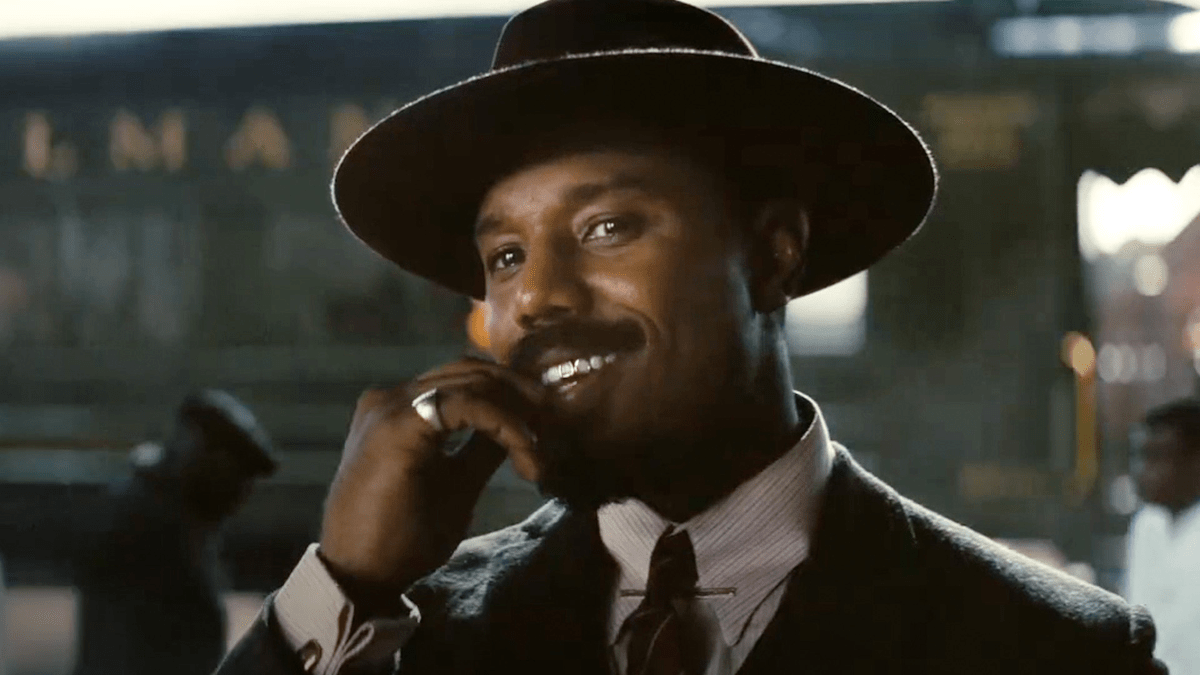
So this is what’s been on writer-director Ryan Coogler’s mind while he’s been making films based on existing IP. Although he left his imprint upon Creed and the Black Panther movies, they weren’t entirely his creation. For example, you could tell which parts of his Marvel movies came from his mind and which were mandated in order to fit into the larger MCU. Sinners, Coogler’s first original film since Fruitvale Station twelve years ago, reflects the freedom he likely felt at no longer needing to tell a story using other people’s characters and storylines. His latest is a rare intimate blockbuster, one that is brazenly adult-oriented, filled with big ideas and told with indelible images that demand our attention. It’s a full-throated cinematic experience that swings for the fences and connects more often than not.
The plot of Sinners would feel right at home in a film about gangsters from the Forties or Fifties. In 1932, twin brothers Smoke and Stack (both Michael B Jordan) return home after an extended stint working for gangsters in Chicago. They left seven years ago under circumstances befitting a film noir, with a dead father and newborn child. In their possession is a suitcase full of stolen money and a truck of stolen liquor, ingredients for their own juke joint. The brothers promptly purchase an empty sawmill from a man ominously named Hogwood (David Maldonado), then convince their younger cousin Sammie (Miles Caton) to team up with him. Sammie, who plays a mean guitar and sings beyond his years, doesn’t need much convincing to ditch his preacher father on Saturday night.
The Smoke and Stack reunion tour continues in town, where they lure veteran musician Delta Slim (Delroy Lindo), singer Pearline (Jayme Laswon) to round out the musical talent. The twins purchase food from local grocers Bo (Yao) and Grace (Li Jun Li). Smoke makes up with his estranged wife Annie (Wunmi Mosaku) because she’ll cook the food. A big fella nicknamed Cornbread (Omar Benson Miller) will serve as the door man. Not to be outdone in the ladies department, Stack reunites with his old flame Mary (Hailee Steinfeld) who he left behind without a word. (Those flames will be rekindled soon enough without much trouble.)
All of what I’ve described is very on target for a routine gangster picture, except that I intentionally left out several key pieces of information. First, the story takes place in Clarksdale, Mississippi. Second, all of the actors are People of Color with the exception of Mary and Hogwood. While Coogler certainly could have provided the audience a good time via watching handsome people committing various sins, he intends to do more than that. He wants us to look upon these sinners and their sinful behavior within a larger context, where their actions take on a larger significance.
Smoke and Stack’s place is up and running by dusk, and the patrons steadily arrive dressed to the nines. The twins’ idea was a good one because their place fulfills a need within an underserved community. There are issues, however, in catering exclusively to African Americans in the Deep South, however. As former slaves, they sometimes pay with wooden nickels. Smoke is upset at taking money that is next to useless, but Stack reminds him that they need to win customers first, make money later. Overall, their first night in business is a success. Delta Slim’s playing has people dancing, Sammie’s performance extends beyond space and time (literally) and Pearline scorching singing threatens to set the place on fire.
As happens in life, success attracts unsavory people interested in using it for their own benefit. This comes in the form of Irishman Remmick (Josh O’Conner), a vampire who eluded Chocktaw hunters earlier in the story. Accompanied by a married Klan couple he turned saunter, the three saunter up to the joint and ask for permission to enter. All they want to do is enjoy the atmosphere and play their music for the crowd. Heck, they’ll even pay to get in. While Smoke is amused by their rendition of “Pick Poor Robin Clean”, Stack doesn’t trust them and tells them to get lost.
The movie then detours sharply into B-movie territory, where both patrons and members of the joint’s inner circle are turned into vampires. This precipitates a violent confrontation between both sides, where Remmick makes overtures to the others about how becoming a vampire is the best way to overcome oppressive racists. (Like all vampires, his argument has a shred of truth that masks the monster’s true intentions.) Few escape the ensuing bloody carnage, but those who do turn up in the end, when the movie provides incredibly insightful and moving commentary on soul music and what it means to the African American community, then and now.
Recommendation
On the level of cinematic spectacle, Sinners is a thrilling sensual experience. Writer-director Ryan Coogler and cinematographer Autumn Durald Arkapaw fill this movie with jaw-dropping imagery. From breathtaking shots of expansive Arkansas farmland, to views of sweaty juke joint patrons dancing to the two confrontations at the end of the story, the film is a feast for the eyes. The soundtrack throbs with the sounds of music and the moans of characters in the throws of passion. If you only ever see this movie on your television, that would be a mistake because Coogler made this film to be experienced on a big screen with an audience.
On the narrative side, the movie works best when it describes what music means, from historical, communal and racial perspectives. There’s a tour de force scene midway through that gives one of the best depictions of how music both connects us and transports us backward and forward in time. What we see and hear borders on the mystical, and may end up being the signature scene of 2025.
If only Coogler had kept this movie on that trajectory. Instead, he delves into horror movie tropes to make several murky philosophical observations about revenge sought by oppressed races and the voraciousness of popular (white) culture. While I have no issue with the points being made, the tonal shift that accompanies them detracts from the film’s compelling spiritual investigation. By the time Coogler course-corrects to unify his overarching themes, the film’s momentum has almost been lost. For all of Coogler’s confidence in taking us on this journey, his risky swerve into the supernatural nearly sabotages the entire enterprise.
Fortunately, everything before and after that episode borders on greatness. The performances are electric across the board. Michael B Jordan continues proving that he is a star playing twin brothers. Having him playing twins doesn’t add anything to the story, but it’s a fun flex on behalf of Coogler and the visual effects team pulling this off. (Watch Jordan share a cigarette with himself!) The movie is a showcase for all of its female actors, with Jayme Lawson, Hailee Steinfeld and Tenaj L. Jackson each taking turns setting the camera ablaze. Not to be outdone are Miles Caton, incredible in his first acting role, and veteran Delroy Lindo stealing every scene he’s in.
Sinners is a bravura piece of filmmaking on behalf of Ryan Coogler, a richly sensual spectacle that confidently explores the both good and bad aspects of African Americans living in the Deep South of the 1930s. The movie is an audacious work of art, full of ideas rendered in breathtaking imagery, with captivating performances and soul-stirring music. Although a few of Coogler’s risks nearly derail the enterprise, the film’s raw, emotional power is undeniable. Recommended.
Analysis
Sinners is a collage of themes, some of which writer-director Ryan Coogler has touched upon previously (Black Panther), as well as new ones he’s been waiting patiently to explore. This results in a film that comes across as an effort to convey as much as possible before time runs out. Thankfully, Coogler’s earnestness ensures that what we get never feels forced or busy.
The movie reminded me of Jordan Peele’s Us, another movie bursting at the seams with “stuff”. Peele is a terrific director, but even his Herculean efforts couldn’t unite all of the disparate threads into a cohesive statement in the end. Nope works better because Peele limited himself to a handful of solid, well thought-ideas ideas and saw them all through to the end.
In this IP-dominated cinematic landscape, a big budget movie based on an original story stands out. As the major studios have become increasingly risk-averse over the past several decades, movies like Sinners are unicorns. The underlying belief in Hollywood is that every sequel and reboot is sure money because they are easier to sell to a finicky movie-going public. Even as recycled properties deliver diminishing returns, those results haven’t dissuaded those who run the major studios to change course. This is why we get yet another Transformers sequel or superhero reboot instead of something new. Audiences know the property, paid to see it last time around and hopefully will show up again.
All of this is a long way of saying that I don’t like grading movies like Sinners on a curve. It shouldn’t automatically get an “A” or a “thumbs-up” just because it is original. The movie has to succeed on its own merits, regardless of the cinematic landscape from which it arrived. Although I grade Ryan Coogler highly on execution, a film must be more than just images and sounds. Unlike a music video, a movie must tell a cohesive story, one that makes sense from a narrative perspective while also weaving its themes satisfactorily into that narrative.
This is why I was unable to call Sinners a great film. While much of it is great, I had issues with its overarching narrative. Most of the story’s themes mesh, but others don’t. The biggest culprit is the introduction of the vampires into the plot, who are symbolic stand-ins for several points Coogler wants to make. Regardless of his intentions, their impact on the movie is awkward. What Coogler says through them could have been accomplished in a way that wouldn’t have distracted the story from where it was headed.
As I stated above, Coogler makes valid points with his detour into horror movie tropes. However, he does this at the expense of the narrative momentum he’d built at that point. Then, after nearly all the heroes have been killed off, Coogler swerves the film back onto the road with a direct confrontation with the KKK. Watching Jordan’s surviving twin dispatch those awful racists is the payoff we’ve been anticipating. Having the KKK be the ones to attack the juke joint would have been more impactful because it would have taken us directly to the crux of the story. Watching the vampires jump around ripping out throats was a cute diversion, but it covers up the pain and trauma that teems throughout the story.
Themes
Like Todd Field’s Tar, Sinners explores many themes. As such, providing a comprehensive examination of all of them is prohibitive. Following are several themes I picked up on that resonated with me.
The duality of man
You may recall that this was the primary theme of Stanley Kubrick’s Full Metal Jacket. In that movie, Private Joker (Matthew Modine) uses it to explain why his helmet is adorned with a peace symbol and the phrase “Born to kill”. Sinners uses the twin brothers Smoke and Stack to explore several aspects of this theme.
One comment I’d heard about the movie before seeing it was how the personalities of Smoke and Stack are very similar. This raises the question as to what Coogler is trying to tell us via twins that are differentiated by their wardrobe. Instead of each one representing different aspects of human nature, the twins represent the contradictory behavior of people.
Smoke and Stack leave Chicago and return to Arkansas to open a juke joint exclusively for African Americans. While their business will be welcomed with open arms by their community, Smoke and Stack make clear that they aren’t running a charity. Stack chafes at having to take wooden knuckles from plantation workers. At the end of the night, when the two discuss the evening’s take, one of them comments that it could take them several months to break even. Although Smoke and Stack genuinely care about their community, they aren’t altruistic.
Further evidence of the twins’ dual natures is provided when they head into town for supplies. The one brother has the young girl honk the horn if anyone snoops into the back of the truck. When the horn is sounded, the brother runs out and shoots one of the potential thieves without warning. Love of one’s community only goes so far, apparently.
The movie also comments on how men view loyalty differently based on whether they’re dealing with men or women. Smoke and Stack are fiercely loyal to each other and are protective of their cousin Sammy, but they aren’t as loyal to the women in their lives. Stack abandoned Beatrice after their child died. Smoke left Mary despite their passionate romance.
Another comparison is made between the twins and their cousin Sammie. Smoke and Stack describe their father as evil, and the rumor is that Stack killed him. Sammie’s father, who is Smoke and Stack’s uncle, is a preacher. Their family runs the gamut from wickedness to holiness, heaven and hell.
Exploring all of these contrasts and dualities ties directly to the movie’s title. People can be both good and bad, sinners and saints. Further, an act can be perceived completely differently by different people. Sammie’s father denounces his decision to play at the juke joint as sinful behavior, but the movie shows that what he does is a spiritual act as well, one that honors the past, present and future of Black music.
The multifaceted nature of music
In the movie’s tour de force scene, Ryan Coogler visualizes how music can take us backward and forward in time. The notion of music as a boundless force spanning time and cultures is evident when musicians from the past and the future make appearances. The scene is both audacious and poetic, an artistic conceit that succinctly depicts something I’ve felt at concerts but could never put into words.
Sinners isn’t only about the transportive nature of music, however. Coogler also explains how music has an elevated importance within the African American community. After Delta Slim tells a story about a Black man who was lynched by the KKK for having money, he sings a spiritual hymn. The song represents the only way African American communities in the Deep South can express their anger without fear of reprisal. Music gives African Americans like Delta Slim the strength to keep on living despite the fact that he could be killed at any time for any reason.
At the end of the movie, Coogler includes a montage of how everyone came together to help get the juke joint ready to open. Music is the lifeblood of the African American community, and being able to enjoy it together openly motivates them towards a shared goal.
Finally, music is a way that the African American community has passed their history from generation to generation, as oral narratives shared over time.
Sacrifice
It isn’t until the mid-credits scene that Coogler addresses another theme that he’d introduced earlier. As sole (human) survivor of the vampire attack, Sammie understood that he needed to be more than a working musician for the rest of his life. He has a responsibility to honor those who sacrificed their lives for his, which he does by committing his life to playing their music.
I was surprised when Sammie turned down Smoke’s offer to become a vampire, which would have allowed him to keep playing forever. However, the point that the elder Sammie (and Coogler) are making is that honoring those who died for us shouldn’t fall to one person. The younger generation needs to take up the mantle from Sammie, because if they don’t, the music and everything it represents will have died.
About those vampires
From what I’ve been reading, the vampire assault on the juke joint has become the crux of the viewing experience for people. I guess witnessing an African American slaughtering the local chapter of the KKK with a Tommy Gun is no big deal these days. Jokes aside, I found several different ways to interpret the vampire segment. It symbolizes how White culture consumes Black culture, reflecting how White musicians became famous for playing jazz, R&B, soul and Rock & Roll music.
Another angle is provided through Remmick. When he tries to convince Sammie to become a vampire, he does so by insisting that the only way to survive racism in this time in history is turning to the supernatural. Although Remmick is White, he’s also Irish, who were looked down upon both in the UK and when they immigrated to the US. (See Martin Scorsese’s Gangs of New York.) Remmick and his rainbow coalition of vampires have had a long history of mistreatment at the hands of White people. Remmick signifies how that desire for revenge can become all-consuming, devouring everyone with its wrath.
The scene also serves as the crux of Sammie’s experiences with both traditional religions and the occult. He is the only character who ever inhabits both worlds, first through his father and then by way of his cousins. Only Sammie survives the vampire attack because he believes in both.
Coogler’s obsessions
Are directors at their best when they unleash their obsessions upon the audience? One could make that argument for directors like Alfred Hitchcock and David Lynch, who showed the world what turned them on in nearly all of their films. Coogler certainly tells us what he likes throughout Sinners. There are two scenes where the camera lingers on the sight of a woman walking away in a tight dress. There are multiple scenes where characters openly discuss oral sex. I fully expect a porn remake of this film titled Sinners and the Art of Cunnilingus to be released soon.
A big, bold cinematic experience
Many box office pundits have offered various explanations for Sinners’ incredible box office success. I believe it can be narrowed down to several factors. Ryan Coogler and Michael B Jordan have built up audience goodwill from their previous collaborations, all of which have been successful. Also, as I mentioned above, the movie stands out in a sea of reboots, sequels and overly familiar IP.
The most important aspect of Sinners’s incredible word-of-mouth is that people are describing it as needing to be seen in a theater. Regardless of whether you think the film is perfect or a mess, the movie was made for the big screen and demands to be seen that way, like Tenet, Barbie and Oppenheimer. It is big and bold entertainment, with electrifying performances by a handsome cast filled with swagger. The movie is silver screen entertainment at its best, a larger-than-life experience that people will enjoy seeing with an audience.
To Kill a Mockingbird
I’ve been reading Harper Lee’s novel while writing this review, and happened across the follow passage:
Reverend Sykes warned his flock against the evils of heady brews, gambling and strange women. Bootleggers caused enough trouble in the Quarters, but women were far worse. Again, as I had often met it in my own church, I was confronted with the Impurity of Women doctrine that seemed to preoccupy all clergymen.
Was To Kill a Mockingbird one of Coogler’s influences for Sinners?
 Detroit Cineaste