
There’s nothing more dangerous than a man of principle. That man will sacrifice everything to advance his cause, his friends, family, his health and even his own life. His unshakeable belief in his own righteous cause justifies every decision, no matter the cost or who pays it. The Order tells the story of two such men, one an FBI agent, the other the leader of a white separatist faction. Despite their distinct differences in age, background and life experience, the movie reveals that they’re actually sides of the same coin. Before the movie arrives at that conclusion, it establishes that these men are destined to collide in violent fashion.
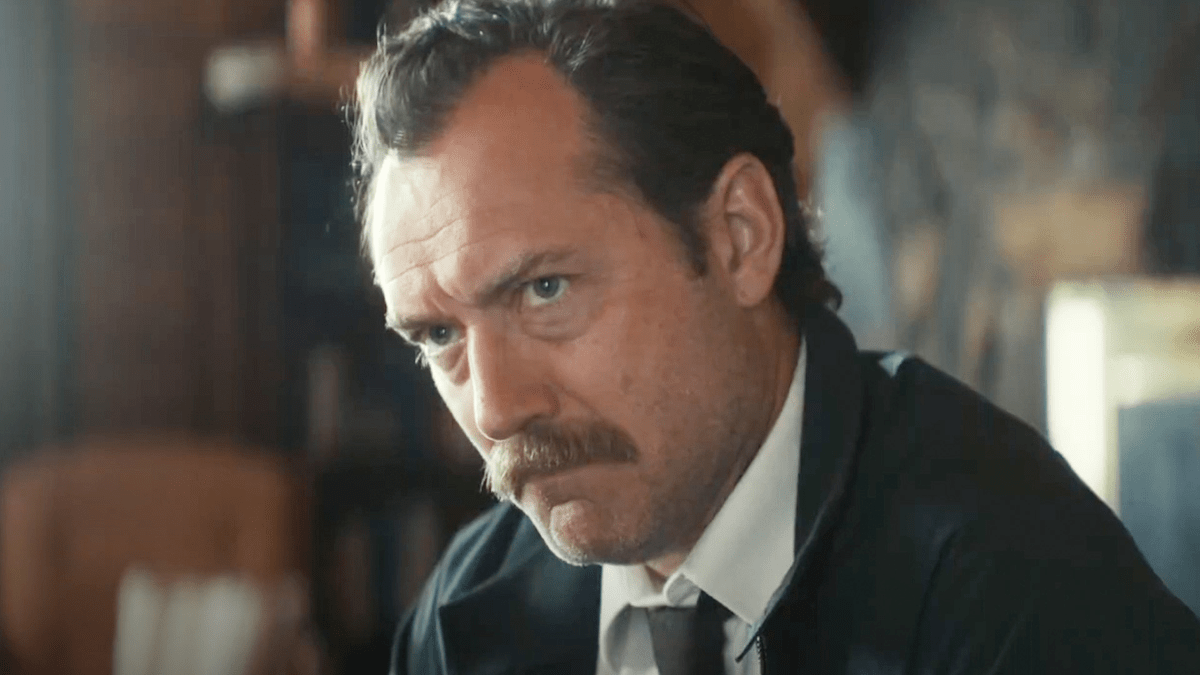
In 1983, FBI agent Terry Husk (Jude Law, looking tired and weather-beaten) rides into the sleepy town of Coeur d’Alene, Idaho to revive a long-vacant field office. He carries himself like a lawman who has seen things and done things he’d like to forget. Terry tells others that he’s come to this town to lead a quiet life, but then he notices a flyer for a white power meeting at a local bar. You can almost hear him thinking, “Dammit.”
Having worked cases involving the KKK before, Terry inquires with the local sheriff’s office, but the sheriff downplays the group’s significance. (Based on the preceding bank robbery carried out by white men in masks, we know that’s not true.) Officer Jamie Bowen (Tye Sheridan) injects himself in the conversation and says that the group is only a 15-20 minute car ride away. The sheriff clearly has no interest in poking the bear, but Jamie is young and is eager to do more than cite people for fishing without a license.
Jamie tries to convince Terry that members of the Aryan Nation are behind a bank robbery and a synagogue bombing, but Terry is unconvinced because white power groups typically don’t commit violent felonies. The last thing they want is to attract the attention of federal law enforcement. Jamie’s also concerned about Walter West (Daniel Doheny), the husband of a high school friend. West has been missing for several weeks, but his wife hasn’t filed a missing person’s report. (Terry’s a bit like Colombo, in that the audience observes him piece things together that we already know.)
When Terry and Jamie meet with West’s wife, she’s skittish but is comfortable around Jamie. Her husband went on a late night hunting trip with Bruce Pierce (Sebastian Pigott) and Gary Yarbrough (George Tchortov) and never returned. Terry and Jamie investigate the location and find West’s body, along with a copy of a red-covered book titled “The Turner Diaries” nearby.
Terry has Jamie drive them out to the Aryan Nation compound, which is protected by armed men in fatigues. The two meet group leader and minister Richard Butler (Victor Slezak, exceptionally oily and sinister), who knows how to handle law enforcement types. Butler says that the two men last seen with West, Bruce Pierce (Sebastian Pigott) and Gary Yarbrough (George Tchortov), were kicked out of the group for counterfeiting. Butler also denies any knowledge of the former member’s suspected illegal activities. As a going away present, Butler offers Terry a copy of “The Turner Diaries”, but Terry declines.
While Terry and Jamie investigate, Bob Matthews (Nicholas Hoult) has been busy. As the movie established at the outset, he and his men are behind a recent string of robberies and bombings. Bob is a combination of charisma, intensity and handsomeness that makes him an ideal revolutionary leader. He also leads a double life. Bob is a husband and a father and cares for his family. However, his “job” is to bring about the race war espoused in “The Turner Diaries”. Unlike Butler, who he dismisses as all talk, Bob is a man of action. The money his group has stolen will be used to train and equip an army of like-minded individuals. If Bob has any doubts about his plan coming to fruition, he never shows it.
Terry meets up with fellow FBI agent Joanne Carney (Jurnee Smollett), and the two have a casual familiarity that implies they’ve done more than shared intelligence. (Later on, when Terry describes to Jamie the horrific outcome of a mob case he was on, I suspected that Joanne pulled Terry out of his spiral.) Joanne agrees to include Terry when any violent incidents happen, and soon there’s a bombing at a pornographic theater. Terry instinctively knows it’s a misdirection, and he and Jamie drive off to a bank robbery reported seconds later. When they arrive, Terry runs in with his shotgun blazing, but Jamie freezes. Terry is used to the adrenaline of a gun fight, but Jamie clearly is not.
Eventually, Jamie convinces Terry that the group behind the robberies and bombings is using the “The Turner Diaries” as the guide for its activities. They’ve currently in the fundraising phase, which will lead to armed revolution, domestic terror and assassination. After Jewish radio talk show host Alan Berg (a wonderfully acerbic Marc Maron) is gunned down in his driveway, Terry is able to bring more agents onto the case. Unfortunately, while we know that the leader of “The Order” is Bob, he’s a mystery to law enforcement. Until a slip-up during an armored car heist gives Terry the lead he’s been waiting for. Now it’s a race against time before the group commits a large-scale domestic terror attack like bombing a federal building or seizing the Capitol. (Sounds familiar?)
Recommendation
As far as crime thrillers go, The Order is solid. All of the performances are first-rate, led by Jude Law and Nicholous Hoult. Director Justin Kurzel keeps things moving at a steady pace, mixing the investigative beats with episodes of violence. The movie is beautifully filmed by Adam Arkapaw, who received Emmys for his work on television shows True Detective and Top of the Lake. Although the film is thoroughly compelling and full of interesting characters, it never quite achieves greatness.
The problem is that the movie’s examination of the world of white separatists is much more interesting than the storylines involving the law enforcement officials. Other movies have used white supremacists as the bad guys before, depicting them as scowling hulks spouting racial epithets. The Order eschews those superficial treatments by explaining at length how people become aligned with white supremacist ideology and its mission, as well as why it’s impossible to convince those people that their beliefs are fundamentally flawed.
In an effort to counterbalance the white supremacist aspects of the story, the filmmakers divide time with the law enforcement characters. Jude Law’s performance is the most interesting one he’s given in some time, and he appears to enjoy playing a character who’s intense and damaged. But the movie avoids delving into his character beyond surface-level tics. His troubled history is alluded to on multiple occasions but remained frustratingly opaque. Law’s relationship with Jurnee Smollett’s character is also teased but forgotten when the action escalates. Tye Sheridan is fine as the baby-faced police officer, but his character is the same as any other wide-eyed young recruit in these sorts of movies.
The movie’s obsession with comparing Law’s grizzled FBI agent and Hoult’s white supremacist leader doesn’t yield much beyond a layman’s psychological insight. Both men are hard-charging, single-minded loners, but the movie needed to go further than highlight those commonalities for us. In the end, the movie basically shrugs while affirming one last time that “these guys are kinda alike”.
Stylistically and structurally, The Order seems heavily influenced by Denis Villeneuve’s Sicario. However, this movie doesn’t reach the same levels as Sicario because it repeatedly prevents the tension from building. Instead, it loosing steam every time it switches between the white power and the law enforcement worlds. The Order has all of the ingredients to be as propulsive a story as Sicario, but it never gets there because it doesn’t want the bad guys to become the stars of the show.
The Order is a solid law enforcement thriller, featuring exceptional performances by Jude Law and Nicholas Hoult. Although I had issues with the movie’s pacing and focus, the view it provides of the world of white separatism is as gripping as it is troubling. Recommended.
Analysis
Films that include white supremacists/separatists as villains have their work cut out for them. Once we learn that such-and-such character is a neo-Nazi, we know that they’re bad guys within milliseconds. The logic behind our reasoning is straightforward: neo-Nazis are racists, racists are evil, therefore neo-Nazis are evil. This is one of the most efficient ways to communicate to the audience that the person we see is a villain, right up there with guys sporting greasy hair, flashy suits and foreign accents.
The Order certainly could have worked with stereotypical white separatist villains portrayed as gruff, beady-eyed thugs yelling racial epithets. We would have accepted them as reprehensible characters who deserve justice and waited for it to be meted out by upstanding law enforcement types. Thankfully, that is not the movie The Order wants to be.
Instead, The Order takes its time explaining why Bob Mathews and his followers ascribed to white separatist ideology in the first place. It wants us to understand the psychological drivers behind this level of radicalization. While this conversion can be partially attributed to the Mississippi Burning theory of racism (it isn’t taught, it’s learned), the conversion of a person from a racist into a full-fledged white supremacist is more complex.
According to the movie, the path to white supremacy is built upon grievances borne out of traumatic life experiences. Future white supremacists witnessed something that made them conclude that the world is rigged against them. Much of what Bob Matthews tells his converts focuses on two common white supremacist themes: lack of opportunity and feelings of helplessness. White supremacists believe that powerful forces have aligned to take opportunities away from whites and give them to non-whites, leaving them helpless to earn a living as a result.
Bob arrived at this conclusion during his poor upbringing, when he saw his father getting kicked around from job to job. Bob’s father was unable to find work (opportunity) and was unable to support his family (helplessness). Observing his father’s failure made Bob grow up angry and resentful, but he was unwilling to lay the blame for his unhappiness at his father’s feet. Instead, Bob’s feelings found a receptive ear in white supremacy, which told him that others were responsible for his father’s problems, specifically people who didn’t look like him. (Bob’s backstory is remarkably similar to Edward Norton’s fictional character in American History X.)
According to white supremacy ideology, Bob’s father couldn’t get ahead because society was focused on making life better for African Americans, Hispanics and other non-white groups. Of course, Bob never took into account the various socioeconomic factors that likely made life hard for his father. (For starters, supporting a family is incredibly hard as an uneducated worker.) People like Bob view life as a zero-sum game, where someone must lose in order for someone else to win. They also see the government, through immigration policies and civil rights legislation, as efforts to tip the scales in favor of non-white people. They also see Jews as secretively pulling the strings behind everything, a racist myth that has persisted for thousands of years.
When Bob Mathews OKs Berg’s assassination, we hear a recording from Berg’s show where he makes his case against white supremacy that is very provocative and blunt:
“You don’t know anything about the Jewish People. It’s just an easy target, because you’re too afraid to see what’s in yourself, because you have to have somebody to blame for your life, because you can’t really blame the people that have put you in the position that you’re in, whether its a government that doesn’t care about you and has taught you to believe otherwise, or its something within yourself–you can’t face yourself, so it’s the Jews…but the one thing you really believe is that the only really good Jew is a dead Jew, and for some reason you think he cares about you.”
As an outsider to white supremacy, I agree completely with Berg’s conclusions. White supremacy ideology is based entirely upon grievances and creating boogeymen to blame for those grievances. Unfortunately, when it comes to people like Bob Mathews, explaining to them that their anger is misplaced simply doesn’t work. What white supremacists believe isn’t rooted in logic but within their emotional responses to life events, which in turn informed their core beliefs. This makes changing their minds impossible, and also what makes men like Bob so dangerous. He was so convinced of his beliefs that he was willing to die for them, which is exactly what happens in the end.
The related point Berg makes about white supremacy is how it absolves its members of any personal responsibility for their lives. When they find themselves poor, out of work and unhappy with their lives, it’s not their fault. White supremacy conveniently tells them that someone else is to blame for your unhappiness, someone who happens to be is non-white.
As a Jew, Berg has no patience for people who hate Jews but know nothing about them besides myths contending that they’re a mysterious force controlling other people’s lives. A man of reason and logic, Berg considers the insistence that Jews control the levers of power in the world as akin to believing in something as irrational as sorcery or witchcraft. What Berg fails to understand is that when it comes to a person’s core beliefs, rationality often doesn’t apply. And attacking someone’s core beliefs only further convinces them that they’re right.
In the end, the argument The Order has been patiently constructing reveals itself. Rather than surrender, Bob chooses to become a martyr for the cause, convinced that his actions will trigger the race war predicted in “The Turner Diaries”. Neither logic, reason, bodily harm or even death are a match for zealotry.
The brotherhood
Not very long ago, up-and-coming actors made a name for themselves by playing neo-Nazis. Russell Crowe, (Romper Stomper, 1992), Edward Norton (American History X, 1998) and Ryan Gosling (The Believer, 2001) all made a name for themselves through roles based on white supremacist characters. At thirty-five, Nicholas Hoult isn’t a fresh face. Although he first earned acclaim as the eponymous boy in About a Boy, I never thought of him as a serious actor. His turns as Hank McCoy/Beast in the X-Men movies were forgettable. He recently found a niche with roles in black comedies like The Favorite, The Menu and The Great on television, where he displayed a gift for caustic banter. Even still, I considered Hoult to be a lightweight, someone who would always be known for being handsome instead of talented.
Which brings me to Hoult’s performance in The Order. He’s still as handsome as ever, with his piercing blue eyes and cheekbones, but the intensity he brings to the role is noteworthy. Even though he played a mutant covered in blue fir, with claws and fangs, he never came across as dangerous or threatening. He brings that as Bob Matthews, a man that people like and follow not just because of his looks, but because of his conviction and determination. I don’t know if this performance will have a long-lasting impact on his career, but it shows that he be much more than a witty, pretty boy.
 Detroit Cineaste