
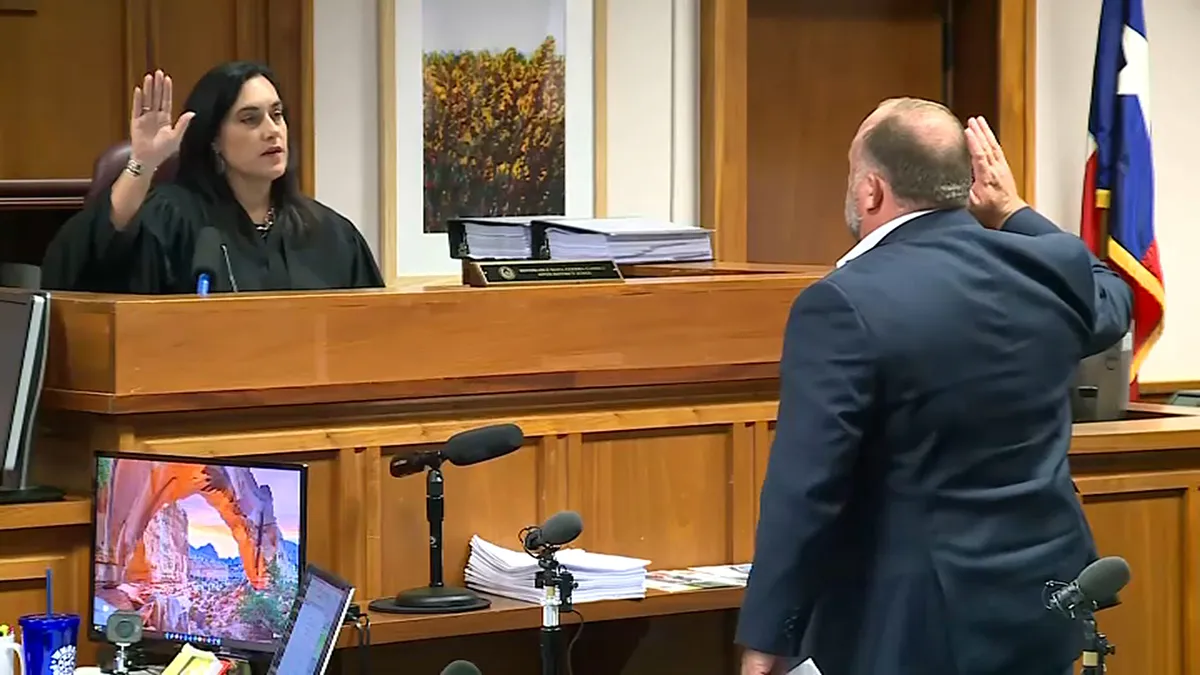
Structurally, The Truth vs. Alex Jones looks and sounds like a typical true crime documentary. Somber cellos play over the opening credits. Drones provide an aerial view of the town and the site where the crime took place. Lawyers make confident and or defiant statements in front of microphones. Photos and home movies of the victims accompany interviews with the grief-stricken surviving family members. The shocking details of the crime echo in news media coverage. Prosecuting attorneys and defendants have tense courtroom exchanges. What distinguishes this documentary from the rest is that its focus isn’t the inciting incident–the mass shooting at Sandy Hook Elementary–but the criminal activity that began in the aftermath of that tragic event.
If you’re a fan of Alex Jones I guarantee you’ll hate this film. The Truth sides with the parents, for obvious reasons. They’re nice, ordinary people caught in an impossible situation not of their making. As such, the film advocates on behalf of the parents because they are very easy to sympathize with. I should mention that as a parent with a child still in school, I can’t fathom the idea that he wouldn’t come home from school one day, let alone having him become the face of a vast conspiracy insisting he didn’t exist.
The film then examines the years-long harassment campaign that Alex Jones waged against the surviving parents. We see Jones and his followers repeatedly demonize the parents with a rabid zealousness one would expect to be directed at pedophiles and rapists, not parents who had to bury their grade school-aged children. Through his own words, both on his show and in depositions, we see that Alex Jones is not the staunch defender of the First Amendment he portrays himself to be, but an unethical, narcissistic, fear-mongering opportunist.
The lack of compassion Jones repeatedly shows towards the parents while exploiting their tragedy to peddle supplements is mind-boggling. After seeing how Jones evolved from a public access flamethrower into the head of a multi-million dollar media empire, I was left with two impressions. Jones is an evil genius, a natural performer who uses his undeniable talents towards making the lives of everyone he touches worse. He’s also symptomatic of how social media platforms like YouTube have served as a breeding ground for unfiltered hate levied towards everyone and anyone.
The Truth vs. Alex Jones would be thoroughly compelling if it had only been about the parents of the children who were murdered at Sandy Hook. What makes it fascinating is the window it gives us into the machinations of Alex Jones to hijack the tragedy to enrich himself. Incredibly, the most disturbing revelation made is how eagerly a significant portion of society believes opinions that coddle to their paranoia, made by a man who yells until his face turns red. Highly recommended.
Analysis
On December 14, 2012, a shooter entered Sandy Hook Elementary School in Newton, Connecticut and killed twenty-six people, including twenty children. The entire ordeal took all of six minutes before the police arrived and the shooter took his own life. The Truth vs. Alex Jones doesn’t spend much time examining the shooting itself, which is presented as fact. Instead, the crime it focuses on is the ongoing emotional distress inflicted by Jones upon the parents. Using evidence and testimony from the civil trials brought against him (for defamation), the film unravels why Alex Jones perpetuated his conspiracy theory for years. The film also provides a forum for the surviving parents, who explain why they turned to the justice system for relief from Jones over his actions.
One of the challenges with making a documentary about a school shooting like the one that happened at Sandy Hook is unintentionally glorifying the shooter. The Truth vs. Alex Jones achieves this through a very deliberate narrative choice: it never mentions the shooter’s name once during the film, provides no background on him, and never conjectures why he committed the shooting. (That information can easily be found on the internet.) Instead, director Dan Reed directs our attention towards the victims of the shooting, namely the children and their parents, as well as members of the Newton community who were also affected by the actions of Jones and his employees.
Daniel Jewiss, Lead Investigator for the Connecticut State Police, provides a harrowing by-the-minute breakdown of the shooting. Talking about the investigation still saddens him and he probably wishes he never had to speak about it again, but he keeps his emotions in check and conveys the facts with respect and sympathy for the victims. Considering how much time he spent on the investigation, I’m not surprised that he remembered the name of everyone who died, including where they were and what they were doing when they were shot. He probably couldn’t forget those details if he tried. Most importantly, Jewiss’ recount confirms that regardless of what Alex Jones and his followers choose to ignore, the victims were defenseless children and school workers, shot to death at the beginning of what should have been a normal school day.
The film also introduces us to several of the parents, who tell us about their children and describe what were their last moments together. Neil Heslin says that he didn’t want to take his child to school that day, but his son had a class project to complete. Mark Barden states how he wished he’d taken a picture of his son the day before he died instead of the winter landscape outside. These gut-wrenching stories eliminate any doubt as to whether children really were shot and killed at Sandy Hook. Nobody could fake the grief the parents are still living with ten years after the tragedy. Their words also makes what Alex Jones did after the shooting incomprehensible, at least until his motivations are revealed.
The unlikely fallout
Within hours, the shooting became the lead story for Alex Jones on InfoWars. He insisted that the shooting was a hoax, a “false flag” operation concocted by the government and perpetuated by the liberal media. Why? So that elected officials would be justified in enacting laws that would tighten gun ownership laws and make it harder for citizens to legally buy and own guns. Jones was just confirming to his followers what he told them before would happen. What made Jones’ conspiracy theory spread like wildfire was that he had “evidence” to back up his claims.
Robbie Parker gave a press conference the evening after the shooting, and his behavior fed much of the conspiracy theories. He smiled nervously before he began his statement, then broke down when he remembered he was talking about his own dead child. Jones and others interpreted his reactions as indications of a performance, and then it was off to the races. Next, a doctored video of an interview between parent Véronique De La Rosa and Anderson Cooper was given as “proof” that the funerals were staged. After that point, it was open season on the grieving parents. The film shows how Jones’ “evidence” was ridiculous, but that didn’t matter because his audience was very willing to believe whatever he told them.
The man behind the conspiracy
In a brilliant opening sequence, the film provides crucial background information on Jones that I was unaware of. Before watching this film, I had only seen clips of his show on John Oliver’s “Last Week Tonight”. Amazingly, he looked much different when he first started out on a public access channel in Austin, Texas. Today, with his barrel chest and jowly neckline, he struts around like a chicken pumped with saline to the point of exploding. Seeing him gradually transform over the years into the person he became is stunning. Today, he looks like one of those guys at the gym who bulks up only his arms and chest but allows his legs to atrophy into pencil-thin spindles. (Sorry, I don’t want this review to turn into an attack on Jones’s appearance, but I can’t help myself.)
Jones initially gained a following by preying on people’s concerns over fluoride. He points out that a tube of toothpaste mentions that if you swallow a significant portion, you need to call poison control. Like all conspiracy theorists, Jones is skillful in how effortlessly he taps into people’s ignorance, fear and paranoia. He moved on to freaking people out about radiation from the Fukushima nuclear reactor, then made a name for himself as a 9/11 truther. As a conspiracy theorist, Jones became particularly adept at providing his followers with ridiculously simple answers that simultaneously reinforced their belief system and worldview. It was through his prior conspiracy theory successes that Jones was emboldened to transform the Sandy Hook shooting into a conspiracy theory that would make him rich and infamous.
The accomplices
The film also interviews some of the most notorious Sandy Hook deniers, none of whom I’ll mention by name here. One says that the absence of trauma helicopters is proof that nobody ever died. Another says that because government officials refused to tell her what service cleaned up all the blood, there was no shooting. Every dubious question asked by a member of the denial chorus points to how circumspect their logic is. Why were no helicopters sent to transport the victims to local hospitals? (None were sent because all of the victims were dead.) Why did the shooter have a 99.9% kill rate? (Because the children were either huddling in a corner of the classroom or crammed into a tiny bathroom. All the shooter needed to do was point and shoot.) One denier actually insisted that a parent needed to excavate their child’s body in order to convince them.
The survivors
Parent Nicole Hockley explains that initially, she and others tried to converse with the deniers rationally, but every explanation only fueled more inane questions. The sad truth that Hockley and the other parents learned is that deniers don’t follow logic or rationality, and there is no way to dissuade them. They are emotionally invested in their beliefs and nothing will convince them otherwise.
Although all of the parents suffered tremendously after the shooting, Robbie Parker had it the worst. After his press conference, he was ridiculed over and over by Jones and his followers. People left vile messages on his daughter’s Facebook page. He recounts how when he was in Seattle, thousands of miles from Newton, a stranger recognized him and heckled him. Jones made Parker the face of the conspiracy, and you can see how the years of constant harassment took an immense toll on him.
I’d read about Lenny Pozner years earlier, the parent who had to copyright his son’s image so that he could force YouTube to take down videos claiming that his son never existed. As a parent, the idea that I would need to go to these lengths to protect my son’s legacy is unfathomable. And yet this was the only way Pozner could prevent others from profiting off his son’s death for years on YouTube. (Content creators make their money off of advertisements embedded within the video.) As I heard Pozner describe his crusade, I thought that someone should make a documentary about how YouTube and other social media platforms willfully allow content creators to profit from projecting their hate towards others.
The truth about Alex Jones
Ultimately, the documentary reveals Jones to be nothing more than an unethical snake oil salesman. The way he used the Sandy Hook tragedy as the basis for a marketing campaign for supplements is insidious, if not evil. The only person I could think of like him is the fictional character Harry Lime in The Third Man come to life. In that movie, Lime sold diluted penicillin that resulted in children dying. While Jones’s actions never directly resulted in anyone’s death, he did inflict severe emotional distress on the parents for years. Through his depositions and statements on the witness stand, I believe that Jones rationalized his amorality just like Lime did. If he didn’t profit off of the Sandy Hook tragedy, someone else would have.
For those who believe Jones’ line that his words are protected as free speech, the lawyers working on behalf of the parents remind us what the First Amendment actually means. It protects citizens from being censured by the government. Private citizens suing other private citizens for harm falls outside of the First Amendment. Regardless, there was one key moment in the film that proves how Alex Jones could give a whip about the First Amendment. Outside the courthouse, Jones makes a blustery speech about how the trial is trying to limit his rights and so on. He concludes by telling the reporters–as well as anyone listing back home–to buy his book on Amazon. For all of his fiery rhetoric on the subject of free speech, Jones will say anything about anybody to make a buck.
Alex Jones, the performer
As a media personality, Jones is a fascinating creature. Even Scarlett Lewis, who Jones has attacked on his show, admits that she finds herself drawn to him when he speaks in court. (She is kind to him once during the trial, and he responds by subsequently attacking her and her husband on his show.) The way Jones modulates his voice, widens his eyes and waves his arms perfectly communicates his incredulity, anger, contempt, etc. at whatever he’s railing against. I’m convinced that if Jones hadn’t chosen to be a media personality, he could have been an actor, comedian or maybe a wrestler.
Whenever Jones is on camera, he always gives a performance for his followers no matter the situation. During the trials, Jones never sits passively next to his council. Although he can’t speak until he’s on the stand, he communicates his every thought to his followers through his eyes, facial expressions, head movements, shifting in his chair, etc. There is no doubt as to what Jones thinks about what others are saying about him. He knows his audience hangs on his every gesture, so he does the next best thing without getting into trouble with the judge.
The verdict
Like everything surrounding the aftermath of the Sandy Hook shooting, the aftermath of the second civil trial is both expected and unexpected. Although guilty verdicts have been reached in favor of the plaintiffs, they haven’t succeeded in getting Jones to admit publicly that he lied about the shooting or apologize for the horrible way he treated the parents. Was justice done? In some way, the parents have been vindicated. But there’s no way to stop someone like Jones. He’s a cockroach in human form, feasting on the bodies of murdered children and their anguished parents.
 Detroit Cineaste
One thought on “The Truth vs. Alex Jones”