
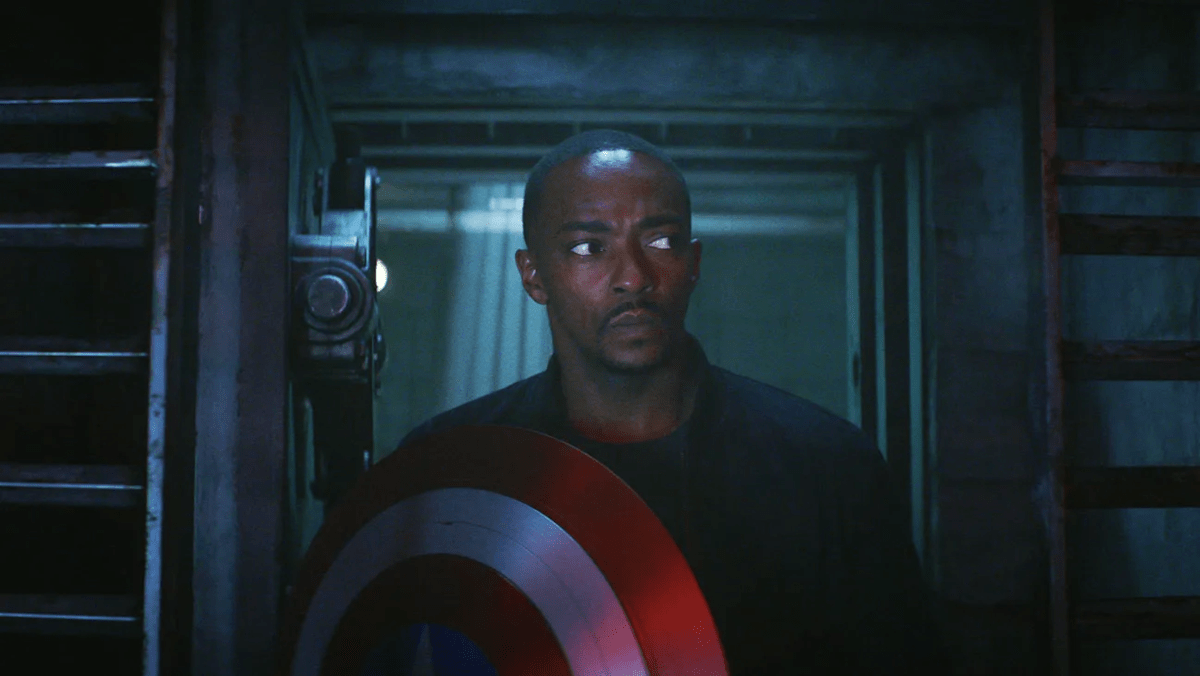
From what we see at the outset of Captain America: Brave New World, Sam Wilson (Anthony Mackie) has made great strides since he accepted being Captain America four years ago. His contacts in Wakanda have outfitted him with Vibranium wings, which emit a purple energy blast when he slams them on the ground. He’s also become proficient wielding his shield, so much so that the speed and complexity of the ricochets boggle the mind. I wished the movie had included one of those training montages that were mandatory in all superhero movies. I really would have appreciated seeing how Sam learned how to fling it so that it caroms off of walls, people and everything in between until it circles back like a gleaming frisbee. Where did he train? How did he become so adept at playing the angles? Did he start out by mastering billiards, or perhaps bowling? Did an elderly Steve Rogers train Sam à la Mr Miagi just before he checked out permanently? (No, Chris Evans is not in this movie.)
One thing that hasn’t changed is Sam’s relationship with the military. The movie opens with him on a mission to retrieve a container of Adamantium mined from the Celestial island in the Pacific Ocean, which is currently controlled by Japan. In case you never saw Eternals, that movie ended with those superheroes killing a celestial (or large robot) before it could fully emerge from the center of the Earth. What wasn’t revealed back then was that Celestial beings are made of Adamantium. Leave it to Marvel to find the most incongruous way possible to tell the faithful that The X-Men are coming.
Sam’s mission is notable not just for its objective, but that he’s taking direct orders from newly elected president Thaddeus “Thunderbolt” Ross (Harrison Ford). Yep, Sam’s now reporting to the guy who locked Sam and his fellow Avengers up in the floating prison known as “The Raft” for several years (see Captain America: Civil War). To say that the two have an uneasy partnership would be an understatement, but Sam has no problems following orders that make strategic sense. What happens when the two don’t see eye-to-eye is another matter entirely, which the movie does get into.
The mission involves retrieving some stolen Adamantium from a special ops team known as the Serpent Society, who trade in illegal stuff. They’re led by a badass known as Sidewinder (Giancarlo Esposito, a.k.a. Gus Fring from Breaking Bad and Better Call Saul). Also along for the ride is Sam’s good buddy Torres (Danny Ramirez), who is apprenticing as The Falcon. Sam’s not cool with Torres wearing his old wings because it’s dangerous work and neither of them have taken the Super Serum (yet). C’mon Sam, you’re in the MCU. Black Widow had no super powers and only died when she threw herself off a cliff (see: Avengers: Endgame).
Sam makes quick work of the Serpent Society but Sidewinder escapes. With the Adamantium secured, Sam wonders why the buyer chose a location that would make it easy for Sam to play the hero. Too easy. Back home, Ross is thrilled that the mission was successful and invites Sam and Torres to a shindig at the White House. Ross is pushing an international treaty to govern Adamantium’s mining and distribution. His sending Sam to retrieve the sample was an act of good faith, proof that the US won’t resort to skullduggery to steal Adamantium behind Japan’s back. The US resorting to dirty tricks? Why, I never! Sam asks his old friend and former Super Soldier Isaiah Bradley (Carl Lumbly) to join them, but Isaiah is less than enthused. There’s the matter of Ross destroying Harlem in pursuit of the Hulk (see: The Incredible Hulk). Isaiah also doesn’t trust Ross after he locked Sam up. Sam convinces Isaiah that he and Ross are cool now, and that it will be a party they don’t want to miss.
Of course, everything goes terribly wrong. When a song is played on walkie-talkies, Isaiah and several other soldiers present attack the president and other guests. Isaiah agrees to be captured despite not wanting to go back to prison. Sam busts into a meeting between Ross and his cabinet and asks for Isaiah to be released, but Ross angrily refuses to do so. He can’t release someone who tried to kill him on Sam’s word alone. (Fair point.)
Sam and Torres go off on their own to figure out what could have turned Isaiah and the other soldiers into Mancurian Candidates. They and Ruth Bat-Seraph (Shira Haas), a former Black Widow who is Ross’s head of security, discover that everyone involved in the attack were triggered by something they saw on their phones. Some sort of mind control is going on, but who is behind it? What big-brained genius could have made all of this possible? If you’ve seen The Incredible Hulk, you already know who. If you haven’t, it doesn’t really matter because the movie provides ample backstory along the way.
Once the evil mastermind has been revealed, it’s off to Celestial Island for a tense showdown with the Japanese, followed by a very tense appearance by the Red Hulk. It’s now up to Sam to save the free world. If only he’d taken the damn serum…
Recommendation
Of all the franchises that make up the MCU, Captain America franchise is by far the most eclectic. The first entry (The First Avenger) was set during WWII. The second one (The Winter Soldier) took place in the present, with a paranoid tone inspired by political thrillers of the Seventies. The third one (Civil War) was basically an Avengers spin-off that included nearly every superhero. In terms of story and scope, Brave New World is similar to The Winter Soldier, in that none of the Avengers make a guest appearance and the action is more grounded. Well, as grounded as it can be for a superhero with Vibranium wings who can fly faster than a missile fired from a military jet.
Before I get to the heroes, the villains in Captain America 4 were good for the most part. I liked Giancarlo Esposito’s Sidewinder, a character he could play in his sleep. (The thought of him in a scene with Samuel L. Jackson intrigues me.) Since Harrison Ford is not William Hurt, I expected his take on Thaddeus Ross to be vastly different in this movie, and it is. Ford, one of the best action movie actors of all time, has never played a bad guy to my knowledge. As such, his take on Ross is to play him not as an obviously bad man, but one quick to anger when under duress. Ford also garners sympathy for him by showing him preoccupied with reconciling with his estranged daughter. Then there’s this movie’s Hulk, the “Red Hulk”, and I enjoyed his brief tet-a-tet with Sam. Lastly, there’s the movie’s mysterious string-puller, played by one of my favorite character actors but depicted in the most ridiculous way imaginable.
The actors behind the heroes are the best part of the film, beginning with Anthony Mackie. Counting The Falcon and the Winter Soldier, this is his seventh appearance in the MCU but first as the headliner. After Sam spent that entire Disney+ series riddled with doubt, I liked that he now has his swagger back. Mackie will never be a substitute for Samuel L. Jackson’s badassery, but I liked his sense of humor in this movie and want to see more of it. I especially enjoyed his camaraderie with the actors playing his fellow vets, Danny Ramirez (the optimist) and Carl Lumbly (the pessimist). Giving Sam Wilson his own “band of brothers” to hang with was a wise decision on behalf of the filmmakers, and should pay dividends going forward.
Captain America 4 has issues, though. The action sequences are edited to death and the CGI isn’t great. The score is needlessly bombastic at times. The movie’s Big Bad is a variation on Baron Zemo and looks like a rotting broccoli stalk. If you haven’t seen either Eternals or The Incredible Hulk, several plot points in this movie will leave you baffled. The Israeli super-spy character is either underdeveloped or was curtailed to the point of being superfluous. Several supporting characters here have pre-existing ties to Sam, but I couldn’t remember how.
I enjoyed Captain America: Brave New World for what it is, a meat-and-potatoes entry within this franchise and the larger MCU. I liked the heroes, Harrison Ford’s performance was very effective and the action sequences were exciting. The movie isn’t perfect, but it’s a serviceable, entertaining entry that implies the MCU is headed in the right direction. Recommended.
Analysis
I’ve seen nearly every Marvel MCU film since Iron Man was released in 2008. Putting aside the irony of Captain America: Brave New World being a direct tie-in to one of only two films I’ve skipped, I’ve liked a majority of these films. Some of them have let me down, while others I’ve enjoyed tremendously and have revisited them several times. I’ve watched each new release with the expectation that it will be funny, exciting and have characters I care about. I consider Marvel movies to be superhero movies first, expressions of cinematic artistry second. Like all genre pictures, the quality of them varies. Between Morbius and The Batman (or The Dark Knight) there’s a vast middle filled with films that strive only to entertain. Captain America 4 falls squarely within that part of the superhero spectrum.
I don’t like ranking films, because deciding which film is in tenth place as opposed to ninth is a silly exercise. I prefer using tiers and would put Captain America 4 in the B-tier as a movie that I mostly enjoyed and would watch again. Like Thor, Doctor Strange and Ant-Man, it’s good but not great. It’s better than several recent entries I disliked, namely Black Widow, Ant-Man 3 and Thor 4. There’s little in Captain America 4 that was distractingly bad. From a filmmaking perspective, it’s not as sharp as Winter Soldier. Instead of letting scenes play out confidently, they’re frequently overheated with overzealous editing and/or a histrionic score.
For example, there’s an early scene with Sam and Ross talking in an office that is edited way too much, with an accompanying score that gives the impression that the world may explode if the two don’t part on good terms. Having the second action sequence take place around Celestial Island was an obvious gimmick, as was revealing the island as the source of Adamantium. (Hello, X-Men!) These choices were annoying but didn’t sabotage the experience for me.
This leads me to some of the vitriol I’ve read about the movie. Some of it is so overwhelmingly negative I thought I watched a different movie. Black Widow is inferior to Captain America 4 in almost every aspect, but received a much better response from critics. My guess is that critics smell blood in the water and are no longer holding back any of their anger at Marvel and the MCU for “destroying cinema”. Hating the MCU has been in vogue for several years now, and I expect to see some piling-on these days. But the attacks leveled at what is a generally entertaining movie are a bit much.
Political undertones
Captain America 4 was originally scheduled to be released in April 2024. However, due to the writers and actors strikes and reshoots, the film was initially pushed back to July 2024 and then February 2025. While I don’t want to turn this review into political commentary, I wonder how much the film’s reception has been affected by current geo-political events. Unlike the previous entries in the franchise, this one was released with two ongoing military conflicts in the background (Gaza and Ukraine). I suspect this is what led Marvel to change the title from its original Bush-era sounding “New World Order” into something with less baggage.
I’ve read a lot of gossip surrounding the treatment of the Israeli Ruth Bat-Seraph character. In the comics, she’s a superhero called “Sabra” who has a Jewish star on the front of her costume. In the movie she’s just a former Black Widow who happens to be the head of Ross’ security detail. Did Marvel reduce her presence in the movie out of concern over how she would be perceived by audiences? The movie certainly left me with that impression.
Then there’s the matter of the fictional president in the movie having a temper that eventually transforms him into a red-colored rage monster. If the movie had come out during President Biden’s administration, everyone would have chuckled at the thought of him hulking-out. (Harrison Ford and Biden are both 82 years old.) Now that we’re in President Trump’s second term in office, I suspect that the character’s transformation is likely offensive to those on the right and simultaneously prophetic to those on the left.
With that in mind, I suspect the next entry in this franchise will steer clear of anything that could possibly be perceived as relating to current political events. Maybe Marvel will send Captain into space to fight bad guys on the moon.
Sam Wilson, the peacemaker
For those who find an uneasy parallel between Ross/Red Hulk and President Trump, I can see them being disappointed by Sam’s behavior in this movie. He willingly serves alongside a fascist and talks him down at the end instead of simply killing him, exhibiting sympathy where others would have chosen a more expedient course of action. Before I saw the movie, someone I follow on-line mentioned that the movie showcases Sam’s background as a counselor with a focus on peaceful conflict resolution. Since he can’t overpower his enemies, he tries to end conflicts without resorting to physical aggression. Knowing this in advance helped me see Sam’s actions through the right lens and appreciate them accordingly.
Much of the tension in the movie involves whether Sam should take Isaiah’s advice and steer clear of Ross or continue being a good soldier. Considering how things would have turned out without Sam’s involvement, the movie makes a strong case for choosing to work with people you don’t like (or trust) instead of retreating from the world. It’s the same argument from Black Panther. Just like Chadwick Boseman’s T’Challa, Sam is positioned as a pragmatist who understands that while it would be easier for him to sit things out, doing nothing would make things far worse for everyone. Sam chooses to remain engaged, while retaining the option to take things into his own hands when they spiral out of control.
Captain America 4 does a nice job showing the fine line Sam walks between service to his country and questioning authority, which is also what the Steve Rogers Captain America films were about. The key difference here is that Sam’s beliefs were formed in the present day, not a sepia-toned past that no longer exists. While he knows he can’t solve society’s problems just by being Captain America, he also knows that his presence and his actions can make things better. That’s the hope, at least.
 Detroit Cineaste