
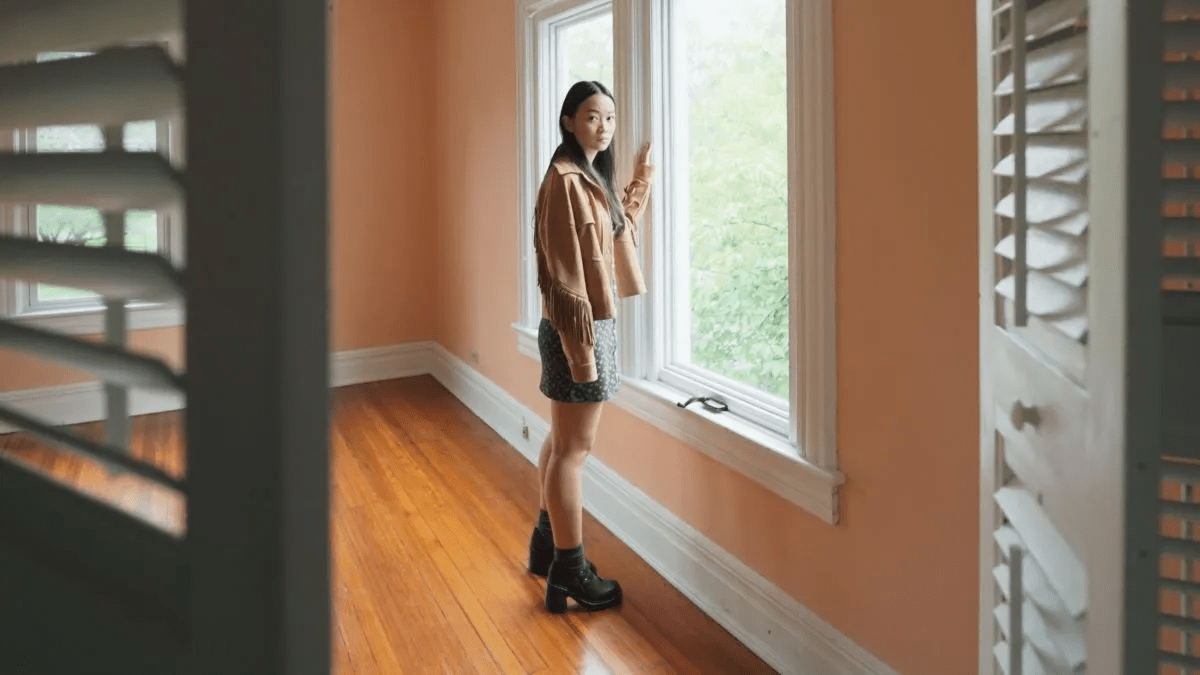
Presence is an atypical ghost story, in that it’s a first-person narrative told exclusively from the perspective of the ghost. As such, the movie camera doubles as the ghost’s “eyes”, zooming around the suburban home setting like a hyperactive drone. That’s because the camera actually is a drone, operated by Academy Award-winning director Stephen Soderbergh.
By using a drone to capture what happens, Soderbergh does something which has been difficult to accomplish: give the point-of-view a modicum of “personality”. The drone doesn’t passively record what it sees, but also conveys feelings and emotions. When it notices two characters having sex, the ghost becomes embarrassed and looks elsewhere. It becomes shy when someone looks directly at it and darts out of that person’s line of sight. When it tries to get the attention of the living, it pulses in a way that mimics a person shouting. When it’s curious, it cautiously glides over for a closer look. I’m amazed that the actors tuned-out the constant presence of a drone throughout their performances. I’m sure that the drone Soderbergh used was very quiet, but acting in front of a drone must have required mental adjustments. I imagine the experience must have been like acting normally while a dragonfly softly buzzes around you.
The movie opens with a ghost “waking up” in what I assumed was an unfamiliar home. Soon, a realtor arrives to show the house to a family of four. Mom Rebekah (Lucy Liu) is thrilled about being able to bid on a home before anyone else, as well as how it will get her son Tyler (Eddy Maday) into a choice school. Dad Chris (Chris Sullivan) wonders if the move is too soon for Chloe (Callina Liang), who recently lost a close friend. Chloe looks around tentatively, and detects the ghost while inspecting what will become her room. The ghost, unsure of how to react, backs away and hides in the closet.
After the family moves in, the ghost gradually takes an interest in them. Its inquisitiveness provides us with insight into the family members and their interdynamics. Rebekah seems to be in some legal trouble but won’t go into details with Chris. He suspects trouble on the horizon and speaks to his lawyer “hypothetically” about whether her troubles could ensnare him. The two show little affection for each other and come off more as cohabitants than a married couple.
Rebekah is very affectionate with Tyler, and their touchy-feely interactions have a tinge of incest to them. Rebekha keeps Chloe at a distance for reasons never explained, even though she’s a relatively good kid. Chris is worried about his daughter and regularly checks in to see how she’s doing. Chris also defends Chloe from Tyler’s verbal harassment, which is ridiculously mean-spirited for sibling rivalry.
Before long, Tyler becomes friends with Ryan (West Mulholland), a social development of value because Ryan is popular. Ryan also takes an interest in Chloe, who is initially cool to him but changes her tune rather quickly. Being invisible, the ghost figures out that Ryan is bad news. When he spikes Chloe’s juice with a suspicious powder (presumably GHB), the ghost acts up and knocks the glass to the floor. The ghost also does other poltergeist-y things throughout the movie, which looked like they were accomplished with practical effects.
After being coy as to why the ghost is present for most of the movie, Presence eventually reveals that it is Chloe’s supernatural protector. But why it appeared at Chloe’s house remains a mystery, even after a medium shows up to confirm that Chloe isn’t imagining things. As for who in her family believes her, it’s unsurprising how they line up. Chris is the only one who believes her, and he tells her a story about his mother that provides some comfort. (Chris Sullivan does a nice job in that scene.)
When the movie’s tension-filled final confrontation arrives, it adequately ties up all of the various loose threads surrounding Chloe, her recently deceased friend and another girl she knew who also died under mysterious circumstances. Although Presence doesn’t try very hard to hide who is behind those tragedies, the creepiness of the perpetrator did surprise me. The last 10-15 minutes of this movie are the most compelling, and the movie thankfully doesn’t conclude with a truly horrifying ending. Instead, the ghost becomes an “avenging angel” of sorts, spurring an unlikely family member to action when things grow dire. Presence curiously ends on a sentimental note which I didn’t think it earned. The only explanation I could come up with is that after all these years, Soderbergh has somehow transformed into a sentimentalist, which is the biggest surprise in this movie by far.
Recommendation
A family moves into their dream home, only to discover that a ghost (or presence) also resides there. Many horror movies have used this setup before. What differentiates Presence from those films is that it’s told exclusively from the ghost’s point of view, where everything we see is as the ghost sees it. This approach is obviously a gimmick, not unlike how Searching and Unfriended told their stories entirely through computer screens. However, when you take the underlying gimmick away from Presence, all that remains is a spare and surprisingly tentative retread of Poltergeist, Insidious, The Amityville Horror, etc.
Aside from its unique perspective, the other main selling point for Presence is that it’s directed by Steven Soderbergh. (On the poster, Soderbergh’s name is featured prominently, along with screenwriter David Koepp. None of the cast members are mentioned.) Not long ago, Soderbergh was widely recognized as one of the top directors working in Hollywood. For the past five years or so, he’s been content to make movies that are released directly to streaming platforms–TV movies. (Magic Mike’s Last Dance was given a theatrical release in 2023, but it was originally intended for HBO Max.) I hadn’t seen a film of Soderbergh’s in a theater (or elsewhere) since 2013’s Side Effects, so this one provided an opportunity for me to reconnect with one of my favorite directors.
The question with Presence is whether the combination of the ghost’s perspective and Soderbergh’s drone-driven direction is enough to make this very skimpy and generic story interesting. It does, but just barely. Soderberg’s typically smooth and detached style is a good fit for the material, and I can imagine him enjoying how easily he can float around the actors at any point in space. (The effect is not unlike using a steadicam with an option for close-ups.) The movie gives Soderbergh an excuse to road test new technology for filmmaking, as he did when he directed Unsane using only iPhones. I can see his endorsement inspiring other filmmakers to try the same thing, hopefully in increasingly creative ways.
The performances in the movie are uneven, with Callina Liang and Chris Sullivan as the best. As the shady high school friend, West Mulholland is suitably shady and creepy. Lucy Liu is shrill as the mom, and Eddy Maday is so overheated as the son I suspected he was suffering from ‘roid rage. Natalie Woolams-Torres is good as the medium, although I secretly wished that Lin Shaye’s character from the Insidious franchise showed up instead.
Although a character in Presence mentions how ghosts don’t perceive time as the living do, the plot proceeds linearly throughout, with scenes starting and ending somewhat arbitrarily. The ending allows Soderbergh to show us that he’s still an excellent director, tightening the screws to an unbearable degree. I didn’t buy the outcome of the final confrontation, which is constructed so that the movie can conclude with a tear-jerking shot. (The movie certainly could have wrapped up with far less meaningful repercussions.) The interpersonal dynamics of the family is frustratingly opaque. Several subplots are red herrings, and in hindsight exist only to ensure that the movie gets to a lean 90 minutes. (There’s maybe 45-60 minutes of meaningful story in this movie.)
After devoting his recent years to streaming platform releases, it’s nice to see a Steven Soderbergh film on the big screen again. I wished Presence were more consequential than it is, coming off more as an exercise in technique than compelling storytelling. The movie is a moderately entertaining diversion that doesn’t overstay its welcome. Above all else, Presence proves that Soderbergh is still a world-class director. Only someone with his skill could make an interesting movie out of such thin material. As far as drone movies go, this is a baby step. Mildly recommended.
 Detroit Cineaste
2 thoughts on “Presence”