
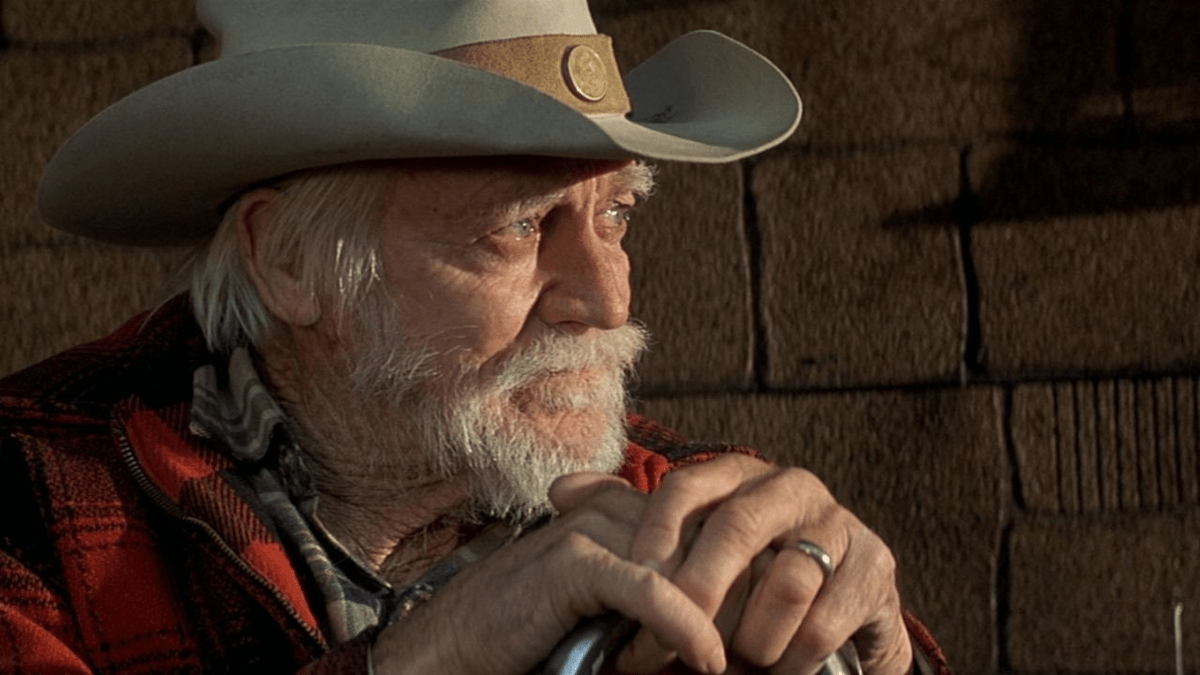
In what may be cinema’s most perplexing title card sequence ever, The Straight Story begins with “Walt Disney Pictures Presents…A Film By David Lynch”. No, this isn’t a joke on Lynch’s behalf. This movie really was released by Disney in 1999. It was also Lynch’s only “G” rated film, which makes the odd juxtaposition easier to comprehend. If you’re a Lynch devotee like myself, I want to assure you that although the movie is for general audiences, it does includes many of Lynch’s signature artistic touches that his fans will recognize immediately. In other words, The Straight Story is just as “Lynchian” as Blue Velvet or Mulholland Drive, two of his most highly regarded films.
The opening scenes in this movie actually echo those of Blue Velvet. After seeing picaresque shots of Laurens, Kansas, the camera settles on a quiet, sunny backyard, where a middle-aged woman on a chaise lounge works on her tan. When she leaves to replenish her snack tray, the camera pans over to a neighboring house and we hear the sound of a man falling down. The lady then returns, sits back down, dons her tanning glasses, grabs a pink snack cake known as a “snowball” and takes a bite. A movie can’t get any more Lynchian than that.
Fortunately, this ominous beginning is not as bad as it seems. The man who fell is Alvin Straight (Richard Farnsworth), and he’s soon discovered by Bud, a member of his old man posse who went looking for him when he doesn’t show up at the local bar. After some wonderfully crotchety repartee between Bud and Dorthy (the tanning lady), Bud finds Alvin laying on the floor. (“What the gol-darn Hell are ya doin’ layin’ on the floor. You nuts?”) Rose (Sissy Spacek) promptly takes him to see the doctor, and when he tries to bolt she pleads with him, “You promised me, Dad!”
Alvin refuses the pretty nurse’s instructions and asks for the doctor. After the examination, the doctor gives Alvin advice they both know he’ll ignore (stop drinking, smoking, eat healthier and get some exercise.) Alvin does accept using a second cane. Back home, Alvin promptly lights up a cigar. Rose asks Alvin what the doctor said. “He said I was gonna live to be a hundred,” he lies sheepishly. Alvin knows he’s not going to be around for much longer, but he doesn’t want his daughter to worry about the inevitable.
The next fateful event in the story takes place during a lightning storm. We see Alvin and Rose sitting in their living room with the lights out, facing the window. The thunder crashes and the lightning flashes across their grinning faces. Then the phone rings, and after a few moments delay, Rose gets up to answer it. Alvin’s brother Lyle has had a stroke. Alvin hears the news and looks troubled.
A few days pass, and Alvin tells Rose that he’s going back on the road to see Lyle. Rose is incredulous, reminding him why his trip is next to impossible. Among her list of legitimate concerns, his eyes are bad, so he can’t drive, it’s 317 miles to Mount Zion, Wisconsin, his hips are so bad that he can’t stand up for longer than two minutes and she can’t drive him there. None of that matters to Alvin. He and his brother haven’t spoken in ten years after a heated argument. This trip is his way of making amends, and he has to do it alone.
Alvin’s plan to make his way to Lyle is certifiable. He’ll drive there on his lawn tractor, which he personally upgraded to pull a makeshift trailer. Alvin’s initial ride out of town doesn’t get him very far, though. Once he’s back home, he puts the tractor out of its misery and heads to the local John Deere store for a replacement. Fans of Twin Peaks will immediately recognize Everett McGill playing Tom the Dealer, who teases Alvin over his plan. “Alvin, you’ve always struck me as a smart man.” “Well, that’s appreciated.” “Until now.”
Equipped with his “new” John Deere 1965 tractor, Alvin heads out again. Up until this point, the movie has been a funny character study. Once Alvin starts making headway, however, the movie soars. As he slowly puts down the road, Alvin takes in the natural beauty around him. Incredible images of wheat fields and mist-covered mountains at dawn, all set to Angelo Badalamenti’s folksy score, make it easy to understand why both Alvin (and Lynch) loved this part of the country.
The Straight Story is not content with being a travelogue of Americana, though. Alvin also meets a variety of people along the way, whom he befriends and offers advice when it’s appropriate. He helps a young hitchhiker, reminding her of the importance of family. He meets up with a bike racing team, who cheer his arrival. When one of them asks Alvin, “What’s the worst thing about being old, Alvin?” “The worst thing about being old is rememberin’ when you was young.” Five weeks into his journey, Alvin meets a fellow WWII veteran, and they share terrible secrets they’ve likely told no one else.
Ultimately, what kept Alvin going on his very arduous trip was not just seeing Lyle again, but the experiences he has along the way. In his last great adventure, Alvin reconnected with the land and interacted with the kind and decent people who lived there. Together, they gave him the strength to continue on until the end. Alvin Straight’s road trip may have been an utterly ridiculous thing for him to do, but it was also necessary to replenish his soul.
Recommendation
The Straight Story stands apart from the rest of David Lynch’s works in that its his most accessible film by far. It contains none of the elements that one typically associates with his films, specifically sex, violence or foul language. There are no surrealistic touches, nightmare dreamscapes or cryptic dialog. The story doesn’t include a pretty blond girl in trouble, a naive man in over his head or a violent sociopath looming over everything. The movie is as wholesome as a box of Girl Scout cookies and can be enjoyed by the entire family without reservation.
The Straight Story also has much of what earned Lynch a devoted fan base over his career. Co-written by longtime Lynch collaborator Mary Sweeney, the dialog has an ear for kooky phrasings and loopy repartee that Lynch is known for. Visually, Lynch includes many of the visual and auditory motifs that are often present in his films: strange-looking old people, raging fires, the sounds emitted by machinery, flashes of light illuminating faces, jalopies, wide-open highways, smoking, local bars, disheveled homes, natural landscapes, starry night skies and so on. Like The Elephant Man, Lynch took a story given to him and applied his idiosyncratic sensibilities to it. From the opening scene, there’s never a doubt as to whether this is a David Lynch film.
Unlike Lynch’s more challenging films, this one unspools in a unfussy, straightforward manner not unlike its eponymous character. Alvin Straight hits the road and hands out folksy wisdom and advice to the people he meets along the way. In lesser hands, this movie might have easily become overly sentimental, or even worse, boring. Lynch’s pristine direction, however, elevates the story above its humble origins into one that proudly celebrates the natural beauty of the Midwest and the kind and decent people who live there.
Richard Farnsworth is unforgettable as Alvin Straight, bringing him to life as a stubborn old coot who you can’t resist rooting for. Farnsworth had already been diagnosed as being terminally ill before filming began, and while that knowledge does lend this performance an air of sadness, it doesn’t outshine the dignity and respect he bestows upon Alvin. Farnsworth’s acting here is so understated and emotionally raw throughout, it brought him a well-deserved Best Actor nomination, his second. Sissy Spacek is similarly touching as Alvin’s daughter Rose, a woman enduring a cruel punishment for being neurodivergent. Their scenes together are remarkable in how effortlessly they evoke the movie’s theme about the strength of family bonds.
On the surface, The Straight Story is about an old man’s crazy road trip to repair his relationship with his estranged brother. The film is also a candid expression of David Lynch’s spirituality, more so than any of his previous films. In scene after scene, Lynch shows us how much our lives benefit from our connections to nature and each other. Where the former restores us, the latter helps us get through the day and occasionally achieve the impossible. The Straight Story is a beautifully made film, filled with wonderful characters who eloquently reveal Lynch’s inner feelings of love and compassion for humanity. It’s also one of the best films David Lynch made. Highly Recommended.
Analysis
Sides of a coin
The similarities between the opening scenes of Blue Velvet and The Straight Story aren’t the only reason why I see the two films as companion pieces. They both have an abiding interest in showing us what lies beneath the surface of everyday American life.
In Blue Velvet, Lynch reveals that evil lurks underneath the sunny facade of small town life. After Jeffrey Baumant (Kyle MacLachlan) comes into contact with this hidden evil, it begins to infect his one placid existence in horrific ways. In short order, Jeffrey is abducted and beaten up by Frank Booth (Dennis Hopper), who subsequently takes out his frustrations on Dorothy Vallens (Isabella Rossellini), the object of Jeffrey’s illicit desires. When she shows up at Jeffrey’s house naked and bruised, the evil he encountered has fully emerged from the shadows and threatens to destroy his normal life.
The Straight Story is also interested in taking a closer look at everyday life in America’s Heartland. However, instead of showing us evil, it shows that good, decent people are everywhere, ready to offer a helping hand when needed. If it weren’t for the help of kind, sympathetic people, Alvin would have never made it to see his brother. His successful journey is a testament to being a good neighbor. When he’s stranded, a bus driver gives him a ride home. Locals help him retrieve his tractor and trailer. He gets a deal on a replacement tractor from Tom the John Deere Dealer. He’s welcomed by a racing team, who let him warm up in front of their fire. When he loses control of his tractor, Danny helps get him off the road and lets him camp outside his home. Alvin also does his part by befriending a young hitchhiker, offering her food and his trailer when he realizes she’s pregnant.
I don’t think Mary Sweeney wrote The Straight Story as a rebuttal to Blue Velvet’s underlying pessimism. However, the former does speak directly to Lynch’s underlying optimism in confirming that there are more good people in the world than bad, and how the good ones always look out for each other. In Lynch’s other films, optimism rarely wins out. In this one, though, it permeates every image until it leaves you with a feeling that no matter how bad things are, they’ll turn out all right in the end.
Elegy
With the passing of David Lynch on January 15, 2025, I decided to honor him not by watching a film from his catalog that I’ve seen many times, like Blue Velvet, Wild At Heart or Mulholland Drive. Instead, I immediately thought of one I’d seen once, The Straight Story. I saw it when it was originally released in theaters back in 1999, and while I enjoyed it, I never felt compelled to see it again. However, after learning of Lynch’s death, this was the first film I thought of to watch the evening on the day he died.
Lynch filmed The Straight Story in the fall of 1998, making him fifty-two years old at the time. Although he would go on to make Mulholland Drive, Inland Empire and the eighteen hour Twin Peaks: The Return, it is this film that gained newfound resonance with me after his death. As a middle-aged man, I find myself remembering what it was like to be young, just like Alvin Straight. I also think about the importance of family as time goes on, wondering whether fissures can ever be repaired or will remain broken. Whenever I get sick, I realize how much longer it takes for me to recover. I think about my own mortality, and what it will mean for my loved ones when I’m no longer here to care for them.
I have no idea if Lynch decided to direct The Straight Story because it struck similar chords in him. (As a lifelong smoker, Lynch knew he’d eventually be diagnosed with emphysema, one of Alvin Straight’s many afflictions.) Now that he’s passed on, I can’t help but see it as encapsulating many things he would like to be remembered for afterwards. Beginning with Eraserhead, Lynch repeatedly explored the darker aspects of human existence, showing how self-destructive those tendencies can be. Although Lynch’s films can be interpreted any number of ways, at their core they illustrate the struggle between good and evil within us. Will we allow evil to overwhelm us, or will we fight back for everything that is good and decent in this world?
With The Straight Story, Lynch possibly saw Alvin as a kindred soul, an imperfect yet decent man intent on living his life exactly as he wanted until the very end. And like him, Lynch concluded it with a similarly grand gesture, a third and final season of Twin Peaks, the television show that made him a household name.
Behind the scenes
Several of Lynch’s regular collaborators worked with him on The Straight Story, including Angelo Badalamenti (score), Freddie Francis (cinematography), Mary Sweeney (editing) and Patricia Norris (costume design). Your dedication to helping Lynch bring his visions to life, on screens large and small, has had a profound effect on me throughout my life. Thank you.
 Detroit Cineaste