
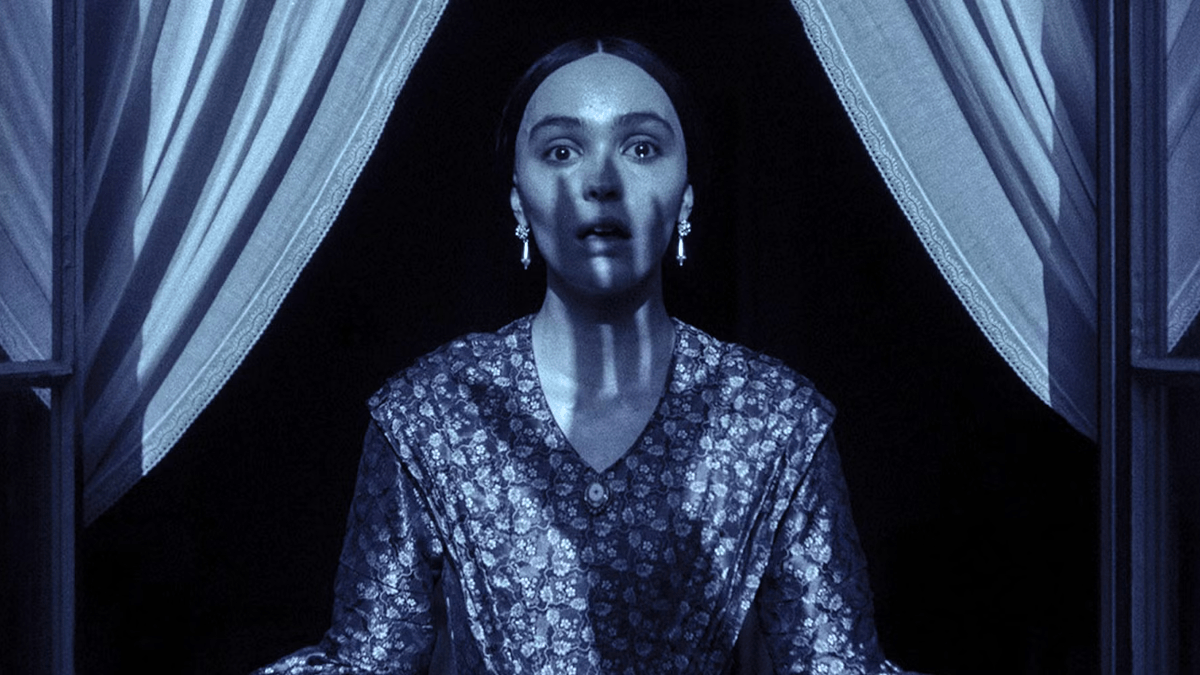
Instead of trying to find a new approach to the 127 year-old tale of Dracula, writer-director Robert Eggers has based his movie on director WF Murnau’s unauthorized adaptation from 1922, Nosferatu: A Symphony of Horror. Murnau famously altered Stoker’s story in a failed attempt to circumvent copyright protections. What he produced was a film that is both very similar to Dracula and while diverging from it in very distinct ways. In using Murnau’s film as his starting point, Eggers’ reimagining of the Dracula legend is the most compelling version of the vampire I’ve seen since Coppola’s Bran Stoker’s Dracula.
Eggers’ adaptation of Murnau’s film incorporates the same superficial changes Murnau made to avoid legal trouble. Nosferatu uses alternate names for characters we’re already familiar with. Count Dracula is now Count Orlock, Jonathan and Mina Harker are Thomas and Ellen Hutter, Abraham Van Helsing is Albin Eberhart Von Franz and so on. Instead of London, the story is set in Wisborg, Germany. A majority of the plot points are also the same between Stoker’s Dracula and Murnau’s adaptation. Despite their many obvious similarities, the story of Nosferatu is definitely unique.
In Dracula, both Stoker’s novel and its cinematic adaptations, the story traditionally revolved around the actions of the male characters. Dracula falls in love with Jonathan Harker’s wife Mina and attempts to steal her away from him. Harker and his male colleagues undertake heroic actions to prevent that from happening, and manage to both destroy Dracula and save Mina in the end. Murnau’s film, however, transforms the Mina character (as Ellen) into the hero. It is through her sacrifice that Nosferatu is ultimately defeated, and not by the actions of men. (Murnau’s movie is 102 years old and spoilers no longer apply, sorry.)
Eggers has retained what makes Murnau’s film such a unique take on Dracula. Instead of the vampire (now Count Orlock) being handsome and charming, he’s a repulsive, hideous monster. Orlock’s feelings for Thomas Hutter’s wife Ellen aren’t romantic, but lustful, impure urges. Count Orlock wants to overpower and consume Ellen, not marry her and be with her through eternity.
Additionally, Eggers uses the changes Murnau made to Stoker’s text as the basis for a modern (feminist) interpretation of the story. Ellen is not just the hero, but placed at the center of the story to deliver a harsh critique on Victorian-era beliefs propagated by men. It is they who established the rules for what behavior is appropriate for women in society, and what is to be condemned. This is apparent in the film’s gripping opening scene, where Ellen (Lily-Rose Depp) frantically prays late at night for celestial intervention. Nothing divine answers her pleas, but something sinister does respond. She quickly finds herself outside, on the ground in the grips of something largely unseen. It is only when Ellen catches a brief glimpse of her attacker that we realize that she’s being ravished by a horrible monster.
Six years later, Ellen is newly (and happily) married to Thomas Hutter (Nicholas Hoult). They are unable to indulge in their marital bliss for more than one night, however, because Thomas’ employer requires him to leave at once for Transylvania to close a property sale with the mysterious Count Orlock (Bill Skarsgård). Thomas’ experiences while abroad follow established in Dracula lore, but Ellen’s back home do not. She experiences violent nighttime convulsions, instigated by visions of her encounters with the nocturnal monster she met as a child. Ellen’s friend Anna Harding enlists the help of Dr. Sievers, who treats Ellen using methods considered modern back then (but comical by today’s standards).
Eggers uses this setup to investigate how the men within Ellen’s circle react to her condition. Dr. Sievers (Ralph Ineson) stoically responds to Ellen’s malady by treating it as a feminine medical issue. Friedrich Harding (Aaron Taylor-Johnson), an aristocrat, chafes at Ellen’s outspoken ways and fears that Ellen’s behavior may infect his proper wife Anna. Thomas, however, is comfortable with his wife’s sexual appetite and loves her regardless of her past. The radical Prof. Albin Eberhart Von Franz (Willem Dafoe), unbeholden to societal prejudices, discerns what is going on and devises a plan.
Von Franz convinces Ellen that only her sacrifice can alleviate the plague that has beset the town and destroy Count Orlock, a course of action that conveniently exempts the men from having to engage with the dangerous vampire themselves. When Ellen’s sacrifice is complete, Eggers depicts Ellen’s death as not only tragic, but damning for those who believed it necessary to save (male) society. There’s no happy ending here, because we know that Ellen’s life shouldn’t have been disposable.
Recommendation
Like Robert Eggers’ first film The Vvitch, Nosferatu takes a familiar legend and transforms it into something frightening and new. In the former, he showed us how evil isn’t just the domain of witches, but also the righteous. Similarly, Eggers uses FW Murnau’s version of Dracula to explore Nineteenth century male attitudes to women and their physical desires. Together, both films deliver provocative commentary on the scant choices available to women in their respective societies. They are companion pieces for the same feminist argument, that a woman’s value is derived solely in how she advances the cause of men. In the former, triumph is only achievable through a deal with the devil. In the latter, women are only deemed useful when they sacrifice themselves for the greater good. In both films, Eggers shows us that the horror women experience isn’t limited to actual monsters, but those wearing the disguise of good, upstanding men as well.
As a filmmaker, Eggers’ respect for the craft is obvious. Everything about his films is a testament to his intense deliberation of his art and the care he produces it with. His trademark style is on full display in Nosferatu, beginning with the cinematography. The world of Nosferatu is cloaked in blacks in grays, only occasionally broken up by bursts of color from flames, blood and flesh. Eggers’ camera routinely sits still to examine the emotional state of the characters, a tactic straight out of the silent movies that inspire him. Whenever he slowly pans in search of something lurking in the darkness, be ready for a jump scare. The soundtrack is teeming with harsh, violent strings emphasizing the underlying terror. At this point, Eggers has fully established himself as another filmmaker with their own distinct artistic personality, like Wes Anderson.
While Nosferatu is filled with excellent supporting performances (Ralph Ineson, Simon McBurney, Emma Corrin, Aaron Taylor-Johnson, Willem Dafoe), the movie is anchored by those playing the beleaguered newlyweds, Lily-Rose Depp and Nicholas Hoult. Together, they personify a married couple who struggle against a society intent on keeping them obedient and subservient. Of all of the performances I’ve seen from Hoult so far, this is his best. Depp is a revelation here, with a performance that’s part silent film actress, part emboldened Jane Austin heroine.
While every aspect of the film is remarkable, its singular creation is Count Orlock. Portrayed by an unrecognizable Bill Skarsgård, he’s the film’s ancient, ravenous beating heart. Of all the versions of vampires (and Dracula) I’ve seen, this one is the stuff of nightmares. If this were a typical Hollywood production, the monster would have been an entirely CG creation and minimal impact. In Nosferatu, however, his towering and repulsive physical presence registers in ways that computers simply cannot replicate. If there ever needed to be an argument to ditch the software and reinstate the art of creature makeup, Nosferatu is it. I’m not entirely sure how Skarsgård affected Orlock’s voice, whether it was computer addled or entirely organic. Regardless, his raspy drawl is the most distinct Dracula voice I’ve heard since Lugosi’s.
My main issue with the film is with pacing, which slows down noticeably in the latter third. Also, while I understand what Eggers’ is conveying with his monochrome palette–that this world is cold, harsh and repressive, injecting a bit more color would have been welcome. That aside, Nosferatu is easily Eggers’ most complete film since The Vvitch, where its artistic and thematic concerns work in concert instead of in opposition. (I wasn’t a fan of The Lighthouse or The Northman, which come off as style-over-substance exercises to me.) Similar to his remarkable debut, Eggers uses macabre imagery to expose monsters lurking in the shadows, while offering a stinging rebuke of the patriarchal structures governing these so-called enlightened societies. Nosferatu is a beguiling, visually arresting and thought-provoking, ranking among the best Dracula adaptations ever made. Recommended.
Analysis
When I reviewed The Invitation and The Last Voyage of the Demeter, I mentioned how audience interest in Dracula has declined precipitously over the last several decades. The last movie featuring him as a character that did well at the box office was Bram Stoker’s Dracula way back in 1992. While the declining returns can be partially blamed on the quality of the movies that followed, I suspected that modern audiences had grown bored with a character whose mythology is so well-known. As the Twilight saga and countless television shows featuring vampires have proven, people love the creatures, but not Dracula.
Before seeing Nosferatu, I believed that the best way to approach Dracula would be to adopt a modern approach similar to Invisible Man (the invisible man) and Birth/Rebirth (Frankenstein and the monster) Those movies used our familiarity with those classic monsters as the starting point for stories with feminist undertones. As a result, both of those movies felt relevant even though the characters that inspired them were a hundred years old. Those two movies didn’t just slap a new coat of paint onto a legend, they built a brand new house for it to haunt.
Although Eggers’ Nosferatu is still set in the past, his narrative choices make his version of Dracula more interesting than he’s been in decades. Eggers’ decision to use FW Murnau’s Nosferatu as his starting point–and not Stoker’s Dracula–is critical to his movie’s success. The story of Nosferatu, while inspired by Dracula, hasn’t worn out its welcome. There has only been one adaptation of Murnau’s film since it was released, Werner Herzog’s Nosferatu the Vampyre (1979). While audiences have grown tired with Dracula, they certainly don’t know Nosferatu anywhere near as well. With his feminist interpretation of the story, Eggers’s Nosferatu fits alongside Invisible Man and Birth/Rebirth as another film that retells the story of a classic monster in a way that is both familiar and fresh.
A different tragic figure
In a departure from how Dracula has been typically depicted as a tragic figure doomed in his pursuit of love, Eggers instead presents the vampire as a repellent and unredeemable figure. Unlike Dracula, Eggers’ Count Orlock is physically hideous and has no regard for social graces. His actions are thoroughly reprehensible, particularly when he kills Friederich Harding’s pregnant wife Anna and their two young children. There’s nothing about Orlock intended to garner any sympathy; he’s a monster in both appearance and actions.
Eggers instead focuses his version of Nosferatu on Ellen, a young woman driven by passions that are frowned upon by society. In the Nineteenth century, women like Ellen were taught to neither discuss nor express their inner passions with anyone besides their husbands. For a woman in her position to submit to her desires outside of marriage was scandalous. This is why she eventually disavows her nocturnal sessions with Orlock and commits to a socially acceptable union with Thomas Hutter. Once married, she can satisfy her sexual appetites without scorn. Unfortunately, when Orlock’s plan takes Thomas away from Ellen, her unfulfilled desires leave her open to Orlock’s influence, which leads to negative treatment from the male authority figures that surround her.
Eggers depicts Ellen as a tragic figure whose nature is directly at odds with how men in her society expect her to behave. Dr. Sievers sees her behavior as something that must be suppressed through bloodletting, corsets and drugs. Friederich detests Ellen because she’s not quiet and subservient like his wife. He sees Ellen’s behavior as a disruptive, confrontational force and orders her to leave his house before she influences Anna. Although Thomas loves her the way she is, his weakened physical state leaves Ellen unprotected from Von Franz’s patriarchal influence. While alone with Ellen, Von Franz preys upon her guilt and shame to convince her to sacrifice herself to destroy Orlock. Although Ellen is ultimately successful, her death is tragic because it wasn’t the only way to defeat Orlock. Having Ellen lure Orlock to his death was Von Franz’s preferred plan because it didn’t require him risking anything.
Eggers also uses Ellen to represent how men treated outspoken and passionate women like herself. Women who went against societal expectations risked being excluded from polite society or worse. For Ellen, dying is preferable to spending the rest of her life conforming to men’s expectations for how she should be. At least she gets to die on her own terms.
That closing image
Like Eggers’ The Vvitch, Nosferatu closes with an image that perfectly encapsulates the themes explored throughout the film. In the former, Thomasin laughs joyfully as she is lifted into the air to join her coven. For the first time in her life, she has agency and can do as she pleases. Of course, Thomasin’ victory comes with significant strings attached. But until the time comes when she must deliver her soul to Satan, Thomasin is in control of her destiny.
Nosferatu similarly explores the fate of women living in a patriarchal society. Like Thomasin, Ellen’s life is largely controlled by the men. While Thomas is away on business, Ellen stays at her friend Anna’s home with the permission of Anna’s husband Friedrich. When Ellen begins sleepwalking and convulsing at night, interrupting Friedrich’s sleep, he has Dr. Sievers prescribe narcotics to render her unconscious. Professor Von Franz initially presents as an ally to Ellen, ordering that the drugs be stopped and allowing her nighttime convulsions to resume. But it is later revealed that he does this as the first step of his plan to defeat Count Orlock.
The closing shot of Nosferatu is the first scene in the movie with sunlight instead of drab, overcast skies. This sudden infusion of light and color symbolizes how the death of Orlock has put an end to the plague that has beset the city. Now that the source of the plague has been destroyed, life can begin anew. After Von Franz states that Ellen has succeeded in freeing everyone from Orlock, he picks up Ellen’s cat and stares out the window. While his back is turned to the camera, Eggers captures Von Franz’s face in a nearby mirror. He’s happy and smiling ear-to-ear, which contrasts with Thomas’ off-screen sobs over his wife’s lifeless body.
This closing image indicates that Von Franz’s plan all along was for Ellen to sacrifice herself while the men were safely elsewhere. Von Franz stated earlier that he didn’t know if driving a stake through Orlock’s heart would kill him, and he didn’t want to risk his life to find out. Von Franz knew that Orlock would immediately go to Ellen when night fell, meaning that Orlock’s lair would be the safest place for Thomas, Dr. Sievers and himself to be. In the end, Von Franz is pleased with himself because he guessed right. Although Ellen is dead and Thomas distraught, Von Franz’s plan saved the city while preserving his own life.
The closing image of Nosferatu also effectively epitomizes male attitudes towards women in 1830s society. Back then, women’s lives only had value only if they could bear children, even if they died during childbirth. With her sacrifice, Ellen not only saved the lives of Thomas, Dr. Sievers and Von Franz, but the entire town of Wisborg as well. They are all effectively reborn through her actions. Von Franz is clearly elated by this outcome, which ensures that the patriarchal societal order he represents will endure. As a learned man with influence, he successfully convinced Ellen to sacrifice herself for the good of himself and all men. Unlike for Thomasin in The Vvitch, the only way for Ellen to escape her suffocating existence was in death.
The simple act of picking up and cradling Ellen’s cat is also not the innocent action it appears to be. The cat was Ellen’s sole possession in life. In taking the cat as his own, Von Franz’s actions symbolize the control he wielded over Ellen before she died. To him, Ellen’s life was equivalent to a pet, to be done with as he pleases. Now that she is dead, Von Franz has no qualms taking possession of her cat. Both exist at his pleasure, and live or die as he sees fit.
Pestilence and perversity
Throughout Nosferatu, Ellen describes her urges for Orlock and unclean and unholy. When her carnality begins to manifest as violent convulsions, they disgust Friederich. He’s concerned that Anna will somehow become infected by Ellen’s passions (i.e. her lust and desires). Friederich and his wife’s marriage represents acceptable sex relations between men and women at that time. The two have an active sex life (as evinced by their children) but keep the particulars hidden behind the closed doors of their bedchamber. Ellen’s open carnality is frowned upon in polite society epitomized by Friederich, which is why he eventually orders her and Thomas out of his home.
The belief that women freely expressing their physical passions would result in the downfall of society is symbolized by the rats streaming from Orlock’s boat. Ellen’s union with Orlock goes directly against societal mores because it takes place openly and outside of marriage. This scares men like Friederich because it could inspire women to seek sexual fulfillment outside of marriage. If unchecked, Ellen’s expression of her sexuality would become a plague upon society, leading women to question the necessity of being married in order to be recognized in society.
When Ellen dies, Von Franz proclaims that the plague is over. This is true in a literal sense, but also figuratively, as Ellen will no longer be able to influence women choosing how best to fulfill their desires.
(And now for some frivolous commentary.)
He’s out of her league
We all have met someone who we describe as being out of their partner’s league. In his depiction of Count Orlock, Eggers has given us the ultimate dumpy boyfriend. Among his many faults, Orlock wheezes when he breathes, doesn’t trim his fingernails, sports a ridiculous mustache and slurps while he eats. It makes perfect sense that Orlock does everything in his powers to take Ellen away from her husband. Thomas is young, handsome and respectful. If he didn’t trick Thomas into nullifying his divorce from Ellen, Orlock wouldn’t stand a chance. Even then, Orlock increases the stakes by having Ellen choose between a life with him and having the entire town be killed by a plague. Orlock isn’t just an evil monster, he’s a thoroughly bad boyfriend.
 Detroit Cineaste
Try the poem Umbra Nosferatu by Ashlan Chidester. The first line is epic.
LikeLike